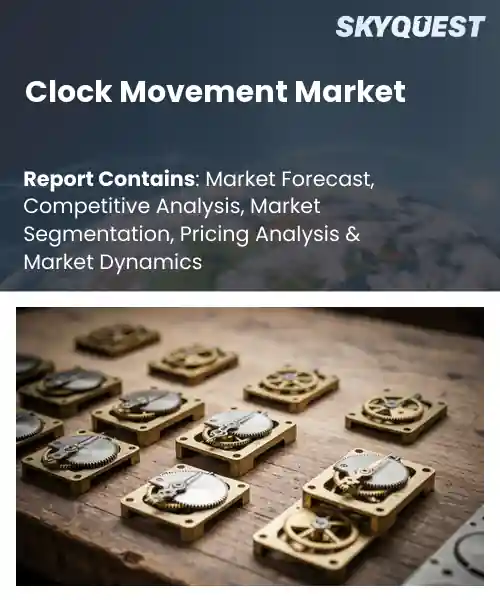
Clock Movement Market
Report ID: SQMIG25I2116
Report ID: SQMIG25I2116
[email protected]
USA +1 351-333-4748
Report ID:
SQMIG25I2116 |
Region:
Global |
Published Date: July, 2026
Pages:
157
|Tables:
171
|Figures:
79


Global Clock Movement Market size was valued at USD 842.6 Million in 2024 and is poised to grow from USD 913.38 Million in 2025 to USD 1741.35 Million by 2033, growing at a CAGR of 8.4% during the forecast period (2026-2033).
The global clock movement market comprises the design, manufacture, and distribution of mechanical, quartz, and smart watch movement modules that power time‑keeping devices. Its significance stems from the indispensable role of accurate timing in consumer watches, industrial instrumentation, and emerging IoT applications. Historically, the market was dominated by Swiss mechanical movements, but the 1970s quartz revolution introduced low‑cost, high‑precision alternatives that reshaped supply chains. Recent advances in miniaturization and wireless power have spurred smart‑watch movements, as illustrated by Apple’s custom silicon that integrates health sensors and Bluetooth connectivity. This evolution reflects a shift from mechanical reliability toward multifunctional, data‑centric platforms. The dominant growth factor is the convergence of wearable health monitoring and connected ecosystems, which forces manufacturers to embed sensor arrays and communication protocols within clock movements. As consumers seek heart‑rate, SpO2, and ambient data, clock‑movement suppliers integrate MEMS accelerometers and Bluetooth Low Energy chips, enabling seamless transmission to smartphones. This loop drives higher unit prices and creates opportunities for niche firms specializing in miniaturized power‑management ICs. For example, a Korean company recently secured a contract to supply movement modules for a fitness‑focused smartwatch brand, illustrating how demand for multifunctional timing cores fuels market expansion and attracts investment in packaging.
How is AI-driven automation impacting the precision and cost of the clock movement market?
AI‑driven automation is reshaping the clock movement market by tightening tolerances and streamlining assembly. Machine‑learning algorithms analyze vibration data in real time, allowing micro‑adjustments that improve the steadiness of gear trains and reduce wear. Robotics equipped with vision systems handle delicate components, cutting manual handling errors and shortening cycle times. The result is higher precision in both mechanical and quartz movements while lowering labor costs and material waste. Manufacturers can now scale production of complex complications without sacrificing quality, making premium timepieces more affordable and expanding access to high‑end features for a broader consumer base.In March 2024, a leading clock movement manufacturer introduced an AI‑driven production line that boosted assembly efficiency and enhanced component accuracy, underscoring how automation fuels market growth and cost reduction.
Market snapshot - (2026-2033)
Global Market Size
USD 842.6 Million
Largest Segment
Bedside ECG Monitors
Fastest Growth
Wearable ECG Monitors
Growth Rate
8.4% CAGR
To get more insights on this market click here to Request a Free Sample Report
Global clock movement market is segmented by product type, lead configuration, end user, patient group, connectivity type, procurement type and region. Based on product type, the market is segmented into Bedside ECG Monitors, Portable ECG Monitors, Wearable ECG Monitors and Others. Based on lead configuration, the market is segmented into 3-Lead ECG Monitors, 5-Lead ECG Monitors and 12-Lead ECG Monitors. Based on end user, the market is segmented into Hospitals, Cardiac Care Centers, Ambulatory Care Centers and Others. Based on patient group, the market is segmented into Adult Patients, Pediatric Patients and Neonatal Patients. Based on connectivity type, the market is segmented into Wired Monitors and Wireless Monitors. Based on procurement type, the market is segmented into New Equipment Purchases and Replacement Equipment Purchases. Based on region, the market is segmented into North America, Europe, Asia Pacific, Latin America and Middle East & Africa.
Wearable ECG monitors segment dominates because they integrate continuous cardiac tracking with patient mobility, aligning with the Clock Movement Market’s emphasis on precision timing and data synchronization. Their compact form factors allow seamless incorporation of miniature clock movement mechanisms, enabling accurate heartbeat interval measurement while patients move freely. Manufacturers prioritize miniaturization and low power design, which fuels adoption across home care and remote monitoring settings, reinforcing the segment’s leadership in the overall market.
However, portable ECG monitors segment is the most rapidly expanding because emerging outpatient clinics seek flexible timing solutions that can be quickly deployed without fixed infrastructure. Advances in battery technology and modular clock movement designs reduce setup complexity, encouraging wider adoption and creating new opportunities for vendors to penetrate untapped care environments.
12 lead ECG monitors segment dominates because it provides comprehensive cardiac waveforms that require precise timing alignment, which is central to the Clock Movement Market’s focus on accurate rhythm interpretation. The extensive lead array synchronizes multiple clock movement components, delivering high fidelity data for complex diagnostics. Clinical reliance on detailed electrocardiographic insight drives OEMs to embed advanced timing mechanisms, cementing this segment’s preeminence.
On the other hand, wireless monitors segment emerges as a high growth area because untethered patient mobility matches clock movement designs that need low latency data flow. Freedom from cables drives adoption in telehealth and home based care, encouraging innovators to create compact battery efficient timing modules that broaden market reach and open new application scenarios.
To get detailed segments analysis, Request a Free Sample Report
Asia Pacific leads the global clock movement market through a blend of deep manufacturing expertise, long‑standing watchmaking heritage, and rapid adoption of advanced micro‑mechanical technologies. The region benefits from tightly integrated supply chains that connect component producers, precision machining firms, and assembly specialists within close geographic proximity. Strong emphasis on research and development drives continuous miniaturisation and enhanced energy efficiency, while cultural appreciation for both traditional mechanical and modern smart timepieces fuels diverse demand. Collaborative ecosystems between universities, technology parks, and major brands accelerate innovation cycles, ensuring that new movement architectures reach market swiftly. In addition, regional trade frameworks promote seamless export of high‑value components, while a growing middle‑class consumer base values precision timekeeping as a status symbol, further expanding market depth.
Clock Movement Market in Japan thrives on a fusion of artisanal precision and cutting‑edge automation. Legacy watch manufacturers collaborate closely with advanced electronics firms to integrate hybrid mechanisms that balance tradition with connectivity. A dense network of specialised tooling suppliers and a culture of improvement enable rapid prototyping and high‑volume consistency. Consumer preference for refined craftsmanship combined with export orientation sustains Japan’s reputation as a benchmark for movement excellence global.
Clock Movement Market in South Korea is propelled by an emphasis on electronic integration and innovative design. Leading semiconductor manufacturers supply high‑performance components that empower compact, energy‑efficient movements for smart devices. Collaborative research hubs link engineering universities with watch brands, fostering rapid adoption of new materials and manufacturing techniques. The domestic market’s enthusiasm for technology‑driven fashion fuels demand, while export channels expand the country’s influence in precision time‑keeping solutions worldwide.
Europe’s clock movement market expands swiftly as a result of deep horological heritage combined with a forward‑looking emphasis on sustainability and digital convergence. Strong engineering traditions in Germany provide a foundation of precision machining and component reliability, while the United Kingdom leverages its design‑centric culture and burgeoning fintech ecosystem to accelerate smart‑watch integration. France contributes emerging expertise in material science and avant‑garde aesthetics, attracting niche consumer segments. Collaborative research programs across borders foster cross‑pollination of micro‑mechanical and electronic know‑how, supported by a regulatory environment that encourages eco‑design and responsible sourcing. Furthermore, the region’s dense network of specialized suppliers and its commitment to collaborative standards enable rapid prototyping and seamless integration of new functionalities, reinforcing Europe’s position as a hub of refined yet progressive time‑keeping solutions.
Clock Movement Market in Germany remains a benchmark for precision engineering and component durability. Established factories combine centuries‑old machining techniques with modern automation to deliver movements that meet exacting standards. Strong collaboration between automotive suppliers and horological firms accelerates material innovations, while a culture of continuous improvement drives efficiency. Domestic demand for high‑quality timepieces and a export framework reinforce Germany’s leadership in the European movement landscape and ongoing technical excellence.
Clock Movement Market in United Kingdom thrives on a blend of creative design and rapid digital adoption. Heritage watch houses partner with fintech innovators to embed connectivity into classic movements, appealing to tech‑savvy consumers. A focus on limited‑edition collaborations fuels brand desirability, while flexible manufacturing hubs enable swift iteration of new functionalities. International fashion influence and a proactive regulatory stance on sustainability further accelerate the market’s expansion across the region.
Clock Movement Market in France is emerging through a focus on avant‑garde aesthetics and innovative material applications. Boutique manufacturers experiment with unconventional alloys and sustainable composites, creating movements that double as artistic statements. Close ties with design schools foster fresh perspectives that blend form and function, attracting niche collectors. Growing enthusiasm for crafted luxury pieces, combined with cultural policies, helps France carve a distinctive niche within the broader European market.
North America fortifies its clock movement position by merging cutting‑edge electronics with traditional mechanical expertise, creating hybrid solutions that satisfy both luxury and connected‑device markets. The United States drives this momentum through a robust ecosystem of semiconductor innovators, software developers, and design studios that accelerate the integration of sensors, wireless communication, and energy‑harvesting technologies into compact movements. Canada complements this effort with a strong emphasis on sustainable manufacturing practices and a growing community of boutique horologists who prioritize eco‑friendly materials. Cross‑border collaboration encourages knowledge exchange and rapid prototyping, while a consumer base eager for personalized, tech‑enabled timepieces fuels continuous product evolution. This synergy of high‑tech capability, design agility, and responsible production underpins North America’s expanding influence in the global movement arena.
Clock Movement Market in United States blends Silicon Valley innovation with horological craftsmanship, delivering integrated time‑keeping solutions. Leading chip makers provide ultra‑low‑power processors that extend battery life in smart watch movements, while traditional watchmakers use micro‑machining to keep tactile appeal. Capital fuels startups exploring biometric integration and reality displays in wrist devices. Consumer demand for personalized, data‑driven experiences drives adoption, making the United States a hub where technology meets horology.
Clock Movement Market in Canada emphasizes manufacturing and engineering, leveraging a strong network of micro‑component suppliers. Canadian firms integrate actuation technologies with locally sourced alloys, delivering movements that balance durability with environmental responsibility. Collaborative programs with design institutes foster innovative aesthetics that appeal to niche luxury segments. Export initiatives target North American and European markets, while government incentives support research into time‑keeping solutions, reinforcing Canada’s emerging role in the sector.
To know more about the market opportunities by region and country, click here to
Buy The Complete Report
Rising Demand For Precision Timing
Integration Of Smart Connectivity
High Cost Of Advanced Materials
Regulatory Compliance Complexity
Request Free Customization of this report to help us to meet your business objectives.
Top Player’s Company Profile
Recent Developments
SkyQuest’s ABIRAW (Advanced Business Intelligence, Research & Analysis Wing) is our Business Information Services team that Collects, Collates, Correlates, and Analyses the Data collected by means of Primary Exploratory Research backed by robust Secondary Desk research. As per SkyQuest analysis, the global clock movement market is being propelled primarily by the rising demand for precision timing, which pushes manufacturers toward tighter tolerances and advanced materials, while the integration of smart connectivity adds a second boost by embedding IoT modules that enable remote calibration and data services. The high cost of advanced materials remains a notable restraint, limiting adoption in price‑sensitive segments. Asia Pacific dominates the market thanks to its deep manufacturing base and rapid adoption of micro‑mechanical technologies. Within product categories, wearable ECG monitors lead the segment landscape by offering continuous, accurate timing for mobile health applications, reinforcing overall growth.
| Report Metric | Details |
|---|---|
| Market size value in 2024 | USD 842.6 Million |
| Market size value in 2033 | USD 1741.35 Million |
| Growth Rate | 8.4% |
| Base year | 2024 |
| Forecast period | (2026-2033) |
| Forecast Unit (Value) | USD Million |
| Segments covered |
|
| Regions covered | North America (US, Canada), Europe (Germany, France, United Kingdom, Italy, Spain, Rest of Europe), Asia Pacific (China, India, Japan, Rest of Asia-Pacific), Latin America (Brazil, Rest of Latin America), Middle East & Africa (South Africa, GCC Countries, Rest of MEA) |
| Companies covered |
|
| Customization scope | Free report customization with purchase. Customization includes:-
|
To get a free trial access to our platform which is a one stop solution for all your data requirements for quicker decision making. This platform allows you to compare markets, competitors who are prominent in the market, and mega trends that are influencing the dynamics in the market. Also, get access to detailed SkyQuest exclusive matrix.
Table Of Content
Executive Summary
Market overview
Parent Market Analysis
Market overview
Market size
KEY MARKET INSIGHTS
COVID IMPACT
MARKET DYNAMICS & OUTLOOK
Market Size by Region
KEY COMPANY PROFILES
Methodology
For the Clock Movement Market, our research methodology involved a mixture of primary and secondary data sources. Key steps involved in the research process are listed below:
1. Information Procurement: This stage involved the procurement of Market data or related information via primary and secondary sources. The various secondary sources used included various company websites, annual reports, trade databases, and paid databases such as Hoover's, Bloomberg Business, Factiva, and Avention. Our team did 45 primary interactions Globally which included several stakeholders such as manufacturers, customers, key opinion leaders, etc. Overall, information procurement was one of the most extensive stages in our research process.
2. Information Analysis: This step involved triangulation of data through bottom-up and top-down approaches to estimate and validate the total size and future estimate of the Clock Movement Market.
3. Report Formulation: The final step entailed the placement of data points in appropriate Market spaces in an attempt to deduce viable conclusions.
4. Validation & Publishing: Validation is the most important step in the process. Validation & re-validation via an intricately designed process helped us finalize data points to be used for final calculations. The final Market estimates and forecasts were then aligned and sent to our panel of industry experts for validation of data. Once the validation was done the report was sent to our Quality Assurance team to ensure adherence to style guides, consistency & design.
Analyst Support
Customization Options
With the given market data, our dedicated team of analysts can offer you the following customization options are available for the Clock Movement Market:
Product Analysis: Product matrix, which offers a detailed comparison of the product portfolio of companies.
Regional Analysis: Further analysis of the Clock Movement Market for additional countries.
Competitive Analysis: Detailed analysis and profiling of additional Market players & comparative analysis of competitive products.
Go to Market Strategy: Find the high-growth channels to invest your marketing efforts and increase your customer base.
Innovation Mapping: Identify racial solutions and innovation, connected to deep ecosystems of innovators, start-ups, academics, and strategic partners.
Category Intelligence: Customized intelligence that is relevant to their supply Markets will enable them to make smarter sourcing decisions and improve their category management.
Public Company Transcript Analysis: To improve the investment performance by generating new alpha and making better-informed decisions.
Social Media Listening: To analyze the conversations and trends happening not just around your brand, but around your industry as a whole, and use those insights to make better Marketing decisions.
REQUEST FOR SAMPLE
 REQUEST FREE CUSTOMIZATION


Want to customize this report? This report can be personalized according to your needs. Our analysts and industry experts will work directly with you to understand your requirements and provide you with customized data in a short amount of time. We offer $1000 worth of FREE customization at the time of purchase.
Feedback From Our Clients


 USA (+1) 351-333-4748

