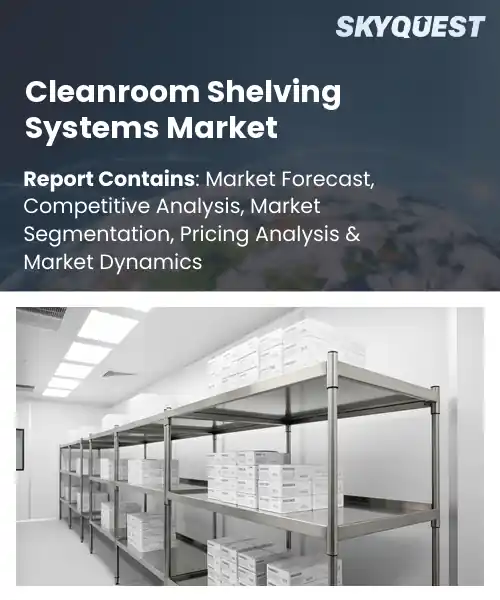
Cleanroom Shelving Systems Market
Report ID: SQMIG20B2198
Report ID: SQMIG20B2198
[email protected]
USA +1 351-333-4748
Report ID:
SQMIG20B2198 |
Region:
Global |
Published Date: June, 2026
Pages:
157
|Tables:
174
|Figures:
79


Global Cleanroom Shelving Systems Market size was valued at USD 384.6 Million in 2024 and is poised to grow from USD 412.29 Million in 2025 to USD 719.06 Million by 2033, growing at a CAGR of 7.2% during the forecast period (2026-2033).
The rapid expansion of pharmaceutical, biotechnology, and medical device manufacturing is a primary driver of the global cleanroom shelving systems market. With the growing production of sterile pharmaceuticals, biologics, vaccines and precision medical parts, manufacturers are required to maintain contamination-free environments that meet very stringent regulatory (FDA) requirements. As a result, there is a greater demand for cleanroom shelving systems designed using stainless steel and other non-particle-shedding materials to facilitate hygienic storage and allow for easy cleaning of these shelf systems. By utilizing these shelving systems, the cleanroom process is improved through improved workflow, reduced risk of contamination, maintenance of product quality and achieving regulatory compliance while supporting high volume manufacturing.
Increasing emphasis on cleanroom compliance and operational efficiency is a key factor driving market growth. With the implementation of stricter GMP, ISO and FDA regulations for all industries, storage systems must now be designed to reduce particle generation, withstanding frequent sterilizations and optimizing space utilization. Therefore, companies are looking to implement a shelving solution that is modular, corrosion-resistant and customizable to make cleaning easier, organize materials better and increase accessibility to inventory. In turn, these will reduce maintenance expense, improve contamination control, maximize operator throughput, and allow cleanroom operators to keep consistent environmental standards for all critical manufacturing and laboratory operations.
How is AI-Driven Automation Impacting the Cleanroom Shelving Systems Market?
AI‑driven automation is reshaping cleanroom shelving by embedding sensors, predictive analytics and robotic handling into storage units. Real time monitoring of temperature, humidity and particle counts by intelligent shelving will notify staff of out-of-specification conditions before they actually occur. This data is sent to integrated inventory management software to allow for just-in-time delivery and to reduce the amount of manual checking required. Automation of the above processes significantly shortens changeover times, enhances traceability of critical components and allows technicians to spend more time on higher-value tasks. As the number of cleanroom environments grows and continues to evolve, the capability of AI-enabled shelving to meet or exceed stringent standards and optimize space and workflow provides manufacturers a distinct competitive advantage.
In April 2024, Thermo Fisher Scientific announced an AI‑controlled modular shelving system, demonstrating how real‑time monitoring and automated inventory adjustments can boost cleanroom efficiency and support market growth.
Market snapshot - (2026-2033)
Global Market Size
USD 384.6 Million
Largest Segment
Fastest Growth
Growth Rate
7.2% CAGR
To get more insights on this market click here to Request a Free Sample Report
Global cleanroom shelving systems market is segmented by product type, material type, cleanroom class, end user industry, installation type, sales channel and region. Based on product type, the market is segmented into fixed shelving systems, mobile shelving systems, modular shelving systems, others. Based on material type, the market is segmented into stainless steel shelving, aluminum shelving, polymer shelving, others. Based on cleanroom class, the market is segmented into iso class 1–4 cleanrooms, iso class 5–6 cleanrooms, iso class 7–9 cleanrooms. Based on end user industry, the market is segmented into pharmaceuticals, biotechnology, semiconductor manufacturing, others. Based on installation type, the market is segmented into floor mounted shelving, wall mounted shelving, freestanding shelving. Based on sales channel, the market is segmented into direct sales, distributors, others. Based on region, the market is segmented into North America, Europe, Asia Pacific, Latin America and Middle East & Africa.
Stainless steel material segment dominates because its inherent corrosion resistance and ability to maintain particle‑free surfaces align perfectly with stringent cleanroom standards. For brands around the world, stainless steel offers long-lasting performance, an easier process for cleaning surfaces and compatibility with almost every type of sterilisation. By delivering all these features, stainless steel helps to eliminate maintenance downtime and minimise contamination risks, which makes it a highly-desirable choice amongst manufacturers within the pharmaceutical, semiconductor and biotech sectors. Another benefit of stainless steel is its non-magnetic properties, this means stainless steel offers no interference to sensitive equipment, which makes it even more desirable for end-users.
However, aluminum material segment is the most rapidly expanding as manufacturers seek lighter, cost‑effective solutions for modular cleanroom designs. Its superior strength‑to‑weight ratio enables easier relocation and rapid assembly, appealing to emerging biotech startups and flexible manufacturing cells. This agility fuels broader market entry and accelerates overall system adoption.
Fixed installation segment leads because it provides permanent anchoring that guarantees structural stability, essential for maintaining integrity under high‑velocity airflow and strict contamination control. The lack of vibration allows for automatic validation and state-of-the-art regulated facility layout, making this option ideal for large scale pharmaceutical and semiconductor manufacturing processes. Furthermore, Fixed Installations allow for a more efficient way to route utilities in the facility eliminating the requirement for additional infrastructure and increasing overall operation dependability.
On the other hand, modular installation segment emerges as the fastest growing due to its flexibility in rapidly reconfigurable cleanroom layouts. Companies value the ability to add, remove, or relocate shelves without extensive downtime, supporting agile manufacturing and quick compliance adaptations. This versatility drives heightened investment and broadens market participation.
To get detailed segments analysis, Request a Free Sample Report
North America leads the cleanroom shelving systems market through a convergence of advanced manufacturing capabilities and rigorous regulatory environments. The continued partnership between technology providers and end-users also maintains their market leadership. Additionally, there has been significant capital invested in upgrading existing facilities which results in further demands for high-performance cleanroom shelving systems. Because sustainability is becoming a priority for many businesses, companies are looking at using modular shelving components that can be reused or recycled, thereby supporting larger environmental goals. Collaborative research efforts between universities and industry collaborators are creating opportunities for developing new materials that provide improved sterility and durability. Together, these elements create an environment where North America provides the benchmark for excellence in cleanroom storage systems on a global scale.
Cleanroom shelving systems market in the United States benefits from a dense network of life‑science research hubs and a leading semiconductor manufacturing base. Clients focus on precision‑engineered storage products designed to meet high levels of contamination control, leading vendors to provide readily modifiable or configurable modular solutions. Additionally, there are examples of a strong culture of continuous improvement across the industry, with numerous examples of research and development partnerships between equipment manufacturers and their users for incorporating new technologies, including advanced coatings and sensor-based tracking systems.
Cleanroom shelving systems market in Canada is shaped by a strong emphasis on pharmaceutical production and emerging medical‑device manufacturing. In order for operators to have reliable shelving that is easy to assemble and meets their stringent decontamination protocols, many suppliers have turned their attention toward the use of durable materials and ergonomic designs. Additionally, the proximity of the market to U.S. innovation corridors provides multiple opportunities for technology transfers and collaborative development projects, resulting in improved compliance capabilities in North American facilities and the promotion of globally acceptable best practices.
The Asia Pacific region experiences a swift expansion of cleanroom shelving systems fueled by burgeoning electronics and semiconductor manufacturing alongside growing biotech activity. The regional governments have provided incentives for high-quality clean room facilities, which has caused manufacturers to implement better ways to store products and to keep their facilities free from contaminants. The availability of Industry 4.0 technology has resulted in integrating new smart-shelving systems and shelf-monitoring equipment into production facilities as a means of keeping track of inventory and controlling processes. Additionally, research and development (R&D) spending are helping to speed the introduction of new materials and modular designs that facilitate reconfiguration of clean room layouts. The coexistence of newly liberalized markets, qualified engineering talent, and cultural values of precise production makes the Asia Pacific an ideal marketplace for advanced clean room infrastructure and helps create demand for custom shelving solutions that can adapt to new production methods and comply with defined regulatory requirements as they continue to evolve over time.
Cleanroom shelving systems market in Japan is driven by the nation’s leadership in high‑precision electronics and materials research. Manufacturers are looking for shelves that meet stringent requirements for contamination control. Suppliers are building shelves with ultra-clean surface finishes and modular designs. Manufacturers can benefit from close working relationships between equipment manufacturers and research institutions to help improve the durability and ease of cleaning and sterilizing the shelves. This focus on reliability aligns with Japan commitment to maintain competitive advantage in semiconductor and pharmaceutical sectors.
Cleanroom shelving systems market in South Korea reflects the country’s rapid growth in semiconductor fabrication and bio‑pharmaceutical production. To get the product onto shelves in a high-efficiency manner, operators want seamless integration between their automated cleanroom workflow and the type of rack being used to hold the product. Suppliers have responded with designs that are compact, precision engineered and easily accessible. Government programs are also encouraging suppliers to develop new technologies through advanced manufacturing and strict quality standards, creating a dynamic environment for continuous innovation.
Europe strengthens its position in the cleanroom shelving systems market by leveraging deep expertise in precision engineering and a rigorous regulatory landscape that emphasizes safety and environmental stewardship. Top companies put in lots of time designing modular, recyclable shelf products that comply with strict contamination control requirements and will help satisfy their companies' sustainability initiatives. All around Europe, collaborative projects are encouraging the usage of new material types and the creation of smart sensor technology to improve the traceability and improve the operational capabilities of businesses. Unified standards of operation between European countries also provide for ease of trade across Europe and promote consistent practices to produce quality products. The combination of superior engineering capability, regulatory unity, and an enduring commitment to green manufacturing positions Europe as the global standard for high-quality cleanroom infrastructure.
Cleanroom shelving systems market in Germany benefits from the country’s strong foundation in high‑precision mechanical engineering and a dense network of pharmaceutical and semiconductor firms. Suppliers emphasize robust, low‑particle‑emission designs that integrate seamlessly with the rigorous validation processes typical of German cleanrooms. Close collaboration between equipment manufacturers and research universities drives the development of advanced coating technologies that extend shelf life and simplify sterilization. The concentration on quality and performance supports Germany's image as the standard country in regards to cleanroom storage solutions for all of Europe.
Cleanroom shelving systems market in the United Kingdom is shaped by a vibrant life‑science sector and stringent health‑care standards that demand high‑performance storage solutions. The vendors favor flexible modular shelving, designed to be reconfigured quickly to meet changing research methods and regulatory audits. Close relationships between leading academic institutions and the industry support and encourage adoption of smart monitoring systems that provide real-time contaminant data. This integration of adaptability and technological insight positions the United Kingdom as a forward‑looking market for advanced cleanroom infrastructure.
Cleanroom shelving systems market in France reflects the country’s emphasis on high‑quality manufacturing in the aerospace and pharmaceutical domains. Suppliers are responding to a demand for shelving with the superior engineering capabilities required and that are easy to clean. Stainless steel frames with sealed joints and coatings contain built-in anti-microbial properties. Close working relationships with national regulatory agencies help them assure that their products conform to both the high standards of France and the stringent European Union standards for contamination control.
To know more about the market opportunities by region and country, click here to
Buy The Complete Report
Growth In Pharmaceutical Cleanroom Demand
Adoption Of Modular Shelving Solutions
High Initial Capital Expenditure
Stringent Regulatory Compliance Requirements
Request Free Customization of this report to help us to meet your business objectives.
The competitive landscape of the global cleanroom shelving systems market is shaped by a few dominant players Stora Solutions, Metro (InterMetro Industries Corporation) and GMP Technical who are actively pursuing strategic moves to secure market share. Recent actions taken to grow have included obtaining specialty component vendors through acquisition, working together with partners of cleanroom equipment manufacturers for additional integration of shelving with environmental monitoring equipment a new offering, and launching complex modular shelving systems that will improve contamination control and simplify their installation.
Top Player’s Company Profile
Recent Developments
SkyQuest’s ABIRAW (Advanced Business Intelligence, Research & Analysis Wing) is our Business Information Services team that Collects, Collates, Correlates, and Analyses the Data collected by means of Primary Exploratory Research backed by robust Secondary Desk research.
As per SkyQuest analysis, the global cleanroom shelving systems market is being propelled primarily by the surge in pharmaceutical cleanroom construction, which fuels demand for high‑performance storage that meets strict contamination standards; a second important driver is the rapid adoption of modular shelving that lets facilities reconfigure layouts quickly and support lean manufacturing. The market faces a notable restraint in the form of high upfront capital costs required for specialized, certified shelving. North America remains the dominant region, thanks to its advanced life‑science and semiconductor sectors, while stainless‑steel material continues to dominate the segment landscape because of its corrosion resistance and ease of sanitisation.
| Report Metric | Details |
|---|---|
| Market size value in 2024 | USD 384.6 Million |
| Market size value in 2033 | USD 719.06 Million |
| Growth Rate | 7.2% |
| Base year | 2024 |
| Forecast period | (2026-2033) |
| Forecast Unit (Value) | USD Million |
| Segments covered |
|
| Regions covered | North America (US, Canada), Europe (Germany, France, United Kingdom, Italy, Spain, Rest of Europe), Asia Pacific (China, India, Japan, Rest of Asia-Pacific), Latin America (Brazil, Rest of Latin America), Middle East & Africa (South Africa, GCC Countries, Rest of MEA) |
| Companies covered |
|
| Customization scope | Free report customization with purchase. Customization includes:-
|
To get a free trial access to our platform which is a one stop solution for all your data requirements for quicker decision making. This platform allows you to compare markets, competitors who are prominent in the market, and mega trends that are influencing the dynamics in the market. Also, get access to detailed SkyQuest exclusive matrix.
Table Of Content
Executive Summary
Market overview
Parent Market Analysis
Market overview
Market size
KEY MARKET INSIGHTS
COVID IMPACT
MARKET DYNAMICS & OUTLOOK
Market Size by Region
KEY COMPANY PROFILES
Methodology
For the Cleanroom Shelving Systems Market, our research methodology involved a mixture of primary and secondary data sources. Key steps involved in the research process are listed below:
1. Information Procurement: This stage involved the procurement of Market data or related information via primary and secondary sources. The various secondary sources used included various company websites, annual reports, trade databases, and paid databases such as Hoover's, Bloomberg Business, Factiva, and Avention. Our team did 45 primary interactions Globally which included several stakeholders such as manufacturers, customers, key opinion leaders, etc. Overall, information procurement was one of the most extensive stages in our research process.
2. Information Analysis: This step involved triangulation of data through bottom-up and top-down approaches to estimate and validate the total size and future estimate of the Cleanroom Shelving Systems Market.
3. Report Formulation: The final step entailed the placement of data points in appropriate Market spaces in an attempt to deduce viable conclusions.
4. Validation & Publishing: Validation is the most important step in the process. Validation & re-validation via an intricately designed process helped us finalize data points to be used for final calculations. The final Market estimates and forecasts were then aligned and sent to our panel of industry experts for validation of data. Once the validation was done the report was sent to our Quality Assurance team to ensure adherence to style guides, consistency & design.
Analyst Support
Customization Options
With the given market data, our dedicated team of analysts can offer you the following customization options are available for the Cleanroom Shelving Systems Market:
Product Analysis: Product matrix, which offers a detailed comparison of the product portfolio of companies.
Regional Analysis: Further analysis of the Cleanroom Shelving Systems Market for additional countries.
Competitive Analysis: Detailed analysis and profiling of additional Market players & comparative analysis of competitive products.
Go to Market Strategy: Find the high-growth channels to invest your marketing efforts and increase your customer base.
Innovation Mapping: Identify racial solutions and innovation, connected to deep ecosystems of innovators, start-ups, academics, and strategic partners.
Category Intelligence: Customized intelligence that is relevant to their supply Markets will enable them to make smarter sourcing decisions and improve their category management.
Public Company Transcript Analysis: To improve the investment performance by generating new alpha and making better-informed decisions.
Social Media Listening: To analyze the conversations and trends happening not just around your brand, but around your industry as a whole, and use those insights to make better Marketing decisions.
REQUEST FOR SAMPLE
 REQUEST FREE CUSTOMIZATION
Global Cleanroom Shelving Systems Market size was valued at USD 384.6 Million in 2024 and is poised to grow from USD 412.29 Million in 2025 to USD 719.06 Million by 2033, growing at a CAGR of 7.2% during the forecast period (2026-2033).
The competitive landscape of the global cleanroom shelving systems market is shaped by a few dominant players—Stora Solutions, Metro (InterMetro Industries Corporation) and GMP Technical—who are actively pursuing strategic moves to secure market share. Recent activities include targeted acquisitions of niche component suppliers, collaborative partnerships with cleanroom equipment manufacturers to integrate shelving with environmental monitoring solutions, and the rollout of advanced modular shelving designs that enhance contamination control and ease of installation. 'Metro Industries, Inc.', 'Eagle Group', 'Quantum Storage Systems LLC', 'NewAge Products Inc.', 'Clean Air Products', 'Terra Universal, Inc.', 'Teknomek Ltd.', 'Cleatech LLC', 'SteriTec Products, Inc.', 'TrippNT Industries, Inc.', 'AES Clean Technology, Inc.', 'Palbam Class', 'Harloff Manufacturing Co.', 'Clean Rooms International, Inc.', 'Felcon Cleanroom Furniture', 'Advantage Storage Products', 'Hann Manufacturing Inc.', 'Air Science USA LLC', 'Asecos GmbH', 'Laboratory Supply Network, Inc.'
Pharmaceutical manufacturers are expanding cleanroom facilities to meet rising demand for biologics and aseptic processing, which directly increases the need for reliable shelving systems that support stringent contamination control. The enhanced focus on product purity drives facilities to invest in high‑quality storage solutions engineered for easy cleaning and modular reconfiguration, thereby creating sustained demand for advanced cleanroom shelving across the sector. Additionally, the ability to integrate standardized accessories and labeling enhances traceability and hygiene, reinforcing modular shelving value in cleanrooms.
Modular Design Adoption: Manufacturers are increasingly offering modular cleanroom shelving that can be quickly reconfigured to accommodate changing workflow layouts and varying product volumes. This flexibility reduces downtime during upgrades and allows facilities to adapt to new contamination control protocols without extensive construction. Clients value the ability to add or remove compartments, adjust load capacities, and integrate accessories such as pass‑through doors, all while maintaining certified cleanliness standards. The modular approach also streamlines inventory management and supports lean operational strategies across diverse industries.
Why does North America Dominate the Global Cleanroom Shelving Systems Market? |@12


Want to customize this report? This report can be personalized according to your needs. Our analysts and industry experts will work directly with you to understand your requirements and provide you with customized data in a short amount of time. We offer $1000 worth of FREE customization at the time of purchase.
Feedback From Our Clients


 USA (+1) 351-333-4748

