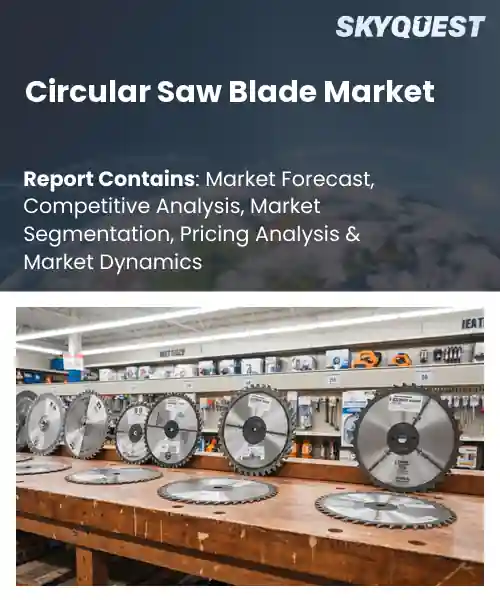
Circular Saw Blade Market
Report ID: SQMIG20I3090
Report ID: SQMIG20I3090
[email protected]
USA +1 351-333-4748
Report ID:
SQMIG20I3090 |
Region:
Global |
Published Date: June, 2026
Pages:
157
|Tables:
94
|Figures:
73


Global Circular Saw Blade Market size was valued at USD 11.7 Billion in 2024 and is poised to grow from USD 12.23 Billion in 2025 to USD 17.39 Billion by 2033, growing at a CAGR of 4.5% during the forecast period (2026-2033).
The main push behind the circular saw blade market growth is the rising need for precise cutting across construction, woodworking and metal fabrication. The market itself is made up of blade makers, and they differ by diameter, tooth design, what the material is, and what coatings they use, and well it matters because the blade which is picked affects productivity, site safety, and cost control in a pretty direct way. Over time the whole thing has drifted away from purpose carbon steel discs toward carbide tipped, diamond ,and coated blades, this is driven by mechanization, CNC setups and tighter quality requirements. Like, for instance, automotive body shops started using fine tooth carbide variants to cut down on burrs ,while contractors often lean on segmented diamond blades for concrete.
From that technological move, one of the bigger reasons the global market keeps growing is wider adoption of high-performance blade materials and coatings, which then sparks a chain reaction of demand for precision tooling. Since carbide, polycrystalline diamond, and upgraded PVD coatings extend tool life and let cutting speeds go higher, manufacturers and end users can reduce downtime and also lower total cost of ownership. So contractors and industrial fabricators start specifying premium blades more often. As a result, suppliers put more money into R&D and production capacity, opening up chances in prefabrication plants, cabinetry workrooms and tile installation where cleaner cuts and fewer passes mean less rework ,and in parallel, newer markets keep expanding as power tool adoption rises.
AI-driven automation improves precision by mixing sensor feedback, machine learning, and closed loop process control, which sounds fancy but it really means the system keeps checking itself as it works. Important parts include automated grinding and straightening, but guided by AI models, plus predictive maintenance that helps keep blade geometry stable over time. There are also optical inspection systems that detect micro defects before assembly, so defects get caught earlier instead of showing up later as quality issues. Manufacturers use these methods to reduce variation and keep edge quality steadier across different batches. This matters because buyers want consistent cuts, not “mostly fine” results that cause extra rework.
Market snapshot - (2026-2033)
Global Market Size
USD 11.7 Billion
Largest Segment
Circular Saw Blades
Fastest Growth
Circular Saw Blades
Growth Rate
4.5% CAGR
To get more insights on this market click here to Request a Free Sample Report
The global circular saw blade market is segmented by product type, application, blade material and region. Based on product type, the market is segmented into Circular Saw Blades, Band Saw Blades, Chain Saw Blades, Hand Saw Blades and Others. Based on application, the market is segmented into Wood Cutting, Metal Cutting, Stone Cutting and Others. Based on blade material, the market is segmented into Carbide Tipped, Diamond Tipped, High-Speed Steel and Others. Based on region, the market is segmented into North America, Europe, Asia Pacific, Latin America and Middle East & Africa.
As per the circular saw blade market analysis, the Circular saw blades segment dominates because it packs together precision, speed, and compatibility with a wide range of handheld plus stationary setups, so it ends up being the go to option for most general cutting jobs. Manufacturers push these blades harder since standardized diameters and tooth layouts make cutting results more “repeatable”, even if the material varies. Then the established supply chain ecosystem and aftermarket support, basically keep everyone comfortable buying and replacing them. OEM partnerships and all that tool integration , along with ongoing design tweaking, also keeps their leadership locked in across residential, commercial, and industrial use.
However, band saw blades are getting the strongest growth traction right now. A lot of manufacturers and workshops want more material flexibility for irregular shapes and thicker section work. With better metallurgy and improved tooth design, band saw blades move deeper into metalworking and fabrication. On top of that automation friendly blade profiles and lower kerf needs help adoption, and suddenly some specialized industrial use cases and higher value service options become easier to justify.
According to the circular saw blade market forecast, the Carbide Tipped segment is leading, largely because it hits a balance between toughness and hardness, which gives longer service life across different cutting media. That’s why professionals and OEMs tend to favor it. It holds sharpness better during high speed cutting, and the fact that it can be retipped or reground helps lower the total cost, while also simplifying inventory planning. Toolmakers keep investing into carbide tooth geometries and coating systems, and those improvements show up as more consistent performance, which supports wider adoption in construction, woodworking, and mixed fabrication.
Meanwhile, Diamond Tipped is the fastest expanding category. This is mainly because demand keeps rising for abrasive materials like stone, ceramics, and engineered composites. Improvements in bonding techniques and blade matrix design boost both durability and cutting accuracy, and that is pushing adoption by specialized contractors and fabricators. In practical terms it also opens the door to premium service opportunities and more new product development tailored for hard material applications.
To get detailed segments analysis, Request a Free Sample Report
As per the circular saw blade market regional forecast, Asia Pacific ends up dominating the market, mostly because there’s this dense concentration of manufacturing muscle, plus locked in supply chains, and also steady end user demand that shows up across construction, woodworking, automotive and electronics. The region leans on access to raw materials and pretty competitive production costs, so companies can offer everything from plain work blades to higher performance, niche specialty types. A bunch of advanced manufacturing hubs in the area keep pushing incremental change in carbide grades, brazing approaches and surface coatings, while the industrial clusters already there help with rapid prototyping and then scale up without too much drama. There’s also strong export orientation and broad distribution reach that basically connects local output to international buyers. Tool makers, machine builders, and trade distributors staying connected also helps with aftersales support, so they can stick to shifting quality and safety rules, which keeps the region wide dominant position intact.
Japan Circular Saw Blade Market
In Japan, the circular saw blade market is supported by precision manufacturing, deep tooling know how, and serious, focused material science investment. Domestic demand, especially from precision metalworking, construction, and electronics, pushes a high value blade segment that prioritizes long life and accurate cutting. Close work with machine tool makers enables bespoke geometries, and tight tolerances that feel almost “locked in”. R and D keeps improving carbide compositions and the coating behavior, while the established distribution and aftermarket systems help professional users keep running smoothly.
South Korea Circular Saw Blade Market
The South Korean circular saw blade market draws leverage from being near major heavy industries, plus automotive, and electronics manufacturing, so the demand leans toward high performance, specialized blades. The big emphasis falls on advanced metallurgy and coating methods, which gives durable products meant for industrial schedules. Collaboration with precision machine tool suppliers makes it easier to land tailored blade solutions that fit real production constraints. Meanwhile, organized distribution channels and an export minded posture help broaden market reach, and then resharpening and service networks keep the user relationships going.
North America is seeing rapid circular saw blade market penetration, fueled by a mix of professional construction work, renovation momentum that won’t really quit, and a solid base of industrial manufacturing. The market is also supported by distribution systems that are pretty sophisticated, serving both big contractors and independent trade crews, plus there’s a DIY customer group that wants many blade types, depending on the task. Blade technology investment, including tougher carbide formulations and improved coating workflows, helps raise performance and keeps the market tilted toward premium offerings. Regulations that back safety and performance standards make it easier for consumers and businesses to adopt quality choices. When tool manufacturers collaborate closely with end users, customization for specialized uses speeds up, and the broad aftermarket services with local resharpening options help lock in long term blade utilization and loyalty.
United States Circular Saw Blade Market
The circular saw blade sector in the United States reflects a wide professional construction and industrial fabrication base, along with a do it yourself segment. Demand for premium and specialty blades is backed by strong links between tool manufacturers and national distributors. Safety and performance focus pushes more standardized offerings and certification style practices. Aftermarket services that are widely accessible plus resharpening support also keeps blades usable longer, and then technical assistance together with rental channels give contractors practical access.
Canada Circular Saw Blade Market
In Canada, the circular saw blade industry is driven by forestry and construction, and also by infrastructure needs in remote locations where durable blade performance is a must. Suppliers tend to prefer blades made for cold conditions and heavy duty applications, and cooperation with sawmills and contractors supports timber optimized solutions. Aftermarket options like resharpening and field support matter a lot, because they sustain productivity across scattered industrial sites, plus seasonal work cycles, work patterns, and ongoing operations.
Europe is strengthening its standing in the circular saw blade market via precision engineering, very strict quality standards, and also a noticeable push on sustainability. A lot of regional manufacturers stress high value differentiation, like they really try to make blades with more advanced tooth geometries, special coatings, and carbide mixtures that are tailored in a pretty specific way for both demanding industrial work and that artisanal side too. Cross-border supply routes and close back and forth between tool makers and end users help refine the product specs quickly, and they keep the aftermarket support efficient, as in, no long delays. On top of that the policy environment, plus customer preference for blades that last longer and can actually be repaired, pushes the whole idea of extended blade life and easier serviceability. There’s also investment in digital production and tighter process control, so quality stays consistent. And then with well established distribution networks plus technical service providers professional users across different sectors can get the right blade solution, along with maintenance know how.
Germany Circular Saw Blade Market
The circular saw blade market in Germany sits on a tradition of precision engineering and strong integration with machine tool and automotive clusters. Demand tends to reward high quality, steady performance, and solutions that are customized for industrial use. Manufacturers focus on innovation across alloy selection, tooth geometry, and coating systems, mainly to hit tight tolerances. There’s a good collaboration between users and producers, so blades get tailored without too much friction, and the extensive distribution and service network also supports aftermarket resharpening and technical assistance.
United Kingdom Circular Saw Blade Market
In the United Kingdom, the circular saw blade market reflects a varied demand mix, driven by construction, refurbishment, and specialist woodworking. That demand is supported by independent trades and contractor networks, which basically shapes what gets sold and how fast it moves. Suppliers and distributors often tailor offerings for general purpose needs, plus those niche applications too, with a clear emphasis on easy handling and compatibility with common power tool systems. Aftermarket options matter a lot, like sharpening services, technical guidance, and parts supply, because busy contractors and workshops need continuity rather than interruptions.
France Circular Saw Blade Market
France’s circular saw blade market is pulled by carpentry needs and industrial machining, with attention on surface finish and overall versatility. Suppliers build blades intended for hardwood, engineered wood, and metal cutting, and they try to prioritize multi application performance, not just single job usage. Collaboration with aerospace and automotive subcontractors supports adoption of high precision blades for those specialized processes. A dense chain of distributors, plus aftermarket sharpening services, helps small workshops and larger industrial users both stay supplied and properly maintained.
To know more about the market opportunities by region and country, click here to
Buy The Complete Report
Growth In Construction Demand
Adoption Of Advanced Blade Materials
High Raw Material Price Volatility
Stringent Safety and Environmental Regulations
Request Free Customization of this report to help us to meet your business objectives.
Competition in the global circular saw blade market is, um driven by a mix of consolidation among well-known toolmakers and tech based differentiation, M&A plus distribution partnerships are basically rearranging the supply chain , example is those recent focused purchases by big cutting tool groups and smaller producers pushing their export brands harder. New players chase advanced carbide and PCD tooling, while incumbents keep pouring money into coating and grinding tweaks to hold onto share.
Top Player’s Company Profile
Recent Developments in the Circular Saw Blade Market
SkyQuest’s ABIRAW (Advanced Business Intelligence, Research & Analysis Wing) is our Business Information Services team that Collects, Collates, Correlates, and Analyses the Data collected by means of Primary Exploratory Research backed by robust Secondary Desk research.
As per SkyQuest analysis, a key driver is rising demand for precision cutting across construction, woodworking and metal fabrication, and a second driver is wider adoption of advanced blade materials and coatings that extend tool life, while lowering total cost of ownership. A restraint is high raw material price volatility, which can squeeze margins and maybe dull the appetite for premium blades. The dominating region is Asia Pacific, due to its manufacturing density and strong end user pull, and the dominating segment is circular saw blades, because they’re versatile across both handheld and stationary equipment. Suppliers that push premiumization, digital integration, and aftermarket services are best set up to capture this growth.
| Report Metric | Details |
|---|---|
| Market size value in 2024 | USD 11.7 Billion |
| Market size value in 2033 | USD 17.39 Billion |
| Growth Rate | 4.5% |
| Base year | 2024 |
| Forecast period | (2026-2033) |
| Forecast Unit (Value) | USD Billion |
| Segments covered |
|
| Regions covered | North America (US, Canada), Europe (Germany, France, United Kingdom, Italy, Spain, Rest of Europe), Asia Pacific (China, India, Japan, Rest of Asia-Pacific), Latin America (Brazil, Rest of Latin America), Middle East & Africa (South Africa, GCC Countries, Rest of MEA) |
| Companies covered |
|
| Customization scope | Free report customization with purchase. Customization includes:-
|
To get a free trial access to our platform which is a one stop solution for all your data requirements for quicker decision making. This platform allows you to compare markets, competitors who are prominent in the market, and mega trends that are influencing the dynamics in the market. Also, get access to detailed SkyQuest exclusive matrix.
Table Of Content
Executive Summary
Market overview
Parent Market Analysis
Market overview
Market size
KEY MARKET INSIGHTS
COVID IMPACT
MARKET DYNAMICS & OUTLOOK
Market Size by Region
KEY COMPANY PROFILES
Methodology
For the Circular Saw Blade Market, our research methodology involved a mixture of primary and secondary data sources. Key steps involved in the research process are listed below:
1. Information Procurement: This stage involved the procurement of Market data or related information via primary and secondary sources. The various secondary sources used included various company websites, annual reports, trade databases, and paid databases such as Hoover's, Bloomberg Business, Factiva, and Avention. Our team did 45 primary interactions Globally which included several stakeholders such as manufacturers, customers, key opinion leaders, etc. Overall, information procurement was one of the most extensive stages in our research process.
2. Information Analysis: This step involved triangulation of data through bottom-up and top-down approaches to estimate and validate the total size and future estimate of the Circular Saw Blade Market.
3. Report Formulation: The final step entailed the placement of data points in appropriate Market spaces in an attempt to deduce viable conclusions.
4. Validation & Publishing: Validation is the most important step in the process. Validation & re-validation via an intricately designed process helped us finalize data points to be used for final calculations. The final Market estimates and forecasts were then aligned and sent to our panel of industry experts for validation of data. Once the validation was done the report was sent to our Quality Assurance team to ensure adherence to style guides, consistency & design.
Analyst Support
Customization Options
With the given market data, our dedicated team of analysts can offer you the following customization options are available for the Circular Saw Blade Market:
Product Analysis: Product matrix, which offers a detailed comparison of the product portfolio of companies.
Regional Analysis: Further analysis of the Circular Saw Blade Market for additional countries.
Competitive Analysis: Detailed analysis and profiling of additional Market players & comparative analysis of competitive products.
Go to Market Strategy: Find the high-growth channels to invest your marketing efforts and increase your customer base.
Innovation Mapping: Identify racial solutions and innovation, connected to deep ecosystems of innovators, start-ups, academics, and strategic partners.
Category Intelligence: Customized intelligence that is relevant to their supply Markets will enable them to make smarter sourcing decisions and improve their category management.
Public Company Transcript Analysis: To improve the investment performance by generating new alpha and making better-informed decisions.
Social Media Listening: To analyze the conversations and trends happening not just around your brand, but around your industry as a whole, and use those insights to make better Marketing decisions.
REQUEST FOR SAMPLE
 REQUEST FREE CUSTOMIZATION
Global Circular Saw Blade Market size was valued at USD 11.7 Billion in 2024 and is poised to grow from USD 12.23 Billion in 2025 to USD 17.39 Billion by 2033, growing at a CAGR of 4.5% during the forecast period (2026-2033).
Competition in the global circular saw blade market is driven by consolidation among established toolmakers and technology led differentiation, with M&A and distribution partnerships reshaping supply chains; for example recent targeted acquisitions by major cutting tool groups and smaller manufacturers expanding export brands. New entrants pursue advanced carbide and PCD tooling while incumbents invest in coating and grinding innovation to defend market share. 'Stanley Black & Decker', 'Robert Bosch', 'Makita Corporation', 'Tenryu Saw', 'Kanefusa', 'Positec Tool', 'Amana Tool', 'Apex Tool Group', 'Dimar Group', 'Leitz', 'Leuco', 'Stark S.p.A.', 'AKE Knebel', 'Pilana', 'Kinkelder', 'Julius Klinke', 'GSP - High Tech Saws'
Performance Premiumization: Manufacturers are shifting toward premium, high-performance blades that emphasize longevity, precision, and application-specific designs to meet demanding industrial and professional needs. Differentiation centers on proprietary alloys, advanced tooth geometries, and specialized coatings, combined with integrated services such as diagnostics, retipping, and specification consultancy. Suppliers position these offerings around total lifecycle value rather than unit price, enabling closer OEM collaboration, channel specialization, and bespoke solutions for niche substrates, which elevates margins and fosters long-term relationships across construction, woodworking, industrial fabrication sectors.
Why does Asia Pacific Dominate the Global Circular Saw Blade Market? |@12


Want to customize this report? This report can be personalized according to your needs. Our analysts and industry experts will work directly with you to understand your requirements and provide you with customized data in a short amount of time. We offer $1000 worth of FREE customization at the time of purchase.
Feedback From Our Clients


 USA (+1) 351-333-4748

