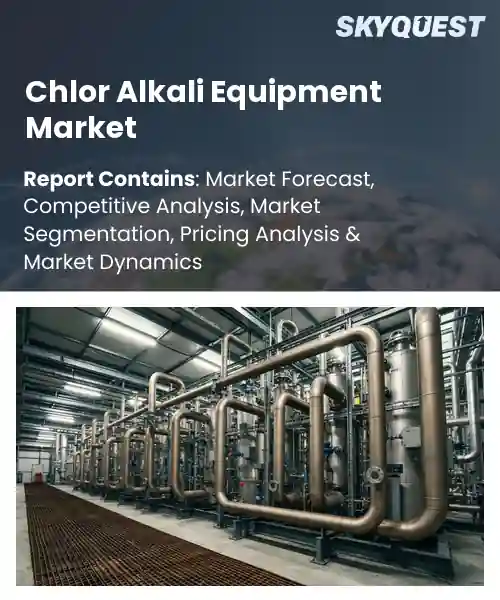
Chlor Alkali Equipment Market
Report ID: SQMIG20I3016
Report ID: SQMIG20I3016
[email protected]
USA +1 351-333-4748
Report ID:
SQMIG20I3016 |
Region:
Global |
Published Date: May, 2026
Pages:
157
|Tables:
179
|Figures:
79


Global Chlor Alkali Equipment Market size was valued at USD 891.6 Million in 2024 and is poised to grow from USD 929.05 Million in 2025 to USD 1291.16 Million by 2033, growing at a CAGR of 4.2% during the forecast period (2026-2033).
At the core of the chlor alkali equipment market lies demand for caustic soda and chlorine driven by industrialization and construction, with polyvinyl chloride production the largest downstream consumer. The market comprises electrolytic cells, power systems, brine purification units and controls converting salt and electricity into chlorine, sodium hydroxide and hydrogen. It matters because these basic chemicals feed paper bleaching, aluminum refining, water treatment and numerous chemical syntheses, and equipment efficiency and reliability have outsized economic and environmental consequences. Over decades the sector evolved from mercury and diaphragm technologies toward membrane cells, prompted by environmental regulation and energy efficiency goals.
The industry transition to membrane cells, stricter environmental standards are the principal catalyst shaping equipment demand because producers need lower emissions and higher energy efficiency to remain competitive. When regulations force mercury cell closures, plants invest in membrane retrofits that reduce power consumption, creating aftermarket and engineering service opportunities. Similarly, growth in PVC, pulp and aluminum sectors increases caustic demand, which incentivizes capacity expansion and modular plant design for faster commissioning. Coupling electrolysis systems with renewable power and digital energy management enables lower carbon footprints and operational savings, which attract investment into smarter, flexible chlor alkali equipment globally.
How is AI improving operational efficiency in the chlor-alkali equipment market?
AI is improving operational efficiency in the chlor alkali equipment market by combining real time sensor data with machine learning to predict failures and fine tune process conditions. Key aspects include predictive maintenance for electrolysis stacks model based control for stable current and voltage energy management to lower consumption and digital twin simulations for what if scenarios. The current state shows growing adoption of edge AI for immediate alerts and cloud analytics for longer term optimization. In a market where energy use and uptime determine competitiveness these tools reduce unplanned shutdowns extend equipment life and streamline capital projects.
AVEVA March 2026, announced a new lifecycle digital twin architecture with NVIDIA that brings AI driven simulation and real time analytics to large scale industrial plants. This development helps chlor alkali operators by enabling predictive optimization of electrolysis cells and smarter maintenance planning supporting efficiency gains and smoother production cycles.
Market snapshot - (2026-2033)
Global Market Size
USD 891.6 Million
Largest Segment
Electrolyzers
Fastest Growth
Hydrogen Processing Equipment
Growth Rate
4.2% CAGR
To get more insights on this market click here to Request a Free Sample Report
Global chlor alkali equipment market is segmented by product type, process type, application, end user industry, equipment material, sales channel and region. Based on product type, the market is segmented into Electrolyzers, Chlorine Handling Equipment, Caustic Soda Processing Equipment, Hydrogen Processing Equipment, Evaporation & Concentration Systems and Others. Based on process type, the market is segmented into Membrane Cell Process, Diaphragm Cell Process and Mercury Cell Process. Based on application, the market is segmented into Caustic Soda Production, Chlorine Production, Hydrogen Production and Industrial Chemical Processing. Based on end user industry, the market is segmented into Chemical Industry, Pulp & Paper, Water Treatment, Textiles, Alumina Production and Others. Based on equipment material, the market is segmented into Titanium-Based Equipment, Nickel-Based Equipment, Steel-Based Equipment and Others. Based on sales channel, the market is segmented into Direct Sales, Distributors & EPC Contractors and Aftermarket Services. Based on region, the market is segmented into North America, Europe, Asia Pacific, Latin America and Middle East & Africa.
Electrolyzers segment dominates because electrolytic cells are the central equipment for producing chlorine, caustic soda and hydrogen, and their performance directly determines plant throughput and energy intensity. Advances in cell design, materials and modular factory integration reduce energy consumption and operational downtime, incentivizing operators to prioritize electrolyzer upgrades. OEM and operator investment flows toward advanced cells, which drives demand for complementary handling and processing equipment and services.
However, Hydrogen Processing Equipment is witnessing the strongest growth momentum as demand for purified and stored hydrogen from chlor alkali operations rises. Advances in compression, purification and storage allow byproduct valorization and industrial energy integration, while regulatory focus on low carbon hydrogen and new end uses drives investment and aftermarket opportunities across plants.
Membrane Cell Process segment dominates because it delivers higher energy efficiency and produces purer caustic soda with lower contaminant carryover, directly addressing environmental and quality pressures in chlor alkali operations. Its compatibility with modern electrolyzer designs and reduced reliance on hazardous materials reduces compliance burden and lifecycle costs, prompting operators to retrofit legacy plants and standardize membrane compatible systems, which in turn strengthens demand for membrane compatible ancillary equipment and service offerings.
Meanwhile, Diaphragm Cell Process is emerging as the key high growth area due to innovations in diaphragm materials and process optimization that improve caustic yield and reduce maintenance. Renewed interest stems from cost effective retrofits of aging plants, operational flexibility for variable feedstocks, and regulatory momentum favoring mercury free alternatives.
To get detailed segments analysis, Request a Free Sample Report
Asia Pacific dominates global chlor alkali equipment market due to synergistic combination of large chemical manufacturing base, concentrated industrial demand, favorable industrial policy, and strong presence of major equipment manufacturers and technology providers. Integrated supply chains across petrochemicals, PVC production, and pulp and paper create steady demand for reliable, high capacity electrolytic cells and membrane systems. Regional investment patterns favor modernization and retrofitting of older plants, encouraging adoption of advanced automation, energy efficiency improvements, and localized fabrication. Robust engineering capabilities in select countries support customization for challenging feedstocks and regulatory requirements, while proximity to raw materials and end users reduces lead times and costs. Strong domestic demand coupled with export orientation sustains continuous capital expenditure in equipment and services.
Chlor Alkali Equipment Market in Japan reflects advanced engineering and a focus on high reliability. Domestic manufacturers and engineering firms emphasize compact, energy efficient electrolytic systems and sophisticated control instrumentation tailored to stringent quality and safety standards. Collaboration between equipment suppliers and end users supports continuous improvement in materials selection and maintenance practices. The stable industrial ecosystem and emphasis on innovation drive steady demand for customized retrofit solutions and offerings.
Chlor Alkali Equipment Market in South Korea is defined by integration with chemical complexes and a focus on cost effective, high throughput equipment. Local engineering firms and fabricators partner with global technology licensors to adapt membrane and diaphragm cell technologies for regional feedstock. Emphasis on operational efficiency, lifecycle service contracts and swift maintenance enhances plant availability. Strategic collaboration between equipment suppliers and end users encourages practical innovations and aftermarket support.
Rapid expansion in North America is driven by a combination of modernization initiatives, diversified end market demand, and active involvement of established engineering procurement and construction firms that facilitate large scale deployments. Emphasis on improving energy efficiency and reducing environmental footprint encourages upgrades to membrane technologies and advanced control systems. Strong service ecosystems and aftermarket providers support lifetime performance and prompt retrofits, while flexible financing and project execution models lower barriers to capital projects. Collaborative partnerships between equipment vendors, utility operators, and industrial consumers accelerate practical adoption of newer cell designs and automation packages. Localized manufacturing, coupled with a focus on reducing lead times and enhancing supply chain resilience, also supports accelerated procurement and deployment across multiple industrial clusters.
Chlor Alkali Equipment Market in the United States benefits from a mature industrial base and strong network of engineering and aftermarket service providers. Demand centers around modernization of legacy plants, incorporation of energy efficient cell technologies and advanced process controls. Robust project management and financing enables complex upgrades and new installations. Close collaboration among equipment manufacturers, contractors and end users fosters tailored solutions that address regulatory expectations and reliability needs.
Chlor Alkali Equipment Market in Canada blends resource access with emphasis on sustainable operations and localized fabrication. Demand reflects needs for reliability in remote sites and industry initiatives to lower energy intensity via membrane upgrades and advanced controls. Stakeholder engagement and cooperative procurement help align equipment specifications with environmental and safety objectives. Service networks and partnerships with international technology providers facilitate adaptation of established designs to regional conditions and opportunities.
Europe is strengthening its position through a concerted emphasis on technological refinement, regulatory compliance, and industrial collaboration that raises equipment standards and operational performance. Manufacturers and engineering houses prioritize energy efficient membrane technologies, advanced materials, and integrated control platforms to meet stringent environmental and quality expectations. Cross border partnerships and knowledge sharing accelerate best practice adoption and enable customization for diverse feedstock scenarios. Investment in refurbishment and lifecycle service models supports longevity of installed assets, while a dense network of specialized suppliers fosters rapid prototyping and modular solutions. Policy frameworks and industry consortia further incentivize improvements in emissions management and process safety, reinforcing Europe role as a center for high specification equipment and premium aftermarket services. Focus on digitalization and predictive maintenance also contributes to higher uptime and lifecycle cost reduction, enhancing competitiveness within global supply chains.
Chlor Alkali Equipment Market in Germany benefits from precision manufacturing and a focus on energy efficient membrane systems. Equipment suppliers emphasize durable materials, integrated automation and rigorous testing to satisfy heavy industry requirements. Research collaborations with fabricators and plant operators support validated improvements and optimized performance. Strong aftermarket capabilities and retrofit expertise, aligned with strict environmental compliance, maintain demand for high specification systems and targeted maintenance services and ongoing solutions.
Chlor Alkali Equipment Market in United Kingdom emphasizes modular equipment design and integration of advanced control systems. UK engineering firms focus on customizable membrane and cell packages that can be rapidly deployed. Partnerships with academic centers support research in materials and process intensification. A robust consulting and contracting sector simplifies project execution, while attention to safety standards and environmental performance steers the market toward premium equipment and full lifecycle support.
Chlor Alkali Equipment Market in France combines strong chemical industry clusters with a preference for advanced and compliant equipment. French suppliers and engineering houses prioritize energy efficient cell technologies, corrosion resistant materials and integrated process control solutions. Collaboration between industry and technical institutes fosters practical innovations and pilot testing. Emphasis on aftermarket service, modular retrofit approaches and environmental performance ensures sustained need for high quality equipment and specialist maintenance offerings.
To know more about the market opportunities by region and country, click here to
Buy The Complete Report
Increasing Demand For Downstream Applications
Advancements In Electrolysis Technology
High Energy Consumption and Costs
Capital Intensity and Financing Challenges
Request Free Customization of this report to help us to meet your business objectives.
Competitive landscape is shaped by incumbent equipment suppliers defending share through licensing, partnerships, and targeted investments while startups push chlorine free and modular electrochemical alternatives. Examples include Permascand and Verdagy working to commercialize advanced electrochemical cells, Solvay investing in Chengyang Tech to accelerate on site electrochemical production, and INOVYN supplying BICHLOR electrolysers to new builds, signaling licensing, partnerships and product innovation.
SkyQuest’s ABIRAW (Advanced Business Intelligence, Research & Analysis Wing) is our Business Information Services team that Collects, Collates, Correlates, and Analyses the Data collected by means of Primary Exploratory Research backed by robust Secondary Desk research.
As per SkyQuest analysis, the global chlor alkali equipment market is driven primarily by increasing demand from downstream applications such as PVC, pulp and alumina production, and further supported by advancements in electrolysis technology that improve energy efficiency and modularity. Growth is constrained by high energy consumption and related operating costs which can delay upgrades and capital projects. Asia Pacific remains the dominant region due to large chemical manufacturing bases and ongoing modernization, while electrolyzers are the leading product segment because cell performance determines throughput and energy intensity. These dynamics create opportunities for retrofits, digital optimization and aftermarket services as operators pursue lower emissions and lifecycle cost reductions.
| Report Metric | Details |
|---|---|
| Market size value in 2024 | USD 891.6 Million |
| Market size value in 2033 | USD 1291.16 Million |
| Growth Rate | 4.2% |
| Base year | 2024 |
| Forecast period | (2026-2033) |
| Forecast Unit (Value) | USD Million |
| Segments covered |
|
| Regions covered | North America (US, Canada), Europe (Germany, France, United Kingdom, Italy, Spain, Rest of Europe), Asia Pacific (China, India, Japan, Rest of Asia-Pacific), Latin America (Brazil, Rest of Latin America), Middle East & Africa (South Africa, GCC Countries, Rest of MEA) |
| Companies covered |
|
| Customization scope | Free report customization with purchase. Customization includes:-
|
To get a free trial access to our platform which is a one stop solution for all your data requirements for quicker decision making. This platform allows you to compare markets, competitors who are prominent in the market, and mega trends that are influencing the dynamics in the market. Also, get access to detailed SkyQuest exclusive matrix.
Table Of Content
Executive Summary
Market overview
Parent Market Analysis
Market overview
Market size
KEY MARKET INSIGHTS
COVID IMPACT
MARKET DYNAMICS & OUTLOOK
Market Size by Region
KEY COMPANY PROFILES
Methodology
For the Chlor Alkali Equipment Market, our research methodology involved a mixture of primary and secondary data sources. Key steps involved in the research process are listed below:
1. Information Procurement: This stage involved the procurement of Market data or related information via primary and secondary sources. The various secondary sources used included various company websites, annual reports, trade databases, and paid databases such as Hoover's, Bloomberg Business, Factiva, and Avention. Our team did 45 primary interactions Globally which included several stakeholders such as manufacturers, customers, key opinion leaders, etc. Overall, information procurement was one of the most extensive stages in our research process.
2. Information Analysis: This step involved triangulation of data through bottom-up and top-down approaches to estimate and validate the total size and future estimate of the Chlor Alkali Equipment Market.
3. Report Formulation: The final step entailed the placement of data points in appropriate Market spaces in an attempt to deduce viable conclusions.
4. Validation & Publishing: Validation is the most important step in the process. Validation & re-validation via an intricately designed process helped us finalize data points to be used for final calculations. The final Market estimates and forecasts were then aligned and sent to our panel of industry experts for validation of data. Once the validation was done the report was sent to our Quality Assurance team to ensure adherence to style guides, consistency & design.
Analyst Support
Customization Options
With the given market data, our dedicated team of analysts can offer you the following customization options are available for the Chlor Alkali Equipment Market:
Product Analysis: Product matrix, which offers a detailed comparison of the product portfolio of companies.
Regional Analysis: Further analysis of the Chlor Alkali Equipment Market for additional countries.
Competitive Analysis: Detailed analysis and profiling of additional Market players & comparative analysis of competitive products.
Go to Market Strategy: Find the high-growth channels to invest your marketing efforts and increase your customer base.
Innovation Mapping: Identify racial solutions and innovation, connected to deep ecosystems of innovators, start-ups, academics, and strategic partners.
Category Intelligence: Customized intelligence that is relevant to their supply Markets will enable them to make smarter sourcing decisions and improve their category management.
Public Company Transcript Analysis: To improve the investment performance by generating new alpha and making better-informed decisions.
Social Media Listening: To analyze the conversations and trends happening not just around your brand, but around your industry as a whole, and use those insights to make better Marketing decisions.
REQUEST FOR SAMPLE
 REQUEST FREE CUSTOMIZATION
Global Chlor Alkali Equipment Market size was valued at USD 891.6 Million in 2024 and is poised to grow from USD 929.05 Million in 2025 to USD 1291.16 Million by 2033, growing at a CAGR of 4.2% during the forecast period (2026-2033).
Competitive landscape is shaped by incumbent equipment suppliers defending share through licensing, partnerships, and targeted investments while startups push chlorine free and modular electrochemical alternatives. Examples include Permascand and Verdagy working to commercialize advanced electrochemical cells, Solvay investing in Chengyang Tech to accelerate on site electrochemical production, and INOVYN supplying BICHLOR electrolysers to new builds, signaling licensing, partnerships and product innovation. 'Thyssenkrupp nucera', 'Asahi Kasei', 'Tosoh Corporation', 'De Nora', 'Chemfab Alkalis', 'Bluestar Beijing Chemical Machinery', 'NEL Hydrogen', 'AGC', 'Mitsubishi Chemical Corporation', 'Covestro', 'Dongyue Group', 'Shandong Tianwei Membrane Technology', 'Saltworks Technologies', 'Bilfinger', 'McPhy Energy', 'Uhde Inventa-Fischer', 'Worley', 'Fluor Corporation', 'Technip Energies', 'Siemens Energy'
Rising demand for chlor alkali derivatives in downstream industries encourages capacity expansion and modernization of production facilities, motivating operators to invest in advanced electrolysis cells, control systems, and ancillary equipment. Manufacturers are prompted to replace outdated assets to improve efficiency and reduce energy consumption, which directly increases procurement of specialized equipment. The focus on operational reliability and consistent product quality compels procurement of sophisticated instrumentation and automation, supporting sustained market growth through ongoing capital expenditures and technology driven upgrades across established and emerging producers.
Electrochemical Process Innovation: Manufacturers are prioritizing advances in membrane technologies, cell designs to improve selectivity and durability of electrochemical production. Innovations focus on modular configurations, smarter automation and materials that extend component lifetimes while enabling lower environmental footprints. Suppliers collaborate with chemical producers to pilot novel electrode materials and process intensification approaches that reduce downtime and streamline maintenance. This trend supports faster technology adoption across diverse plant scales and opens pathways for flexible, resilient chlor-alkali operations responsive to evolving regulatory and customer demands.
Why does Asia Pacific Dominate the Global Chlor Alkali Equipment Market? |@12


Want to customize this report? This report can be personalized according to your needs. Our analysts and industry experts will work directly with you to understand your requirements and provide you with customized data in a short amount of time. We offer $1000 worth of FREE customization at the time of purchase.
Feedback From Our Clients


 USA (+1) 351-333-4748

