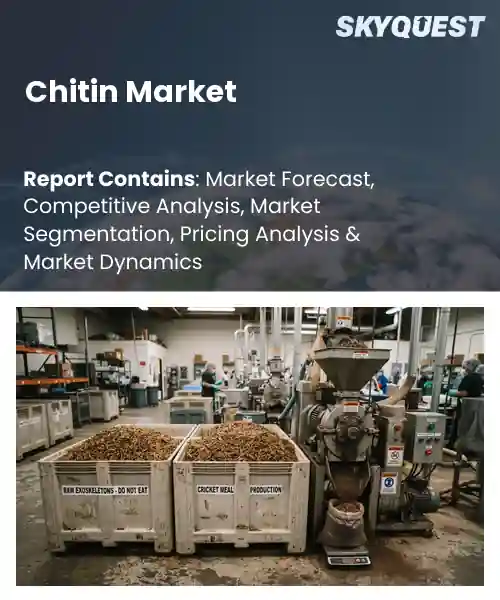
Chitin Market
Report ID: SQMIG15E4277
Report ID: SQMIG15E4277
[email protected]
USA +1 351-333-4748
Report ID:
SQMIG15E4277 |
Region:
Global |
Published Date: August, 2026
Pages:
157
|Tables:
147
|Figures:
78


Global Chitin Market size was valued at USD 1.62 Billion in 2024 and is poised to grow from USD 1.74 Billion in 2025 to USD 3.01 Billion by 2033, growing at a CAGR of 7.1% during the forecast period (2026-2033).
The factor shaping the chitin market is the convergence of biotechnology with incentives that favor bio inputs, creating an environment for diversification and penetration. Breakthroughs in enzymatic deacetylation have lowered production costs, allowing manufacturers to scale chitin‑derived chitosan for water‑treatment membranes; this reduces reliance on metal‑based filters and meets tightening environmental standards. Simultaneously, subsidies for biodegradable packaging stimulate investment in chitin‑based films, exemplified by a North‑American startup that secured funding to replace polystyrene trays in food service. These cause‑and‑effect dynamics significantly accelerate demand, broaden application scope, and cement chitin’s role as a cornerstone of the global green‑economy supply chain today.
How is AI-driven automation influencing product development in the chitin market?
AI-driven automation is reshaping product development across the chitin sector by linking data‑rich extraction processes with rapid formulation cycles. Machine‑learning models analyze raw shell inputs to predict purity and molecular weight, allowing producers to tailor biopolymers for pharmaceutical, agricultural and food uses. Automated reactors adjust temperature and pH in real time, cutting trial‑and‑error loops and accelerating scale‑up. Integrated digital twins simulate end‑use performance, guiding researchers toward applications such as biodegradable films or bio‑active powders. This blend of speed, precision and insight aligns with the market’s expanding demand and positions firms to launch innovative chitin products faster than before.In August 2026 a biotech firm announced an AI‑optimized chitin wound‑care platform that reduced formulation cycles and improved material consistency, demonstrating how automation can accelerate product rollout and support market growth. The system leverages real‑time sensor data to fine‑tune polymer cross‑linking, cutting development time and enabling faster entry into clinical and consumer channels.
Market snapshot - (2026-2033)
Global Market Size
USD 1.62 Billion
Largest Segment
Crustaceans
Fastest Growth
Insects
Growth Rate
7.1% CAGR
To get more insights on this market click here to Request a Free Sample Report
Global chitin market is segmented by source, grade, application, form, end user and region. Based on source, the market is segmented into Crustaceans, Fungi and Insects. Based on grade, the market is segmented into Industrial Grade, Food Grade and Pharmaceutical Grade. Based on application, the market is segmented into Pharmaceuticals, Food & Beverages, Agriculture, Water Treatment and Cosmetics. Based on form, the market is segmented into Powder, Flakes and Granules. Based on end user, the market is segmented into Pharmaceutical Companies, Food Manufacturers, Agricultural Sector and Cosmetic Manufacturers. Based on region, the market is segmented into North America, Europe, Asia Pacific, Latin America and Middle East & Africa.
Crustaceans segment dominates because it offers the most abundant raw material base, with well established harvesting and processing infrastructure that reduces cost and complexity. The familiarity of seafood industry supply chains ensures consistent quality, while the high chitin content in shells provides efficient conversion yields. These advantages translate into reliable feedstock for manufacturers, reinforcing its preferred status among producers seeking scalability and operational certainty. Moreover, the extensive research on crustacean extraction methods further streamlines production, enabling rapid response to market demand.
Meanwhile, insects segment is emerging as the most rapidly expanding source because its sustainability profile aligns with circular economy goals and consumer preference for eco friendly ingredients. Innovative low impact farming reduces environmental footprint while novel applications in nutraceuticals and biodegradable materials stimulate fresh demand, positioning insects as a catalyst for broader market growth.
Food grade segment dominates because consumers increasingly seek natural and clean label ingredients, and regulatory bodies favor chitin derived from safely consumable sources. The established safety certifications and predictable functional properties such as emulsification and texture enhancement make it a go to additive for manufacturers aiming to meet health centric trends. This reliability drives its widespread adoption across product lines, reinforcing its leadership in the market.
On the other hand, pharmaceutical grade segment is witnessing the strongest growth momentum because advanced biomedical applications demand high purity and precise molecular characteristics. Ongoing breakthroughs in drug delivery systems and wound care gels elevate its relevance, while stringent quality standards attract investment in specialized processing. This surge fuels new product pipelines and expands the overall market horizon.
To get detailed segments analysis, Request a Free Sample Report
The Asia Pacific region combines extensive marine resources with advanced biotechnological capabilities, creating a fertile environment for chitin development. Strong governmental support for sustainable materials drives research collaborations between academia and industry. The presence of a mature seafood processing sector provides abundant raw material streams, while a growing emphasis on eco‑friendly packaging and agricultural inputs fuels demand. Talent pipelines in polymer science and a culture of rapid innovation further reinforce the region’s leadership. Collectively, these factors generate a resilient ecosystem that continuously expands the application landscape for chitin across multiple sectors.
Chitin Market in Japan is bolstered by a longstanding tradition of seafood processing that supplies high‑quality raw inputs. Integrated research institutes focus on functional derivatives for medical and cosmetic uses, aligning with national priorities for health‑oriented innovation. Collaborative platforms link manufacturers with end‑users, accelerating product adoption in specialty sectors. The emphasis on high‑performance biopolymers reinforces Japan’s role as a pioneer in next‑generation chitin applications.
Chitin Market in South Korea benefits from robust government incentives that encourage green material development. Strong ties between biotech firms and fisheries create efficient supply chains for raw chitin. Emphasis on agricultural sustainability drives exploration of chitin‑based bio‑fertilizers and pest‑management solutions. Academic centers excel in tailoring chitin nanostructures for electronics and packaging, supporting diversification of the market. This integrated approach positions South Korea as a dynamic contributor to the region’s dominance.
North America experiences rapid expansion of the chitin market through a convergence of environmental policy, consumer awareness, and innovative research ecosystems. Strong demand for biodegradable alternatives propels interest in chitin for packaging and textiles, while the healthcare sector explores its antimicrobial and regenerative properties. Significant investment in biotechnology startups nurtures novel processing techniques that enhance performance and cost‑effectiveness. Collaborative networks among universities, federal agencies, and private firms accelerate translation of laboratory breakthroughs into commercial products. This multifaceted momentum establishes North America as a fast‑growing hub for diverse chitin applications.
Chitin Market in United States thrives on a vibrant startup culture that translates academic discoveries into commercial ventures. Federal research programs emphasize sustainable materials, encouraging development of chitin‑based composites for packaging and aerospace. Strong consumer preference for natural ingredients fuels growth in personal care and dietary supplement segments. Partnerships between large agribusinesses and biotech firms streamline supply of raw material, supporting scale‑up of agricultural applications. The cumulative effect creates a dynamic environment for continuous market expansion.
Chitin Market in Canada leverages abundant marine and freshwater resources to supply high‑purity feedstock for specialty products. Governmental emphasis on circular economy principles drives adoption of chitin in biodegradable packaging and soil health enhancers. Collaborative research clusters link coastal communities with universities, fostering community‑focused innovation. Emerging interest in veterinary and animal health applications further diversifies market opportunities. This holistic approach positions Canada as a forward‑looking participant in the North American chitin landscape.
Europe strengthens its position in the chitin market by integrating stringent sustainability standards with advanced material science. Strong regulatory frameworks promote the transition to bio‑based alternatives, encouraging industries to adopt chitin in packaging, textiles, and medical devices. Leading research institutions across the continent excel in nanostructuring chitin for high‑value applications, while collaborative consortia bridge gaps between academia and industry. Investment in green chemistry and circular economy initiatives reinforces supply chain resilience, ensuring consistent raw material availability from diversified fishery sources. Together, these strategic actions enhance Europe’s competitive edge and broaden the functional scope of chitin products.
Chitin Market in Germany is driven by a robust chemical engineering sector that refines chitin into high‑performance polymers for automotive and construction uses. Governmental programs champion bio‑based material adoption, aligning with broader climate objectives. Partnerships between research institutes and industrial firms focus on scalable processing technologies, reducing barriers to market entry. The emphasis on precision engineering supports development of chitin composites with superior mechanical properties, reinforcing Germany’s leadership in innovative material solutions.
Chitin Market in United Kingdom benefits from a strong life‑science ecosystem that explores medical and pharmaceutical applications. Collaborative research hubs link universities with biotech companies to develop chitin‑derived wound dressings and drug delivery platforms. Policy incentives encourage sustainable sourcing from coastal fisheries, ensuring ethical supply chains. Growing consumer demand for natural cosmetics further expands market reach. This integrated approach positions the United Kingdom as a hub for high‑value chitin innovations.
Chitin Market in France is underpinned by a tradition of culinary and marine expertise that supplies premium raw material streams. Research centers specialize in functionalizing chitin for agricultural bio‑stimulants and eco‑friendly packaging. Governmental emphasis on agritech and environmental stewardship accelerates adoption of chitin‑based solutions in farming practices. Collaborative networks between regional producers and technology firms facilitate rapid prototyping and market testing, reinforcing France’s contribution to the broader European chitin agenda.
To know more about the market opportunities by region and country, click here to
Buy The Complete Report
Increasing Demand for Sustainable Materials
Advancements in Extraction and Processing Technologies
High Production Cost Compared To Alternatives
Regulatory Uncertainty Across Regions
Request Free Customization of this report to help us to meet your business objectives.
The chitin market is shaped by intense rivalry among specialty chemical firms and biotech innovators, with competition driving accelerated M&A activity, strategic joint ventures, and rapid adoption of enzymatic extraction technologies; recent examples include a merger between two leading chitin processors to expand capacity and a partnership between a biotech company and a marine‑resource group to co‑develop high‑purity chitin derivatives for medical applications.
Top Player’s Company Profile
Recent Developments
SkyQuest’s ABIRAW (Advanced Business Intelligence, Research & Analysis Wing) is our Business Information Services team that Collects, Collates, Correlates, and Analyses the Data collected by means of Primary Exploratory Research backed by robust Secondary Desk research. As per SkyQuest analysis the global chitin market is projected to grow at a 7.1% CAGR through 2033, driven primarily by rising demand for sustainable, biodegradable materials that replace conventional plastics, while a second catalyst comes from rapid advances in enzymatic extraction and processing that lower costs and improve product consistency. High production expenses relative to synthetic polymers remain a notable restraint, limiting adoption in price‑sensitive segments. Asia Pacific leads the market thanks to abundant marine waste and strong biotech support, and the crustacean source segment dominates because of its plentiful, low‑cost feedstock. These dynamics together shape a market poised for continued expansion.
| Report Metric | Details |
|---|---|
| Market size value in 2024 | USD 1.62 Billion |
| Market size value in 2033 | USD 3.01 Billion |
| Growth Rate | 7.1% |
| Base year | 2024 |
| Forecast period | (2026-2033) |
| Forecast Unit (Value) | USD Billion |
| Segments covered |
|
| Regions covered | North America (US, Canada), Europe (Germany, France, United Kingdom, Italy, Spain, Rest of Europe), Asia Pacific (China, India, Japan, Rest of Asia-Pacific), Latin America (Brazil, Rest of Latin America), Middle East & Africa (South Africa, GCC Countries, Rest of MEA) |
| Companies covered |
|
| Customization scope | Free report customization with purchase. Customization includes:-
|
To get a free trial access to our platform which is a one stop solution for all your data requirements for quicker decision making. This platform allows you to compare markets, competitors who are prominent in the market, and mega trends that are influencing the dynamics in the market. Also, get access to detailed SkyQuest exclusive matrix.
Table Of Content
Executive Summary
Market overview
Parent Market Analysis
Market overview
Market size
KEY MARKET INSIGHTS
COVID IMPACT
MARKET DYNAMICS & OUTLOOK
Market Size by Region
KEY COMPANY PROFILES
Methodology
For the Chitin Market, our research methodology involved a mixture of primary and secondary data sources. Key steps involved in the research process are listed below:
1. Information Procurement: This stage involved the procurement of Market data or related information via primary and secondary sources. The various secondary sources used included various company websites, annual reports, trade databases, and paid databases such as Hoover's, Bloomberg Business, Factiva, and Avention. Our team did 45 primary interactions Globally which included several stakeholders such as manufacturers, customers, key opinion leaders, etc. Overall, information procurement was one of the most extensive stages in our research process.
2. Information Analysis: This step involved triangulation of data through bottom-up and top-down approaches to estimate and validate the total size and future estimate of the Chitin Market.
3. Report Formulation: The final step entailed the placement of data points in appropriate Market spaces in an attempt to deduce viable conclusions.
4. Validation & Publishing: Validation is the most important step in the process. Validation & re-validation via an intricately designed process helped us finalize data points to be used for final calculations. The final Market estimates and forecasts were then aligned and sent to our panel of industry experts for validation of data. Once the validation was done the report was sent to our Quality Assurance team to ensure adherence to style guides, consistency & design.
Analyst Support
Customization Options
With the given market data, our dedicated team of analysts can offer you the following customization options are available for the Chitin Market:
Product Analysis: Product matrix, which offers a detailed comparison of the product portfolio of companies.
Regional Analysis: Further analysis of the Chitin Market for additional countries.
Competitive Analysis: Detailed analysis and profiling of additional Market players & comparative analysis of competitive products.
Go to Market Strategy: Find the high-growth channels to invest your marketing efforts and increase your customer base.
Innovation Mapping: Identify racial solutions and innovation, connected to deep ecosystems of innovators, start-ups, academics, and strategic partners.
Category Intelligence: Customized intelligence that is relevant to their supply Markets will enable them to make smarter sourcing decisions and improve their category management.
Public Company Transcript Analysis: To improve the investment performance by generating new alpha and making better-informed decisions.
Social Media Listening: To analyze the conversations and trends happening not just around your brand, but around your industry as a whole, and use those insights to make better Marketing decisions.
REQUEST FOR SAMPLE
 REQUEST FREE CUSTOMIZATION


Want to customize this report? This report can be personalized according to your needs. Our analysts and industry experts will work directly with you to understand your requirements and provide you with customized data in a short amount of time. We offer $1000 worth of FREE customization at the time of purchase.
Feedback From Our Clients


 USA (+1) 351-333-4748

