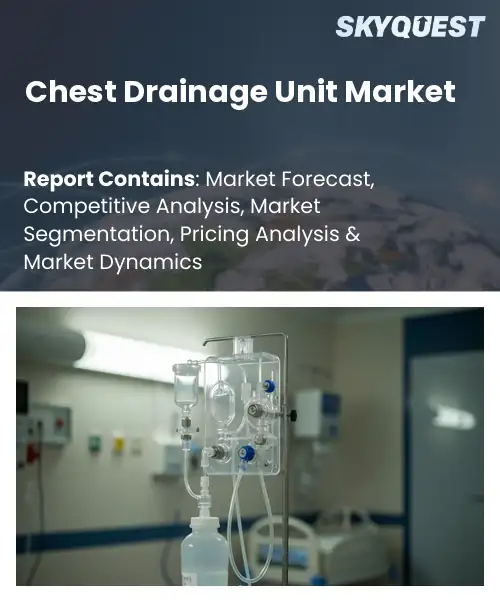
Chest Drainage Unit Market
Report ID: SQMIG35A4152
Report ID: SQMIG35A4152
[email protected]
USA +1 351-333-4748
Report ID:
SQMIG35A4152 |
Region:
Global |
Published Date: July, 2026
Pages:
157
|Tables:
148
|Figures:
78


Global Chest Drainage Unit Market size was valued at USD 680.4 Million in 2024 and is poised to grow from USD 715.51 Million in 2025 to USD 1070.09 Million by 2033, growing at a CAGR of 5.16% during the forecast period (2026-2033).
The global chest drainage unit market is about devices that help evacuate air, blood, or other fluid from the pleural space, which is one of those key steps people rely on in postoperative care. It matters a lot in terms of patient mortality and length of stay, so clinicians worldwide keep paying close attention to it.
Regulatory push toward minimally invasive surgery is the major factor behind the chest drainage unit market growth, since hospitals want equipment that works smoothly with video‑assisted thoracoscopic procedures. And when manufacturers include wireless sensors that report intrapleural pressures back to the surgeon console, the team can tweak suction settings in time, which reduces retained pneumothorax, but also can bring down intensive care unit days. In practice, this “better flow” tends to mean lower overall costs, so procurement teams, at least in many health systems, start preferring these advanced units rather than older bottle approaches. As a result, firms that combine thoughtful device engineering with software capabilities are grabbing more contracts in North America, and Asia‑Pacific too. There, surgical case volume is growing, and reimbursement models tend to reward outcomes that shorten hospitalization.
AI-driven automation is changing the chest drainage unit market outlook by adding real‑time analytics, predictive alarms, plus suction controls that adjust on their own. The idea is that it lowers manual monitoring, cuts down the set‑up time and supports earlier detection of complications. In this setup, sensor inputs get routed into cloud platforms, where machine‑learning models spot patterns like persistent air leaks or fluid build up. That makes clinicians act sooner, which reduces staff burden and supports faster patient turnover. More hospitals are leaning in to these smarter systems because they fit with wider digital health initiatives, and they also meet cost‑efficiency targets. So overall, it makes the market feel more appealing for both established manufacturers, and for new players trying to enter too.
Market snapshot - (2026-2033)
Global Market Size
USD 680.4 Million
Largest Segment
Traditional Water-Seal Systems
Fastest Growth
Digital Systems
Growth Rate
5.16% CAGR
To get more insights on this market click here to Request a Free Sample Report
The global chest drainage unit market is segmented by product mechanism type, material, flow type, clinical application, end user and region. Based on product mechanism type, the market is segmented into Traditional Water-Seal Systems, Dry-Seal Systems, Digital Systems and Mobile Automated Systems. Based on material, the market is segmented into Plastic-Based Single-Use Units and Glass-Based Reusable Units. Based on flow type, the market is segmented into Gravity Drainage and Suction Drainage. Based on clinical application, the market is segmented into Thoracic Surgery, Pulmonology, Cardiac Surgery, Trauma Medicine, Emergency Medicine, Oncology and Critical Care. Based on end user, the market is segmented into Hospitals, Ambulatory Surgical Centers, Specialty Thoracic Clinics and Cardiac Clinics. Based on region, the market is segmented into North America, Europe, Asia Pacific, Latin America and Middle East & Africa.
As per the chest drainage unit market analysis, the Traditional water-seal systems segment dominates because it offers dependable, low cost drainage, and it aligns with those long standing clinical protocols. Clinicians lean on the visible air leak checking and passive gravity based action, which cuts down on training headaches and lowers equipment malfunction risk. Hospitals tend to choose these units for routine thoracic procedures, where the whole “simple and proven” angle matters more than getting advanced data. So, procurement policies often push bulk buying , which in turn supports market leadership and cost effectiveness across very different care settings.
Still, the digital systems segment is showing the fastest expansion, mainly due to real-time analytics plus wireless connectivity, which boosts patient oversight and decision support. When digital units connect to electronic health records it helps the workflow feel more streamlined, and automated alerting reduces staff burden, so there is no need to watch every single change all day. That tech advantage encourages broader uptake in high acuity settings, and it also opens fresh growth lanes for manufacturers.
According to the chest drainage unit market forecast, the Thoracic surgery segment seems to dominate a lot, mostly because chest drainage units are basically baked into postoperative care after lung resections, esophagectomies, and those mediastinal procedures. Surgeons lean on these devices so they can evacuate air as well as fluid, it helps keep complications away, and it supports proper re expansion of the lungs. Also the high procedural volume and those standardized drainage protocols, lock in the routine, so hospitals are pushed to keep a fairly robust inventory. As a result, procurement cycles stay predictable, and this particular use case ends up looking like it’s leading the market , and clinical outcomes too.
On the other hand, the oncology segment is picking up the strongest growth momentum, largely due to novel thoracic tumor therapies. These newer treatments seem to raise the need for postoperative drainage, and they don’t just do it slightly. Minimally invasive resections, plus immunotherapy related pleural effusions, generate demand for specialized units that offer better monitoring. That added clinical complexity, it’s the whole driver here, so adoption increases and market opportunities broaden beyond the usual surgical environments.
To get detailed segments analysis, Request a Free Sample Report
As per the chest drainage unit market regional forecast, North America is staying ahead, mainly due to a more mature health care infrastructure, decent reimbursement frameworks, and that general high level of uptake of advanced technologies. There are established clinical guidelines that keep pushing a consistent approach to chest drainage solutions across a big mix of hospitals, and even surgical centers. On top of that, research and development ecosystems are strong enough to keep pushing new product ideas, while supply chains that are well integrated help devices show up fast. Also, the clinical workforce is highly skilled, so they tend to lean toward more sophisticated, safety-first units, and that somehow keeps market leadership steady due to continued demand and strong brand loyalty.
United States Chest Drainage Unit Market
The United States Chest Drainage Unit sector benefits from broad hospital networks and a culture where early technology adoption is normal. Main manufacturers usually work close with academic medical centers to tweak device performance, while payer structures generally support reimbursement for high-quality solutions. Clinicians keep focusing on patient safety and efficiency, so procurement shifts toward units that include monitoring features. The regulatory environment too, helps with faster entry of innovative products, so the competitive landscape stays active and not stagnant.
Canada Chest Drainage Unit Market
In Canada, the Chest Drainage Unit industry is shaped by universal health care, and it leans heavily on cost effectiveness plus clinical outcomes. Provincial health authorities tend to choose devices that can show clear benefits for patient recovery, and how efficiently resources get used. Hospitals and distributors also collaborate to make access smoother, so clinicians can reach newer technologies without too much friction. Plus, ongoing training programs help clinicians get more confident with the systems. With policy support and clinical focus working together, the market stays fairly stable.
Europe is seeing faster chest drainage unit market penetration because patient-centered care is emphasized, clinical standards are taken seriously, and there is more investment in minimally invasive procedures. Regulatory pathways that are more harmonized across the region also make cross-border product availability easier, so manufacturers can roll out innovations in wider territories. Providers increasingly want devices with digital monitoring and safety alarms, which fits broader digital health initiatives. Collaborative research networks, along with sustainable procurement goals, further add momentum. And reimbursement schemes that reward clinical efficiency, make adoption of advanced chest drainage units feel more realistic across settings.
Germany Chest Drainage Unit Market
The Germany’s Chest Drainage Unit Market is driven by a medical device sector that’s well established, plus clinical research that’s basically baked into everyday practice. Hospitals look for solutions that combine precision engineering with strong safety features, which signals a real commitment to high-quality patient care. Manufacturers and academic institutions collaborate a lot, and that helps accelerate product refinement. Reimbursement policies also tend to reward technologies that show measurable clinical benefits, and because of that, the market maintains a dominant position.
United Kingdom Chest Drainage Unit Market
In the United Kingdom, the Chest Drainage Unit Market is marked by a quicker uptake of new technologies, backed by NHS initiatives that emphasize efficiency and patient outcomes. Clinicians lean toward units that make workflow simpler, while also delivering advanced monitoring capabilities, which ties into goals around shorter hospital stays. Public procurement frameworks push competition around performance and value, so innovative suppliers can gain traction fairly quickly. The overall push for evidence-based practice keeps fueling ongoing growth.
France Chest Drainage Unit Market
France’s Chest Drainage Unit Market is moving forward as health care facilities modernize their equipment portfolios, mainly to align with updated clinical guidelines. Safety, along with ease of use is a key theme, so systems that include alarm functions and digital connectivity attract more attention. Hospitals and research centers also run collaborative programs to validate new technologies. Meanwhile, reimbursement structures are starting to reward clinical efficiency more often. That supportive ecosystem helps create gradual but steady expansion over time.
Asia Pacific seems to push its role forward by riding on expanding surgical volumes , a lot more awareness around post-op care, and some focused government pushes meant to upgrade hospital infrastructure. At the same time regional manufacturers are putting serious money into R&D, so they can shape devices for different care environments, rather than only one “standard” setting. International brands also hop into local partnerships, trying to widen distribution reach ,and to get closer to the people actually using the products. Lately, the growing attention on digital health and remote monitoring naturally fits with the rise of smart chest drainage units, which basically strengthens the whole innovation mood around the market. Plus training sessions and professional societies keep pushing best-practice benchmarks, and that helps lock in market confidence across the region, even when demand patterns change.
Japan Chest Drainage Unit Market
In Japan, the Chest Drainage Unit Market benefits from a highly tech-forward medical ecosystem and a strong mindset toward precise, tailored care. Hospitals tend to prefer equipment that feels dependable, but also comes with sophisticated monitoring capabilities, because patient safety is treated like a non-negotiable. There are also collaborative ties between device makers and clinical research institutions, which can shorten the path for next‑generation unit rollouts. On top of that, reimbursement structures that acknowledge clinical value make it easier for hospitals to justify buying higher-performance solutions, so the market keeps a fairly stable base.
South Korea Chest Drainage Unit Market
South Korea’s Chest Drainage Unit Market moves ahead due to the fast uptake of minimally invasive surgical approaches, plus a fairly proactive regulatory atmosphere. Providers often look for integrated systems that speed up workflows while lowering the likelihood of complications, so advanced units get pulled in more quickly. Local manufacturers keep working on innovation and cost competitiveness, while alliances with global firms help bring technology transfer into practice. Ongoing professional education also matters, because it supports correct, skilled use of newer devices, and that keeps demand steady rather than dropping after adoption.
To know more about the market opportunities by region and country, click here to
Buy The Complete Report
Rising Demand for Minimally Invasive Surgery
Advancements in Device Materials and Design
High Cost of Advanced Units
Regulatory Approval Complexity
Request Free Customization of this report to help us to meet your business objectives.
The global chest drainage unit makers are starting to push harder, mainly via strategic acquisitions, some joint ventures, and this growing attempt to plug in digital monitoring tech. In the recent wave of M&A, a prominent device company has taken over a smaller catheter producer, which is basically meant to extend the range of its lineup, and at the same time partnerships between bigger manufacturers and health tech players are trying to bake sensor based analytics into drainage systems, so clinical decision support gets a little more “automatic” and timely, even if people still need oversight.
Top Player’s Company Profile
Recent Developments in the Chest Drainage Unit Market
SkyQuest’s ABIRAW (Advanced Business Intelligence, Research & Analysis Wing) is our Business Information Services team that Collects, Collates, Correlates, and Analyses the Data collected by means of Primary Exploratory Research backed by robust Secondary Desk research.
As per SkyQuest analysis, the global chest drainage unit market is also expanding mainly because minimally invasive surgery is increasing the need for dependable postoperative fluid management, and meanwhile innovative materials plus design tweaks are making these systems safer and easier to use, which boosts adoption even further. Traditional water seal setups still dominate the main product segment, mostly due to their low cost and how familiar the operation feels. North America keeps the lead as well, supported by strong healthcare infrastructure and reimbursement coverage. Still, the high price of advanced digital units is acting like a brake, slowing uptake in settings where budgets are tighter. This pressure is pushing manufacturers to concentrate on more affordable smart solutions, to help bridge that gap, and not lose momentum.
| Report Metric | Details |
|---|---|
| Market size value in 2024 | USD 680.4 Million |
| Market size value in 2033 | USD 1070.09 Million |
| Growth Rate | 5.16% |
| Base year | 2024 |
| Forecast period | (2026-2033) |
| Forecast Unit (Value) | USD Million |
| Segments covered |
|
| Regions covered | North America (US, Canada), Europe (Germany, France, United Kingdom, Italy, Spain, Rest of Europe), Asia Pacific (China, India, Japan, Rest of Asia-Pacific), Latin America (Brazil, Rest of Latin America), Middle East & Africa (South Africa, GCC Countries, Rest of MEA) |
| Companies covered |
|
| Customization scope | Free report customization with purchase. Customization includes:-
|
To get a free trial access to our platform which is a one stop solution for all your data requirements for quicker decision making. This platform allows you to compare markets, competitors who are prominent in the market, and mega trends that are influencing the dynamics in the market. Also, get access to detailed SkyQuest exclusive matrix.
Table Of Content
Executive Summary
Market overview
Parent Market Analysis
Market overview
Market size
KEY MARKET INSIGHTS
COVID IMPACT
MARKET DYNAMICS & OUTLOOK
Market Size by Region
KEY COMPANY PROFILES
Methodology
For the Chest Drainage Unit Market, our research methodology involved a mixture of primary and secondary data sources. Key steps involved in the research process are listed below:
1. Information Procurement: This stage involved the procurement of Market data or related information via primary and secondary sources. The various secondary sources used included various company websites, annual reports, trade databases, and paid databases such as Hoover's, Bloomberg Business, Factiva, and Avention. Our team did 45 primary interactions Globally which included several stakeholders such as manufacturers, customers, key opinion leaders, etc. Overall, information procurement was one of the most extensive stages in our research process.
2. Information Analysis: This step involved triangulation of data through bottom-up and top-down approaches to estimate and validate the total size and future estimate of the Chest Drainage Unit Market.
3. Report Formulation: The final step entailed the placement of data points in appropriate Market spaces in an attempt to deduce viable conclusions.
4. Validation & Publishing: Validation is the most important step in the process. Validation & re-validation via an intricately designed process helped us finalize data points to be used for final calculations. The final Market estimates and forecasts were then aligned and sent to our panel of industry experts for validation of data. Once the validation was done the report was sent to our Quality Assurance team to ensure adherence to style guides, consistency & design.
Analyst Support
Customization Options
With the given market data, our dedicated team of analysts can offer you the following customization options are available for the Chest Drainage Unit Market:
Product Analysis: Product matrix, which offers a detailed comparison of the product portfolio of companies.
Regional Analysis: Further analysis of the Chest Drainage Unit Market for additional countries.
Competitive Analysis: Detailed analysis and profiling of additional Market players & comparative analysis of competitive products.
Go to Market Strategy: Find the high-growth channels to invest your marketing efforts and increase your customer base.
Innovation Mapping: Identify racial solutions and innovation, connected to deep ecosystems of innovators, start-ups, academics, and strategic partners.
Category Intelligence: Customized intelligence that is relevant to their supply Markets will enable them to make smarter sourcing decisions and improve their category management.
Public Company Transcript Analysis: To improve the investment performance by generating new alpha and making better-informed decisions.
Social Media Listening: To analyze the conversations and trends happening not just around your brand, but around your industry as a whole, and use those insights to make better Marketing decisions.
REQUEST FOR SAMPLE
 REQUEST FREE CUSTOMIZATION
Global Chest Drainage Unit Market size was valued at USD 680.4 Million in 2024 and is poised to grow from USD 715.51 Million in 2025 to USD 1070.09 Million by 2033, growing at a CAGR of 5.16% during the forecast period (2026-2033).
Global chest drainage unit manufacturers are intensifying competition through strategic acquisitions, joint ventures, and integration of digital monitoring technologies. Recent M&A activity includes a leading device maker acquiring a niche catheter producer to broaden its product portfolio, while partnerships between established manufacturers and health‑tech firms aim to embed sensor‑based analytics into drainage systems, enhancing clinical decision support. 'Teleflex Incorporated', 'Getinge AB', 'Medtronic plc', 'Cardinal Health, Inc.', 'B. Braun Melsungen AG', 'Smiths Group plc', 'Rocket Medical plc', 'LivaNova PLC', 'Cook Medical LLC', 'Merit Medical Systems, Inc.', 'Utah Medical Products, Inc.', 'Redax S.r.l.', 'Sinapi Biomedical', 'Grena Ltd.', 'Poly Medicure Limited', 'Wuhan Vation Medical Device Co., Ltd.', 'Romed Holland', 'Sterimed SAS', 'ATMOS MedizinTechnik GmbH & Co. KG', 'Pacific Hospital Supply Co., Ltd.'
Minimally invasive techniques are increasingly adopted worldwide, reducing patient trauma while maintaining therapeutic effectiveness. These procedures often require precise postoperative fluid management, creating a clear need for reliable chest drainage units. Manufacturers respond by developing compact, easy‑to‑use devices that integrate seamlessly with laparoscopic and thoracoscopic equipment. As clinicians prioritize faster recovery and lower complication rates, the demand for such specialized drainage solutions expands, directly supporting market growth through heightened clinical reliance and broader procedural utilization across diverse healthcare settings and patient populations globally.
Innovation In Portable Designs: The shift toward lightweight, battery‑operated drainage systems is reshaping clinical protocols, enabling bedside placement and rapid mobilization of patients in diverse settings. Manufacturers prioritize ergonomic form factors, intuitive interfaces, and modular components that simplify training and reduce procedural time. This portability supports emergency response, field hospitals, and outpatient procedures, expanding the market beyond traditional operating rooms. Clinicians appreciate the flexibility to adjust therapy without cumbersome infrastructure, fostering broader acceptance, accelerating adoption, and improving patient outcomes worldwide.
Why does North America Dominate the Global Chest Drainage Unit Market? |@12


Want to customize this report? This report can be personalized according to your needs. Our analysts and industry experts will work directly with you to understand your requirements and provide you with customized data in a short amount of time. We offer $1000 worth of FREE customization at the time of purchase.
Feedback From Our Clients


 USA (+1) 351-333-4748

