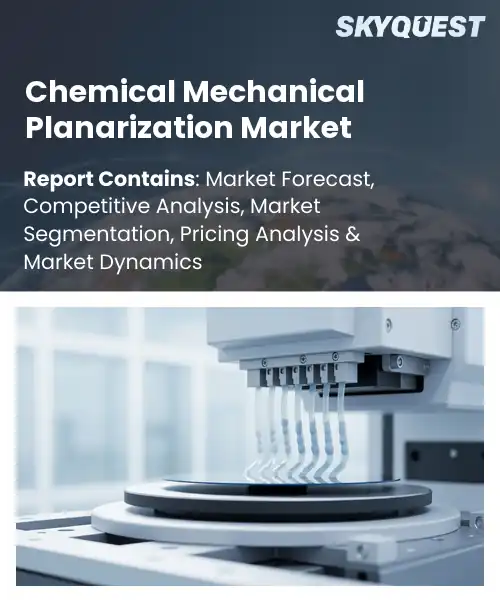
Chemical Mechanical Planarization Market
Report ID: SQMIG45N2223
Report ID: SQMIG45N2223
[email protected]
USA +1 351-333-4748
Report ID:
SQMIG45N2223 |
Region:
Global |
Published Date: June, 2026
Pages:
157
|Tables:
116
|Figures:
77


Global Chemical Mechanical Planarization Market size was valued at USD 6.1 Billion in 2024 and is poised to grow from USD 6.58 Billion in 2025 to USD 12.09 Billion by 2033, growing at a CAGR of 7.9% during the forecast period (2026-2033).
The chemical mechanical planarization market consists of the equipment, supplies and service used to flatten and smooth a semiconductor wafer’s surface so that there are no bumps or variations on the wafer prior to their assembly into a multi-layered connection. chemical mechanical planarization is driven primarily by the continuous need for smaller devices and the heterogeneous integration of chips, both of which place increased pressure on the need to have atomic-level flat surfaces in order to achieve the highest possible yield and performance. chemical mechanical planarization entered the market in the 1990s as a replacement for either chemical or mechanical polishing. Since that time, this segment of the semiconductor industry has matured through the development of new slurry chemistry, polishing pads, and endpoint detection. Foundries such as TSMC and Intel have scaled chemical mechanical planarization technology to support manufacturing below 10nm and have also expanded the use of chemical mechanical planarization into MEMS, LEDs, and HDD manufacturing, thus creating an escalating demand for investment into chemical mechanical planarization and the sourcing of consumables. In addition, demand for chemical mechanical planarization has been impacted by the availability of three-dimensional (3D) integrated circuit (IC) architectures and advanced packaging methods.
The use of die stacking and through-silicon vias creates additional planarity challenges, resulting in increased use of chemical mechanical planarization tools and ultimately the consumption of consumable materials. As manufacturers begin utilizing 3D NAND and die are manufactured as chiplets, process engineers are demanding more refined and tighter-tolerance slurry types and polishing pads, consequently increasing the total cost for R&D and consumables for high-performance chemical mechanical planarization processes. Real-world examples include TSMC’s use of customized chemical mechanical planarization recipes for fan-out wafer-level packaging and memory makers deploying additional polishing steps for vertical NAND, creating opportunities for equipment retrofits, novel abrasives and in-line metrology providers and services.
How is AI Improving Yield Optimization In The Chemical Mechanical Planarization Market?
AI enhances chemical-mechanical planarization (chemical mechanical planarization) yield optimization in chemical mechanical planarization by transforming extensive sensor data and historical records into effective control strategies. The major features of this technology are virtual metrology, predictive endpoint detection, anomaly detection, and closed-loop adjustments of the process parameters. In practice, machine learning predictive models are developed to forecast non-uniformity and direct the conditioning of pads as well as to direct the flow and pressure of slurries used for polishing. The result of this successful application is a significant reduction in defectivity associated with polishing.
The chemical mechanical planarization market has transitioned to manufacturing devices at advanced node dimensions and using stacked architectures, so by utilizing data-driven process control for manufacturing devices using chemical mechanical planarization, you can support manufacturing lithography and reliability downstream. An example of this type of technology would be the deployment of digital twins and sensor fusion to make the chemical mechanical planarization more repeatable and easier to scale. In March 2026, Applied Materials announced it had joined forces with another company to enhance the development of material simulations, as well as to apply AI to process control in order to improve chemical mechanical planarization yield optimization by increasing material discovery, implementing virtual metrology, and developing closed-loop adjustments to reduce variability and to improve throughput.
Market snapshot - (2026-2033)
Global Market Size
USD 6.1 Billion
Largest Segment
CMP Consumables
Fastest Growth
CMP Consumables
Growth Rate
7.9% CAGR
To get more insights on this market click here to Request a Free Sample Report
Global chemical mechanical planarization market is segmented by product portfolio segment, application form, end-use industry, distribution channel and region. Based on product portfolio segment, the market is segmented into CMP Equipment and CMP Consumables. Based on application form, the market is segmented into Integrated Circuits, Compound Semiconductors and MEMS & NEMS. Based on end-use industry, the market is segmented into IT & Telecommunications, Consumer Electronics, Automotive Electronics and Aerospace & Defense. Based on distribution channel, the market is segmented into Direct and Indirect. Based on region, the market is segmented into North America, Europe, Asia Pacific, Latin America and Middle East & Africa.
As per chemical mechanical planarization market analysis, the CMP Consumables category is the largest area, as consumables like slurries, polishing pads, and conditioning materials are essential for obtaining the necessary surface planarity and for defect control in CMP operations (chemical mechanical planarization). The material chemistries of these consumables and their construction are responsible for setting removal rates, defectivity profiles, and process windows, so fabs (semiconductor fabrication facilities) are placing a high priority on qualifying these consumables and co-developing them with suppliers, thus supporting an ongoing demand and influencing technology roadmaps throughout the CMP ecosystem.
As per chemical mechanical planarization market forecast, CMP Equipment is growing the fastest of the four categories. Accelerating adoption of advanced tool architectures, enhanced automation, and enhanced in-line metrology are all pushing the demand for tighter process control and higher throughput through CMP Equipment. The combination of investments in retrofits and next-generation single-wafer tools is resulting in shorter tool replacement cycles, expanding demand for equipment innovation that can create productivity improvements and deliver new process capabilities, therefore expanding market opportunities and differentiating suppliers.
The Integrated Circuits portion continues to be the major player due to the demands placed by the advanced logic and memory manufacturing markets for extreme levels of planarity, ultra-low defectivity and precise layer-to-layer thickness control that can be achieved through condition CMP processes. The combined complexity of the multilayer interconnections and the stringent yield targets for those interconnections leads to a constant refining of the slurry chemistries, pad designs and process recipes used to produce them which creates long-term supplier relationships and aligns R&D and capital allocations to the IC requirements as the primary driver of all markets.
As per chemical mechanical planarization market outlook, MEMS & NEMS has become the fastest growing application and the continuing trend towards miniaturization and the need for a greater variety of sensors has created new planarization challenges. The need to have a high-precision finish on the surface of the wafers, heterogeneous material stack compatibilities and wafer-level packaging (WLP) innovations will require CMP chemistries and tooling adaptations to be developed which provide new niche opportunities and create a motivation for CMP suppliers to invest in developing customized process solutions that will extend the use of CMP.
To get detailed segments analysis, Request a Free Sample Report
The Chemical Mechanical Planarization sector within the global market has largely been established through the concentration of semiconductor production in the Asia-Pacific region. When you take into account the density of the ecosystem comprised of suppliers, equipment manufacturers and research institutions involved in semiconductor production, it makes sense that this region is dominant in the chemical mechanical planarization sector. In addition, the demand from memory manufacturers and logic manufacturers creates large economies of scale and extensive local supply chains for slurries, pads and polishing equipment. In addition to the strong demand for these materials, the close cooperation and interaction between semiconductor fabrication (fabs) and materials scientists has led to accelerated process optimization and product qualification. Furthermore, the presence of governmental and regional industrial policies that support capabilities for advanced manufacturing, as well as the proximity of many large electronics original equipment manufacturers (OEMs) to Asia, has helped to provide rapid adoption of these technologies. Lastly, a strong existing service and maintenance infrastructure reduces downtime and enables high throughput operations while the established domestic capabilities in precision chemistry and polishing pad design set this region apart from others and are attractive to companies around the world.
Japan Chemical Mechanical Planarization Market is a fusion of skilled manufacturing and expertise in material sciences, as well as machinery design and development, and process engineering. In addition, Japan has several local suppliers that provide slurries and other consumables that have been developed specifically for the CMP industry. The close relationship between the research community and manufacturing companies allows them to accelerate the qualification process for CMP consumables. Demand for tailored service and rapid iteration is a result of the advanced packaging and mixed signal applications. Japan is also known for its strong service networks and its focus on quality - therefore, Japan is considered a leader in incremental innovation and reliability in CMP solutions.
In South Korea, the Chemical Mechanical Planarization Market is driven by demand from a combination of large memory and logic fabrication facilities, as well as strong collaboration between fabriicating and equipment manufacturing companies. In addition, process cycles and yield are major drivers for adopting advanced CMP consumables such as slurries, pads, and tools. South Korea has many local service support companies that provide both qualification and field service for CMP consumables. Research organizations in South Korea are focused on integrating new processes and innovation through materialsthat are required to support CMP processes. The responsive and innovative manufacturing culture and supply chain in South Korea will continue to support the leadership position of South Korea in the "planarization performance" area.
Rapid expansion of the Chemical Mechanical Planarization market in North America is driven by a combination of advanced logic and foundry activity, strong institutional research, and emphasis on yield improvement across high performance computing and emerging packaging formats. Domestic equipment manufacturers and specialty chemical suppliers work closely with integrated device manufacturers and fabless companies to tailor slurry chemistries and pad designs. Services for qualification, aftermarket support, and process optimization are widely available, reducing deployment risk. Policy focus on reshoring production coupled with collaborations between industry and academia strengthens supply chain resilience. Strong venture capital activity and collaborative pilot programs help translate laboratory advances into manufacturing ready processes for complex device architectures.
Chemical Mechanical Planarization Market in United States is anchored by research institutions, tool manufacturers, and an ecosystem of integrated device manufacturers and foundries. Demand for advanced logic and packaging drives planarization requirements and cooperation on slurry formulation and pad conditioning. Service networks enable qualification and field engineering support. Partnerships between industry and universities accelerate materials innovation, while proximity to major OEMs facilitates adoption of tailored planarization solutions across diverse semiconductor segments.
Chemical Mechanical Planarization Market in Canada emphasizes materials research, specialty chemicals, and metrology with close links to academic centers. Domestic firms focus on high purity slurries and niche consumables while service providers support qualification and process tuning for regional customers. Collaborative projects with industry partners translate laboratory innovations into manufacturable processes. Focus on quality and customized solutions positions Canada as a strategic provider of specialized planarization inputs and technical services capabilities.
Europe is strengthening its role in the Chemical Mechanical Planarization market through targeted industrial collaboration, advanced materials research, and growing emphasis on semiconductor manufacturing sovereignty. Manufacturers and research centers across the region are developing specialized slurries, pads, and metrology solutions tailored to automotive and industrial electronics needs. Investment in pilot fabs and demonstration projects supports local qualification and reduces dependence on external supply chains. Cross border partnerships and standardization efforts help harmonize process requirements and accelerate commercial adoption. Strengths in precision engineering, chemical production, and niche equipment manufacturing enable Europe to serve specialized segments and compete on quality, customization, and regulatory compliance rather than scale alone. Strong supply chain networks, skilled workforce, and emphasis on sustainable chemistry practices further reinforce Europe capability to deliver differentiated planarization offerings.
Chemical Mechanical Planarization Market in Germany leverages precision engineering expertise, automotive electronics demand, and advanced manufacturing services. Firms develop specialized pads, equipment components, and metrology solutions while chemical suppliers focus on quality consumables. Cooperation between manufacturers and research institutes supports qualification for demanding applications. Pilot lines and technical services enable tailored process integration. Emphasis on reliability, regulatory compliance, and industrial quality positions Germany as a European hub for robust planarization solutions.
Chemical Mechanical Planarization Market in United Kingdom benefits from university research, chemical engineering expertise, and a focus on advanced packaging. Academic collaborations drive materials innovation while specialist firms provide niche slurries, pads, and testing services. Consultancies support process qualification and integration for device developers. Cross sector partnerships translate laboratory advances into pilot manufacturing. Emphasis on flexible, customized solutions and metrology capabilities positions United Kingdom as a center for specialized planarization development.
Chemical Mechanical Planarization Market in France draws on materials science expertise, with suppliers developing high purity slurries and specialty consumables. Research institutes collaborate with industry to refine formulations and metrology for applications in automotive and industrial electronics. Equipment makers and service providers support qualification and process optimization. Regional partnerships facilitate technology transfer. Focus on regulatory compliance, sustainable chemical practices, and customization helps France serve niche planarization requirements with high quality standards.
To know more about the market opportunities by region and country, click here to
Buy The Complete Report
Increasing Adoption In Semiconductor Manufacturing
Demand For Advanced Polishing Slurries
High Cost Of CMP Equipment
Environmental Regulations on Wastewater
Request Free Customization of this report to help us to meet your business objectives.
Competitive pressure in the global CMP market centers on material innovation, pad engineering, and supply-chain consolidation, driven by fabs demanding higher selectivity for AI and power devices. Companies pursue M&A and strategic investments, for example Entegris buying Sinmat to secure SiC and GaN slurry IP, while startups and incumbents run pad and slurry co-development pilots and targeted partnerships to win foundry qualification.
SkyQuest’s ABIRAW (Advanced Business Intelligence, Research & Analysis Wing) is our Business Information Services team that Collects, Collates, Correlates, and Analyses the Data collected by means of Primary Exploratory Research backed by robust Secondary Desk research.
As per SkyQuest analysis, the global chemical mechanical planarization market is poised for steady growth driven primarily by relentless device scaling and heterogeneous integration, which raise planarity requirements and push tighter process controls. A second driver is the rapid adoption of advanced packaging and three dimensional architectures that increase tool utilization and consumable consumption. A restraint is the high capital cost of CMP equipment which can delay upgrades and limit adoption among smaller fabs. The dominating region is Asia Pacific given its dense semiconductor manufacturing ecosystem and supply chain. The dominating segment is CMP consumables led by slurries and polishing pads that sustain recurring revenue and supplier collaboration.
| Report Metric | Details |
|---|---|
| Market size value in 2024 | USD 6.1 Billion |
| Market size value in 2033 | USD 12.09 Billion |
| Growth Rate | 7.9% |
| Base year | 2024 |
| Forecast period | (2026-2033) |
| Forecast Unit (Value) | USD Billion |
| Segments covered |
|
| Regions covered | North America (US, Canada), Europe (Germany, France, United Kingdom, Italy, Spain, Rest of Europe), Asia Pacific (China, India, Japan, Rest of Asia-Pacific), Latin America (Brazil, Rest of Latin America), Middle East & Africa (South Africa, GCC Countries, Rest of MEA) |
| Companies covered |
|
| Customization scope | Free report customization with purchase. Customization includes:-
|
To get a free trial access to our platform which is a one stop solution for all your data requirements for quicker decision making. This platform allows you to compare markets, competitors who are prominent in the market, and mega trends that are influencing the dynamics in the market. Also, get access to detailed SkyQuest exclusive matrix.
Table Of Content
Executive Summary
Market overview
Parent Market Analysis
Market overview
Market size
KEY MARKET INSIGHTS
COVID IMPACT
MARKET DYNAMICS & OUTLOOK
Market Size by Region
KEY COMPANY PROFILES
Methodology
For the Chemical Mechanical Planarization Market, our research methodology involved a mixture of primary and secondary data sources. Key steps involved in the research process are listed below:
1. Information Procurement: This stage involved the procurement of Market data or related information via primary and secondary sources. The various secondary sources used included various company websites, annual reports, trade databases, and paid databases such as Hoover's, Bloomberg Business, Factiva, and Avention. Our team did 45 primary interactions Globally which included several stakeholders such as manufacturers, customers, key opinion leaders, etc. Overall, information procurement was one of the most extensive stages in our research process.
2. Information Analysis: This step involved triangulation of data through bottom-up and top-down approaches to estimate and validate the total size and future estimate of the Chemical Mechanical Planarization Market.
3. Report Formulation: The final step entailed the placement of data points in appropriate Market spaces in an attempt to deduce viable conclusions.
4. Validation & Publishing: Validation is the most important step in the process. Validation & re-validation via an intricately designed process helped us finalize data points to be used for final calculations. The final Market estimates and forecasts were then aligned and sent to our panel of industry experts for validation of data. Once the validation was done the report was sent to our Quality Assurance team to ensure adherence to style guides, consistency & design.
Analyst Support
Customization Options
With the given market data, our dedicated team of analysts can offer you the following customization options are available for the Chemical Mechanical Planarization Market:
Product Analysis: Product matrix, which offers a detailed comparison of the product portfolio of companies.
Regional Analysis: Further analysis of the Chemical Mechanical Planarization Market for additional countries.
Competitive Analysis: Detailed analysis and profiling of additional Market players & comparative analysis of competitive products.
Go to Market Strategy: Find the high-growth channels to invest your marketing efforts and increase your customer base.
Innovation Mapping: Identify racial solutions and innovation, connected to deep ecosystems of innovators, start-ups, academics, and strategic partners.
Category Intelligence: Customized intelligence that is relevant to their supply Markets will enable them to make smarter sourcing decisions and improve their category management.
Public Company Transcript Analysis: To improve the investment performance by generating new alpha and making better-informed decisions.
Social Media Listening: To analyze the conversations and trends happening not just around your brand, but around your industry as a whole, and use those insights to make better Marketing decisions.
REQUEST FOR SAMPLE
 REQUEST FREE CUSTOMIZATION
Global Chemical Mechanical Planarization Market size was valued at USD 6.1 Billion in 2024 and is poised to grow from USD 6.58 Billion in 2025 to USD 12.09 Billion by 2033, growing at a CAGR of 7.9% during the forecast period (2026-2033).
Competitive pressure in the global CMP market centers on material innovation, pad engineering, and supply-chain consolidation, driven by fabs demanding higher selectivity for AI and power devices. Companies pursue M&A and strategic investments, for example Entegris buying Sinmat to secure SiC and GaN slurry IP, while startups and incumbents run pad and slurry co-development pilots and targeted partnerships to win foundry qualification. 'Applied Materials', 'Lam Research', 'Entegris', 'Cabot Microelectronics', 'Fujimi Incorporated', 'Showa Denko', 'Merck KGaA', 'DuPont', '3M Company', 'Dow Inc', 'Asahi Glass', 'Sumitomo Chemical', 'Tokyo Seimitsu', 'Okamoto Machine Tool Works', 'Ebara Corporation', 'Reon Tech', 'Rohm and Haas', 'Hitachi Chemical', 'Fujifilm Holdings', 'Kanto Chemical'
Increasing integration of advanced wafer fabrication processes has elevated the need for precise surface planarization, which directly benefits demand for chemical mechanical planarization solutions. Manufacturers emphasize defect reduction, uniformity, and yield improvement, leading to greater reliance on CMP technologies and consumables. Adoption of smaller device geometries and complex layer stacks requires consistent planar surfaces that only specialized CMP equipment and slurries can provide, encouraging procurement of comprehensive polishing systems and services across fabrication facilities seeking process control and reliability.
Advanced Slurries Enhancing Selectivity: Tailored slurry chemistries and engineered abrasive particles are driving advancements in planarization performance by improving material selectivity and reducing defectivity across emerging materials. Suppliers are focusing on molecular additives and hybrid abrasives that interact predictably with novel metallization and dielectric stacks, enabling gentler removal of sensitive layers while maintaining throughput. This trend fosters tighter supplier and fab collaboration around formulation IP, drives differentiation through custom solutions, and supports more consistent process windows without aggressive mechanical conditions.
Why does Asia Pacific Dominate the Global Chemical Mechanical Planarization Market? |@12


Want to customize this report? This report can be personalized according to your needs. Our analysts and industry experts will work directly with you to understand your requirements and provide you with customized data in a short amount of time. We offer $1000 worth of FREE customization at the time of purchase.
Feedback From Our Clients


 USA (+1) 351-333-4748

