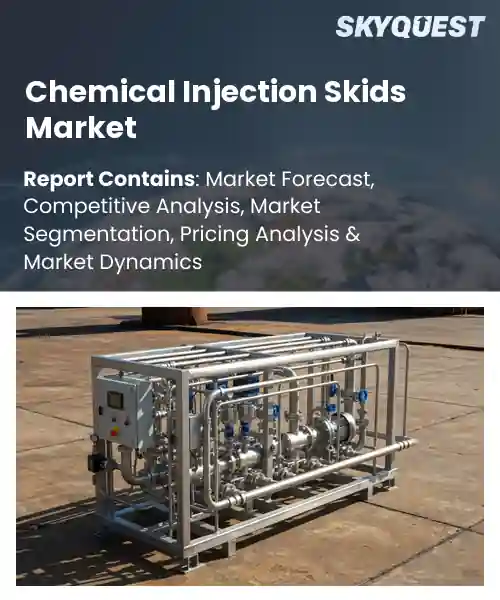
Chemical Injection Skids Market
Report ID: SQMIG20F2044
Report ID: SQMIG20F2044
[email protected]
USA +1 351-333-4748
Report ID:
SQMIG20F2044 |
Region:
Global |
Published Date: May, 2026
Pages:
157
|Tables:
182
|Figures:
79


Global Chemical Injection Skids Market size was valued at USD 3.9 Billion in 2024 and is poised to grow from USD 4.0 Billion in 2025 to USD 4.95 Billion by 2033, growing at a CAGR of 2.68% during the forecast period (2026-2033).
Rising demand for precise chemical dosing systems, increasing focus on operational efficiency and regulatory compliance, rising investments in water treatment and oil and gas infrastructure, expansion of industrial automation, and growing adoption of factory-assembled process systems are boosting sales of chemical injection skids.
Adoption of digital control systems, SCADA systems, and remote monitoring systems will be one of the most important reasons for the increased demand for chemical injection skids. In the industrial sector, particularly utility companies, there is a growing trend of use of closed-loop injection systems and sophisticated monitoring systems to reduce consumption of chemicals and avoid excessive dosages. Growth in the demand for automation kits, predictive maintenance offerings, and cloud-based analytics is expected to drive the adoption of chemical injection skids. Furthermore, increased adoption of pre-packaged metering systems for injecting anti-corrosive, pH balancing, anti-scaling, and other chemical treatments in various applications is creating a new business scope. High emphasis on accurate chemical dosing and increasing need to reduce operational risks and equipment damage around the world coupled with rising industrial automation are expected to primarily drive chemical injection skids market growth.
On the contrary, high installation and maintenance costs, fluctuations in raw material and component prices, complexity associated with integration into existing industrial systems, and cybersecurity concerns related to connected process control systems are anticipated to slow down chemical injection skids market penetration over the coming years.
How is IoT Enhancing Operational Efficiency of Chemical Injection Skids?
Through the IoT adoption, the chemical injection skids industry has seen an improvement in terms of operational efficiency through integration of the pumps, sensors, and valves into cloud-based and edge-based monitoring systems. In addition, the industrial sector is incorporating retrofit applications using IoT-based gateways and ready-to-use smart chemical injection skids. IoT has been useful in providing real-time tracking of the flow rate and pressure levels while at the same time sending out alerts on any conditions associated with equipment. This is because the technology can be integrated with SCADA and other industrial control systems to enable automatic adjustments on the dose levels of the chemicals used.
Market snapshot - (2026-2033)
Global Market Size
USD 3.9 Billion
Largest Segment
Pumping Systems
Fastest Growth
Instrumentation & Monitoring Systems
Growth Rate
2.68% CAGR
To get more insights on this market click here to Request a Free Sample Report
Global chemical injection skids market is segmented by component, type, operation mode, capacity, application, end user, and region. Based on component, the market is segmented into pumping systems, tanks & reservoirs, valves & control systems, instrumentation & monitoring systems, piping & fittings, control panels, and others. Based on type, the market is segmented into standard chemical injection skids and customized chemical injection skids. Based on operation mode, the market is segmented into manual, semi-automatic, and automatic. Based on capacity, the market is segmented into low capacity, medium capacity, and high capacity. Based on application, the market is segmented into oil & gas production, refineries & petrochemical plants, water & wastewater treatment, chemical processing, power generation, offshore platforms, marine applications, and others. Based on end user, the market is segmented into upstream oil & gas, midstream oil & gas, downstream oil & gas, industrial utilities, municipal utilities, and process industries. Based on region, the market is segmented into North America, Europe, Asia Pacific, Latin America, and Middle East & Africa.
The pumping systems segment is anticipated to lead the global chemical injection skids market revenue generation in the future. Pumping systems serve as the backbone behind accurate metering and dispensation. A solid choice of pumps can significantly minimize maintenance and chemical waste, allowing for more flexibility in terms of handling different viscosities and chemistries. Good coupling between control panels and tubing minimizes leaks, and performance consistency makes it easy to favor certain pump designs for continuous and batching dosing operations.
However, instrumentation & monitoring systems is the fastest growing segment as per this chemical injection skids industry analysis. Focus on regulations and demands from operators for remote monitoring are key factors contributing to the use of more sophisticated sensors and telemetry. The use of better analytics makes predictive maintenance and optimization possible. These developments lead to the creation of new market opportunities.
The automatic segment is forecasted to account for the highest global chemical injection skids market share going forward. It provides a reliable delivery of dosage through automation with minimum human error, making sure there is compliance in any process. With the use of automated skids, they can easily be integrated with the control system in a facility and even monitor from afar without much effort. Their reliability and easy long-term monitoring encourage operators to use automated systems.
On the other hand, semi-automatic is emerging as the most promising segment owing to the combination of manual and automatic control is ideal for people who are looking forward to upgrading their system in an economical way. Due to the modular approach to building such systems, it will also be easy to retrofit older models in the process.
To get detailed segments analysis, Request a Free Sample Report
Strong industrial demand, concentrated upstream and downstream energy projects, and a mature manufacturing ecosystem are helping this region hold sway over others. Regional operators prioritize reliability and compact system integration, which favors adoption of chemical injection skids. Dense supplier networks, extensive maintenance and service capabilities, and competitive engineering expertise enable rapid deployment and localization of designs. Supportive regulatory frameworks and investments in process modernization further encourage adoption. Proximity to major petrochemical and refining hubs reduces logistics complexity and accelerates aftermarket support. An emphasis on modularizing, integrating digital monitoring capabilities, and collaborating with suppliers will reinforce regional supremacy and facilitate cross-border supply of sophisticated skid systems. The availability of a highly skilled engineering labor pool and strong connections between manufacturers and end users lead to the refinement of skid systems and services.
Advanced engineering capabilities and a strong precision manufacturing base that supports high quality skid fabrication and integration shapes demand outlook in Japan. Reliability, life-cycle service agreements, and advancements in monitoring and control systems explain the need for advanced skid systems in oil refineries and chemical plants. Effective partnerships between equipment suppliers and major industrial end-users result in chemical injection skids that are designed to ensure optimum performance within confined spaces and with high safety levels.
Strong process engineering talent and close ties between manufacturers and heavy industry are helping shape sales of chemical injection skids in South Korea. An emphasis on fast service and customizability helps to strengthen supplier relations and drive improvements in design and support. Modular construction, export-oriented manufacturing, and interfacing with control and monitoring systems contribute to the wide acceptance of these skids in refinery and petrochemical settings across the country.
Retrofit and new build demands across energy and industrial sectors, a strong emphasis on operational safety, and broad adoption of digital monitoring and control capabilities influences chemical injection skids demand in the region. Operators prefer compact/complete engineered skid solutions that require less installation time, ease dosing accuracy, and minimize the amount of commercial skid procurement. Collaborative efforts of engineering firms and end users to develop and utilize application-specific solutions and standardizing their interface designs are helping to reduce procurement timelines; they are also improving aftermarket support for the operation and maintenance of chemical injection skids throughout various industrial facilities. Manufacturers in each region are placing a significant amount of focus on developing modular design features that will enable the easy transport/installation of chemical injection skids on job-site locations. Integration firms are providing lifecycle service agreements that place a strong emphasis on minimizing downtime and compliance with applicable laws/regulations. All these capabilities combined create a competitive marketplace that is primarily comprised of experienced suppliers that offer total turn-key delivery services and field-based support for chemical injection skids.
Diverse industrial base, extensive upstream activity, and an established engineering services sector ate helping boost adoption of novel chemical injection skids in the United States. Excellent local fabrication capacity and extensive after-sales networks ensure fast mobilization and excellent service support, promoting tight cooperation between users, engineers, and skid builders. Focus on retrofit capabilities, digitization, and performance throughout the lifecycle motivates suppliers to develop modular and maintainable systems.
Chemical injection skid demand in Canada is influenced by a mix of heavy industry and natural resource processing that values reliability, modularity, and serviceability. Lifecycle maintenance, rapid vendor response, and flexibility towards varying conditions all contribute towards increased demand for custom-designed skids and control systems. Local vendors and engineering companies design skids that adhere to regional regulations for safety and the environment yet allow for the skids to be installed at remote sites.
Advanced engineering capability, stringent regulatory frameworks, and a focus on sustainability and process efficiency help shape sales of chemical injection skids in Europe. Quality, precision fabrication and modular design and engineering as well as advanced control and monitoring systems are critical success factors in meeting ever-stringent safety and emissions standards. OEMs, system integrators, and service specialists working collaboratively can provide customized solutions for legacy plant upgrades and for new projects. Robust aftermarket support, certified quality initiatives and an ethos around continual improvement enables European manufacturers to effectively deliver on complex projects and provide high value lifecycle services, which positions Europe uniquely as a source for technically sophisticated skid solutions for domestic and international customers. Research investment and integration with digital technologies allow suppliers to provide condition-based maintenance and diagnostics and thus enhance attractiveness to operators focused on uptime and efficiency. Cross-border collaborations and standardization facilitate exportability of skid designs while allowing for the obligations of local compliance to be met.
Engineering expertise and a strong automation industry supporting complex skid integration and quality fabrication creates new business scope in Germany. Post-market services that highlight longevity and efficiency help establish reputation in both the local and global markets. Emphasis is placed on certifiable processes, material selection, and incorporation of control systems that will help comply with industrial regulations. Working together with system integrators and plant owners will bring forth customized solutions for chemical and refinery industries.
Strong offshore engineering tradition and a competitive fabrication sector that delivers modular, transportable skid systems is governing market growth in the United Kingdom. Reliable service infrastructure and qualified integration specialists provide the backing needed for both retrofits and installations in new construction projects. The focus is on safety, compliance, and integration with sophisticated control systems, which spurs design advancements towards more compact and remote monitoring technologies.
Strong chemical processing and manufacturing sector that demands tailored skid solutions with emphasis on safety and environmental compliance shapes chemical injection skids adoption in France. Working with EPC contractors and specialty suppliers allows for flexible designs to suit retrofit and greenfield installations supported by good service and maintenance practices. Local manufacturers and engineers concentrate on designs that have small footprints and are very energy-efficient and integrate easily into the process control system.
To know more about the market opportunities by region and country, click here to
Buy The Complete Report
Rising Industrial Water Treatment Demand
Increasing Adoption Of Modular Systems
High Capital Investment Requirements
Complex Regulatory Compliance Requirements
Request Free Customization of this report to help us to meet your business objectives.
Competitive landscape in the global chemical injection skids market is shaped by OEMs and service providers racing to deliver modular, IoT enabled skids and lifecycle services. Competition is driven by buyer demand for remote monitoring and lower operating expense. Real strategies include consolidation reported across dosing and pump vendors, product innovation such as SPX FLOW Novados pump developments, and digital pump controllers like SEKO Elektra driving differentiated service offerings.
SkyQuest’s ABIRAW (Advanced Business Intelligence, Research & Analysis Wing) is our Business Information Services team that Collects, Collates, Correlates, and Analyses the Data collected by means of Primary Exploratory Research backed by robust Secondary Desk research.
As per SkyQuest analysis, growing demand for precise chemical dosing systems and increasing focus on operational efficiency and regulatory compliance are anticipated to drive the demand for chemical injection skids going forward. However, high installation and maintenance costs and complexity associated with integration into existing industrial systems are slated to slow down the adoption of chemical injection skids in the future. North America is slated to spearhead the demand for chemical injection skids owing to the strong presence of oil and gas, water treatment, and industrial processing infrastructure. Development of IoT-enabled smart dosing systems and increasing integration of remote monitoring and SCADA-connected control technologies are anticipated to be key trends driving the chemical injection skids sector in the long run.
| Report Metric | Details |
|---|---|
| Market size value in 2024 | USD 3.9 Billion |
| Market size value in 2033 | USD 4.95 Billion |
| Growth Rate | 2.68% |
| Base year | 2024 |
| Forecast period | (2026-2033) |
| Forecast Unit (Value) | USD Billion |
| Segments covered |
|
| Regions covered | North America (US, Canada), Europe (Germany, France, United Kingdom, Italy, Spain, Rest of Europe), Asia Pacific (China, India, Japan, Rest of Asia-Pacific), Latin America (Brazil, Rest of Latin America), Middle East & Africa (South Africa, GCC Countries, Rest of MEA) |
| Companies covered |
|
| Customization scope | Free report customization with purchase. Customization includes:-
|
To get a free trial access to our platform which is a one stop solution for all your data requirements for quicker decision making. This platform allows you to compare markets, competitors who are prominent in the market, and mega trends that are influencing the dynamics in the market. Also, get access to detailed SkyQuest exclusive matrix.
Table Of Content
Executive Summary
Market overview
Parent Market Analysis
Market overview
Market size
KEY MARKET INSIGHTS
COVID IMPACT
MARKET DYNAMICS & OUTLOOK
Market Size by Region
KEY COMPANY PROFILES
Methodology
For the Chemical Injection Skids Market, our research methodology involved a mixture of primary and secondary data sources. Key steps involved in the research process are listed below:
1. Information Procurement: This stage involved the procurement of Market data or related information via primary and secondary sources. The various secondary sources used included various company websites, annual reports, trade databases, and paid databases such as Hoover's, Bloomberg Business, Factiva, and Avention. Our team did 45 primary interactions Globally which included several stakeholders such as manufacturers, customers, key opinion leaders, etc. Overall, information procurement was one of the most extensive stages in our research process.
2. Information Analysis: This step involved triangulation of data through bottom-up and top-down approaches to estimate and validate the total size and future estimate of the Chemical Injection Skids Market.
3. Report Formulation: The final step entailed the placement of data points in appropriate Market spaces in an attempt to deduce viable conclusions.
4. Validation & Publishing: Validation is the most important step in the process. Validation & re-validation via an intricately designed process helped us finalize data points to be used for final calculations. The final Market estimates and forecasts were then aligned and sent to our panel of industry experts for validation of data. Once the validation was done the report was sent to our Quality Assurance team to ensure adherence to style guides, consistency & design.
Analyst Support
Customization Options
With the given market data, our dedicated team of analysts can offer you the following customization options are available for the Chemical Injection Skids Market:
Product Analysis: Product matrix, which offers a detailed comparison of the product portfolio of companies.
Regional Analysis: Further analysis of the Chemical Injection Skids Market for additional countries.
Competitive Analysis: Detailed analysis and profiling of additional Market players & comparative analysis of competitive products.
Go to Market Strategy: Find the high-growth channels to invest your marketing efforts and increase your customer base.
Innovation Mapping: Identify racial solutions and innovation, connected to deep ecosystems of innovators, start-ups, academics, and strategic partners.
Category Intelligence: Customized intelligence that is relevant to their supply Markets will enable them to make smarter sourcing decisions and improve their category management.
Public Company Transcript Analysis: To improve the investment performance by generating new alpha and making better-informed decisions.
Social Media Listening: To analyze the conversations and trends happening not just around your brand, but around your industry as a whole, and use those insights to make better Marketing decisions.
REQUEST FOR SAMPLE
 REQUEST FREE CUSTOMIZATION
Global Chemical Injection Skids Market size was valued at USD 3.9 Billion in 2024 and is poised to grow from USD 4.0 Billion in 2025 to USD 4.95 Billion by 2033, growing at a CAGR of 2.68% during the forecast period (2026-2033).
Competitive landscape in the global chemical injection skids market is shaped by OEMs and service providers racing to deliver modular, IoT enabled skids and lifecycle services. Competition is driven by buyer demand for remote monitoring and lower operating expense. Real strategies include consolidation reported across dosing and pump vendors, product innovation such as SPX FLOW Novados pump developments, and digital pump controllers like SEKO Elektra driving differentiated service offerings. 'LEWA GmbH', 'Milton Roy Company', 'SPX FLOW, Inc.', 'Petronash', 'AES Arabia Ltd.', 'INTECH Process Automation', 'Integrated Flow Solutions LLC', 'Proserv UK Ltd', 'SEKO S.p.A.', 'IDEX Corporation', 'Petroserve International', 'Carotek, Inc.', 'Haskel International LLC', 'Petrak Industries, Inc.', 'Dencil Fluidtek Systems Pvt. Ltd.', 'Euro Mechanical', 'TechnipFMC plc', 'SLB', 'Amarinth Limited', 'Watson-Marlow Fluid Technology Solutions'
Growing requirements for precise chemical dosing in industrial water treatment and process conditioning drive demand for compact, preconfigured injection skid solutions that simplify installation and operation. Operators value modular packages that integrate pumps, metering systems, and controls to reduce onsite engineering effort and minimize the risk of human error during chemical handling. This preference encourages suppliers to offer customizable skids that accelerate commissioning, enhance process reliability, and support regulatory compliance, thereby making packaged injection solutions a favored option when facilities prioritize operational efficiency and consistent treatment performance.
Digitalization And Remote Monitoring: Adoption of advanced sensing, connectivity, and analytics is reshaping chemical injection skid operation by enabling continuous remote monitoring, data driven optimization, and condition based maintenance strategies. Manufacturers and operators prioritize seamless integration with plant control systems and cloud platforms to enhance uptime, reduce manual interventions, and accelerate response to process deviations. Emphasis on scalable software architectures and user centric interfaces supports deployment across sites while increasing focus on data governance and secure communications to protect operational integrity and intellectual property.
Why does Asia Pacific Dominate the Global Chemical Injection Skids Market? |@12


Want to customize this report? This report can be personalized according to your needs. Our analysts and industry experts will work directly with you to understand your requirements and provide you with customized data in a short amount of time. We offer $1000 worth of FREE customization at the time of purchase.
Feedback From Our Clients


 USA (+1) 351-333-4748

