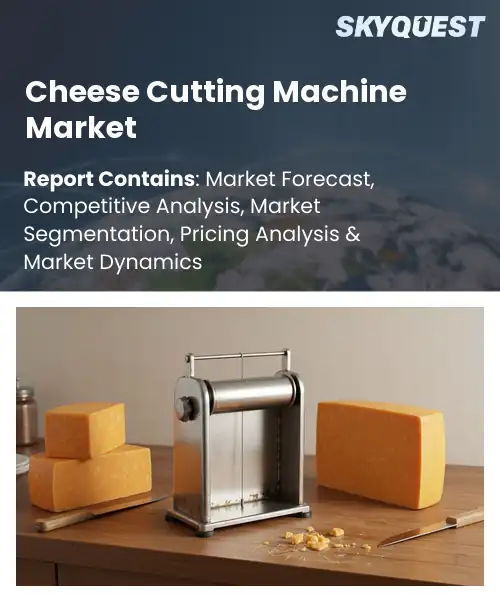
Cheese Cutting Machine Market
Report ID: SQMIG20I2623
Report ID: SQMIG20I2623
[email protected]
USA +1 351-333-4748
Report ID:
SQMIG20I2623 |
Region:
Global |
Published Date: February, 2026
Pages:
157
|Tables:
145
|Figures:
78


Global Cheese Cutting Machine Market size was valued at USD 8.5 Billion in 2024 and is poised to grow from USD 8.96 Billion in 2025 to USD 13.65 Billion by 2033, growing at a CAGR of 5.4% during the forecast period (2026-2033).
The rise in demand for automation in dairy processing, increase in need for maintaining product quality, expansion of the retail and foodservice sectors, imposition of stringent food safety regulations, and growing focus on operational efficiency are considered the key factors augmenting the sales rate of cheese cutting machines.
Increased production levels and stricter sanitation requirements have hastened the transition from manual knives and simple wire cutters to automated slicers and modern servo-driven inline systems. Large dairy operations have begun to integrate cutting and packaging lines to boost processing capacity. The regulations regarding food safety have created the demand for more efficient equipment, and the industry is now encouraged to invest in more advanced machines with servo motors, vision systems, and clean-in-place designs constructed from stainless steel. The adoption of advanced technologies helps to minimize downtime, the risk of contamination, and assists retailers in expanding their pre-packaged product lines, thereby increasing the demand for cheese cutting machines.
However, increase in rate of capital investment, maintenance issues, variability in prices of raw material, and high costs of regulatory compliance related to changing food safety regulations may create challenges for the cheese cutting machine market manufacturers in the long run.
How is AI Enhancing Precision and Yield of Cheese Cutting Machines?
AI is improving precision and yield in cheese cutting machines by combining vision systems, sensors, and intelligent control into one streamlined process. It enables adaptive slice planning, real-time weight feedback, and predictive blade maintenance. Robot-guided ultrasonic cutting and weighing systems are some of the technologies that aid in reducing product giveaway and protecting product appearance. AI technology is capable of adjusting cutting paths to accommodate irregular shapes and softer cheese textures, while checkweighers work to continuously monitor portions and make automatic adjustments to ensure consistency in weight.
Market snapshot - 2026-2033
Global Market Size
USD 8.5 Billion
Largest Segment
Automatic
Fastest Growth
Automatic
Growth Rate
5.4% CAGR
To get more insights on this market click here to Request a Free Sample Report
Global cheese cutting machine market is segmented by type, material, cutting speed, cutting style, application and region. Based on type, the market is segmented into automatic, semi-automatic, and manual. Based on material, the market is segmented into stainless steel, aluminum, and cast iron. Based on cutting speed, the market is segmented into low speed, medium speed, and high speed. Based on cutting style, the market is segmented into block cutting, slicing, dicing, and shredding. Based on application, the market is segmented into industrial, commercial, and household. Based on region, the market is segmented into North America, Europe, Asia Pacific, Latin America, and Middle East & Africa.
The automatic segment is slated to spearhead the global cheese cutting machine market revenue generation in the long run. Major dairy product manufacturers and industrial food producers favor fully automatic machines, as they provide consistent portion control and better compliance with hygiene standards. The labor-saving and high return on investment characteristics of automatic machines make it the most prominent segment in developed dairy markets.
On the other hand, the demand for semi-automatic segment is slated to expand at a rapid pace as per this cheese cutting machine industry analysis. Lower upfront investment compared to fully automatic systems, along with easier installation and maintenance, supports rapid adoption.
The stainless steel segment is forecasted to account for the largest global cheese cutting machine market share going forward. Dairy processors prefer stainless steel equipment because it is easy to clean, durable under frequent washdowns, and resistant to contamination. Its strength and long service life make it ideal for high-capacity, continuous production environments.
Meanwhile, the aluminum segment is slated to exihibit robust increase in demand in the future. Small and mid-sized processors focus on using aluminum parts in semi-automatic and compact machines where mobility and flexibility are of prime importance. It is relatively cheaper than stainless steel and thus preferred by developing markets and cost-effective operations.
To get detailed segments analysis, Request a Free Sample Report
The presence of a robust dairy industry, increasing cheese manufacturing, and presence of specialized equipment suppliers are helping Europe lead the global cheese cutting machine demand outlook. The fact that a large variety of cheese is being produced in various nations such as France, Italy, Denmark, and the United Kingdom is also contributing to the region’s dominance. End users value machines that can be easily integrated into complex processing and packaging lines, thereby creating a demand for modular and serviceable machines. Geographical proximity between the manufacturers and the large dairy companies enables fast customization and excellent after-sales service. Standardized food safety requirements and involvement of trade bodies also help to maintain high standards for machine performance.
Presence of a robust industrialized dairy sector that emphasizes precision engineering and automation is allowing Germany to emerge as a top market for cheese cutting machine suppliers. Technical expertise in metalworking and control systems supports reliable, hygienic designs suited to high throughput facilities. cheese cutting machines that can be easily integrated with other cheese manufacturing equipment are expected to be highly popular among German end users in the long run.
Demand for cheese cutting machines in the country is slated to be driven by artisanal producers and processors seeking flexible hygienic solutions for varied product profiles. Suppliers focus on delivering compact and easy to sanitize machines with simple controls suited to production environments. cheese cutting machine companies are also focusing on offering customization and automation services to stand out in the United Kingdom.
Tradition of diverse cheese production in France is slated to boost the demand for cheese cutting machines that are capable of handling soft as well as firm forms of cheeses. Preference for cheese cutting machines offering gentle handling, sanitary construction, and portioning options that preserve texture and appearance is high among French cheese companies. Culinary and export-oriented markets promote the use of reliable and easy-to-clean cutters that can be integrated into different production and packaging systems.
High consumer demand for convenience and portioned products coupled with modernization of dairy processing facilities is boosting the demand for cheese cutting machines in North America. The popularity of automated cutters that integrate with upstream and downstream equipment is high in this region. Supplier emphasis on user friendly controls, strong local service networks, and customization for specific cheese formats lowers barriers to implementation. Training, after-sales service, and alignment with food safety requirements also enhance market adoption and make North America an exciting growth market for advanced cutting technology.
The availability of large processors and a focus on automation to improve flow and reduce manual labor is driving the procurement of cheese cutting machines in the United States. The availability of strong aftermarket support and engineering expertise is making it easier to implement and customize cheese cutting machines for different types of cheese. The cheese cutting machine suppliers are focusing on integration with packaging lines, controls, and monitoring to maximize their sales potential in the coming years.
Demand for cheese cutting machines in Canada is driven by artisan cheesemakers and regional processors who require flexible sanitary equipment. Cheese cutting machines that are easy to clean and maintainare likely to be in high demand in this country. Emphasis on flexible machines that integrate with packaging equipment helps producers maintain product quality, improve portioning consistency, and respond to retail and food service needs.
The growing domestic dairy sector, focus on cheese processing facility modernization, and access to low-cost labor resources make the Asia Pacific region an attractive market for cheese cutting machine suppliers. The domestic suppliers are also focusing on integrating advanced technologies and engineering to make the machines compatible with the domestic cheese types. Improving the service infrastructure and learning from the global suppliers’ expertise will make the adoption process smoother. The focus on cost-effective automation, adaptability to different product sizes, and innovation in control and hygiene design will also open up new business opportunities.
Strong demands for precision, compactness, and strict hygiene requirements are influencing the purchase of cheese cutting machines in the Japanese market. Local suppliers stress careful engineering and gentle handling to avoid damage to soft cheeses, with strong integration with packaging lines. Strong aftersales service and reliability encourage processors to adopt cutters aligned with exacting culinary and industrial needs in the country going forward.
Increasing presence of modern dairy plants with small footprints are driving the demand for compact, high precision cheese cutting machines in South Korea. Local cheese cutting machine manufacturers are using their knowledge in electronics and control to differentiate themselves from the competition. Partnership with food processors ensures that the machines produced meet the required texture and presentation standards for both local and export markets. Good service networks are also helping processors to adopt efficient portioning and packaging systems while maintaining high levels of hygiene.
To know more about the market opportunities by region and country, click here to
Buy The Complete Report
The cheese cutting machine manufacturers are trying to make use of the digitization trend by automating their products. Automation ensures uniform slice thickness, and the process also increases efficiency. The companies that aim to enhance cleanliness and minimize dependence on labor use cheese cutting machines that are integrated into the processing lines. This helps in scalable production and flexible product sizes. Additionally, the minimized handling of products and waste associated with automation also drives the cheese cutting machine market outlook.
Heightened regulatory emphasis on food safety compels cheese processors to upgrade equipment to systems that facilitate sanitary operations and compliance. Cheese cutting machines offering easy cleaning, minimal product contact, and consistent cuts are gaining popularity among cheese processors as they help boost compliance and productivity. As regulatory scrutiny influences procurement decisions, equipment suppliers that demonstrate hygienic design and compliance support are slated to bolster the cheese cutting machine market outlook in the long run.
One of the challenges that can be considered significant is the high capital cost involved in the purchase, installation, and maintenance of such automated cheese cutting machines. This may have an impact on the development of small and medium-sized dairy processing companies, as the high capital costs may deter such firms from investing in such technology.
The wide variations of texture, density, and format of cheese methods, such as cutting machines, make standardization difficult. Very little of the machines can be standardized and most of them to properly cut can mean requiring a lot of modification, still more specialized to specific types of cheese while balancing resources and usage at the same time. The boom of automated cheese cutting will drive innovation, however even cutting systems that cost one-three times manual will limit the even eventuality of the opportunity to small producers and the setbacks that some achieve with state innovation.
Request Free Customization of this report to help us to meet your business objectives.
Competitive landscape in the global cheese cutting machine market is defined by consolidation and technology-led differentiation, with incumbents pursuing acquisitions to add robotic and vision capabilities and suppliers forming partnerships to embed ultrasonic cutting and inline weighing. Strategic acquisitions focused on automation and vision-guided robotic portioning is also a key area of interest for companies as per this cheese cutting machine market analysis.
In October 2025, Marel hosted a Demo+ Cheese webinar showcasing integrated cutting, slicing and portioning solutions from Marel and TREIF, emphasizing improved hygiene design, modular line integration and remote demonstration capabilities to help processors evaluate equipment performance and accelerate deployment of advanced cheese cutting and portioning configurations.
In May 2025, GEA unveiled the OptiSlicer 7000 and OptiScanner 5000, promoting a combined pre-scan and slicing approach that improves portion consistency, reduces product giveaway and enables easier integration into automated packaging lines while stressing IoT readiness and sustainability measures to support efficient, low waste cheese slicing operations across large scale processing environments.
In December 2025, Fortifi Food Processing Solutions has completed its acquisition of Provisur Technologies, a major provider of further-processing equipment for the global protein sector. The acquisition adds Provisur’s portfolio of grinding, forming, slicing and tumbling technologies to Fortifi’s existing footprint in primary processing, robotics and production software.
Automation and Hygiene Focus: One of the most notable global cheese cutting machine trends is the increased utilization of automation, artificial intelligence, and Internet of Things technologies for cheese cutting machines. Contemporary models are capable of self-calibrating machines and optimizing slicing parameters. Contemporary cheese cutting machines now provide predictive maintenance through cloud-connected models. The cheese cutting machine market trend pushes momentum toward innovative systems which is expected to create new business scope through 2033.
Customization and Flexible Production: Rising demand for cheese variety is driving development of customizable cutting systems that accommodate different cheese shapes, textures, and portioning schemes. Manufacturers are offering modular tooling, programmable recipe libraries, and rapid changeover features to address the changing demands of cheese processors. Emphasis on intuitive interfaces and on-premise adaptability further highlights the indispensable nature of this cheese cutting machine industry trend going forward.
SkyQuest’s ABIRAW (Advanced Business Intelligence, Research & Analysis Wing) is our Business Information Services team that Collects, Collates, Correlates, and Analyses the Data collected by means ofPrimary Exploratory Research backed by robust Secondary Desk research.
As per SkyQuest analysis, rising automation in dairy processing and increasing emphasis on product consistency and food safety compliance are anticipated to drive the demand for cheese cutting machines going forward. However, high initial capital investment and maintenance complexities are slated to slow down the adoption of cheese cutting machines in the future. North America is slated to spearhead the demand for cheese cutting machines owing to the strong presence of large-scale dairy processors and advanced food processing infrastructure. Integration of AI-enabled vision systems and development of modular, IoT-connected cutting solutions are anticipated to be key trends driving the cheese cutting machine industry in the future.
| Report Metric | Details |
|---|---|
| Market size value in 2024 | USD 8.5 Billion |
| Market size value in 2033 | USD 13.65 Billion |
| Growth Rate | 5.4% |
| Base year | 2024 |
| Forecast period | 2026-2033 |
| Forecast Unit (Value) | USD Billion |
| Segments covered |
|
| Regions covered | North America (US, Canada), Europe (Germany, France, United Kingdom, Italy, Spain, Rest of Europe), Asia Pacific (China, India, Japan, Rest of Asia-Pacific), Latin America (Brazil, Rest of Latin America), Middle East & Africa (South Africa, GCC Countries, Rest of MEA) |
| Companies covered |
|
| Customization scope | Free report customization with purchase. Customization includes:-
|
To get a free trial access to our platform which is a one stop solution for all your data requirements for quicker decision making. This platform allows you to compare markets, competitors who are prominent in the market, and mega trends that are influencing the dynamics in the market. Also, get access to detailed SkyQuest exclusive matrix.
Table Of Content
Executive Summary
Market overview
Parent Market Analysis
Market overview
Market size
KEY MARKET INSIGHTS
COVID IMPACT
MARKET DYNAMICS & OUTLOOK
Market Size by Region
KEY COMPANY PROFILES
Methodology
For the Cheese Cutting Machine Market, our research methodology involved a mixture of primary and secondary data sources. Key steps involved in the research process are listed below:
1. Information Procurement: This stage involved the procurement of Market data or related information via primary and secondary sources. The various secondary sources used included various company websites, annual reports, trade databases, and paid databases such as Hoover's, Bloomberg Business, Factiva, and Avention. Our team did 45 primary interactions Globally which included several stakeholders such as manufacturers, customers, key opinion leaders, etc. Overall, information procurement was one of the most extensive stages in our research process.
2. Information Analysis: This step involved triangulation of data through bottom-up and top-down approaches to estimate and validate the total size and future estimate of the Cheese Cutting Machine Market.
3. Report Formulation: The final step entailed the placement of data points in appropriate Market spaces in an attempt to deduce viable conclusions.
4. Validation & Publishing: Validation is the most important step in the process. Validation & re-validation via an intricately designed process helped us finalize data points to be used for final calculations. The final Market estimates and forecasts were then aligned and sent to our panel of industry experts for validation of data. Once the validation was done the report was sent to our Quality Assurance team to ensure adherence to style guides, consistency & design.
Analyst Support
Customization Options
With the given market data, our dedicated team of analysts can offer you the following customization options are available for the Cheese Cutting Machine Market:
Product Analysis: Product matrix, which offers a detailed comparison of the product portfolio of companies.
Regional Analysis: Further analysis of the Cheese Cutting Machine Market for additional countries.
Competitive Analysis: Detailed analysis and profiling of additional Market players & comparative analysis of competitive products.
Go to Market Strategy: Find the high-growth channels to invest your marketing efforts and increase your customer base.
Innovation Mapping: Identify racial solutions and innovation, connected to deep ecosystems of innovators, start-ups, academics, and strategic partners.
Category Intelligence: Customized intelligence that is relevant to their supply Markets will enable them to make smarter sourcing decisions and improve their category management.
Public Company Transcript Analysis: To improve the investment performance by generating new alpha and making better-informed decisions.
Social Media Listening: To analyze the conversations and trends happening not just around your brand, but around your industry as a whole, and use those insights to make better Marketing decisions.
REQUEST FOR SAMPLE
 REQUEST FREE CUSTOMIZATION
Global Cheese Cutting Machine Market size was valued at USD 8.5 Billion in 2024 and is poised to grow from USD 8.96 Billion in 2025 to USD 13.65 Billion by 2033, growing at a CAGR of 5.4% during the forecast period (2026-2033).
Competitive landscape in the global cheese cutting machine market is defined by consolidation and technology-led differentiation, with incumbents pursuing acquisitions to add robotic and vision capabilities and suppliers forming partnerships to embed ultrasonic cutting and inline weighing. Recent examples include strategic acquisitions in related automation sectors and deployments of vision-guided robotic portioning and ultrasonic blades to reduce give-away and improve yield. 'Bizerba', 'Hobart', 'Berkel', 'Vollrath', 'Sammic', 'FAM', 'Marel', 'GEA Group', 'Multivac', 'Dito Sama', 'RISCO GmbH', 'Food Tools', 'Provisur Technologies', 'Thurne-Middleby', 'Gemak Engineering Solutions', 'Industries Castellvall', 'Marchant Schmidt', 'iXAPACK', 'Textor Maschinenbau GmbH', 'Selo'
The growing preference for automated cheese cutting systems among manufacturers increases demand because automation delivers consistent slice dimensions, reduces manual variability, and enhances throughput while maintaining product quality. Manufacturers seeking to improve hygiene and reduce labor dependencies adopt machines that integrate smoothly into processing lines, enabling scalable production and flexible product formats. Automation also minimizes product handling and waste, supports diverse packaging requirements, and allows producers to allocate human resources to higher value tasks, collectively driving investment in cutting machinery across production segments.
The presence of a robust dairy industry, increasing cheese manufacturing, and presence of specialized equipment suppliers are helping Europe lead the global cheese cutting machine demand outlook. The fact that a large variety of cheese is being produced in various nations such as France, Italy, Denmark, and the United Kingdom is also contributing to the region’s dominance.


Want to customize this report? This report can be personalized according to your needs. Our analysts and industry experts will work directly with you to understand your requirements and provide you with customized data in a short amount of time. We offer $1000 worth of FREE customization at the time of purchase.
Feedback From Our Clients


 USA (+1) 351-333-4748

