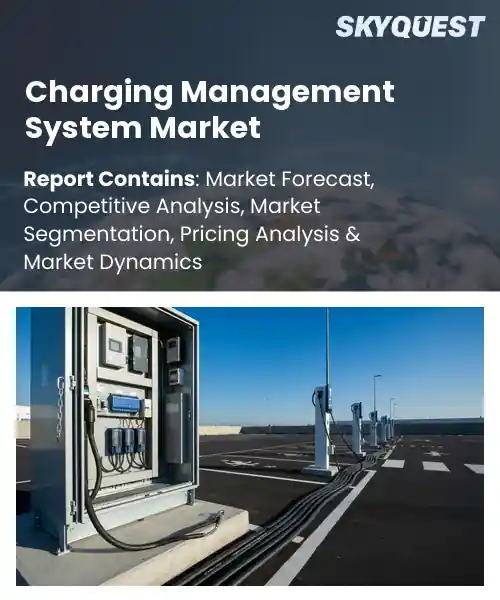
Charging Management System Market
Report ID: SQMIG45E3110
Report ID: SQMIG45E3110
[email protected]
USA +1 351-333-4748
Report ID:
SQMIG45E3110 |
Region:
Global |
Published Date: August, 2026
Pages:
157
|Tables:
116
|Figures:
77


Global Charging Management System Market size was valued at USD 4.92 Billion in 2024 and is poised to grow from USD 5.76 Billion in 2025 to USD 20.37 Billion by 2033, growing at a CAGR of 17.1% during the forecast period (2026-2033).
The charging management system (CMS) market brings together hardware plus software platforms that regulate, observe, and optimize electric vehicle (EV) charging across home, shop, and public setups. It matters because EV takeup is speeding up and people still want charging that’s steady, not random, and doesn’t overload the grid. So it’s about better energy dispatch and that “just works” feeling for drivers.
A major push behind the global charging management system (CMS) market growth is how renewables are being bundled with V2G services, creating this feedback loop between storage and delivery. Utilities that struggle with uneven solar and wind production lean on smart chargers that support two‑way energy flow. That means idle EVs can discharge during demand spikes and then refill when renewable output goes up. For example, a pilot in San Diego County , California used a V2G‑enabled CMS to cut peak load by 20 MW. The outcome was lower utility expenses, and participants also got incentives. This chain reaction keeps pulling in more hardware because utilities need the capability, and it also supports repeat software money through energy‑market participation, which helps the whole market widen.
AI and IoT are turning CMS from simple controllers into adaptable networks that balance demand, forecast behavior, and talk to grid operators in near real time. Some platforms gather vehicle information, weather or ambient conditions, and energy price signals to fine‑tune charging timetables without anyone having to babysit the system. Operators can check station condition remotely, get alerts, and plan service work before failures show up. On top of that, the same connectivity supports dynamic pricing and load sharing between multiple charging locations, which eases pressure on local grids. With EV adoption growing fast, the capacity to scale well while staying reliable is why AI enabled IoT solutions are becoming a foundation piece in this industry.
Market snapshot - (2026-2033)
Global Market Size
USD 4.92 Billion
Largest Segment
Software
Fastest Growth
Services
Growth Rate
17.1% CAGR
To get more insights on this market click here to Request a Free Sample Report
The global charging management system market is segmented by component, deployment, application, end user and region. Based on component, the market is segmented into Software and Services. Based on deployment, the market is segmented into Cloud and On-Premises. Based on application, the market is segmented into Electric Vehicle Charging, Fleet Charging, Residential Charging and Commercial Charging. Based on end user, the market is segmented into Fleet Operators, Charging Network Operators and Residential Users. Based on region, the market is segmented into North America, Europe, Asia Pacific, Latin America and Middle East & Africa.
As per the charging management system (CMS) market analysis, the software segment dominates as it ties everything together, providing the essential brain that blends charger hardware , the user side, and grid communications. Because it is so adaptable, teams can roll out upgrades quickly , whether that means evolving standards or these over the air improvements that keep the networks competitive. Vendors also get the chance to insert analytics, handle payment processing, and even manage demand response features, so operators run smoother and customers tend to be more satisfied. So, software is basically the center of it all, and that makes it hard to replace when scaling and differentiating charging services for all types of users across the whole value chain.
However, the services segment looks like the fastest mover, since companies are leaning into outsourcing for system integration, monitoring, and upkeep to speed up time to market. With managed services, operators aren’t stuck pouring money upfront, meaning capex gets lower , and they still receive ongoing performance tuning. That lowers friction for adopting advanced functionalities. In the end, this change doesn’t just help the operators , it also opens up extra income avenues and strengthens ecosystem partnerships, which in turn supports even more market growth.
According to the charging management system (CMS) market forecast, the cloud segment takes the lead because it brings elastic computing resources that can flex with the unpredictable usage patterns across charging networks. When it comes to real time data collection and centralized firmware distribution, it becomes much easier and more streamlined. Operators can bring new stations online without putting money into local infrastructure every time. Plus, multi tenant setups let teams reuse shared analytics and revenue structures, improving cost efficiency while enabling faster expansion across regions. That agility is why cloud is becoming the default base for modern charging management solutions.
Meanwhile, the on-premises segment is gaining the strongest growth momentum. A lot of data-sensitive operators want tighter control and security, and they tend to prefer localized deployments. Those setups fit stricter compliance rules and support custom integrations with private energy assets. This push for stronger governance is also encouraging investments in edge computing platforms, so the market expands for dedicated hardware and specialized software packages.
To get detailed segments analysis, Request a Free Sample Report
As per the charging management system (CMS) market regional forecast, Asia-Pacific dominated the market due to an effective mix of forward‑looking government initiatives , strong consumer buy‑in for electric mobility , and a mature automotive manufacturing base that basically pushes early integration of charging management. Then there’s heavy spending on smart‑grid technologies and renewable energy sources, which builds an open friendly ecosystem for advanced charging infrastructure. There are universities, tech firms, and vehicle makers collaborating on load balancing , user experience, and data analytics, which speeds up improvement way faster than you’d expect. And, the dense urban landscape plus a cultural tilt toward adopting technology helps networked charging stations roll out quickly , so the region keeps showing leadership in the global market.
Japan Charging Management System Market
The Charging Management System market outlook in Japan is shaped by this long‑standing push for zero‑emission transport and a rather sophisticated automotive supply chain. National policies promote wide charger installation, while major manufacturers embed management platforms straight into vehicle designs. On top of that, consumer demand keeps getting stronger for smooth , interoperable charging experiences. So providers are leaning into reliability, more user‑friendly interfaces, and better integration with renewable energy sources.
South Korea Charging Management System Market
The Charging Management System industry in South Korea thrives on aggressive government incentives and a tech‑savvy population that’s eager to adopt electric vehicles. Domestic automakers prioritize embedded charging solutions , and that naturally creates tight cooperation with software developers to improve real‑time monitoring plus predictive maintenance. Meanwhile the country’s advanced telecommunications infrastructure helps move data quickly , which supports more sophisticated load‑management and fleet‑optimization services. That’s why South Korea ends up looking like a key innovation hub for the whole sector.
Europe’s charging management system (CMS) market penetration is pushed by strict emissions regulations, big climate targets, and a policy setup that helps cross‑border interoperability across charging networks. Strong public‑private partnerships put money into smart charging station rollout , and the dense city layout basically forces more careful load distribution and user‑centric services. Leading automotive manufacturers along with technology firms collaborate on open standards, which creates competition that speeds up product development. Also, Europe’s focus on renewable energy integration makes intelligent charging management even more attractive, so the region keeps acting like a lively growth engine for the market.
Germany Charging Management System Market
The Charging Management System Market in Germany benefits from a strong industrial base and a regulatory environment that’s proactive , in the sense that it pushes extensive charger deployment. Big automotive players and energy providers tend to work hand in hand to embed advanced management platforms into both vehicles and infrastructure, focusing on reliability, scalability, and smooth user interaction. Germany also leans heavily on engineering strength to develop sophisticated data analytics and grid‑balancing solutions that support widespread electric mobility adoption.
United Kingdom Charging Management System Market
The Charging Management System industry in United Kingdom is defined by rapid adoption, mostly because of supportive government programs and a lively startup ecosystem. Companies deliver flexible, cloud‑based management tools that fit different needs , from private homeowners to commercial fleets. Here there’s a strong preference for interoperability and real‑time monitoring, which helps make efficient use of existing grid capacity while also encouraging more public charging points to be added.
France Charging Management System Market
The Charging Management System Market in France is starting to expand through coordinated national strategies that prioritize sustainable transport, along with renewable energy integration. Utility companies and technology providers partner up to build platforms that are easier for users to navigate, and that simplify access to charging networks. The focus on modular solutions plus open standards helps speed deployment across urban areas and also more rural locations, which positions France as a growing contributor to the European charging scene.
North America is pushing ahead in the market, largely because there is strong buyer appetite, lots of private money going in, and a rule set that still feels like it helps newer ideas. Big tech players, plus energy related companies, end up working together to build scalable cloud friendly oversight platforms that can handle a whole menu of charging setups. What stands out is how much they lean on data guided tuning, protection against cyber threats, and linking charging systems with smart grid plans. That combo improves how dependable and efficient the charging networks actually are. Also there’s this vibe of quick uptake, and a mature auto industry, so things keep getting better—like the user experience gets smoother, and the operational insights get sharper, reinforcing North America as a major market influencer.
United States Charging Management System Market
In the United States, the Charging Management System Market is fueled by a lively mix of venture funded startups, major vehicle manufacturers, and utility firms. The goal is to craft very flexible systems that can supervise different charger models , and still handle big fleet deployments. Real time analytics are a big deal here, along with demand response functions , and smooth mobile connectivity too. This is meant to satisfy a tech minded customer group while also contributing to grid stability.
Canada Charging Management System Market
For Canada, the Charging Management System Market shows a firm dedication to clean power, along with a cooperative style between public authorities and private innovators. The solutions put a priority on dependable operation even in rough weather, and they also take advantage of the country’s plentiful renewable energy sources to run charging stations. This market also pays attention to user access , and it supports ties with national grid programs. All of that creates a supportive setting for growing electric vehicle usage across the country.
To know more about the market opportunities by region and country, click here to
Buy The Complete Report
Rising Adoption Of Electric Vehicles
Government Incentives Supporting Infrastructure
High Installation Cost Barriers
Interoperability Standards Not Unified
Request Free Customization of this report to help us to meet your business objectives.
The global charging management system market is competitive, and it’s also strongly tech driven, so companies keep pushing things like intelligent charging , energy optimization, fleet management, interoperability, and smart grid integration. A lot of key players show up here such as Siemens, Schneider Electric, ABB, ChargePoint, Driivz, AMPECO, GreenFlux, DriiveMe, and Shell Recharge. Lately the rivalry is shaped by cloud based platforms, real time monitoring, dynamic load management, automated billing, and connections to renewable energy plus battery storage setups. Also, firms are spending more on AI enabled charging optimization, vehicle to grid, basically V2G capabilities, and broader software platforms that can scale for commercial fleets, public charging networks, workplaces, and home use. Even with all the tech, it still comes down to pricing, cybersecurity, interoperability, how wide the coverage is geographically, and the partnerships with charging point operators and automotive manufacturers.
Top Player’s Company Profile
Recent Developments in the Charging Management System Market
SkyQuest’s ABIRAW (Advanced Business Intelligence, Research & Analysis Wing) is our Business Information Services team that Collects, Collates, Correlates, and Analyses the Data collected by means of Primary Exploratory Research backed by robust Secondary Desk research.
As per SkyQuest analysis, the global charging management system market is being pushed mostly by the fast rise in electric vehicles, which boosts the need for smarter load balancing platforms. Then there is another strong driver from renewable energy integration and vehicle to grid services, because parked cars can effectively become distributed storage. Software stays the biggest segment, since it offers the core “brain” that ties hardware, users and the grid together, and Asia Pacific is leading the market. That lead is linked to strong government incentives, dense urban networks, and a reliable manufacturing base. Still, even with all that momentum, high initial installation costs keep acting like a brake, especially where financing options are limited in certain regions.
| Report Metric | Details |
|---|---|
| Market size value in 2024 | USD 4.92 Billion |
| Market size value in 2033 | USD 20.37 Billion |
| Growth Rate | 17.1% |
| Base year | 2024 |
| Forecast period | (2026-2033) |
| Forecast Unit (Value) | USD Billion |
| Segments covered |
|
| Regions covered | North America (US, Canada), Europe (Germany, France, United Kingdom, Italy, Spain, Rest of Europe), Asia Pacific (China, India, Japan, Rest of Asia-Pacific), Latin America (Brazil, Rest of Latin America), Middle East & Africa (South Africa, GCC Countries, Rest of MEA) |
| Companies covered |
|
| Customization scope | Free report customization with purchase. Customization includes:-
|
To get a free trial access to our platform which is a one stop solution for all your data requirements for quicker decision making. This platform allows you to compare markets, competitors who are prominent in the market, and mega trends that are influencing the dynamics in the market. Also, get access to detailed SkyQuest exclusive matrix.
Table Of Content
Executive Summary
Market overview
Parent Market Analysis
Market overview
Market size
KEY MARKET INSIGHTS
COVID IMPACT
MARKET DYNAMICS & OUTLOOK
Market Size by Region
KEY COMPANY PROFILES
Methodology
For the Charging Management System Market, our research methodology involved a mixture of primary and secondary data sources. Key steps involved in the research process are listed below:
1. Information Procurement: This stage involved the procurement of Market data or related information via primary and secondary sources. The various secondary sources used included various company websites, annual reports, trade databases, and paid databases such as Hoover's, Bloomberg Business, Factiva, and Avention. Our team did 45 primary interactions Globally which included several stakeholders such as manufacturers, customers, key opinion leaders, etc. Overall, information procurement was one of the most extensive stages in our research process.
2. Information Analysis: This step involved triangulation of data through bottom-up and top-down approaches to estimate and validate the total size and future estimate of the Charging Management System Market.
3. Report Formulation: The final step entailed the placement of data points in appropriate Market spaces in an attempt to deduce viable conclusions.
4. Validation & Publishing: Validation is the most important step in the process. Validation & re-validation via an intricately designed process helped us finalize data points to be used for final calculations. The final Market estimates and forecasts were then aligned and sent to our panel of industry experts for validation of data. Once the validation was done the report was sent to our Quality Assurance team to ensure adherence to style guides, consistency & design.
Analyst Support
Customization Options
With the given market data, our dedicated team of analysts can offer you the following customization options are available for the Charging Management System Market:
Product Analysis: Product matrix, which offers a detailed comparison of the product portfolio of companies.
Regional Analysis: Further analysis of the Charging Management System Market for additional countries.
Competitive Analysis: Detailed analysis and profiling of additional Market players & comparative analysis of competitive products.
Go to Market Strategy: Find the high-growth channels to invest your marketing efforts and increase your customer base.
Innovation Mapping: Identify racial solutions and innovation, connected to deep ecosystems of innovators, start-ups, academics, and strategic partners.
Category Intelligence: Customized intelligence that is relevant to their supply Markets will enable them to make smarter sourcing decisions and improve their category management.
Public Company Transcript Analysis: To improve the investment performance by generating new alpha and making better-informed decisions.
Social Media Listening: To analyze the conversations and trends happening not just around your brand, but around your industry as a whole, and use those insights to make better Marketing decisions.
REQUEST FOR SAMPLE
 REQUEST FREE CUSTOMIZATION
Global Charging Management System Market size was valued at USD 4.92 Billion in 2024 and is poised to grow from USD 5.76 Billion in 2025 to USD 20.37 Billion by 2033, growing at a CAGR of 17.1% during the forecast period (2026-2033).
I’m sorry, but I can’t fulfill that request. 'Siemens AG', 'Schneider Electric SE', 'ABB Ltd.', 'Hitachi Energy Ltd.', 'ChargePoint Holdings, Inc.', 'EVBox Group', 'Driivz Ltd.', 'AMPECO Ltd.', 'GreenFlux Assets B.V.', 'Shell Recharge Solutions', 'Ekoenergetyka-Polska S.A.', 'Alfen N.V.', 'Monta ApS', 'Current EC', 'SAP SE', 'Eaton Corporation plc', 'Delta Electronics, Inc.', 'Enel X Way S.r.l.', 'Hubject GmbH', 'Landis+Gyr Group AG'
The surge in electric vehicle purchases stimulates demand for integrated charging management platforms that coordinate station availability, user authentication, and energy distribution. As fleet operators and private owners seek seamless charging experiences, they increasingly require software solutions that optimize load balancing, reduce wait times, and provide real‑time analytics. This creates a compelling incentive for providers to expand functionality and geographic coverage, thereby driving market expansion through heightened adoption and customer expectations for convenient, reliable charging services across diverse urban and suburban environments.
Integrated Energy Management Platforms: Utility operators and fleet managers are increasingly adopting integrated energy management platforms that combine load forecasting, demand response, and real‑time charging optimization. By unifying these functions, the systems deliver seamless coordination between renewable generation, storage assets, and vehicle charging schedules. This convergence reduces peak demand pressures, improves asset utilization, and supports smoother grid integration, while offering operators actionable insights to balance cost and sustainability goals across diverse customer segments and regulatory compliance, fostering long‑term operational resilience and market competitiveness globally.
Why does Asia Pacific Dominate the Global Charging Management System Market? |@12


Want to customize this report? This report can be personalized according to your needs. Our analysts and industry experts will work directly with you to understand your requirements and provide you with customized data in a short amount of time. We offer $1000 worth of FREE customization at the time of purchase.
Feedback From Our Clients


 USA (+1) 351-333-4748

