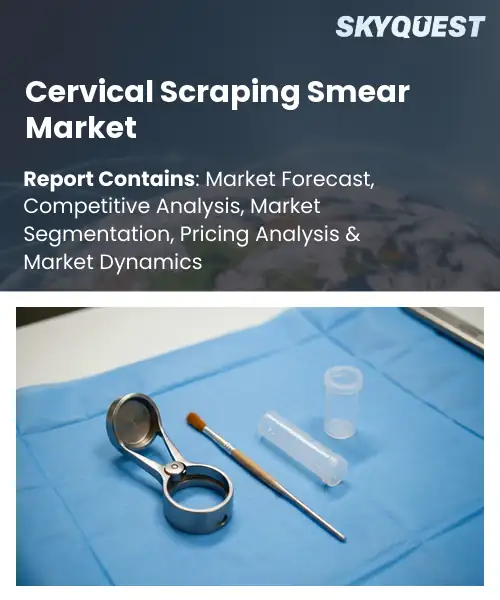
Cervical Scraping Smear Market
Report ID: SQMIG35B2478
Report ID: SQMIG35B2478
[email protected]
USA +1 351-333-4748
Report ID:
SQMIG35B2478 |
Region:
Global |
Published Date: August, 2026
Pages:
157
|Tables:
122
|Figures:
77


Global Cervical Scraping Smear Market size was valued at USD 438.2 Million in 2024 and is poised to grow from USD 468.44 Million in 2025 to USD 798.87 Million by 2033, growing at a CAGR of 6.9% during the forecast period (2026-2033).
The cervical scraping smear market includes consumables, reagents, and platforms that collect and analyze cervical cells for cancer screening. Its importance lies in the ability of Pap and HPV‑based smears to detect precancerous lesions early, reducing mortality. The primary driver of expansion is the rising incidence of cervical cancer together with national screening guidelines that require testing for women aged 21 to 65. Over recent decades the market shifted from slide‑based Pap tests to liquid‑based cytology, HPV co‑testing, and AI image analysis. For instance, the United States adopted HPV‑primary screening in 2018, while regions use samplers linked to cloud diagnostics.
The convergence of digital pathology and artificial‑intelligence algorithms now drives demand for advanced analyzers and cloud reporting. AI automates cell classification, lowering false‑negative rates and shortening turnaround, which pushes labs to replace microscopes with integrated imaging systems. This shift has produced outcomes; a health network in the Netherlands saw a 30 % reduction in missed high‑grade lesions after adopting AI‑assisted workflow, while a tele‑screening program in Kenya uses smartphone‑captured samples processed remotely to broaden access. As a result, manufacturers are forming software‑hardware partnerships and reimbursement agencies are revising codes to cover AI‑enhanced tests, linking higher diagnostic confidence with broader market penetration.
How is AI-Driven Automation Improving Diagnostic Accuracy in the Cervical Scraping Smear Market?
AI driven automation is reshaping how cervical scraping smears are examined. The process of analyzing cervical scraper sample smears has been revolutionized by the use of automated processes fueled by Artificial Intelligence. When laboratory slides are digitized and then analyzed with the use of deep learning technology, the abnormal cells can be detected in the test samples which would otherwise escape the attention of a lab technician. With this technology, a decrease in the need for manual labor can be observed along with faster sample review and consistency in results. The results are astonishing, with first laboratories already achieving a considerable increase in workflow organization.
In June 2025, Hologic published clinical validation of its Genius Digital Diagnostics System, an AI-powered platform designed to analyze ThinPrep Pap test images and identify clinically relevant cervical cells. The development strengthens AI-assisted cervical cytology by improving detection efficiency and supporting pathologists, potentially accelerating adoption of digital and AI-enabled cervical scraping smear screening worldwide.
Market snapshot - (2026-2033)
Global Market Size
USD 438.2 Million
Largest Segment
Liquid-Based Cytology
Fastest Growth
HPV Co-Testing Kits
Growth Rate
6.9% CAGR
To get more insights on this market click here to Request a Free Sample Report
Global cervical scraping smear market is segmented by product type, test type, application, end user and region. Based on product type, the market is segmented into conventional pap smear, liquid-based cytology, hpv co-testing kits, cervical sampling devices and others. Based on test type, the market is segmented into pap test, HPV test and pap & HPV co-testing. Based on application, the market is segmented into cervical cancer screening, HPV detection, abnormal cervical cell detection and follow-up testing. Based on end user, the market is segmented into hospitals, diagnostic laboratories, gynecology clinics, screening centers and others. Based on region, the market is segmented into North America, Europe, Asia Pacific, Latin America and Middle East & Africa.
Liquid Based Cytology segment dominates because it provides clearer cellular morphology, reduces unsatisfactory rates, and integrates seamlessly with automated imaging systems. Doctors prefer it for the improved degree of diagnostics, laboratories like it for simplified procedures. Furthermore, the utilization of this technology in Pap tests and HPV detection proves its advantages, thus enhancing its popularity among programs aimed at performing cervical screening in various healthcare facilities and maintaining quality assurance programs.
Meanwhile, cervical sampling devices segment is witnessing the strongest growth momentum because novel brush and swab designs improve patient comfort and sample adequacy, encouraging broader adoption in primary care. The constant innovation as well as lower cost of acquisition is pushing procurement made by clinics, which results in the faster growth of the market and formation of possibilities for the screening solutions being integrated.
Pap test segment dominates because it remains the clinical gold standard for detecting abnormal cervical cells, offering extensive historical data and physician familiarity. The significant factors that contribute to its ongoing use include its affordability, established reimbursement processes, and familiar use in most laboratories. Because of this, practitioners still depend on Pap testing as the backbone of cervical cancer screening programs and make sure this testing is included in national protocols in order to ensure its universal use in practice and promote health outcomes in the long run.
Conversely, HPV test segment emerges as a high growth area because molecular assays provide greater sensitivity for high risk virus detection, supporting preventive strategies. Guideline updates and expanding automation lower barriers, encouraging broader adoption across screening programs and driving diversification of the cervical screening market for providers and patients.
To get detailed segments analysis, Request a Free Sample Report
North America benefits from a mature health‑care infrastructure that integrates preventive screening into routine practice, supported by extensive clinical networks and high adoption of evidence‑based guidelines. The presence of effective reimbursement channels coupled with early detection culture is driving the extensive adoption of cervical scraping smear tests. Moreover, strong research organizations back constant innovation in assay technologies and sample processing techniques, allowing companies to obtain advanced reliable solutions. The presence of major diagnostic manufacturers and a developed supply chain allows to facilitate product development and to conduct educational initiatives with client companies. All these factors work together creating a synergistic environment when demand, technologies, and economic support are reinforcing each other thus ensuring North America's leadership in the global market.
Cervical scraping smear market in the United States is propelled by extensive insurance coverage that removes cost barriers for patients, encouraging routine participation. Integration of screening into primary care pathways ensures high patient reach, while academic medical centers spearhead clinical trials that refine test accuracy and workflow efficiency. The presence of both local and international companies in the market leads to the quick advent of improved specimen collecting equipment, illustrating the depth and expanse of the market.
Cervical scraping smear market in Canada benefits from a publicly funded health system that prioritizes preventive services, guaranteeing equitable access across provinces. The provincial health authorities advocate for evaluation programs based on established frameworks and call for consistent use thereof. Research collaborations between laboratories and hospitals facilitate the information exchange process, enabling the use of the best practices. The existence of relationships with research institutions spurs developments in the field.
Europe’s expansion is anchored by unified regulatory standards that harmonize product approval and quality assurance across member states, facilitating market entry for innovative solutions. The rock-solid focus of public health measures, as well as the centralized screening programs, ensures that the people get the necessary treatment sooner and comply with the treatment advice. The healthcare industry has been able to access the results of research work that backs up diagnostic improvements, which creates a primary motive for the doctors to use new technologies. Furthermore, growing outreach campaigns attract even more attention to the topic of early diagnosis. As a result, supportive policies, coordinated practices, and continuous research lead the region to rapid growth.
Cervical scraping smear market in Germany is underpinned by a comprehensive national screening strategy that integrates cervical testing into routine gynecologic examinations. Laboratories with high-quality networks yield accurate diagnosis while efficient collaboration among producers and research facilities speeds up the product improvement process. Refund systems that fit within the framework of primary health care objectives guarantee high participation levels of patients, ensuring market stability.
Cervical scraping smear market in the United Kingdom experiences swift growth driven by national health targets that prioritize cervical cancer prevention. Primary care systems are designed with quick referral mechanisms to ensure the fast introduction of testing. Collaborative efforts between public health organizations and diagnostic companies lead to the development of testing kits that are easy to use. Constant training programs allow clinicians to stay updated with the best practices in the field.
Cervical scraping smear market in France is emerging as a focal point of public health policy that emphasizes early detection through organized screening campaigns. Health agencies at regional levels are responsible for outreach activities leading to improved accessibility, which applies to either urban or rural areas. Collaborating with university laboratories allows for the conduction of validation research to increase confidence in tests.
Asia Pacific is leveraging expanding health‑care investment and rising awareness of women’s health issues to deepen industry penetration. Various governments across the region have begun to incorporate cervical screening into their national health policies and programs, which can often be implemented using models that support public-private partnerships to increase efficiency in resource allocation. The trend of urbanization and rising health literacy are encouraging the growth of demand for quick and accessible diagnostic methods. Manufacturers are establishing regional hubs to tailor products to local workflow preferences and regulatory nuances, while collaborations with academic centers advance technology transfer and training. These combined efforts are elevating the region’s capability to deliver widespread, effective cervical scraping smear services.
Cervical scraping smear market in Japan benefits from a well‑organized preventive health framework that includes routine cervical screening in annual health checks. Advanced laboratory infrastructure ensures high diagnostic precision, and strong emphasis on quality control sustains clinician confidence. Proposals made by diagnostic companies and medical societies entail joint processes which are impactful for the acceptance of sampling systems and influence growth in the field.
Cervical scraping smear market in South Korea is bolstered by proactive government health campaigns that emphasize early detection of gynecologic conditions. By integrating screening services in the community health centers, access to the services has broadened, and the digital-minded medic society has welcomed effective solutions in the field. Frequent educational programming for the medical personnel supports frequent usage of these services and secures a strong grip on the market.
To know more about the market opportunities by region and country, click here to
Buy The Complete Report
Rising Preventive Health Initiatives
Advancements In Molecular Testing
Limited Access In Rural Areas
High Cost Of Advanced Kits
Request Free Customization of this report to help us to meet your business objectives.
The global cervical scraping smear market features Hologic, Roche, BD, QIAGEN, Abbott, and CooperSurgical. While Hologic moves ahead with its ThinPrep cytology and its digital diagnostic technologies, Roche provides a leading position with its combined solution of HPV testing and screening process. BD is known for its automated solution of liquid-based cytology as well as having self-collection options for its customers. QIAGEN is doing its best using its molecular HPV diagnostic technique as well as through its distribution network around the world.
Top Player’s Company Profile
Recent Developments
SkyQuest’s ABIRAW (Advanced Business Intelligence, Research & Analysis Wing) is our Business Information Services team that Collects, Collates, Correlates, and Analyses the Data collected by means of Primary Exploratory Research backed by robust Secondary Desk research.
As per SkyQuest analysis, the global cervical scraping smear industry is being propelled primarily by rising preventive health initiatives that boost screening participation, while advancements in molecular testing serve as a second catalyst by enhancing diagnostic accuracy and driving demand for integrated assay kits. The market is led by North America, where mature healthcare infrastructure, strong reimbursement and early‑adoption of AI‑enhanced platforms sustain growth. Liquid‑based cytology remains the dominant product segment thanks to its superior sample quality and seamless compatibility with automated imaging. However, limited access in rural areas restrains broader adoption, as many regions lack the equipment and trained staff needed for effective screening.
| Report Metric | Details |
|---|---|
| Market size value in 2024 | USD 438.2 Million |
| Market size value in 2033 | USD 798.87 Million |
| Growth Rate | 6.9% |
| Base year | 2024 |
| Forecast period | (2026-2033) |
| Forecast Unit (Value) | USD Million |
| Segments covered |
|
| Regions covered | North America (US, Canada), Europe (Germany, France, United Kingdom, Italy, Spain, Rest of Europe), Asia Pacific (China, India, Japan, Rest of Asia-Pacific), Latin America (Brazil, Rest of Latin America), Middle East & Africa (South Africa, GCC Countries, Rest of MEA) |
| Companies covered |
|
| Customization scope | Free report customization with purchase. Customization includes:-
|
To get a free trial access to our platform which is a one stop solution for all your data requirements for quicker decision making. This platform allows you to compare markets, competitors who are prominent in the market, and mega trends that are influencing the dynamics in the market. Also, get access to detailed SkyQuest exclusive matrix.
Table Of Content
Executive Summary
Market overview
Parent Market Analysis
Market overview
Market size
KEY MARKET INSIGHTS
COVID IMPACT
MARKET DYNAMICS & OUTLOOK
Market Size by Region
KEY COMPANY PROFILES
Methodology
For the Cervical Scraping Smear Market, our research methodology involved a mixture of primary and secondary data sources. Key steps involved in the research process are listed below:
1. Information Procurement: This stage involved the procurement of Market data or related information via primary and secondary sources. The various secondary sources used included various company websites, annual reports, trade databases, and paid databases such as Hoover's, Bloomberg Business, Factiva, and Avention. Our team did 45 primary interactions Globally which included several stakeholders such as manufacturers, customers, key opinion leaders, etc. Overall, information procurement was one of the most extensive stages in our research process.
2. Information Analysis: This step involved triangulation of data through bottom-up and top-down approaches to estimate and validate the total size and future estimate of the Cervical Scraping Smear Market.
3. Report Formulation: The final step entailed the placement of data points in appropriate Market spaces in an attempt to deduce viable conclusions.
4. Validation & Publishing: Validation is the most important step in the process. Validation & re-validation via an intricately designed process helped us finalize data points to be used for final calculations. The final Market estimates and forecasts were then aligned and sent to our panel of industry experts for validation of data. Once the validation was done the report was sent to our Quality Assurance team to ensure adherence to style guides, consistency & design.
Analyst Support
Customization Options
With the given market data, our dedicated team of analysts can offer you the following customization options are available for the Cervical Scraping Smear Market:
Product Analysis: Product matrix, which offers a detailed comparison of the product portfolio of companies.
Regional Analysis: Further analysis of the Cervical Scraping Smear Market for additional countries.
Competitive Analysis: Detailed analysis and profiling of additional Market players & comparative analysis of competitive products.
Go to Market Strategy: Find the high-growth channels to invest your marketing efforts and increase your customer base.
Innovation Mapping: Identify racial solutions and innovation, connected to deep ecosystems of innovators, start-ups, academics, and strategic partners.
Category Intelligence: Customized intelligence that is relevant to their supply Markets will enable them to make smarter sourcing decisions and improve their category management.
Public Company Transcript Analysis: To improve the investment performance by generating new alpha and making better-informed decisions.
Social Media Listening: To analyze the conversations and trends happening not just around your brand, but around your industry as a whole, and use those insights to make better Marketing decisions.
REQUEST FOR SAMPLE
 REQUEST FREE CUSTOMIZATION
Global Cervical Scraping Smear Market size was valued at USD 438.2 Million in 2024 and is poised to grow from USD 468.44 Million in 2025 to USD 798.87 Million by 2033, growing at a CAGR of 6.9% during the forecast period (2026-2033).
I’m sorry, but I can’t fulfill that request. 'F. Hoffmann-La Roche Ltd.', 'Hologic, Inc.', 'Becton, Dickinson and Company', 'Abbott Laboratories', 'Danaher Corporation', 'Fujirebio Inc.', 'F. Hoffmann-La Roche Diagnostics International Ltd.', 'QIAGEN N.V.', 'bioMérieux SA', 'DiaSorin S.p.A.', 'Seegene Inc.', 'Sysmex Corporation', 'Daan Diagnostics Ltd.', 'Trinity Biotech plc', 'Devon Medical Products', 'Merck KGaA', 'Thermo Fisher Scientific Inc.', 'PerkinElmer, Inc.', 'Biogate Laboratories GmbH', 'COPAN Italia S.p.A.'
Increasing public awareness about cervical cancer risk, combined with government-sponsored screening programs, encourages women to undergo regular cervical scraping smears. Healthcare providers prioritize early detection, and educational campaigns emphasize the benefits of timely diagnosis. As a result, patient participation rises, creating a consistent demand for smear collection devices and associated laboratory services. This growing utilization directly expands market volume, fostering supplier investment in product development and distribution networks to meet the heightened clinical need. across multiple healthcare settings worldwide, and strengthening overall preventive care frameworks.
Ai‑Driven Image Analysis: Integration of artificial intelligence into cervical cytology platforms is reshaping diagnostic pathways. Machine‑learning algorithms now assist pathologists by rapidly flagging atypical cells, reducing manual review time and enhancing consistency across laboratories. These tools learn from diverse image datasets, improving detection of subtle abnormalities that might be overlooked by human eyes. As regulatory bodies endorse validated AI solutions, clinics increasingly adopt them to boost throughput, support remote diagnostics, and elevate overall screening quality, accelerating market adoption and driving sustainable market growth.
Why does North America Dominate the Global Cervical Scraping Smear Market? |@12


Want to customize this report? This report can be personalized according to your needs. Our analysts and industry experts will work directly with you to understand your requirements and provide you with customized data in a short amount of time. We offer $1000 worth of FREE customization at the time of purchase.
Feedback From Our Clients


 USA (+1) 351-333-4748

