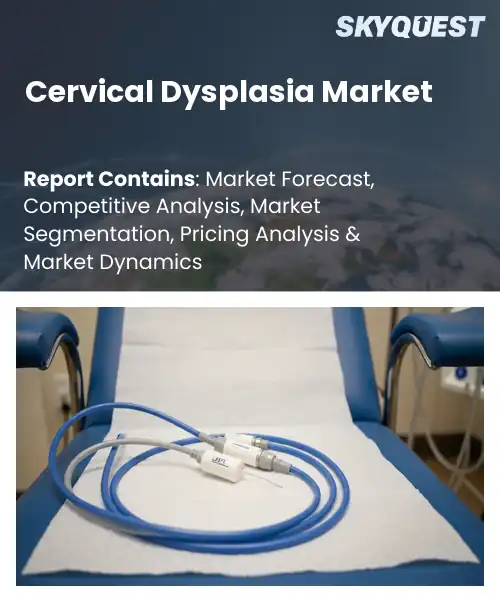
Cervical Dysplasia Market
Report ID: SQMIG35I2841
Report ID: SQMIG35I2841
[email protected]
USA +1 351-333-4748
Report ID:
SQMIG35I2841 |
Region:
Global |
Published Date: June, 2026
Pages:
157
|Tables:
89
|Figures:
76


Global Cervical Dysplasia Market size was valued at USD 810.0 Million in 2024 and is poised to grow from USD 867.51 Million in 2025 to USD 1501.72 Million by 2033, growing at a CAGR of 7.1% during the forecast period (2026-2033).
The global cervical dysplasia market comprises diagnostics, therapeutic devices, and pharmaceuticals aimed at detecting and treating precancerous cervical lesions. Its significance stems from the disease’s potential to progress to invasive cervical cancer, a leading cause of mortality among women in low‑and middle‑income regions. Over the past decade, widespread adoption of high‑risk human papillomavirus (hrHPV) testing and liquid‑based cytology has expanded screening programs, driving demand for more accurate, cost‑effective solutions. For instance, the introduction of polymerase chain reaction‑based HPV assays in Europe reduced false‑negative rates, prompting manufacturers to invest heavily in assay refinement and distribution across global healthcare networks worldwide continues.Key growth in the cervical dysplasia market is driven by the integration of pathology and artificial intelligence (AI) into screening workflows, which accelerates lesion classification and personalizes treatment pathways. When AI algorithms identify high‑grade lesions more reliably, clinicians can intervene earlier, reducing progression rates and expanding the market for targeted therapies such as immune checkpoint inhibitors. Deployments in Australia and Canada have demonstrated a 20 % increase in detection accuracy and a corresponding rise in reimbursement for adjunctive testing. Consequently, manufacturers that partner with software firms gain competitive advantage, while health systems benefit from cost savings and improved overall patient outcomes significantly.
How is AI-driven diagnostic automation influencing the global cervical dysplasia screening market?
AI-driven diagnostic automation is reshaping cervical dysplasia screening by enabling rapid, high‑precision analysis of cytology slides and HPV test results. Machine‑learning algorithms flag abnormal cells, reduce human error, and free pathologists to focus on complex cases. Integrated platforms connect clinics to central labs, supporting tele‑screening in underserved regions. The technology also streamlines workflow, shortens turnaround times and lowers operational costs, making large‑scale population screening more feasible. As health systems prioritize early detection, the market for cervical dysplasia screening expands, driven by demand for scalable, reliable solutions that align with updated preventive guidelines and growing awareness of HPV‑related disease.Future Market Insights September 2025, released a report highlighting the adoption of AI‑powered image analysis that accelerates case review and improves diagnostic confidence, reinforcing market growth and operational efficiency.
Market snapshot - (2026-2033)
Global Market Size
USD 810.0 Million
Largest Segment
Low-Grade Cervical Dysplasia
Fastest Growth
High-Grade Cervical Dysplasia
Growth Rate
7.1% CAGR
To get more insights on this market click here to Request a Free Sample Report
Global cervical dysplasia market is segmented by disease classification type, product type modality, healthcare end user environment and region. Based on disease classification type, the market is segmented into Low-Grade Cervical Dysplasia and High-Grade Cervical Dysplasia. Based on product type modality, the market is segmented into Diagnostic Solutions and Therapeutic Systems. Based on healthcare end user environment, the market is segmented into Acute Care Hospitals, Specialty Gynecology Clinics, Diagnostic Laboratories Testing Centers and Others. Based on region, the market is segmented into North America, Europe, Asia Pacific, Latin America and Middle East & Africa.
Diagnostic Solutions segment dominates because the imperative for accurate, non‑invasive screening fuels continuous demand for high‑performance assays, imaging platforms, and molecular tests. Clinicians rely on these tools to stratify risk, guide management, and meet preventive health mandates, prompting robust procurement cycles and sustained R&D investment. The convergence of technology maturation and payer support further entrenches diagnostic offerings at the core of market activity. These dynamics also attract partnerships across the healthcare ecosystem.
On the other hand, Therapeutic Systems are emerging as the key high‑growth area as minimally invasive ablation technologies and laser platforms gain clinician confidence. Innovations that reduce procedure time and improve patient comfort align with hospital efficiency goals, prompting accelerated uptake. This momentum expands market size and creates new opportunities for vendors to differentiate through outcome‑focused solutions.
Therapeutic Systems segment dominates because emerging minimally invasive technologies provide clinicians with effective alternatives to conventional surgery, reducing patient recovery time and procedural risk. The ability to deliver targeted lesion removal while preserving healthy tissue aligns with clinical guidelines emphasizing fertility preservation, prompting healthcare providers to integrate these systems into standard care pathways. Strong reimbursement incentives and growing evidence of superior outcomes further consolidate the position of therapeutic solutions in market dynamics.
However, Diagnostic Solutions are witnessing the strongest growth momentum as expanded screening recommendations increase demand for comprehensive testing kits and automated platforms. The broadened patient base and focus on early-stage detection encourage manufacturers to innovate with faster, more accurate assays, driving adoption across a variety of care settings. This acceleration amplifies overall market expansion and opens new channels for technology-driven revenue streams.
To get detailed segments analysis, Request a Free Sample Report
North America leads the market through a confluence of advanced clinical infrastructures, widespread preventative health programs, and deep investment in biomedical innovation. Robust payer systems provide comprehensive coverage for screening and treatment, encouraging high patient participation. Leading research institutions and pharmaceutical firms drive continuous development of cutting‑edge diagnostics and therapeutic modalities. Public health campaigns raise awareness, fostering early detection and consistent follow‑up care. The regulatory environment balances safety with expedited pathways for novel solutions, reinforcing confidence among providers and patients alike. Collectively, these factors create a fertile ecosystem that sustains high adoption rates and positions North America as the benchmark for market performance.
Cervical Dysplasia Market in the United States benefits from extensive screening networks and integrated electronic health records that streamline patient pathways. Comprehensive insurance coverage removes financial barriers, while leading academic centers accelerate translational research and product launches. Public‑private collaborations enhance guideline dissemination, supporting uniform clinical practice across diverse care settings. The emphasis on personalized medicine and emerging minimally invasive technologies further consolidates the United States as a hub for market leadership.
Cervical Dysplasia Market in Canada is reinforced by a publicly funded health system that ensures equitable access to screening and treatment services. Provincial health authorities prioritize preventive care, promoting organized outreach programs that reach broad populations. Collaborative research initiatives between universities and industry foster innovations tailored to the Canadian clinical environment. The integration of telehealth solutions expands reach into remote communities, enhancing early diagnosis and consistent management across the nation.
Europe experiences rapid expansion driven by harmonized regulatory frameworks that facilitate cross‑border product availability and clinical trial collaboration. Strong national health services prioritize organized cervical screening, providing a steady demand for diagnostic and therapeutic advancements. Investment in digital health platforms and AI‑assisted pathology enhances accuracy and efficiency, attracting providers seeking modern solutions. Patient empowerment initiatives raise awareness of early detection benefits, increasing participation rates. Moreover, coordinated research networks across member states accelerate the adoption of innovative therapies, positioning Europe as a dynamic and progressively growing market.
Cervical Dysplasia Market in Germany is anchored by a well‑established screening program integrated within the statutory health insurance scheme. High clinical standards and a culture of evidence‑based practice drive early adoption of novel diagnostics. Strong collaboration between university hospitals and biotech firms fuels continuous product development, while reimbursement policies support widespread implementation. The emphasis on precision medicine aligns with emerging therapeutic options, reinforcing Germany’s dominant market position.
Cervical Dysplasia Market in the United Kingdom benefits from a national screening framework that ensures systematic coverage across the population. Recent reforms emphasize risk‑stratified pathways, encouraging the uptake of advanced testing technologies. Research excellence within leading medical schools and dedicated funding for women's health innovations accelerate product pipelines. The NHS’s commitment to value‑based procurement accelerates the diffusion of cost‑effective solutions, underpinning rapid market growth.
Cervical Dysplasia Market in France is emerging through proactive public health campaigns that increase awareness and participation in screening initiatives. The healthcare system’s emphasis on preventive care creates a receptive environment for new diagnostic tools. Collaborative ecosystems linking research institutes, hospitals, and industry enable swift translation of scientific breakthroughs into clinical practice. Reimbursement reforms aimed at supporting innovative therapies further stimulate market development.
Asia Pacific is strengthening its position by rapidly expanding screening infrastructure and embracing digital health innovations that tailor services to diverse populations. Growing middle‑class demographics increase health‑seeking behavior, prompting demand for high‑quality diagnostics and minimally invasive treatments. Governments prioritize women’s health in policy agendas, allocating resources to modernize laboratory capabilities and train specialized clinicians. Partnerships between multinational corporations and local firms accelerate technology transfer, while telemedicine platforms extend specialist access to remote regions. These combined efforts foster a dynamic environment that elevates the region’s relevance in the global market.
Cervical Dysplasia Market in Japan leverages a sophisticated health system that integrates routine cervical screening into annual check‑ups. Advanced imaging and molecular diagnostics are increasingly adopted in tertiary centers, supported by insurance coverage that mitigates patient cost. Industry collaborations focus on tailoring therapeutic devices to the Japanese clinical context, while regulatory pathways encourage swift market entry for innovative solutions. The cultural emphasis on preventive care sustains steady demand for quality interventions.
Cervical Dysplasia Market in South Korea is propelled by a national health insurance framework that provides comprehensive coverage for screening and treatment. Strong emphasis on technological adoption sees hospitals implementing AI‑driven diagnostic platforms that improve accuracy and workflow efficiency. Government initiatives promote research and development in women's health, fostering homegrown innovations that complement imported technologies. The convergence of accessible care, digital advancements, and supportive policy environments positions South Korea as a growing contributor to the regional market.
To know more about the market opportunities by region and country, click here to
Buy The Complete Report
Rising Public Health Initiatives
Advances In Molecular Diagnostics
Limited Access In Low‑Income Regions
Regulatory Hurdles And Reimbursement
Request Free Customization of this report to help us to meet your business objectives.
The global cervical dysplasia market is shaped by intense competition among diagnostic and screening firms, with technology innovation and strategic consolidation driving differentiation. QIAGEN’s recent acquisition of Parse Biosciences exemplifies a move to integrate advanced genomic platforms, while leading players are expanding partnerships with healthcare providers to broaden screening access and accelerate adoption of next‑generation testing solutions.
Top Player’s Company Profile
Recent Developments
SkyQuest’s ABIRAW (Advanced Business Intelligence, Research & Analysis Wing) is our Business Information Services team that Collects, Collates, Correlates, and Analyses the Data collected by means of Primary Exploratory Research backed by robust Secondary Desk research. As per SkyQuest analysis, the global cervical dysplasia market is propelled chiefly by rising public health initiatives that expand screening programmes, while advances in molecular diagnostics serve as a second driver by delivering highly sensitive HPV DNA and biomarker tests. The market faces a key restraint in limited access within low‑income regions where infrastructure and affordable kits remain scarce. North America emerges as the dominating region thanks to robust payer systems, advanced clinical networks and strong innovation pipelines. Within the market, diagnostic solutions dominate the segment, meeting the demand for accurate, non‑invasive early detection tools and are increasingly integrated with AI‑driven platforms to improve workflow efficiency.
| Report Metric | Details |
|---|---|
| Market size value in 2024 | USD 810.0 Million |
| Market size value in 2033 | USD 1501.72 Million |
| Growth Rate | 7.1% |
| Base year | 2024 |
| Forecast period | (2026-2033) |
| Forecast Unit (Value) | USD Million |
| Segments covered |
|
| Regions covered | North America (US, Canada), Europe (Germany, France, United Kingdom, Italy, Spain, Rest of Europe), Asia Pacific (China, India, Japan, Rest of Asia-Pacific), Latin America (Brazil, Rest of Latin America), Middle East & Africa (South Africa, GCC Countries, Rest of MEA) |
| Companies covered |
|
| Customization scope | Free report customization with purchase. Customization includes:-
|
To get a free trial access to our platform which is a one stop solution for all your data requirements for quicker decision making. This platform allows you to compare markets, competitors who are prominent in the market, and mega trends that are influencing the dynamics in the market. Also, get access to detailed SkyQuest exclusive matrix.
Table Of Content
Executive Summary
Market overview
Parent Market Analysis
Market overview
Market size
KEY MARKET INSIGHTS
COVID IMPACT
MARKET DYNAMICS & OUTLOOK
Market Size by Region
KEY COMPANY PROFILES
Methodology
For the Cervical Dysplasia Market, our research methodology involved a mixture of primary and secondary data sources. Key steps involved in the research process are listed below:
1. Information Procurement: This stage involved the procurement of Market data or related information via primary and secondary sources. The various secondary sources used included various company websites, annual reports, trade databases, and paid databases such as Hoover's, Bloomberg Business, Factiva, and Avention. Our team did 45 primary interactions Globally which included several stakeholders such as manufacturers, customers, key opinion leaders, etc. Overall, information procurement was one of the most extensive stages in our research process.
2. Information Analysis: This step involved triangulation of data through bottom-up and top-down approaches to estimate and validate the total size and future estimate of the Cervical Dysplasia Market.
3. Report Formulation: The final step entailed the placement of data points in appropriate Market spaces in an attempt to deduce viable conclusions.
4. Validation & Publishing: Validation is the most important step in the process. Validation & re-validation via an intricately designed process helped us finalize data points to be used for final calculations. The final Market estimates and forecasts were then aligned and sent to our panel of industry experts for validation of data. Once the validation was done the report was sent to our Quality Assurance team to ensure adherence to style guides, consistency & design.
Analyst Support
Customization Options
With the given market data, our dedicated team of analysts can offer you the following customization options are available for the Cervical Dysplasia Market:
Product Analysis: Product matrix, which offers a detailed comparison of the product portfolio of companies.
Regional Analysis: Further analysis of the Cervical Dysplasia Market for additional countries.
Competitive Analysis: Detailed analysis and profiling of additional Market players & comparative analysis of competitive products.
Go to Market Strategy: Find the high-growth channels to invest your marketing efforts and increase your customer base.
Innovation Mapping: Identify racial solutions and innovation, connected to deep ecosystems of innovators, start-ups, academics, and strategic partners.
Category Intelligence: Customized intelligence that is relevant to their supply Markets will enable them to make smarter sourcing decisions and improve their category management.
Public Company Transcript Analysis: To improve the investment performance by generating new alpha and making better-informed decisions.
Social Media Listening: To analyze the conversations and trends happening not just around your brand, but around your industry as a whole, and use those insights to make better Marketing decisions.
REQUEST FOR SAMPLE
 REQUEST FREE CUSTOMIZATION


Want to customize this report? This report can be personalized according to your needs. Our analysts and industry experts will work directly with you to understand your requirements and provide you with customized data in a short amount of time. We offer $1000 worth of FREE customization at the time of purchase.
Feedback From Our Clients


 USA (+1) 351-333-4748

