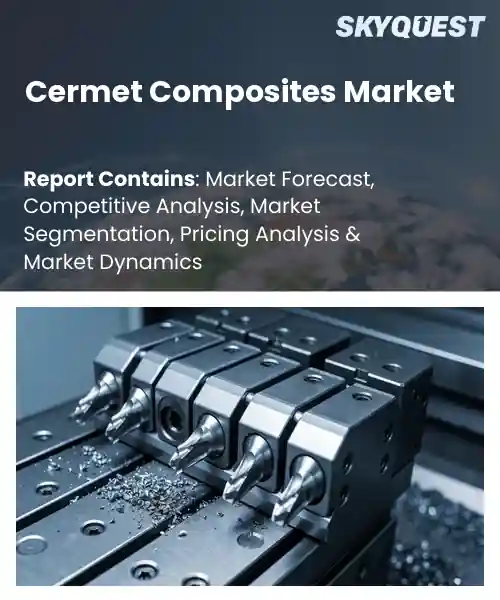
Cermet Composites Market
Report ID: SQMIG25I2061
Report ID: SQMIG25I2061
[email protected]
USA +1 351-333-4748
Report ID:
SQMIG25I2061 |
Region:
Global |
Published Date: March, 2026
Pages:
157
|Tables:
117
|Figures:
77


Global Cermet Composites Market size was valued at USD 5.4 Billion in 2024 and is poised to grow from USD 5.88 Billion in 2025 to USD 11.54 Billion by 2033, growing at a CAGR of 8.8% during the forecast period (2026-2033).
Growing demand for high-performance materials, increasing use in aerospace and automotive applications, rising need for wear-resistant components, advancements in powder metallurgy technologies, and emphasis on durability and efficiency are driving sales of cermet composites.
Uses for cermet composite materials can be found in various fields such as aviation and automobile industry where toughness and reliability matter most. Technological advancements in fields of powder metallurgy, sintering and additive manufacturing have resulted in enormous impact on manufacturing process through efficiency improvement and ability to produce sophisticated parts. Using this technique, manufacturers are able to produce light-weight heat resistant components for use in automobiles, which helps in increasing their efficiency as well as durability. In addition, there has been increased pressure on sustainable manufacturing due to rising emission levels, leading to more applications of cermet coatings.
Growing requirement for materials that combine hardness, toughness, and thermal stability coupled with a shift toward high-efficiency engineering solutions is expected to primarily drive cermet composites market growth. On the contrary, high production costs, complex manufacturing processes, limited availability of raw materials, challenges in machining and fabrication, and lack of widespread awareness in emerging markets are anticipated to slow down cermet composites market penetration going forward.
How is AI Enhancing Performance Prediction for Cermet Composite Companies?
With the advent of AI algorithms, there is a possibility of improving the accuracy of the performance predictions in the cermet composite domain by combining models associated with the microstructure, machine learning techniques, and experiments. Explainable AI will help in identifying factors affecting particular properties such as wear resistance and toughness, which will make the product development process faster and accurate. AI technology can minimize the need for guesswork methods and hasten the product development process. AI utilization in the case scenario can be seen in surrogate modeling and digital twin technologies.
In February 2026, Kennametal highlighted its focus on AI-driven simulation and advanced materials. This shows how leading companies are using AI to improve performance prediction and increase manufacturing efficiency in cermet composites.
Market snapshot - (2026-2033)
Global Market Size
USD 5.4 Billion
Largest Segment
Polymer Matrix Composites
Fastest Growth
Ceramic Matrix Composites
Growth Rate
8.8% CAGR
To get more insights on this market click here to Request a Free Sample Report
Global cermet composites market is segmented by material type, application, end-user, form factor and region. Based on material type, the market is segmented into metal matrix composites, ceramic matrix composites, and polymer matrix composites. Based on application, the market is segmented into automotive industry, aerospace industry, and electronics industry. Based on end-user, the market is segmented into manufacturers, construction companies, and research institutions. Based on form factor, the market is segmented into sheets and plates, pipes and tubes, and powders and granules. Based on region, the market is segmented into North America, Europe, Asia Pacific, Latin America, and Middle East & Africa.
The metal matrix composites segment is estimated to lead the global cermet composites market revenue generation in the future. Combination of metal ductility with ceramic hardness, delivering superior toughness, wear resistance, and thermal conductivity are expected to help this segment hold sway over others. Well-defined processes and compatibility with conventional metals facilitate scale-up and incorporation into current production lines. With an increasing focus on performance in mechanical and thermal conditions, there is an enhanced requirement for cermet materials based on metals, thus ensuring the dominance of cermets.
However, ceramic matrix composites are the most rapidly expanding segment as per this cermet composites industry analysis. Superior high temperature stability and chemical resistance enable novel extreme environment applications to create new business scope. In addition to that, advancements in production and reinforcement methods are contributing towards an increase in use within high-performance industries, resulting in the emergence of new cermet applications and research avenues that will serve as the impetus behind further innovations in this arena.
The sheets and plates segment is anticipated to account for the largest global cermet composites market share going forward. Standardized flat forms simplify joining, machining, and surface finishing, helps bolster the dominance of this segment. Cermet laminate’s ability to integrate easily with traditional processes for metallurgy and coating makes it more convenient and cheaper for the manufacturing process. The ease with which it can be handled in terms of quality control and supply chain management strengthens its position among products with uniform thickness and planarity.
On the contrary, powders and granules have demonstrated the greatest growth potential due to the growing need for materials for Additive Manufacturing processes. These products’ versatility makes their adaptation into specific chemical formulas possible, allowing for rapid prototyping and intricate geometries, among other capabilities.
To get detailed segments analysis, Request a Free Sample Report
High integration between highly developed manufacturing ecosystems, material sciences knowledge, and focused market demand from precision industries will influence the development and usage of cermet composites in the area. Interactions between manufacturers, research institutions, and end-users are greatly facilitated by the existence of industrial clusters within these areas, thereby allowing for rapid development and testing of new applications through iterations. The presence of established supply chains for ceramic and metal feedstocks allows manufacturers to reliably source and scale their operations when creating complex composite materials.
Supportive policy frameworks and investment focus in China, Japan, and India boost the translation of new technologies into pilot production, while also ensuring that there is an adequately skilled workforce along with proprietary processes that will maintain a high level of quality and help keep production costs competitive. Thus, the combination of demand, capability and injecting supportive infrastructure will continue to drive Asia Pacific’s leadership position in the cermet composites market and in the global marketplace.
Mature precision manufacturing base and dense networks between industry and research institutions are helping boost demand for cermet composites in Japan. Precision engineering in electronic devices and automobiles helps bring about quick improvement in composite design and processes. There is more focus on quality control, micro-miniaturization, and performance-enhancing materials, leading to the development of niche products. Efficient collaboration with suppliers ensures faster scalability and reliable deliveries to discerning customers around the world.
Advanced electronics manufacturing and a focus on high performance materials for semiconductor and precision tooling applications drive consistent cermet composites demand in South Korea. Efficient supply chains for high end powders and surface finishing enable production of sophisticated components. Requirement for miniature and efficient product pushes development towards lightweight and thermally stable composites. Partnerships between academic institutions and companies allows for constant improvements in designing and manufacturing composite products
Aerospace, defense, and high precision manufacturing sectors that prioritize durability and thermal resilience are boosting the sales of cermet composites in this region. The existence of a matured ecosystem consisting of specialized OEMs, contract manufacturers and applied research centres allows for the application-driven development of composites and quicker cycles for commercialization. A well-established level of sophistication in sourcing and high service orientation enables the ability to customize and provide aftermarket support of complex components in composite manufacturing.
The existence of cross border collaboration throughout North America and established procurement channels with very large end users serves to promote the acceptance of the composite industry, with an emphasis on better tooling and advanced performance materials continue to be an integral part of the investment into new technologies. Regulatory agencies in the region provide necessary pathways to validate products reducing the risk of purchase while assisting in their integration into complex systems.
Extensive use of cermet composites in aerospace, defense, and performance industrial sectors that require reliable components govern market development in the United States. Sufficient manufacturing capacity and availability of dedicated funds aid the deployment of innovative manufacturing technologies. Focus on certification, quality management, and post-sale services promotes the use of cermet composites for demanding applications where durability is crucial. Excellent research organizations and industrial collaborations facilitate innovation in developing specific composite materials.
Diverse industrial base including advanced manufacturing sectors that value wear resistant and thermally stable components drive cermet composites demand in Canada. Cooperative efforts for research and technological development contribute towards innovation in materials and piloting the production process. The close location to the supply chain and suppliers in North America facilitates adoption by manufacturers who prefer local sources and technical assistance. Customization, dependability, and seamless integration into the production lines attract manufacturers to composites.
Concentrated efforts in advanced manufacturing, standardization, and application driven research are expected to boost the sales of cermet composites across Europe. The collective efforts of the entire supply chain for cermet composites, including suppliers of specialty powders, coatings, and finishing processes, have built robust supplier networks enabling the manufacturers to scale to meet diverse industrial requirements quickly. By leveraging their technical know-how, establishing clear regulatory pathways, and investing in pilot production for developing new cermet composites, cermet composite material manufacturers will increase their competitiveness for high-value applications to satisfy increasing end-user demand.
Emphasis on improving total cost-of-ownership (TCO) through lifecycle performance and repairability, the manufacturers of cermet composites provide their customers with extended value beyond just the initial purchase price across the region.
Mechanical engineering expertise and industrial clusters focused on precision manufacturing are expected to boost the sales of cermet composites in Germany. Material suppliers and tools for powder handling enable the creation of prototypes and production scaling. The focus on standardization and certification ensures that cermet composites are successfully incorporated into complex systems. The need for high-quality, high-performance materials in the OEM industry promotes the use of and innovation within composite materials.
High emphasis on aerospace and defense applications with collaborative research landscape linking universities and industry are augmenting cermet composites adoption in the United Kingdom. Lightweighting and heat management features match the requirements of end-users. The supply chain's flexibility and services-based nature of industry make it possible to customize quickly. Specialty engineering companies modify the composite technology for specific uses in high-value products, with validation provided by test centers.
Robust aerospace supply chain participation and network of SMEs focused on precision components, coatings support steady demand for cermet composites in France. The research facilities and application labs work in partnership with industry for developing the formulations for composites and coatings. Emphasis on performance and manufacturing assures that such advanced materials will be adopted by stringent industries. The proximity to facilities for finish and testing facilitates integration of advanced materials into high-end systems.
To know more about the market opportunities by region and country, click here to
Buy The Complete Report
Increasing Demand From Aerospace
The use of cermet composites is increasing rapidly among aerospace manufacturers because of their requirements for a material that is thermally stable and wear-resistant but is also lightweight, thus providing opportunities for its use in different engine and structural components. Their ability to sustain thermal and mechanical stresses results in durability, minimizing maintenance requirements, and making it conducive to buy such materials. There is an increasing demand for materials that exhibit high performance and energy efficiency but do not compromise on strength.
Advances In Manufacturing Processes
Advancements in manufacturing technologies such as powder processing, sintering, and additive manufacturing improve the reliability and scalability of cermet composite manufacturing processes, thus minimizing variation. This reduces the technological challenges involved and ensures that cermet composite manufacturing is reliable and flexible, making it more appealing to engineers and procurement firms. With the increased reliability and flexibility of manufacturing processes, manufacturers will be able to align the material properties of their products with the desired applications.
High Production And Processing Costs
Expensive manufacturing processes, which utilize expensive powders and expensive energy sources, hamper the competitiveness of cermet products against traditional materials on cost grounds, resulting in a lack of use by a number of end-users. In addition, the requirement for special machines for manufacturing and qualified operators increases costs even further, thus discouraging both suppliers and future users from adopting this material. In light of the fact that most buying decisions are based on comparing improvements in performance and increased costs, the increased cost of production is definitely an impediment to growth.
Limited Standardization And Certification
Lack of well-established material standards and a fast track for certifications hinders the swift uptake of cermet composites because both the end-user and regulatory agencies must have an understood and replicable benchmark for properties before specifying materials that will be used in their operations. Diversity in chemical composition and manufacturing processes poses challenges for comparison purposes, hence causing delay in certification procedures and resulting in more conservative purchasing policies by Original Equipment Manufacturers.
Request Free Customization of this report to help us to meet your business objectives.
Competition in the global cermet composites market is intensifying as aerospace and defense demand lighter, heat-resistant materials. Incumbents and newcomers pursue concrete moves such as strategic investments, targeted acquisitions and supplier partnerships to lock in IP and scale novel production. Examples include GE Aerospace expanding CMC manufacturing capacity and strategic investors placing capital into materials innovators.
SkyQuest’s ABIRAW (Advanced Business Intelligence, Research & Analysis Wing) is our Business Information Services team that Collects, Collates, Correlates, and Analyses the Data collected by means of Primary Exploratory Research backed by robust Secondary Desk research.
As per SkyQuest analysis, rising demand for high-performance materials and advancements in material engineering technologies are anticipated to drive the demand for cermet composites going forward. However, high production costs and challenges in fabrication are slated to slow down the adoption of cermet composites in the future. Asia Pacific is slated to spearhead the demand for cermet composites owing to the strong presence of advanced manufacturing industries, high investment in R&D, and increasing use of high-performance materials in critical applications. Integration of AI-driven material design, advancements in additive manufacturing, and development of lightweight and heat-resistant components are anticipated to be key trends driving the cermet composites industry across the forecast period.
| Report Metric | Details |
|---|---|
| Market size value in 2024 | USD 5.4 Billion |
| Market size value in 2033 | USD 11.54 Billion |
| Growth Rate | 8.8% |
| Base year | 2024 |
| Forecast period | (2026-2033) |
| Forecast Unit (Value) | USD Billion |
| Segments covered |
|
| Regions covered | North America (US, Canada), Europe (Germany, France, United Kingdom, Italy, Spain, Rest of Europe), Asia Pacific (China, India, Japan, Rest of Asia-Pacific), Latin America (Brazil, Rest of Latin America), Middle East & Africa (South Africa, GCC Countries, Rest of MEA) |
| Companies covered |
|
| Customization scope | Free report customization with purchase. Customization includes:-
|
To get a free trial access to our platform which is a one stop solution for all your data requirements for quicker decision making. This platform allows you to compare markets, competitors who are prominent in the market, and mega trends that are influencing the dynamics in the market. Also, get access to detailed SkyQuest exclusive matrix.
Table Of Content
Executive Summary
Market overview
Parent Market Analysis
Market overview
Market size
KEY MARKET INSIGHTS
COVID IMPACT
MARKET DYNAMICS & OUTLOOK
Market Size by Region
KEY COMPANY PROFILES
Methodology
For the Cermet Composites Market, our research methodology involved a mixture of primary and secondary data sources. Key steps involved in the research process are listed below:
1. Information Procurement: This stage involved the procurement of Market data or related information via primary and secondary sources. The various secondary sources used included various company websites, annual reports, trade databases, and paid databases such as Hoover's, Bloomberg Business, Factiva, and Avention. Our team did 45 primary interactions Globally which included several stakeholders such as manufacturers, customers, key opinion leaders, etc. Overall, information procurement was one of the most extensive stages in our research process.
2. Information Analysis: This step involved triangulation of data through bottom-up and top-down approaches to estimate and validate the total size and future estimate of the Cermet Composites Market.
3. Report Formulation: The final step entailed the placement of data points in appropriate Market spaces in an attempt to deduce viable conclusions.
4. Validation & Publishing: Validation is the most important step in the process. Validation & re-validation via an intricately designed process helped us finalize data points to be used for final calculations. The final Market estimates and forecasts were then aligned and sent to our panel of industry experts for validation of data. Once the validation was done the report was sent to our Quality Assurance team to ensure adherence to style guides, consistency & design.
Analyst Support
Customization Options
With the given market data, our dedicated team of analysts can offer you the following customization options are available for the Cermet Composites Market:
Product Analysis: Product matrix, which offers a detailed comparison of the product portfolio of companies.
Regional Analysis: Further analysis of the Cermet Composites Market for additional countries.
Competitive Analysis: Detailed analysis and profiling of additional Market players & comparative analysis of competitive products.
Go to Market Strategy: Find the high-growth channels to invest your marketing efforts and increase your customer base.
Innovation Mapping: Identify racial solutions and innovation, connected to deep ecosystems of innovators, start-ups, academics, and strategic partners.
Category Intelligence: Customized intelligence that is relevant to their supply Markets will enable them to make smarter sourcing decisions and improve their category management.
Public Company Transcript Analysis: To improve the investment performance by generating new alpha and making better-informed decisions.
Social Media Listening: To analyze the conversations and trends happening not just around your brand, but around your industry as a whole, and use those insights to make better Marketing decisions.
REQUEST FOR SAMPLE
 REQUEST FREE CUSTOMIZATION
Global Cermet Composites Market size was valued at USD 5.4 Billion in 2024 and is poised to grow from USD 5.88 Billion in 2025 to USD 11.54 Billion by 2033, growing at a CAGR of 8.8% during the forecast period (2026-2033).
Competition in the global cermet composites market is intensifying as aerospace and defense demand lighter, heat-resistant materials. Incumbents and newcomers pursue concrete moves such as strategic investments, targeted acquisitions and supplier partnerships to lock in IP and scale novel production. Examples include GE Aerospace expanding CMC manufacturing capacity and strategic investors placing capital into materials innovators. 'CeramTec', 'Kyocera Corporation', 'Saint-Gobain', '3M', 'CoorsTek', 'Corning Incorporated', 'NGK Insulators', 'VITA', 'BAE Systems', 'Aremco Products', 'Daikin Industries', 'Merck Group', 'Hexcel Corporation', 'Alcoa Corporation', 'Cerametrics', 'Vitrified Systems', 'Solvay', 'Etex Group', 'H.C. Starck', 'Advanced Ceramics Manufacturing'
Lightweighting For Performance Gains: Manufacturers increasingly prioritize weight reduction to enhance efficiency, performance, and design flexibility across transportation and aerospace sectors. Cermet composites offer a balance of stiffness and toughness that enables lighter components without compromising durability or thermal stability. This trend drives material substitution for structural parts, wear components, and integrated thermal management elements, encouraging designers to exploit cermet microstructures for topology optimization and multifunctional parts. Demand is reinforced by the need for longer service intervals while maintaining reliability under challenging operating conditions.
Asia Pacific Dominates the Global Cermet Composites Market.


Want to customize this report? This report can be personalized according to your needs. Our analysts and industry experts will work directly with you to understand your requirements and provide you with customized data in a short amount of time. We offer $1000 worth of FREE customization at the time of purchase.
Feedback From Our Clients


 USA (+1) 351-333-4748

