
Ceramic Tiles Market
Report ID: SQMIG20B2082
Report ID: SQMIG20B2082
[email protected]
USA +1 351-333-4748
Report ID:
SQMIG20B2082 |
Region:
Global |
Published Date: June, 2025
Pages:
199
|Tables:
170
|Figures:
74


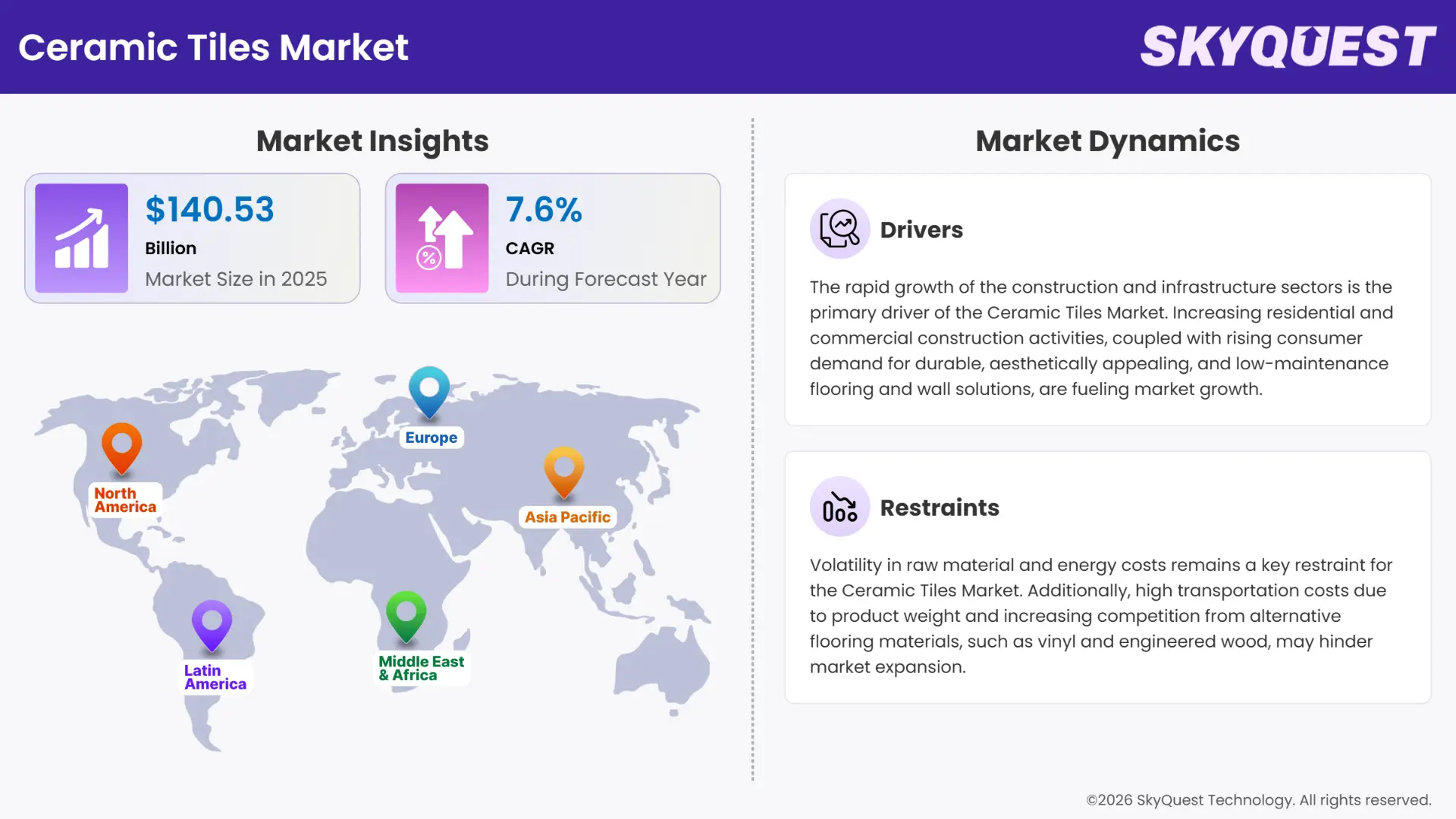
Global Ceramic Tiles Market size was valued at USD 130.6 Billion in 2024 and is poised to grow from USD 140.53 Billion in 2025 to USD 252.5 Billion by 2033, growing at a CAGR of 7.6% in the forecast period (2026–2033).
Key Takeaways: Market Trends & Insights
The increasing Real Estate sector has significantly impacted the growth in recent years. The Real Estate sector is set to reach over USD 6.65 Trillion by 2033 with a CAGR of around 5.5% globally. This expansion is interconnected with the interiors and exteriors designed or aesthetics requiring tiles with different textures for the look and feel.
The investment landscape within the residential sector is high in the Asia Pacific region. Consumers desire to go with the most durable and luxurious tiles for walls and floors. As per the IBEF report, India’s real estate sector is expected to reach USD 5.8 trillion by 2047, which is contributing 15.5% to the GDP from an existing share of 7.3%. Another report from Indian Ceramics Asia reveals India is the second largest consumer of ceramic tiles worldwide holding around 7% market share. The faster growth of the real estate sector within India has propelled this demand for ceramic tiles market.
Despite this promising growth, fluctuation in raw material prices and durability issues compared to other products may let consumers shift to alternative options like cement tiles, stone tiles and other emerging products.
How 3D Printing Technology will impact the Ceramic Tiles Industry?
3D printing is at the dawn of transforming the ceramics tiles market through unprecedented levels of design flexibility, accuracy, and customization. Manufacturers can create complex geometries, textures, and beautiful designs not possible with traditional molding methods. The 3D technology can also save material, shorten the reflux period, and reduce the need for inventory through on-demand production. In addition, it opens the door to faster innovation as designers can explore new forms of tiles or surface designs. Although 3D printing with ceramics is ready to change the industry, there still remain challenges associated with 3D printing in ceramics. These challenges may include high initial equipment costs, slower speeds for mass produced products, and limited materials for large formats of tile.
To get more insights on this market click here to Request a Free Sample Report
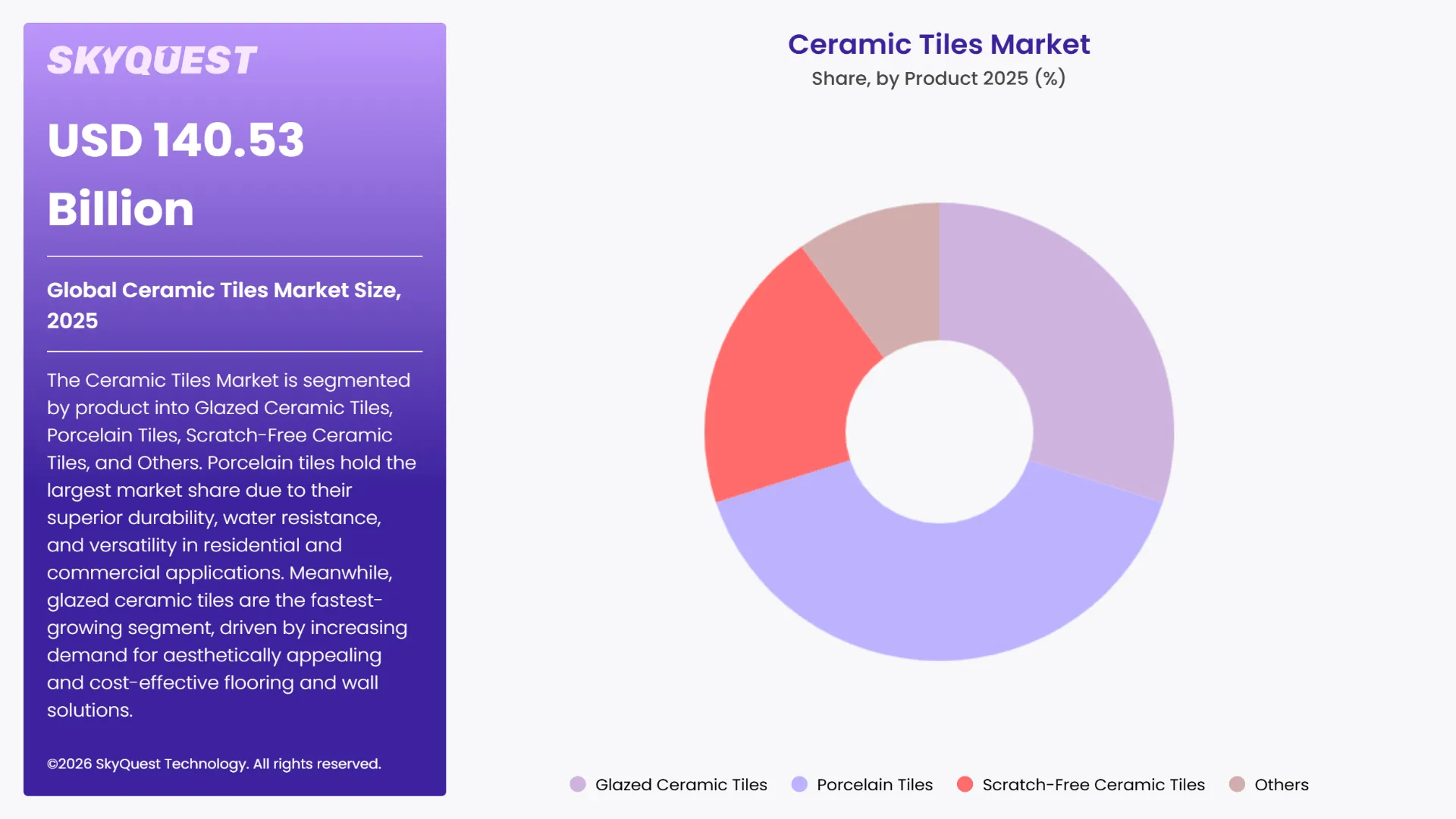
The global ceramic tiles market is segmented into product, construction type, price range, finishing, application, end use and region. By product, the market is segmented into glazed, porcelain and others. By construction type, the market is segmented into new construction and replacement & renovation. By price range, the market is segmented into economy, mid-range and luxury. By finishing, the market is segmented into matt, gloss, wood and others. By application, the market is segmented into floor tiles, wall tiles and others. By end use, the market is segmented into residential and non-residential. By region, the ceramic tiles market is analyzed across North America, Europe, Asia-Pacific, Middle East & Africa, and Latin America.
The global ceramic tiles market is significantly represented by floor tiles, with a market share of about 49.3% in 2024, mainly due to the high levels of construction activity in the residential and commercial sectors. Although floor tiles dominate in both the Asia-Pacific and Middle East regions, the spatial structural environment in those regions is driving a rise in the use of floor tiles, given the increased use of interiors for smart homes, as well as varied approaches to displaying spatial meaning in our built environments.
We found that many clients preferred using floor tiles given their superior durability, slip resistance and aesthetic adaptability in high-footfall places like kitchens, bathrooms, hallways and malls. Furthermore, improvements in digitally printed floor tiles as well as the higher demand for larger format tiles have improved tile use in people's interiors.
At the same time rising disposable incomes of consumers, greater aesthetic awareness among homeowners and a surge in interior renovations led them to adopt tiles for walls also. Thus, this trend will reflect positive growth in the coming years. Our research highlights its CAGR for the forecasted period will be high. Homeowners are increasingly favoring stylish, easy-care wall tiles in their bathrooms, kitchens, and living rooms. As consumers are looking for increased innovation in textures, designs, and environmentally responsible glazes, the trend for accent walls, designer backsplashes, and general wall coverings is on the rise, particularly in urban apartments. The hospitality and healthcare sectors also find themselves utilizing anti-bacterial ceramic wall tiles to help them satisfy hygienic measures.
SkyQuest's market study found that over 60.1% of ceramic tiles market revenue was generated from the residential sector in 2024. This growth is significantly supported by the trend toward urban housing developments, the increase in disposable income seen in emerging economies, and the evident move toward home improvements and aesthetics. Demand is also influenced by the governments in India, China, and Latin America offering low-cost housing initiatives that have led to the mass adoption of cheaper, durable ceramic tiles which are favored for low maintenance, hygiene, and available designs for kitchen and bathrooms, as well as flooring in buildings.
Conversely, ceramic tiles are also gaining traction in non-residential representing faster growth in the coming years. The growth is due to the rapid expansion of global infrastructure developments, such as commercial real estate, hospitality, and institutional projects. It is perceived that there is increased use of large format and digitally printed surfaces within shopping centers, airports, hospitals, and office buildings for functional utility and aesthetics. Additionally, increased environmental sustainability regulations are helping push commercial developers toward the use of sustainable materials, such as ceramic tile (which also has conductive thermal insulation and longevity, which is increasingly valued in new energy-efficient building designs).
To get detailed segments analysis, Request a Free Sample Report
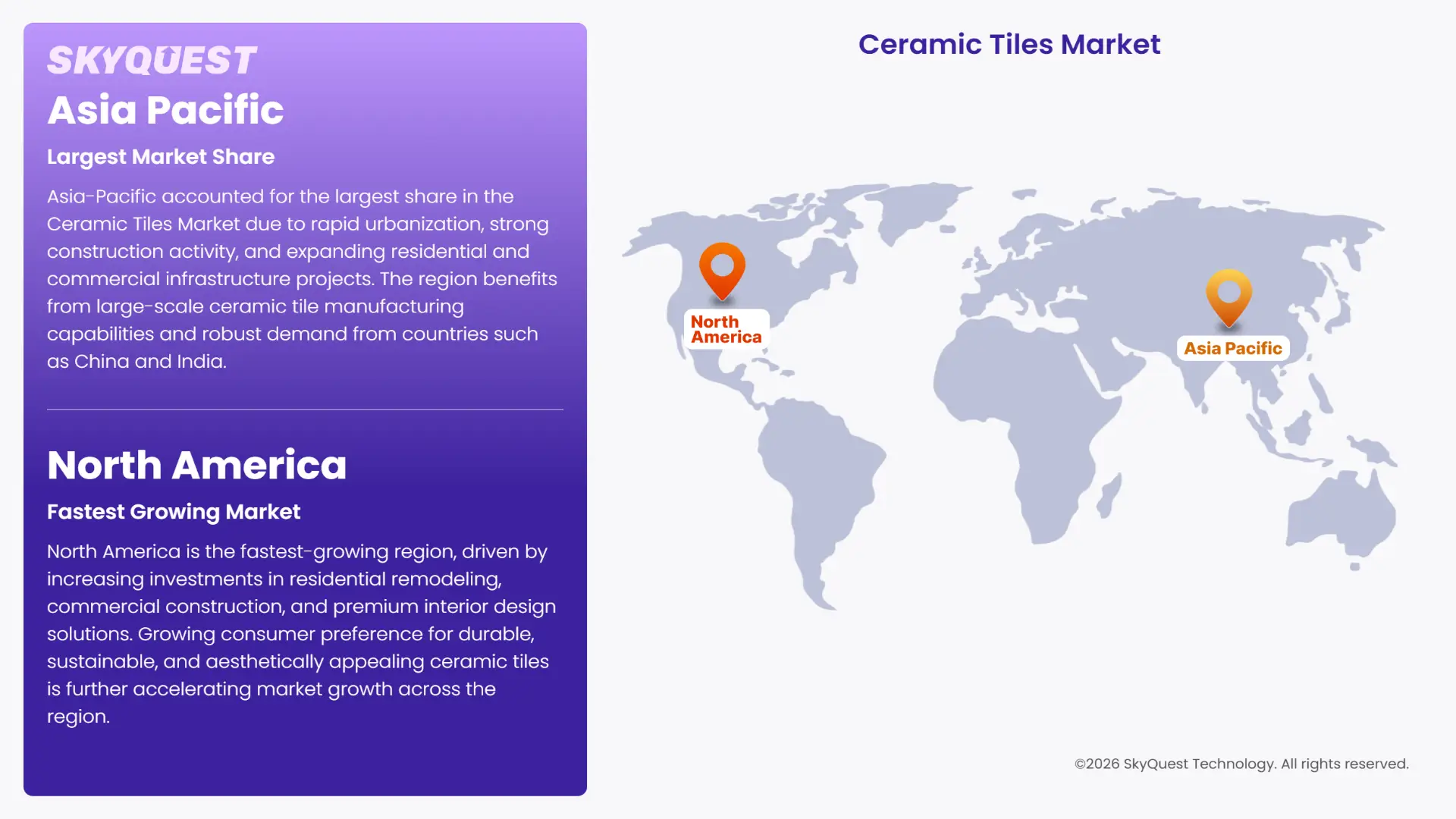
Asia Pacific will continue to be the biggest ceramic tiles market in 2024. The factors contributing to this situation are the increasing construction industry with significant volumes of residential demand and rapid urban infrastructure programs underway in Asia Pacific. This region benefits frequency on cheap availability of raw materials (high volume), proximity to clay reserves, and dense manufacturing clusters. China and India have the bulk of this density.
Also, the middle class is developing in Asia Pacific's economic system along with several government initiatives such as "Housing for All" and smart city initiatives; these factors contribute towards increased tile consumption. In addition, the ability to export product out of the region, particularly from China, gives Asia Pacific a dual presence within the ceramic tiles market value chain as a production and consumption region.
China Ceramic Tiles Market
China continues to be the leader in the ceramic tiles market demand, mostly due to its unique manufacturing capability, established supply chains to dominate tile exports around the world. In 2024, Chinese businesses are going to work on energy-efficient kilns and advances in digital printing to improve production while also satisfying sustainability standards across the globe. In addition, China is benefitting from rising domestic demand for ceramic building materials driven by urban redevelopment projects and infrastructure upgrades due to government directives like "New Urbanization 2.0." China will benefit from trade relationships with other members of RCEP to increase ceramic tile exports to Southeast Asia and new markets in other regions, further entrenching its position in the global supply situation.
India Ceramic Tiles Market
India has become the fastest growing consumer of ceramic tiles market growth in the Asia Pacific region, spurred by a boom in housing development and demand for housing related to rural electrification, expanding industrial zones, and various other drivers. The PMAY (Pradhan Mantri Awas Yojana) initiative from the Indian Government and the push for smart cities has accelerated demand for ceramic tiles, particularly at the affordable and mid-range segment.
India's Morbi region is a significant contributor to global tile production and is now investing upgrading to technologically advanced gas-fired kilns and more income polishing standards to meet export quality. The increasing preference for vitrified and digitally printed tiles among end-users in modern urban, developing urban centres, and tier-2/3 cities will continue to drive consumption to previously unseen levels in India.
Japan & South Korea Ceramic Tiles Market
In 2024, Japan and South Korea represent mature ceramic tiles market growth with an emphasis on premium, design-centric ceramic tiles. Growth in Japan and South Korea is being driven by renovations of aging infrastructure, luxury housing, and antimicrobial and thermal insulating tile technology. Sustainability and space efficiency continue to be at the forefront with architect decisions in both markets. Similarly to the Japanese market, South Korea sees increased demand through urban renewal, increasing investment in high-rise commercial buildings, and demand for faster construction. The Japanese ceramic tile market shows advantages derived from technological innovation with precision-cut tiles and earthquake-resilient building materials conforming to local building codes.
North America is the second-largest ceramic tiles market share in the world and is benefiting from increasing preference for sustainable construction and architectural change. The sustainable building movement is very much a part of North America's commercial floor space, with nearly 48% of all commercial floor space pursuing those credentials, most notably LEED. Technology has also changed the landscape of ceramic tile aesthetics through digital inkjet printing, allowing products to simulate stone, wood, and concrete with incredible quality. Further, tiles are expanding in size, slowly becoming more modular and resembling natural materials in the case of open-plan residential units and commercial spaces. Flexibility in tile designs and sizes is opening demand in both segments.
U.S. Ceramic Tiles Market
The ceramic tile market share in the United States is growing steadily, with a compound annual growth rate (CAGR) of over 6% for the forecast period driven by robust construction and remodeling activity. Growth is coming from innovations such as anti-slip surface coating, ultra-thin tiles for walls, and durable surfaces that are suitable for indoors and outdoors. Increased spending on public infrastructure, and the demand for low-maintenance, fire resistant surfaces in high traffic areas are supporting the use of ceramic tile.
Canada Ceramic Tiles Market
Due to urban densification and increased home renovations, Canada is becoming one of the fastest-growing ceramic tile market share in North America. The Canadian Green Building Council is reporting an invoicing and increase in the number of projects that are sustainable metrics, and had expanded interest in ceramic tiles due to their recyclable, low-emissions material. Digitally printed and textured tiles have also continued to gain popularity, especially in urban centers such as Toronto, Vancouver, and Montreal.
To know more about the market opportunities by region and country, click here to
Buy The Complete Report
Accelerated Urbanization and Infrastructure Development in Emerging Economies
Growing Consumer Preference for Aesthetic Home Renovation
Intense Market Fragmentation and Price Competition
Volatility in Raw Material Prices and Availability
Request Free Customization of this report to help us to meet your business objectives.
The ceramic tiles market is extremely fragmented, with thousands of Regional and Local manufacturers competing on different geographies. This fragmentation provides opportunities for new entrants especially in developing economies; however, competition is fierce on account of price, regional preferences and the lengthy supply chain. To enter the market, new entrants will need to overcome barriers such as distribution and logistics, brand positioning and recognition, and compliance with sustainability. While new entrants have challenges, they can find success with local design innovations, environmentally friendly production, and products tailored for a certain architect or specific niche. Specific strengths that will help in gaining marketing share include good logistics, consistent quality, strong dealer networks, and understanding of local aesthetics and building practices.
Rapid Adoption of Digital Printing & Large‑Format Designs
Intensifying Sustainability & Green Manufacturing Practices
SkyQuest’s ABIRAW (Advanced Business Intelligence, Research & Analysis Wing) is our Business Information Services team that Collects, Collates, Correlates, and Analyses the Data collected using Primary Exploratory Research backed by robust Secondary Desk research.
SkyQuest's study suggests that the worldwide market for ceramic tiles is changing rapidly due to evolving building patterns, increasing consumer awareness of aesthetics, and growing real estate markets in some regions. Demand will continue to remain strong, especially in emerging countries which are still expanding their infrastructure and housing, demonstrating a new preference toward strong, beautiful surface materials. Although floor applications use the large portion of tiles due to their durability and design possibilities, wall tiles are being increasingly adopted in both the residential and commercial markets. Technological advancements like 3D printing may create even more opportunities for design—albeit with some operational issues. Furthermore, raw material price fluctuations and competition may limit profitability and limit innovation.
| Report Metric | Details |
|---|---|
| Market size value in 2024 | USD 130.6 Billion |
| Market size value in 2033 | USD 252.5 Billion |
| Growth Rate | 7.6% |
| Base year | 2024 |
| Forecast period | 2026–2033 |
| Forecast Unit (Value) | USD Billion |
| Segments covered |
|
| Regions covered | North America (US, Canada), Europe (Germany, France, United Kingdom, Italy, Spain, Rest of Europe), Asia Pacific (China, India, Japan, Rest of Asia-Pacific), Latin America (Brazil, Rest of Latin America), Middle East & Africa (South Africa, GCC Countries, Rest of MEA) |
| Companies covered |
|
| Customization scope | Free report customization with purchase. Customization includes:-
|
To get a free trial access to our platform which is a one stop solution for all your data requirements for quicker decision making. This platform allows you to compare markets, competitors who are prominent in the market, and mega trends that are influencing the dynamics in the market. Also, get access to detailed SkyQuest exclusive matrix.
Table Of Content
Executive Summary
Market overview
Parent Market Analysis
Market overview
Market size
KEY MARKET INSIGHTS
COVID IMPACT
MARKET DYNAMICS & OUTLOOK
Market Size by Region
KEY COMPANY PROFILES
Methodology
For the Ceramic Tiles Market, our research methodology involved a mixture of primary and secondary data sources. Key steps involved in the research process are listed below:
1. Information Procurement: This stage involved the procurement of Market data or related information via primary and secondary sources. The various secondary sources used included various company websites, annual reports, trade databases, and paid databases such as Hoover's, Bloomberg Business, Factiva, and Avention. Our team did 45 primary interactions Globally which included several stakeholders such as manufacturers, customers, key opinion leaders, etc. Overall, information procurement was one of the most extensive stages in our research process.
2. Information Analysis: This step involved triangulation of data through bottom-up and top-down approaches to estimate and validate the total size and future estimate of the Ceramic Tiles Market.
3. Report Formulation: The final step entailed the placement of data points in appropriate Market spaces in an attempt to deduce viable conclusions.
4. Validation & Publishing: Validation is the most important step in the process. Validation & re-validation via an intricately designed process helped us finalize data points to be used for final calculations. The final Market estimates and forecasts were then aligned and sent to our panel of industry experts for validation of data. Once the validation was done the report was sent to our Quality Assurance team to ensure adherence to style guides, consistency & design.
Analyst Support
Customization Options
With the given market data, our dedicated team of analysts can offer you the following customization options are available for the Ceramic Tiles Market:
Product Analysis: Product matrix, which offers a detailed comparison of the product portfolio of companies.
Regional Analysis: Further analysis of the Ceramic Tiles Market for additional countries.
Competitive Analysis: Detailed analysis and profiling of additional Market players & comparative analysis of competitive products.
Go to Market Strategy: Find the high-growth channels to invest your marketing efforts and increase your customer base.
Innovation Mapping: Identify racial solutions and innovation, connected to deep ecosystems of innovators, start-ups, academics, and strategic partners.
Category Intelligence: Customized intelligence that is relevant to their supply Markets will enable them to make smarter sourcing decisions and improve their category management.
Public Company Transcript Analysis: To improve the investment performance by generating new alpha and making better-informed decisions.
Social Media Listening: To analyze the conversations and trends happening not just around your brand, but around your industry as a whole, and use those insights to make better Marketing decisions.
REQUEST FOR SAMPLE
 REQUEST FREE CUSTOMIZATION
Global Ceramic Tiles Market size was valued at USD 130.6 Billion in 2024 and is poised to grow from USD 140.53 Billion in 2025 to USD 252.5 Billion by 2033, growing at a CAGR of 7.6% in the forecast period (2026–2033).
Key vendors in the Ceramic Tiles Market include Mohawk Industries, Inc., Grupo Lamosa, Kajaria Ceramics Limited, RAK Ceramics, SCG Ceramics Public Company Limited, Siam Cement Group, Porcelanosa Grupo, China Ceramics Co., Ltd., Grupo Cedasa, and Somany Ceramics Limited. These companies focus on innovative tile designs, sustainable manufacturing practices, and expanding their global distribution networks to meet rising demand across residential and commercial construction sectors.
The key driver of the Ceramic Tiles Market is the rapid growth of the construction and infrastructure sectors. Increasing residential and commercial construction activities, coupled with rising consumer demand for durable, aesthetically appealing, and low-maintenance flooring and wall solutions, are significantly driving market growth.
The key market trend in the Ceramic Tiles Market is the growing demand for large-format and digitally printed ceramic tiles. Manufacturers are increasingly adopting advanced printing technologies and sustainable production processes to offer premium designs, improved durability, and eco-friendly products that cater to evolving consumer preferences.
Asia-Pacific accounted for the largest share in the Ceramic Tiles Market due to rapid urbanization, strong construction activity, and expanding residential and commercial infrastructure projects. The region benefits from large-scale manufacturing capabilities and growing demand for affordable and aesthetically appealing building materials, particularly in China and India.


Want to customize this report? This report can be personalized according to your needs. Our analysts and industry experts will work directly with you to understand your requirements and provide you with customized data in a short amount of time. We offer $1000 worth of FREE customization at the time of purchase.
Feedback From Our Clients


 USA (+1) 351-333-4748

