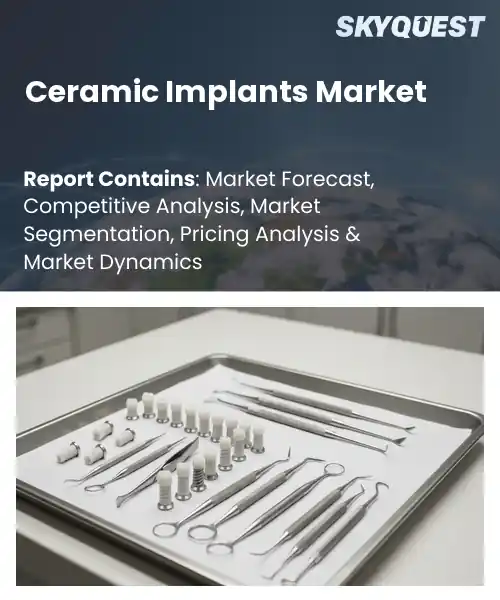
Ceramic Implants Market
Report ID: SQMIG35A3333
Report ID: SQMIG35A3333
[email protected]
USA +1 351-333-4748
Report ID:
SQMIG35A3333 |
Region:
Global |
Published Date: March, 2026
Pages:
157
|Tables:
113
|Figures:
77


Global Ceramic Implants Market size was valued at USD 1.40 Billion in 2024 and is poised to grow from USD 1.50 Billion in 2025 to USD 2.53 Billion by 2033, growing at a CAGR of 6.8% during the forecast period (2026-2033).
Key Takeaways: Market Trends & Insights
Growing demand for biocompatible implant materials, increasing preference for metal-free solutions, rising focus on aesthetic outcomes in dental procedures, advancements in ceramic material technologies, and growing aging population are driving sales of ceramic implants.
Better biocompatibility characteristics of ceramic implants ensure there is a lower chance of developing allergies, whereas their resemblance to natural teeth improves aesthetic results. Advances in surface treatment technology and computer-aided design are improving the process of osseointegration and precision, resulting in fewer complications. Increasing use in dental clinics and hospitals, as well as greater funding from governments, has been contributing to the growth of the market as well. There is an increasing trend in emerging countries to use better-quality prosthetics, thereby offering more prospects to manufacturers. Growing awareness regarding long-term safety and compatibility of implant materials among patients and clinicians coupled with a shift toward aesthetically superior and durable solutions is expected to primarily drive ceramic implants market growth.
On the contrary, high costs of ceramic implants, limited awareness in developing regions, challenges in handling and placement, and lack of widespread reimbursement in some markets are expected to impede ceramic implants market penetration in the future.
How is AI Influencing Market Adoption of Ceramic Dental and Orthopedic Implants?
With the use of AI, ceramic dental and orthopedic implant devices are becoming more readily adopted because of the clinical and operational problems that need to be addressed. AI is useful in making accurate diagnoses through sophisticated image processing. AI also ensures precision in treatment planning, improves the quality of manufacturing, and assists in designing restoration parts. The use of AI technology, such as navigation and robotics, along with digital CAD/CAM systems, will ensure predictability, shorten treatment duration, and streamline operations for dentists and laboratories.
In March 2025, Straumann launched the AXS cloud platform and Falcon dynamic navigation system. These solutions integrate AI into treatment planning and real-time surgical guidance, improving precision in zirconia implant procedures and helping clinics adopt ceramic implants more efficiently.
Market snapshot - 2026-2033
Global Market Size
USD 1.4 Billion
Largest Segment
Zirconia Implants
Fastest Growth
Zirconia Implants
Growth Rate
6.8% CAGR
To get more insights on this market click here to Request a Free Sample Report
Global ceramic implants market is segmented by material type, application, end user, technology, and region. Based on material type, the market is segmented into Zirconia implants and Alumina implants. Based on application, the market is segmented into dental implants and orthopedic implants. Based on end user, the market is segmented into hospitals and dental clinics. Based on technology, the market is segmented into additive manufacturing and casting techniques. Based on region, the market is segmented into North America, Europe, Asia Pacific, Latin America, and Middle East & Africa.
The Zirconia implants segment is estimated to spearhead the global ceramic implants market revenue generation in the future. Superior combination of mechanical strength and aesthetic translucency offered by these implants directly addresses clinicians’ and patients’ primary requirements to help this segment hold sway over others. Biocompatibility and good osseointegration properties lower the risk of complications for patients, which has encouraged companies to focus on zirconia while designing new products. Advances in material science ultimately leading to market dominance.
However, Alumina implants are emerging as the most rapidly expanding segment as per these ceramic implants market forecast. Growing interest in high purity alumina owing to its requirements of extremely high wear and corrosion resistance opens up new business potential. Advances in surface technology allow for the use of alumina in specific orthopedic and dental applications, providing an area for further product development and study.
The casting techniques segment is slated to account for the highest global ceramic implants market share going forward. The long-established processes used in manufacturing ceramics offer material consistency and mechanical performance predictability that meet regulatory and clinical demands for the production of ceramic implants. The well-established processes, tooling, and supply chain logistics make it possible to manufacture large batches at affordable costs for standardized shapes, ensuring their adoption by hospitals and clinics, thus providing wide access and encouraging continued investment in casting systems.
On the other hand, additive manufacturing shows significant growth potential because it provides customized geometries, internal porosity, which promotes osseointegration, and shortened development cycles through digital workflows. Improved ceramics for printing applications and increased clinical interest are driving bespoke implant development for difficult cases.
To get detailed segments analysis, Request a Free Sample Report
Well-established clinical expertise, robust regulatory frameworks that encourage innovation, and concentrated research networks are supporting Europe’s dominance in terms of ceramic implant sales. Collaborations allow academics, implant manufacturers and specialty clinicians to develop new products with continuous improvement and to produce evidence through research related to product improvement. In addition to this, the reimbursement systems in various countries enable the easy use of high-quality biomaterials, which creates the demand for these products. With the demand for non-metal implants being dictated by patients, the supply chain within Europe and the quality of the pipeline for producing these products guarantees that they will be available to meet the growing demand while being manufactured to the highest possible standards. A concentration of investment and talent around the central and west of Europe enables a high level of translational research to be conducted so that the results of scientific activities can be moved quickly from research activities to the company’s commercial inventories.
Concentrated network of specialized clinics, advanced biomaterials research, and precision manufacturing expertise boosts consistent sales of ceramic implants in Germany. Multidisciplinary teamwork between engineers, biomaterials scientists, and surgeons contributes to product improvement. The export route enables the distribution of German designed products to other parts of Europe. Adopting clinicians are assisted through clinical programs and regulation, while purchasing hospitals value the long-term health outcomes.
Clinical networks, a focus on translational research, and professional societies promoting metal-free implant solutions are shaping demand for ceramic implants in the United Kingdom. The environment in the country is favorable for the generation and dissemination of evidence, making it a hub for technological assessment and clinical excellence. Clinical expertise helps in validating the use of implants in practice, and there is an emphasis on long-term results among payers and procurers.
Integrated hospital networks, strong academic research in biomaterials, and collaboration between dental and orthopedic specialists support market growth in France. Centers for clinical testing and technology dissemination foster the development of commercially feasible ceramic implants. The emphasis on biocompatibility and treatment results influences purchasing decisions at clinical facilities. Local producers collaborate with physicians to design implant shapes and surface modifications suited to local clinical practices across France.
Robust clinical demand for aesthetic and metal free implant alternatives, combined with a favorable innovation ecosystem, creates a new business scope for ceramic implants companies in this region. Patients are being treated with biocompatible materials that enhance comfort and durability, prompting clinicians to trial the use of ceramics in both dental and orthopedic procedures. In addition to this, venture capital and strategic partnerships are assisting in converting successful prototype products into regulatory submissions, as well as product launches, while complex distribution networks ensure broad access for clinicians.
Insurers’ and reimbursement agencies’ focus on long term patient outcomes are facilitating the uptake of ceramic implant products in both general and specialty centres for clinical implementation. Collaborations across borders between manufacturers and research institutions are further accelerating product development, making the North American region a high growth marketplace for ceramic implant products. Clinician training programs and professional society guidance are providing an additional level of support to assist clinicians with patient selection and confidence, leading to sustained adoption of the beneficial implant products through diffuse care settings.
Extensive clinical research infrastructure, private investment, and a broad network of specialist surgeons are helping boost sales of ceramic implants in the United States. Startups together with manufacturers and scientific institutions speed up the process of bringing products to the market. Clinical distribution and training programs promote the adoption of the technology by other clinicians. Evidence can be collected using regulatory interaction and multicenter clinical trials, and implementation is carried out within hospitals.
Emphasis on clinical excellence, collaborative research programs, and a measured adoption approach among clinicians drives steady demand for ceramic implants in Canada. Training on the procedure and outcome reporting will foster confidence in clinicians leading to gradual adoption of ceramic implants. Clinical benefits play an important role in the choice of material for implants in the provincial healthcare system and specialty hospitals. Collaboration between university labs and industry facilitates local development and assessment of products.
Focused investments in materials science, growing clinical expertise, and strategic partnerships are helping create an opportune setting in Asia Pacific. Research institutions pursuing more complex ceramic formulations and surface technologies will be complemented by specialty clinics accumulating clinical experience, leading to increased use of both. Manufacturing is growing to accommodate regional requirements in ceramics, supported by trans-border efforts in quality assurance and standardization. Joint ventures and licensing agreements provide for the transfer of sophisticated designs to regional manufacturing. Training at a local level and databases of outcomes enhances clinicians' confidence. Government grants for research and innovation clusters are fostering technology incubators and clinical trial sites and work with international bodies support developing harmonized pathways and benchmarks. This development will be a result of all of these combined activities creating a more competitive and innovation-focused presence in the Asia-Pacific region in the area of ceramic implants.
Advanced materials research, precision manufacturing, and meticulous clinical evaluation support consistent demand for ceramic implants in Japan. Companies modify internationally proven technologies to suit regional surgery practices, while more extensive education programs for clinicians help select appropriate candidates and guarantee good results. Academic institutions conduct research on the development of ceramic materials and surface treatment, while specialist clinics offer precise clinical information. High-quality controls and efficient logistics systems ensure the stable performance of products.
Robust biomaterials research, robust manufacturing, and close collaboration between universities and industry supports steady sales of ceramic implants in South Korea. Targeted training of physicians and export-oriented approaches contribute to increased awareness of ceramic implants from South Korea regionally. Clinical centers give preference to minimally invasive approaches and innovative surfaces that facilitate osseointegration. Companies employ precise manufacturing methods to produce high-quality ceramic parts; at the same time, innovation initiatives support initial clinical studies.
To know more about the market opportunities by region and country, click here to
Buy The Complete Report
Advancements in Biomaterial Research
Rising Demand for Aesthetic Solutions
Complex Regulatory Approval Processes
Limited Clinical Awareness in Regions
Request Free Customization of this report to help us to meet your business objectives.
Competitive landscape is driven by consolidation, material innovation and partnerships, shifting incumbents and specialist entrants. Recent M&A and partnerships have reshaped access to ceramic platforms, for example CeramTec’s 2021 acquisition of Dentalpoint. SINTX’s acquisition of surgical assets expanded silicon nitride capabilities. Large groups also deploy product innovation such as Dentsply Sirona’s Astra Tech Implant EV and Straumann’s strategic clinic investments, intensifying competition around metal-free and bioactive implant solutions.
SkyQuest’s ABIRAW (Advanced Business Intelligence, Research & Analysis Wing) is our Business Information Services team that Collects, Collates, Correlates, and Analyses the Data collected by means of Primary Exploratory Research backed by robust Secondary Desk research.
As per SkyQuest analysis, rising demand for biocompatible and metal-free implant solutions, increasing focus on aesthetic outcomes, and growing adoption of advanced dental and orthopedic procedures are anticipated to drive the demand for ceramic implants going forward. However, high costs, risk of material brittleness, technical complexities in placement, and limited reimbursement support are slated to slow down the adoption of ceramic implants in the future. Europe is slated to spearhead the demand for ceramic implants owing to the strong presence of universal healthcare infrastructure, high adoption of cosmetic dentistry, and increasing use of digital implant technologies. Integration of AI-assisted surgical planning, advancements in CAD/CAM manufacturing, and development of high-strength ceramic materials are anticipated to be key trends driving the ceramic implants sector over the coming years.
| Report Metric | Details |
|---|---|
| Market size value in 2024 | USD 1.40 Billion |
| Market size value in 2033 | USD 2.53 Billion |
| Growth Rate | 6.8% |
| Base year | 2024 |
| Forecast period | 2026-2033 |
| Forecast Unit (Value) | USD Billion |
| Segments covered |
|
| Regions covered | North America (US, Canada), Europe (Germany, France, United Kingdom, Italy, Spain, Rest of Europe), Asia Pacific (China, India, Japan, Rest of Asia-Pacific), Latin America (Brazil, Rest of Latin America), Middle East & Africa (South Africa, GCC Countries, Rest of MEA) |
| Companies covered |
|
| Customization scope | Free report customization with purchase. Customization includes:-
|
To get a free trial access to our platform which is a one stop solution for all your data requirements for quicker decision making. This platform allows you to compare markets, competitors who are prominent in the market, and mega trends that are influencing the dynamics in the market. Also, get access to detailed SkyQuest exclusive matrix.
Table Of Content
Executive Summary
Market overview
Parent Market Analysis
Market overview
Market size
KEY MARKET INSIGHTS
COVID IMPACT
MARKET DYNAMICS & OUTLOOK
Market Size by Region
KEY COMPANY PROFILES
Methodology
For the Ceramic Implants Market, our research methodology involved a mixture of primary and secondary data sources. Key steps involved in the research process are listed below:
1. Information Procurement: This stage involved the procurement of Market data or related information via primary and secondary sources. The various secondary sources used included various company websites, annual reports, trade databases, and paid databases such as Hoover's, Bloomberg Business, Factiva, and Avention. Our team did 45 primary interactions Globally which included several stakeholders such as manufacturers, customers, key opinion leaders, etc. Overall, information procurement was one of the most extensive stages in our research process.
2. Information Analysis: This step involved triangulation of data through bottom-up and top-down approaches to estimate and validate the total size and future estimate of the Ceramic Implants Market.
3. Report Formulation: The final step entailed the placement of data points in appropriate Market spaces in an attempt to deduce viable conclusions.
4. Validation & Publishing: Validation is the most important step in the process. Validation & re-validation via an intricately designed process helped us finalize data points to be used for final calculations. The final Market estimates and forecasts were then aligned and sent to our panel of industry experts for validation of data. Once the validation was done the report was sent to our Quality Assurance team to ensure adherence to style guides, consistency & design.
Analyst Support
Customization Options
With the given market data, our dedicated team of analysts can offer you the following customization options are available for the Ceramic Implants Market:
Product Analysis: Product matrix, which offers a detailed comparison of the product portfolio of companies.
Regional Analysis: Further analysis of the Ceramic Implants Market for additional countries.
Competitive Analysis: Detailed analysis and profiling of additional Market players & comparative analysis of competitive products.
Go to Market Strategy: Find the high-growth channels to invest your marketing efforts and increase your customer base.
Innovation Mapping: Identify racial solutions and innovation, connected to deep ecosystems of innovators, start-ups, academics, and strategic partners.
Category Intelligence: Customized intelligence that is relevant to their supply Markets will enable them to make smarter sourcing decisions and improve their category management.
Public Company Transcript Analysis: To improve the investment performance by generating new alpha and making better-informed decisions.
Social Media Listening: To analyze the conversations and trends happening not just around your brand, but around your industry as a whole, and use those insights to make better Marketing decisions.
REQUEST FOR SAMPLE
 REQUEST FREE CUSTOMIZATION
Global Ceramic Implants Market size was valued at USD 1.4 Billion in 2024 and is poised to grow from USD 1.5 Billion in 2025 to USD 2.53 Billion by 2033, growing at a CAGR of 6.8% during the forecast period (2026-2033).
Competitive landscape is driven by consolidation, material innovation and partnerships, shifting incumbents and specialist entrants. Recent M&A and partnerships have reshaped access to ceramic platforms, for example CeramTec’s 2021 acquisition of Dentalpoint. SINTX’s acquisition of surgical assets expanded silicon nitride capabilities. Large groups also deploy product innovation such as Dentsply Sirona’s Astra Tech Implant EV and Straumann’s strategic clinic investments, intensifying competition around metal-free and bioactive implant solutions. 'CeramTec GmbH', 'Straumann Holding AG', 'Nobel Biocare Services AG', 'ZIRCONZahn GmbH', 'CAMLOG Biotechnologies GmbH', '3M Company', 'Dentsply Sirona Inc.', 'Bredent GmbH & Co. KG', 'ICERAM Dental', 'KATANA™', 'Geistlich Pharma AG', 'Axsys Dental Solutions', 'Alpha-Bio Tec.', 'Biohorizons Implant Systems', 'Heraeus Kulzer GmbH', 'VITA Zahnfabrik H. Rauter GmbH & Co. KG', 'Straumann Group', 'Implant Direct', 'Conescan', 'Dentarum GmbH'
The rapid advancement in ceramic biomaterials and surface engineering enhances implant biocompatibility and osseointegration, encouraging clinicians to prefer ceramic implants for specific indications. Improved material properties reduce adverse tissue responses and promote predictable clinical outcomes, which supports wider adoption in restorative and orthopedic procedures. As research yields novel compositions and surface treatments that better mimic natural bone interaction, treatment planning expands to include ceramic options, driving manufacturer investment and supplier focus on production capacity and clinical validation to meet growing professional interest and patient preference.
Surface Engineering Advances: Ongoing innovations in surface chemistry, micro- and nano-texturing, and bioactive coatings are enhancing implant biocompatibility and integration with host tissue. These improvements reduce failure modes related to poor bonding and infection while extending lifetime, enabling more predictable clinical outcomes. Collaborative development between material scientists, clinicians, and device manufacturers is accelerating translation of multifunctional surfaces that combine wear resistance with biological signaling. This trend supports premium product differentiation, clinical adoption across dental and orthopedic segments and intellectual property opportunities.
Europe Dominate the Global Ceramic Implants Market.
The market is segmented by material type (zirconia-based ceramics, alumina-based ceramics, others), implant type (orthopedic joint implants, dental implants, spinal implants, craniofacial & trauma implants), end-user (hospitals & ASCs, specialty clinics, others), and technology including additive manufacturing and casting techniques.
AI is supporting the ceramic implants market by enabling improved diagnostics, precise treatment planning, and more efficient manufacturing processes. It also helps optimize implant design and enhances clinical decision-making, contributing to better patient outcomes and faster adoption of ceramic implant solutions.


Want to customize this report? This report can be personalized according to your needs. Our analysts and industry experts will work directly with you to understand your requirements and provide you with customized data in a short amount of time. We offer $1000 worth of FREE customization at the time of purchase.
Feedback From Our Clients


 USA (+1) 351-333-4748

