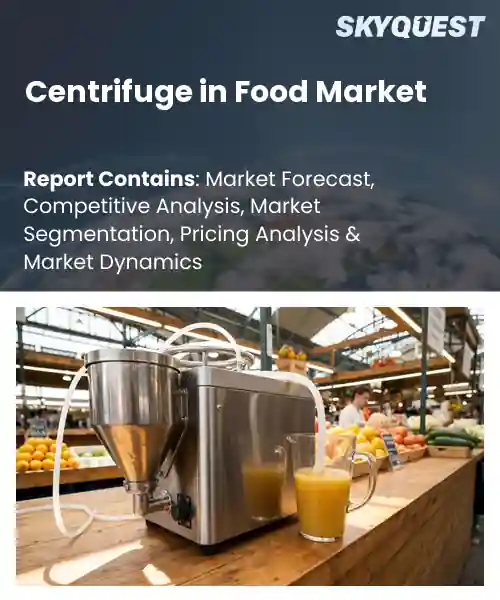
Centrifuge in Food Market
Report ID: SQMIG30C2192
Report ID: SQMIG30C2192
[email protected]
USA +1 351-333-4748
Report ID:
SQMIG30C2192 |
Region:
Global |
Published Date: February, 2026
Pages:
157
|Tables:
61
|Figures:
75


Global Centrifuge In Food Market size was valued at USD 25.5 Billion in 2024 and is poised to grow from USD 30.68 Billion in 2025 to USD 134.56 Billion by 2033, growing at a CAGR of 20.3% during the forecast period (2026-2033).
Primary driver of the centrifuge in the food market is the demand for higher throughput and consistent product quality, which has transformed separation technologies from lab tools into production equipment. The market encompasses specialized decanter, disc‑stack and tubular centrifuges used across dairy, edible oils, beverages and ingredient recovery; it matters because centrifugal separation increases yield, reduces microbial load, and shortens processing time. Over decades vendors have progressed from simple machines to hygienic, automated systems compliant with food safety standards, and examples such as cream skimming in dairy and juice clarification in beverage processing illustrate how technological evolution has enabled scale.A critical factor driving global centrifuge adoption is the convergence of stricter food safety regulations and pressure to improve profitability, because compliance forces processors to adopt hygienic, closed separation systems that simultaneously reduce contamination risk and increase recoverable product. As yield improvements cut raw material waste, producers can justify capital expenditure on high-speed disc‑stack centrifuges, evidenced by dairy plants recovering whey proteins for value-added ingredients and edible oil refiners boosting extraction rates through continuous centrifugation. Moreover, demand for automation and connectivity creates opportunities for predictive maintenance and energy-optimized operation, enabling smaller manufacturers and emerging-market facilities to scale without sacrificing quality.
How is IoT-enabled automation enhancing centrifuge performance in the food market?
IoT enabled automation links sensors, edge controllers and cloud analytics to raise centrifuge performance in the food market. Key aspects include real time monitoring of vibration temperature and feed characteristics predictive maintenance that avoids unexpected stops and closed loop control that keeps separation outcomes consistent. The current state shows growing adoption where food processors demand uptime hygiene and uniform product quality so connected centrifuges improve yield consistency and traceability while lowering waste and manual intervention. Instances range from remote condition dashboards to adaptive control that smooths variable feed streams and shortens maintenance cycles making production more resilient and responsive.Alfa Laval February 2025, launched Optiwia a plug and play water recirculation upgrade for separators which when paired with IoT connected services enables remote optimisation of cooling and process parameters supporting reduced downtime improved resource use and greater operational efficiency in beverage and food processing.
Market snapshot - (2026-2033)
Global Market Size
USD 25.5 Billion
Largest Segment
Automated Centrifuges
Fastest Growth
Automated Centrifuges
Growth Rate
20.3% CAGR
To get more insights on this market click here to Request a Free Sample Report
Global centrifuge in food market is segmented by automation level, material types and region. Based on automation level, the market is segmented into Manual Centrifuges and Automated Centrifuges. Based on material types, the market is segmented into Stainless Steel and Plastic Composites. Based on region, the market is segmented into North America, Europe, Asia Pacific, Latin America and Middle East & Africa.
Manual Centrifuges segment dominates because their lower acquisition and operational complexity align with the needs of small and midsized food processors who prioritize flexibility and predictable maintenance. The straightforward mechanical design reduces training requirements and speeds deployment in diverse product lines, while proven reliability in batch operations fosters continued specification by established producers, creating a broad installed base that sustains aftermarket services and spare parts ecosystems.
However, Automated Centrifuges are the most rapidly expanding area as processors pursue consistency, higher throughput, and integration with process control systems. Advances in automation, remote monitoring, and safety interlocks address labor constraints and traceability demands, accelerating adoption among scale focused manufacturers and enabling new continuous processing models that open opportunities for lifecycle services and software enabled value propositions.
Stainless Steel segment dominates because its inherent corrosion resistance, smooth surface finish and thermal stability make it the default choice for food processors prioritizing sanitation and long equipment life. Compatibility with clean in place protocols and non reactivity with food chemistries simplifies validation and regulatory compliance for manufacturers, encouraging specification by OEMs and end users who value durable materials that minimize contamination risk and downtime.
Meanwhile, Plastic Composites are emerging as the fastest growing area due to lightweight construction, design flexibility and cost advantages for specialized or disposable processing lines. Innovations in food grade formulations and improved chemical resistance expand application scope, while faster tooling and lower capital intensity allow newer entrants to trial centrifuge based processes, catalyzing product specific adaptations and aftermarket service models.
To get detailed segments analysis, Request a Free Sample Report
Asia Pacific dominance in the centrifuge in food market stems from a combination of sustained industrial modernization, concentrated manufacturing capabilities, and dynamic demand across multiple food processing segments. Advanced production clusters and strong supplier networks enable rapid customization of centrifuge solutions for regional processors, while integrated supply chains reduce lead times and costs. Robust investment in automation and sanitary design promotes adoption in dairy, beverage, oil and specialty ingredient processing. Collaboration between equipment makers and large food processors supports iterative product refinement and quality assurance. Technology transfer from adjacent sectors, skilled engineering talent, and proactive standards alignment further strengthen competitive advantage, allowing Asia Pacific to capture a broad spectrum of applications and deliver scalable, cost effective centrifuge systems tailored to diverse food industry needs.
Centrifuge in Food Market Japan benefits from precision engineering heritage and a strong integration between equipment manufacturers and food producers. Focus on high hygiene standards and compact, energy efficient designs drives demand for specialized centrifuge solutions suited to dairy, beverage and seafood processing. Local suppliers emphasize reliability, service support and customization, enabling processors to meet strict quality requirements. Collaboration with research institutions encourages innovation and continuous improvement in separation technologies.
Centrifuge in Food Market South Korea leverages strong electronics manufacturing expertise to advance smart centrifuge controls and predictive maintenance. Emphasis on process automation and compact footprint supports food processors and packaged food manufacturers. Domestic suppliers prioritize after sales service and modular designs that facilitate integration into existing production lines and supply chains. Industry collaboration promotes adaptation of separation technologies for dairy and beverage sectors, reinforcing operational efficiency and product consistency.
Rapid expansion in North America results from a convergence of technological adoption, strong food processing infrastructure, and active investment in food safety and quality assurance practices. Processors increasingly prioritize efficiency gains and product consistency, prompting upgrades to modern separation equipment with enhanced cleanability and automation. Close collaboration between centrifuge manufacturers and major food companies accelerates customization for diverse applications, including oil separation and ingredient clarification. Emphasis on after sales service, regulatory compliance, and lifecycle support strengthens buyer confidence. Distribution networks and service ecosystems facilitate timely deployment and maintenance, while an ecosystem of specialized engineering firms and research institutions supports iterative improvements and integration of digital monitoring capabilities into centrifuge platforms. Growing focus on resource optimization and waste reduction encourages adoption of high efficiency separators, while flexible financing models and local manufacturing hubs lower barriers to procurement.
Centrifuge in Food Market United States is characterized by scale processors seeking automation, sanitation and integration with plant level controls. Demand for customizable centrifuge systems is driven by varied processing streams, including oils, dairy and beverage lines. Suppliers focus on robust after sales networks, services and data enabled monitoring to minimize downtime. Collaboration with engineering firms and laboratories enables validation of separation performance and tailored solutions for complex processing environments.
Centrifuge in Food Market Canada shows emphasis on sanitary design and remote monitoring suitable for dispersed processing facilities. Regional processors value modular centrifuge units that enable upgrades and maintenance. Local suppliers and service partners emphasize responsiveness and regulatory alignment to support dairy, beverage and specialty ingredient producers. Collaboration with research centers and equipment vendors fosters adaptation of separation technology for challenging feedstocks, while logistics networks support spare parts and servicing.
Europe is strengthening its position through a focus on engineering excellence, regulatory harmonization and sustainable processing practices that align with evolving food industry priorities. Manufacturers emphasize hygienic design, material traceability and energy efficient operation to meet stringent quality and environmental expectations. Well established supplier networks and specialized engineering consultancies facilitate bespoke solutions for complex processing needs across dairy, beverage and oil sectors. Cross border collaboration and standards alignment support quicker technology adoption, while investment in research and pilot facilities enables refinement of separation processes. Emphasis on service quality, spare parts availability and training ensures long term operational reliability for food processors adopting advanced centrifuge equipment. Digitalization initiatives and integration of condition monitoring enhance uptime and predictive servicing, while circular economy principles encourage designs that reduce waste and recover valuable streams. Strong domestic markets support scale up and export orientation.
Centrifuge in Food Market Germany emphasizes engineering depth and robust supplier ecosystems that deliver hygienic separation solutions. Processors and equipment makers collaborate to tailor centrifuge specifications for high throughput dairy, oil and beverage applications. Local firms prioritize energy efficiency, material traceability and compliance with strict hygiene standards. Strong manufacturing and service networks ensure parts supply and after sales support, while research partnerships drive improvements in separation efficiency and machine reliability.
Centrifuge in Food Market United Kingdom benefits from engineering services and a focus on modular, maintainable centrifuge designs suitable for diverse processing sites. Suppliers emphasize hygienic construction and digital diagnostics to support uptime. Food manufacturers collaborate with equipment vendors and research institutions to validate separation methods for beverage, dairy and ingredient applications. After sales training, spare parts readiness and local service providers are important for operational continuity across processing facilities.
Centrifuge in Food Market France prioritizes sanitary design and process versatility to serve a varied culinary sector. Equipment suppliers focus on compact, hygienic centrifuge units suitable for artisan and industrial processors alike. Strong links between manufacturers and culinary research centers foster tailored separation solutions for dairy, wine and specialty oils. Emphasis on after sales maintenance, spare part logistics and training helps ensure consistent product quality and long term equipment performance.
To know more about the market opportunities by region and country, click here to
Buy The Complete Report
Rising Demand For Dairy Processing
Demand for processed dairy products has expanded consumer expectations for consistent quality and safety, prompting food producers to invest in centrifuge technologies that enable efficient separation and clarification. Manufacturers perceive centrifuges as essential for improving product uniformity and shelf stability while reducing manual interventions in production lines. Adoption decisions are influenced by the potential to enhance throughput and reduce downtime through reliable separation, which supports scaling operations and meeting retailer specifications, thereby creating steady procurement incentives across the dairy and beverage subsectors.
Stringent Food Safety Regulations
Stricter regulatory emphasis on hygiene, contamination control, and product consistency compels food processors to upgrade separation equipment and practices, making centrifuges a preferred solution. Centrifugation supports clarified liquids and solids removal without extensive chemical use, aligning with regulatory expectations for clean processing and traceability. The capability to integrate with sanitation protocols and to deliver reproducible separation outcomes reduces compliance risk and supports certification efforts, encouraging procurement of modern centrifuge systems by companies seeking to demonstrate adherence to food safety standards and protect brand integrity.
High Capital Investment Requirement
Significant upfront expenditure for acquiring advanced centrifuge systems, coupled with installation and validation costs, poses a barrier for small and medium sized food processors and deters rapid market penetration. Budget limitations lead companies to prioritize other process upgrades, delaying centrifuge adoption despite recognized benefits. Long procurement cycles and the need for skilled technical support further complicate investment decisions. Consequently, capital intensity constrains fleet turnover and moderates demand growth as buyers weigh return on investment against alternative, less costly processing options.
Complex Maintenance Requirements
Centrifuge systems often require specialized maintenance procedures and trained personnel to manage routine servicing, troubleshooting, and part replacement, which increases operational burden for processors. The need for precise balancing, seal maintenance, and periodic inspections can interrupt production schedules and necessitate planned downtime, challenging continuous operations. Smaller facilities may lack in house expertise, leading to dependence on external service providers and longer repair lead times. These operational complexities reduce the attractiveness of centrifuge adoption for operators seeking low complexity solutions, thereby constraining market expansion.
Request Free Customization of this report to help us to meet your business objectives.
The competitive landscape for centrifuges in the global food market is driven by equipment suppliers partnering with food tech and cultivated protein firms, targeted M&A to secure scale up capabilities, and process innovations such as centrifuge based perfusion for continuous harvest. Examples include equipment partnerships to industrialize perfusion and recent supplier collaborations with cultivated meat producers to lower processing costs and accelerate commercialization.
Top Player’s Company Profile
Recent Developments
SkyQuest’s ABIRAW (Advanced Business Intelligence, Research & Analysis Wing) is our Business Information Services team that Collects, Collates, Correlates, and Analyses the Data collected by means of Primary Exploratory Research backed by robust Secondary Desk research. As per SkyQuest analysis, the global centrifuge in food market is being propelled by demand for higher throughput and consistent product quality as a key driver, while a second driver is stricter food safety regulations pushing hygienic, closed separation systems. A significant restraint remains the high capital investment requirement and complex maintenance burden that limit adoption among smaller processors. Asia Pacific emerges as the dominating region due to industrial modernization, supplier networks and rapid customization, and Manual Centrifuges remain the dominating segment because lower acquisition cost and operational simplicity suit small and midsized processors. Vendors benefit from digital integration and service models that support scalability and yield recovery.
| Report Metric | Details |
|---|---|
| Market size value in 2024 | USD 25.5 Billion |
| Market size value in 2033 | USD 134.56 Billion |
| Growth Rate | 20.3% |
| Base year | 2024 |
| Forecast period | (2026-2033) |
| Forecast Unit (Value) | USD Billion |
| Segments covered |
|
| Regions covered | North America (US, Canada), Europe (Germany, France, United Kingdom, Italy, Spain, Rest of Europe), Asia Pacific (China, India, Japan, Rest of Asia-Pacific), Latin America (Brazil, Rest of Latin America), Middle East & Africa (South Africa, GCC Countries, Rest of MEA) |
| Companies covered |
|
| Customization scope | Free report customization with purchase. Customization includes:-
|
To get a free trial access to our platform which is a one stop solution for all your data requirements for quicker decision making. This platform allows you to compare markets, competitors who are prominent in the market, and mega trends that are influencing the dynamics in the market. Also, get access to detailed SkyQuest exclusive matrix.
Table Of Content
Executive Summary
Market overview
Parent Market Analysis
Market overview
Market size
KEY MARKET INSIGHTS
COVID IMPACT
MARKET DYNAMICS & OUTLOOK
Market Size by Region
KEY COMPANY PROFILES
Methodology
For the Centrifuge in Food Market, our research methodology involved a mixture of primary and secondary data sources. Key steps involved in the research process are listed below:
1. Information Procurement: This stage involved the procurement of Market data or related information via primary and secondary sources. The various secondary sources used included various company websites, annual reports, trade databases, and paid databases such as Hoover's, Bloomberg Business, Factiva, and Avention. Our team did 45 primary interactions Globally which included several stakeholders such as manufacturers, customers, key opinion leaders, etc. Overall, information procurement was one of the most extensive stages in our research process.
2. Information Analysis: This step involved triangulation of data through bottom-up and top-down approaches to estimate and validate the total size and future estimate of the Centrifuge in Food Market.
3. Report Formulation: The final step entailed the placement of data points in appropriate Market spaces in an attempt to deduce viable conclusions.
4. Validation & Publishing: Validation is the most important step in the process. Validation & re-validation via an intricately designed process helped us finalize data points to be used for final calculations. The final Market estimates and forecasts were then aligned and sent to our panel of industry experts for validation of data. Once the validation was done the report was sent to our Quality Assurance team to ensure adherence to style guides, consistency & design.
Analyst Support
Customization Options
With the given market data, our dedicated team of analysts can offer you the following customization options are available for the Centrifuge in Food Market:
Product Analysis: Product matrix, which offers a detailed comparison of the product portfolio of companies.
Regional Analysis: Further analysis of the Centrifuge in Food Market for additional countries.
Competitive Analysis: Detailed analysis and profiling of additional Market players & comparative analysis of competitive products.
Go to Market Strategy: Find the high-growth channels to invest your marketing efforts and increase your customer base.
Innovation Mapping: Identify racial solutions and innovation, connected to deep ecosystems of innovators, start-ups, academics, and strategic partners.
Category Intelligence: Customized intelligence that is relevant to their supply Markets will enable them to make smarter sourcing decisions and improve their category management.
Public Company Transcript Analysis: To improve the investment performance by generating new alpha and making better-informed decisions.
Social Media Listening: To analyze the conversations and trends happening not just around your brand, but around your industry as a whole, and use those insights to make better Marketing decisions.
REQUEST FOR SAMPLE
 REQUEST FREE CUSTOMIZATION


Want to customize this report? This report can be personalized according to your needs. Our analysts and industry experts will work directly with you to understand your requirements and provide you with customized data in a short amount of time. We offer $1000 worth of FREE customization at the time of purchase.
Feedback From Our Clients


 USA (+1) 351-333-4748

