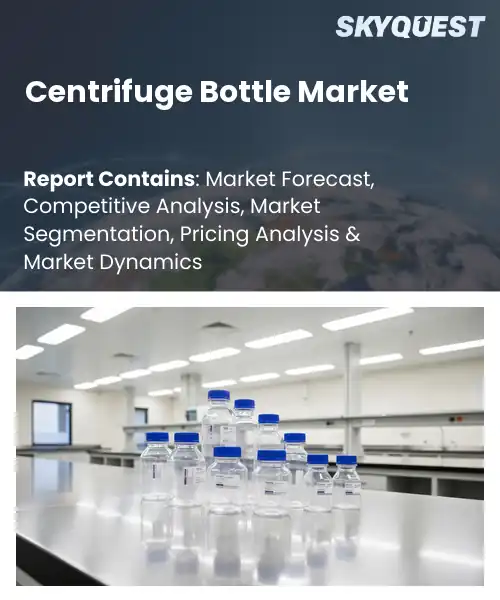
Centrifuge Bottle Market
Report ID: SQMIG35A3257
Report ID: SQMIG35A3257
[email protected]
USA +1 351-333-4748
Report ID:
SQMIG35A3257 |
Region:
Global |
Published Date: February, 2026
Pages:
157
|Tables:
143
|Figures:
78


Global Centrifuge Bottle Market size was valued at USD 354.1 Million in 2024 and is poised to grow from USD 382.43 Million in 2025 to USD 707.85 Million by 2033, growing at a CAGR of 8.0% during the forecast period (2026-2033).
Research and development of new technologies in laboratory diagnostic testing, as labs are utilizing these bottles to increase throughput on their samples and thus require more reliable containers that will maintain sample integrity through the entire process. While also providing safety to the operators before the sample arrives at the clinical laboratory or pharmaceutical development, which leads to good downstream results. The evolution of the centrifuge bottle market can be traced when manufacturers made their first transition from glass to polymeric designs based on growing concerns from hospitals. With regards to contamination incidences and throughput pressure, hospitals began converting to polypropylene bottles to reduce the risk of breakage and cross-contamination, thus creating better patient outcomes. The tightened regulation of biosafety and waste management has created additional product design innovation opportunities in addition to new business opportunities. Because of the introduction of new and stricter regulations require that every laboratory dispose of unsafe and/or disposable products and replace them with certified centrifuge vessels to ensure that products have a proper chain of custody and traceability. As a result, manufacturers are continuing to invest in developing features such as tamper-evident caps, barcoded surfaces and chemically resistant polymers, which allow laboratories to automate their sample processing and comply to the requirements for audits from their accrediting organizations.
How is Automation Improving Manufacturing Efficiency in the Centrifuge Bottle Market?
The centrifuge bottle industry is being enhanced by improved automation, where core manufacturing steps are becoming automated and combined with a digital quality control method. Some of these areas include automated molding to ensure the wall thickness of bottles is consistently creating robotic loading and unloading of bottles to increase speed at which bottles are made.
Manufacturers are experiencing an increased demand from high-throughput laboratories and bioprocessing manufacturers, which is leading to a surge of manufacturers implementing factory automation into their operations. These improvements in automation are reducing the probability of contamination and product variation and providing manufacturers with better predictability when scaling their operations. Manufacturers of consumable products have shifted production towards an automated manufacturing line to provide them with the ability to support consistent production and faster delivery.
Market snapshot - 2026-2033
Global Market Size
USD 354.1 Million
Largest Segment
Polypropylene Bottles
Fastest Growth
Polypropylene Bottles
Growth Rate
8.0% CAGR
To get more insights on this market click here to Request a Free Sample Report
Global centrifuge bottle market is segmented into product type, design type, capacity size, end user, sales channel and region. Based on product type, the market is segmented into polypropylene bottles, polycarbonate bottles, glass bottles, and others. Based on design type, the market is segmented into conical centrifuge bottles and round centrifuge bottles. Based on capacity size, the market is segmented into 50ml - 100ml, 100ml - 250ml and above 250ml. Based on end user, the market is segmented into healthcare and research facilities. Based on sales channel, the market is segmented into online sales, offline retail and direct sales. Based on region, the market is segmented into North America, Europe, Asia Pacific, Latin America, and Middle East & Africa.
As per centrifuge bottle market analysis, the polypropylene bottles segment leads the way due to the properties of chemical inertness and thermal stability, which are the main reasons for their use in standard centrifugation. Using these centrifuge bottles in centrifugation lowers the risk of sample contamination and equipment failure. Additionally, polypropylene has been proven compatible with most laboratory solvents and sterilization methods, thereby minimizing disruptions in procedures. Lastly, the lower costs of both polypropylene as a raw material and to handle it throughout the supply chain create more simplicity in the purchasing process.
As per centrifuge bottle market outlook, the polycarbonate bottles segment is experiencing rapid growth because of the physical strengths of optical clarity and impact strength, which lend themselves to both real-time inspection as well as at high-speed use applications. New developments being made to support improved sterilization and reuse will be especially appealing to those with advanced workflow, and so they will increase to meet demand for applications that require both visibility and strength, thereby providing additional opportunities for premium offerings that can compete based on performance.
As per centrifuge bottle market forecast, direct sales segment leads because institutional procurement often requires tailored solutions, technical validation, and coordinated supply scheduling that vendor relationships provide. The dedicated sales force provides consulting assistance with regards to material selection, compliance documentation and batch traceability, all of which reduce the friction associated with procuring from labs that have strict quality protocols. Long-term contracts and integrated service contracts further connect suppliers to the operational workflows of their laboratories, thereby creating reliable sources of predictable supplies for their centrifuge operations that are critical to mission success.
However, online sales are the fastest-growing channel because digital sales platforms simplify the ordering process, provide detailed specifications and user reviews of products, and reduce the time required to complete a procurement transaction. Integration with inventory systems and targeted digital marketing to smaller and regional buyers represents new sources of demand and allows for rapid penetration into the market for specialty centrifuge bottle types.
To get detailed segments analysis, Request a Free Sample Report
As per centrifuge bottle market regional outlook, the market is centralized in North America, because of advanced laboratory infrastructures, heavy end user demand from clinical/research institutions, and efficient supply chain processes (allowing for rapid product availability and compliance with stringent quality standards). The presence of many of the world's leading manufacturers/distributors also stimulates product innovation, extensive validation services, and strong after-sales support for buyers.
The U.S. centrifuge bottle market is characterized by considerable national demand from diagnostic laboratories, academic research centers, and biopharma development facilities. Major factors influencing buyers' purchasing decisions are validating quality, traceability, and compatibility with automated workflows; all suppliers must provide large assortments of products and comprehensive technical support.
As per centrifuge bottle market regional forecast, Canada market is made up of a balanced combination of public research institutions, clinical laboratories, and small-scale industrial users requiring dependable and traceable consumables. Purchasing decisions center around supplier qualification, logistics resilience across regional/geographic boundaries, and coordinated purchasing arrangements within institutional networks. Local distributors and manufacturers work together to deliver not only technical training but also inventory management systems. Evolving laboratory practices influence demand for specialty bottle styles clearly compatible with standard centrifuge machines.
European markets experience expansion because of regions harmonizing their respective standards to improve the quality of scientific products and services used in the testing/production of diagnostic drugs or devices. Creating a dense ecosystem of industry players, and the existence of solid manufacturing capabilities focused primarily on producing precision consumables. Coordinated purchasing through healthcare systems and research consortia has produced greater visibility of standardized centrifuge bottle solution options, and manufacturers' reduction initiatives have assisted in the commonly used adoption of durable, validated solution formats. Additionally, manufacturers within the European region continue to be aligned with regulatory requirements, certification processes, and compatibility with automated laboratory systems to help facilitate the extended use of centrifuge bottle solutions throughout clinical/research laboratories throughout Europe.
As per centrifuge bottle industry analysis, Germany has a strong centrifuge bottle market primarily driven by the country's precision manufacturing capabilities, integration with industrial/research institutions, and strong quality assurance/certification measures. End-users expect to receive consistent products and fully validated supply chains which have driven suppliers to maintain strict production controls, as well as provide frequent, local technical support. Collaboration between manufacturers and research institutions promotes the development of more tailored products for specialized applications; and effective logistics and established laboratory infrastructures will sustain the demand for centrifuge bottle solutions across diagnostic.
The centrifuge bottle industry the United Kingdom continues to be influenced by the high level of usage within biotech clusters/research centres/contract research organizations; which require consumables that are adaptable and validated. Suppliers are actively adjusting their product development, fulfilment models, and partnership offerings to meet the application-based needs of their customers.
In France, the industry has witnessed market growth and diversification due to the expanding research community and industry development. There has been an increasing centrifuge bottle market trends towards procurement balancing initial costs with the need for certified eco-friendly consumables, thus encouraging suppliers to develop validated plastic bottle products that are recyclable. Also, the establishment of local cooperative relationships between manufacturers and university research laboratories has enabled suppliers to modify their products according to established protocols. Additionally, distributors provide education, traceability regarding the source of samples, and inventory solutions to assist with the changing needs of clinical, academic, and industrial laboratories and service delivery models.
The Asia Pacific region is enhancing its standing as a leader in the market by coordinating efforts for developing laboratory infrastructure, increasing the activities of pharmaceutical and biotechnology companies, and building the capabilities of regional manufacturers to provide high-quality verified consumables. The focus on production levels, creating local products, and reducing lead time increases supply chain resiliency. Competitive prices are attracting suppliers from either side of the ocean to expand their businesses.
In Japan, the centrifuge bottle market growth is characterized by the need for high-quality consumables, rigorous quality specifications, and compatibility with automated laboratories. Japanese and specialized suppliers are concentrating on quality materials, traceability, and production controls to meet customer demands. Distribution provides both technical support and verified supply chains. Collaboration between researchers and original equipment manufacturers will provide niche formats, as well as better qualification of products. Japan remains a recognized supplier of laboratory consumables.
In South Korea, the centrifuge bottle market is largely driven by an active biotech manufacturing environment. Consumers want reliable, verified consumables for use in production and research. Suppliers are placing great emphasis on process fidelity, material quality, and compatibility with automatic equipment. Distributors provide both logistics and technical support. Partnerships and joint ventures with international manufacturers will grow capabilities and improve the quality of products in South Korea, and continued investment in laboratory infrastructure will facilitate the use of centrifuge bottles in clinical, research, and industrial applications throughout the country.
To know more about the market opportunities by region and country, click here to
Buy The Complete Report
Increasing Biopharmaceutical Production
Advancements In Centrifuge Technology
Stringent Regulatory Requirements
High Initial Equipment Costs
Request Free Customization of this report to help us to meet your business objectives.
Competitive landscape shows consolidation and strategic partnerships driven by demand for contamination free single use containers and integration with downstream processing. For example, Eppendorf purchased Koki’s centrifuge business in 2020; Thermo Fisher expanded its SteriBIOS and CentriPAK single-use containers; Alfa Laval commercialized a product called CultureOne that integrates a disposable Spinsert bowl; private equity has also invested in the development of a variety of single-use platforms, which have led to acquisitions and the bundling of product platforms.
SkyQuest’s ABIRAW (Advanced Business Intelligence, Research & Analysis Wing) is our Business Information Services team that Collects, Collates, Correlates, and Analyses the Data collected by means of Primary Exploratory Research backed by robust Secondary Desk research.
As per SkyQuest analysis, the global centrifuge bottle market is driven by a growing need for high-quality consumables for biomedical research and diagnostics. There is also increased production of biopharmaceuticals, which further helps drive demand for validated single-use disposable bottles. The global centrifuge bottle market faces significant constraints from stringent regulations related to sterilization, traceability and validation of materials, which significantly slow down the procurement process and create barriers for smaller suppliers.
North America continues to account for a large centrifuge bottle market share of global spending on laboratory supplies due to factors such as a highly developed laboratory infrastructure and an abundance of established supply chains. Among the various types of bottles utilized in the global centrifuge bottle market, polypropylene will continue to lead the way due to its chemical resistance, thermal stability, and cost advantages over other types of bottles. To keep pace with the changing demands of laboratory workflows, manufacturers are working on automation, sustainable materials, and customized products.
| Report Metric | Details |
|---|---|
| Market size value in 2024 | USD 354.1 Million |
| Market size value in 2033 | USD 707.85 Million |
| Growth Rate | 8.0% |
| Base year | 2024 |
| Forecast period | 2026-2033 |
| Forecast Unit (Value) | USD Million |
| Segments covered |
|
| Regions covered | North America (US, Canada), Europe (Germany, France, United Kingdom, Italy, Spain, Rest of Europe), Asia Pacific (China, India, Japan, Rest of Asia-Pacific), Latin America (Brazil, Rest of Latin America), Middle East & Africa (South Africa, GCC Countries, Rest of MEA) |
| Companies covered |
|
| Customization scope | Free report customization with purchase. Customization includes:-
|
To get a free trial access to our platform which is a one stop solution for all your data requirements for quicker decision making. This platform allows you to compare markets, competitors who are prominent in the market, and mega trends that are influencing the dynamics in the market. Also, get access to detailed SkyQuest exclusive matrix.
Table Of Content
Executive Summary
Market overview
Parent Market Analysis
Market overview
Market size
KEY MARKET INSIGHTS
COVID IMPACT
MARKET DYNAMICS & OUTLOOK
Market Size by Region
KEY COMPANY PROFILES
Methodology
For the Centrifuge Bottle Market, our research methodology involved a mixture of primary and secondary data sources. Key steps involved in the research process are listed below:
1. Information Procurement: This stage involved the procurement of Market data or related information via primary and secondary sources. The various secondary sources used included various company websites, annual reports, trade databases, and paid databases such as Hoover's, Bloomberg Business, Factiva, and Avention. Our team did 45 primary interactions Globally which included several stakeholders such as manufacturers, customers, key opinion leaders, etc. Overall, information procurement was one of the most extensive stages in our research process.
2. Information Analysis: This step involved triangulation of data through bottom-up and top-down approaches to estimate and validate the total size and future estimate of the Centrifuge Bottle Market.
3. Report Formulation: The final step entailed the placement of data points in appropriate Market spaces in an attempt to deduce viable conclusions.
4. Validation & Publishing: Validation is the most important step in the process. Validation & re-validation via an intricately designed process helped us finalize data points to be used for final calculations. The final Market estimates and forecasts were then aligned and sent to our panel of industry experts for validation of data. Once the validation was done the report was sent to our Quality Assurance team to ensure adherence to style guides, consistency & design.
Analyst Support
Customization Options
With the given market data, our dedicated team of analysts can offer you the following customization options are available for the Centrifuge Bottle Market:
Product Analysis: Product matrix, which offers a detailed comparison of the product portfolio of companies.
Regional Analysis: Further analysis of the Centrifuge Bottle Market for additional countries.
Competitive Analysis: Detailed analysis and profiling of additional Market players & comparative analysis of competitive products.
Go to Market Strategy: Find the high-growth channels to invest your marketing efforts and increase your customer base.
Innovation Mapping: Identify racial solutions and innovation, connected to deep ecosystems of innovators, start-ups, academics, and strategic partners.
Category Intelligence: Customized intelligence that is relevant to their supply Markets will enable them to make smarter sourcing decisions and improve their category management.
Public Company Transcript Analysis: To improve the investment performance by generating new alpha and making better-informed decisions.
Social Media Listening: To analyze the conversations and trends happening not just around your brand, but around your industry as a whole, and use those insights to make better Marketing decisions.
REQUEST FOR SAMPLE
 REQUEST FREE CUSTOMIZATION
Global Centrifuge Bottle Market size was valued at USD 354.1 Million in 2024 and is poised to grow from USD 382.43 Million in 2025 to USD 707.85 Million by 2033, growing at a CAGR of 8.0% during the forecast period (2026-2033).
Competitive landscape shows consolidation and strategic partnerships driven by demand for contamination free single use containers and integration with downstream processing; for example Eppendorf acquired Koki's centrifuge business in 2020, Thermo Fisher advanced SteriBIOS and CentriPAK single use containers, and Alfa Laval commercialized CultureOne with a disposable Spinsert bowl; private equity also backs single use platforms, prompting acquisitions and product platform bundling. 'Thermo Fisher Scientific', 'Corning Incorporated', 'Eppendorf AG', 'VWR International, LLC', 'Sartorius AG', 'Sigma-Aldrich Corporation', 'Fisher Scientific', 'Greiner Bio-One', 'PerkinElmer, Inc.', 'Beckman Coulter, Inc.', 'Axygen Scientific', 'Bio-Rad Laboratories, Inc.', 'MIDSCI', 'Starlab International GmbH', 'Falcon Plastics, Inc.', 'NEST Biotechnology', 'Occhio srl', 'Labcon North America', 'Eisco Scientific', 'Harten's Plastics'
Rising global demand for biologics and vaccines has increased the need for reliable and scalable clarification and separation processes, making centrifuge bottles indispensable in many production workflows. Manufacturers prioritise equipment that delivers consistent performance, reduces downtime, and integrates with existing downstream systems, driving procurement decisions towards advanced centrifuge consumables. The ability of centrifuge bottles to support sterile single use or easily cleaned operations enhances operational flexibility and reduces contamination risk, which in turn encourages adoption across contract manufacturers and in house production facilities focused on accelerating product development timelines.
Sustainable Material And Design: Manufacturers are prioritizing sustainable materials and thoughtful design to reduce environmental footprint across the centrifuge bottle lifecycle. Emphasis on recyclable polymers, reduced material thickness, and designs that enable easy decontamination and reuse is shaping product development. Buyers increasingly seek suppliers offering traceable supply chains and certifications reflecting responsible sourcing. This trend drives collaboration between material scientists and OEMs to balance chemical resistance, sterilization compatibility, and longevity while aligning with corporate sustainability commitments and end user preferences for greener laboratory consumables.
North America Dominates the Global Centrifuge Bottle Market


Want to customize this report? This report can be personalized according to your needs. Our analysts and industry experts will work directly with you to understand your requirements and provide you with customized data in a short amount of time. We offer $1000 worth of FREE customization at the time of purchase.
Feedback From Our Clients


 USA (+1) 351-333-4748

