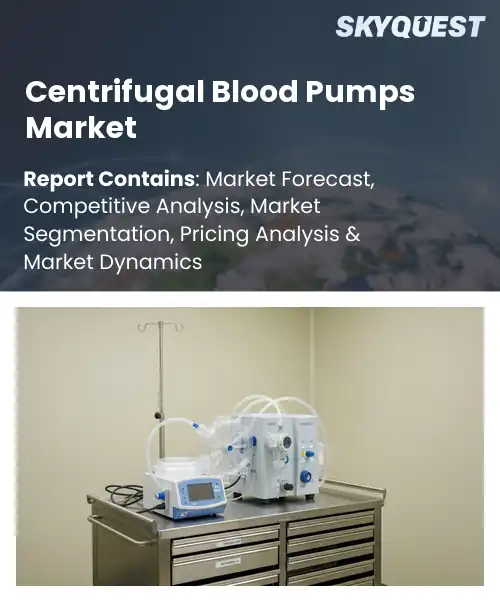
Centrifugal Blood Pumps Market
Report ID: SQMIG35A3660
Report ID: SQMIG35A3660
[email protected]
USA +1 351-333-4748
Report ID:
SQMIG35A3660 |
Region:
Global |
Published Date: June, 2026
Pages:
157
|Tables:
115
|Figures:
77


Global Centrifugal Blood Pumps Market size was valued at USD 582.5 Million in 2024 and is poised to grow from USD 623.97 Million in 2025 to USD 1085.4 Million by 2033, growing at a CAGR of 7.12% during the forecast period (2026-2033).
The primary drivers of centrifugal blood pumps market growth include an increase in prevalence of cardiovascular disease and growing use of extracorporeal circulation for both surgical and prolonged use of mechanical support. This causes the market to develop into a critical segment of medical devices. Centrifugal blood pumps are classified as implantable (internal) and extracorporeal (external) devices. They use rotating impellers to achieve low shear blood flow required for various medical procedures including cardiopulmonary bypass, ventricular assist device (VAD) use, and extracorporeal membrane oxygenation (ECMO). In the last 20 years, technological advancements in miniaturization, biocompatible coatings, and controller software have resulted in reduced risk of hemolysis and thrombosis; thus, physicians have shifted to centrifugal pumps for complex procedures performed in the ICU where they have improved monitoring and outcomes. The trend toward increased use of centrifugal devices for VADs is supported by an aging population and high prevalence of heart failure among elderly individuals.
Therefore, centrifugal pump manufacturers have increased production and continue to invest in R&D efforts to enhance durability and reduce antithrombotic pharmacotherapy requirements. As publications yield positive survival outcomes from clinical trials, reimbursement programs will be developed for both hospitals and payers for providing procured technology; this creates a market demand for financing innovation. The rapid deployment of ECMO to patients with respiratory viruses has resulted in the rapid adoption of centrifugal blood pumps and demonstrated the value of utilizing these devices during emergencies for the purposes of providing support to mobile ECMO teams and during surgery. Therefore suppliers pursue modular platforms and strategic partnerships to seize hospital networks and emerging market opportunities.
How is AI Improving Real-time Performance And Safety In Centrifugal Blood Pump Systems?
Centra-blood pump systems are benefitting from improved performance and safer user operations through AI-based (artificial intelligence) applications, including continuous sensor fusion, adaptive control algorithms and anomaly detection methods that promote stable and gentle blood flow. Specifically, the advanced capabilities provided by predictive control of the pump's speed help prevent suction events (that can cause serious blood trauma) and enable the use of automated alerts that decrease the frequency of false alarms when using the pump. In addition, the use of closed-loop controls will assist in maintaining perfusion of organs during rapidly changing conditions. Many current market trends point toward using embedded machine learning along with cloud-based analysis platforms that provide supporting information for perfusionists and surgical teams.
Both manufacturers and hospitals are engaged in piloting experiments involving both on-device and off-device performance benchmarks to provide clinical evaluations of their current use of pump systems in clinical settings. Example of this activity is LivaNova February 2026, where they announced the integration of the Essenz perfusion system and the Orrum Clinical Analytics CŌRE Insights platform, which highlights how AI driven analytics provide real-time benchmark data and decision support tools to perfusionists, enhancing both pump operational efficiency and patient safety while supporting market development by allowing for more definitive clinical outcome evaluations.
Market snapshot - (2026-2033)
Global Market Size
USD 582.5 Million
Largest Segment
Extracorporeal Centrifugal Pumps
Fastest Growth
Implantable Centrifugal Pumps
Growth Rate
7.12% CAGR
To get more insights on this market click here to Request a Free Sample Report
Global centrifugal blood pumps market is segmented by product type, application, end-user, distribution and region. Based on product type, the market is segmented into Extracorporeal Centrifugal Pumps and Implantable Centrifugal Pumps. Based on application, the market is segmented into Cardiopulmonary Bypass (CPB), ECMO (Extracorporeal Membrane Oxygenation) and Ventricular Assist Devices (VAD). Based on end-user, the market is segmented into Hospitals (Cardiac Surgery), Intensive Care Units and Research Institutes. Based on distribution, the market is segmented into Direct Sales and Distributors. Based on region, the market is segmented into North America, Europe, Asia Pacific, Latin America and Middle East & Africa.
As per centrifugal blood pumps market analysis, the extracorporeal centrifugal pumps category dominates due to being the workhorse of the intraoperative and critical care setting, where temporary circulatory support is partially required. Established clinical protocols (along with the supplier's focus on reliability) support hospital-wide adoption, along with funding on training and service infrastructure to support increased investment in refinement and procurement strategies that maintain the company's leading position.
As per centrifugal blood pumps market forecast, implantable centrifugal pumps have emerged with the fastest growth rate as a result of miniaturization technologies and the use of biocompatible materials for support of function to the heart. Greater clinician acceptance of long-term durable circulatory assistance and continued improvements in regulatory clearances for chronic indications will continue to drive development of implantable devices for the treatment of patients with long-term heart failure.
The ECMO subsystem is unique because it creates a high reliability, continuous flow of fluid through a pump over extended periods of time and under extreme conditions while maintaining an acceptable level of margin for damage to the blood. These factors drive the manufacturer's selection of products and technologies that can withstand long term use, provide a method of monitoring, have a design that minimizes the risk of trauma to the blood, and ultimately lead to the development of advanced centrifugal pumps for use in ECMO applications.
As per centrifugal blood pumps market outlook, VAD is now the most rapidly growing segment due to advancements made in implantable pump technology, and the fact that there is increasing acceptance for using long-term mechanical circulatory support. Improvement in device size and weight, patient care pathways, and evidence- based VAD use for destination therapy will lead to innovation and continued market opportunity for manufacturers and firms engaged in the provision of VAD systems.
To get detailed segments analysis, Request a Free Sample Report
The global centrifugal blood pumps market is dominated by North America thanks to factors such as innovative technologies used in clinical practice; manufacturers doing research in-country; and clinical/billing regulations enabling companies’ products being used more widely throughout the region. North America has many interstate trials taking place between existing manufacturers and larger medical facilities as well as high-level of post market follow up to give confidence to doctors using the devices. There is a mature supply chain and established distribution systems within North America that support timely supply of product, as well as requirements for continuing education/training of professionals using centrifugal blood pump devices in environments involving multiple procedures or medications that may not be used on an inpatient basis which keeps up demand; therefore providing opportunity for continual technical advancements related to the centrifugal blood pump industry. The regulatory path to market (i.e., through Health Canada and FDA) for new device iterations are well established, therefore enabling faster entry into the marketplace than cultures with less mature regulatory processes; also lending smaller payer networks with better supply to utilize centrifugal blood pump devices at similar levels of clinical confidence does help to support manufacturer sales growth in the North American market. Finally, patient knowledge related to referral networks enables consistent utilization at tertiary care hospitals in the US, further reinforcing North America's prevalence within the available centrifugal blood pump markets.
The United States has a dense network of tertiary cardiac centers and leading device innovators and collaborative clinical research that facilitates the use of centrifugal pumps. Proven, established reimbursement and procurement practices have enabled the rapid adoption of new technologies, and strong manufacturer-clinician relationships provide insight into iterative design improvements. With the depth of professional education and specialty training programs available to support the use of advanced technology in complex care environments, clinical confidence is maintained, and clinicians are attracted to emerging trends in clinical practice and technology.
In Canada, centrifugal blood pumps are gradually being integrated into major cardiac centers and provincial referral hospitals, with the help of integrated clinical networks and health authority support. The collaborative development of post-market evidence between hospitals and academic institutions promotes a cautious review of advanced pump technology, resulting in careful but steady adoption. Clinician education initiatives, and centralized purchasing methods support access to devices and facilitate consistent use of devices throughout the country, as well as contribute to clinician competence, and informed procurement practices.
Europe is experiencing rapid expansion in the centrifugal blood pumps market driven by a convergence of clinical adoption within advanced cardiovascular centers, coordinated health technology assessment frameworks, and active innovation ecosystems. Strong collaboration between medical device manufacturers, academic research institutions, and specialized hospitals enables pragmatic evaluation and adoption of newer pump technologies. National reimbursement strategies and centralized procurement in several countries facilitate market access for clinically validated devices. Increasing emphasis on outcome based care and multicenter clinical collaboration supports wider acceptance among clinicians. Harmonized regulatory processes and pan regional professional networks further enable knowledge sharing and standardized training, accelerating diffusion of centrifugal pump solutions across diverse European healthcare systems. Presence of established medical device companies and manufacturing clusters supports supply sustainability and iterative product improvements. Patient advocacy and professional societies play a role in guideline development and clinician education, fostering confidence in device utilization across specialist and community care settings.
Centrifugal Blood Pumps Market Germany benefits from an established medtech industry, advanced cardiac centers, and structured health technology assessment processes that drive adoption of clinically validated devices. Close collaboration between manufacturers, university hospitals, and research institutes accelerates iterative design and clinical evaluation. Centralized procurement approaches in hospital networks, combined with clinician expertise and training programs, support widespread use of centrifugal pumps in cardiac and critical care settings, reinforcing Germany market leadership.
Centrifugal Blood Pumps Market United Kingdom shows accelerated adoption in tertiary cardiac centers supported by clinical evaluation networks and targeted adoption initiatives. Engagement between manufacturers and national health stakeholders promotes pragmatic assessment and phased device rollout. Focused clinician training, multicenter collaboration, and adaptive procurement models enable uptake in specialist hospitals and regional networks, positioning United Kingdom as a prominent adopter of innovative centrifugal pump therapies within Europe in clinical settings.
Centrifugal Blood Pumps Market France is at an emerging stage of adoption, characterized by implementation in university hospitals and cardiac centers. Health authority evaluations and collaborative pilot programs guide cautious but deliberate integration of centrifugal pump technologies. Partnerships between device makers and academic institutions support clinical studies and clinician training, while regional procurement initiatives and advocacy from professional societies foster expanding awareness and diffusion into broader French cardiovascular care pathways.
Asia Pacific is strengthening its position in the centrifugal blood pumps market through a combination of increasing clinical capacity, targeted investments in device engineering, growing local manufacturing capabilities. Regional centers of excellence are expanding experience with circulatory support devices, while collaborative research and cross border partnerships enable technology transfer and localized adaptation. Regulatory alignment and rising focus on evidence generation through multicenter studies are improving clinician confidence. Additionally, strategic alliances between global manufacturers and regional firms support supply chain resilience and scalable training programs, enabling wider clinical adoption across diverse healthcare systems and accelerating the region role in global device innovation and deployment. Government initiatives and hospital modernization programs facilitate investments and procurement for advanced cardiac support devices. Growing awareness among clinicians and patients, along with evolving reimbursement mechanisms and professional society endorsements, is fostering sustainable uptake and encouraging manufacturers to prioritize regional product development and service models.
Centrifugal Blood Pumps Market Japan leverages a mature medical device sector, leading cardiovascular centers, and industry academic collaborations that support device innovation and clinical evaluation. A culture of rigorous clinical assessment and structured regulatory pathways facilitates adoption of refined pump technologies. Training programs and hospital expertise enable skilled clinical use in complex cardiac care, while domestic manufacturing capacity and strategic partnerships with global firms sustain supply reliability and localized service.
Centrifugal Blood Pumps Market South Korea is advancing through a dynamic mix of local manufacturing strength, technology firms, and specialized cardiac hospitals adopting centrifugal pump solutions. Collaborative links between industry, universities, and clinical centers support iteration and clinical validation. Government encouragement of medical device innovation and export strategies enhance supply chain capabilities. Clinician education and centers of excellence facilitate consistent clinical use and integration into cardiac and intensive care pathways.
To know more about the market opportunities by region and country, click here to
Buy The Complete Report
Advancements In Pump Technology
Growing Cardiovascular Disease Burden
High Cost Of Advanced Devices
Regulatory Approval Complexity
Request Free Customization of this report to help us to meet your business objectives.
Competition in the global centrifugal blood pump market centers on differentiated pump architectures, hemocompatible coatings, and minimally invasive delivery; activity is driven by investments in maglev and percutaneous technologies. Major strategic moves include Johnson and Johnson's acquisition of Abiomed, recent clinical translations by BiVACOR using magnetic levitation, and CorWave's funded scale up of membrane pump technology, reflecting mergers and acquisitions, partnerships, and deep tech innovation.
SkyQuest’s ABIRAW (Advanced Business Intelligence, Research & Analysis Wing) is our Business Information Services team that Collects, Collates, Correlates, and Analyses the Data collected by means of Primary Exploratory Research backed by robust Secondary Desk research.
As per SkyQuest analysis, the global centrifugal blood pumps market is driven primarily by a rising burden of cardiovascular disease which expands demand for circulatory support, and by technological advances in pump design, miniaturization and AI-enabled control as a second driver that improve safety and adoption. High acquisition and maintenance costs remain a key restraint limiting uptake in smaller and lower resource hospitals. North America continues to dominate the market due to strong clinical infrastructure, reimbursement and manufacturer presence. The extracorporeal centrifugal pumps segment leads adoption across operative and critical care settings due to established workflows and supplier support.
| Report Metric | Details |
|---|---|
| Market size value in 2024 | USD 582.5 Million |
| Market size value in 2033 | USD 1085.4 Million |
| Growth Rate | 7.12% |
| Base year | 2024 |
| Forecast period | (2026-2033) |
| Forecast Unit (Value) | USD Million |
| Segments covered |
|
| Regions covered | North America (US, Canada), Europe (Germany, France, United Kingdom, Italy, Spain, Rest of Europe), Asia Pacific (China, India, Japan, Rest of Asia-Pacific), Latin America (Brazil, Rest of Latin America), Middle East & Africa (South Africa, GCC Countries, Rest of MEA) |
| Companies covered |
|
| Customization scope | Free report customization with purchase. Customization includes:-
|
To get a free trial access to our platform which is a one stop solution for all your data requirements for quicker decision making. This platform allows you to compare markets, competitors who are prominent in the market, and mega trends that are influencing the dynamics in the market. Also, get access to detailed SkyQuest exclusive matrix.
Table Of Content
Executive Summary
Market overview
Parent Market Analysis
Market overview
Market size
KEY MARKET INSIGHTS
COVID IMPACT
MARKET DYNAMICS & OUTLOOK
Market Size by Region
KEY COMPANY PROFILES
Methodology
For the Centrifugal Blood Pumps Market, our research methodology involved a mixture of primary and secondary data sources. Key steps involved in the research process are listed below:
1. Information Procurement: This stage involved the procurement of Market data or related information via primary and secondary sources. The various secondary sources used included various company websites, annual reports, trade databases, and paid databases such as Hoover's, Bloomberg Business, Factiva, and Avention. Our team did 45 primary interactions Globally which included several stakeholders such as manufacturers, customers, key opinion leaders, etc. Overall, information procurement was one of the most extensive stages in our research process.
2. Information Analysis: This step involved triangulation of data through bottom-up and top-down approaches to estimate and validate the total size and future estimate of the Centrifugal Blood Pumps Market.
3. Report Formulation: The final step entailed the placement of data points in appropriate Market spaces in an attempt to deduce viable conclusions.
4. Validation & Publishing: Validation is the most important step in the process. Validation & re-validation via an intricately designed process helped us finalize data points to be used for final calculations. The final Market estimates and forecasts were then aligned and sent to our panel of industry experts for validation of data. Once the validation was done the report was sent to our Quality Assurance team to ensure adherence to style guides, consistency & design.
Analyst Support
Customization Options
With the given market data, our dedicated team of analysts can offer you the following customization options are available for the Centrifugal Blood Pumps Market:
Product Analysis: Product matrix, which offers a detailed comparison of the product portfolio of companies.
Regional Analysis: Further analysis of the Centrifugal Blood Pumps Market for additional countries.
Competitive Analysis: Detailed analysis and profiling of additional Market players & comparative analysis of competitive products.
Go to Market Strategy: Find the high-growth channels to invest your marketing efforts and increase your customer base.
Innovation Mapping: Identify racial solutions and innovation, connected to deep ecosystems of innovators, start-ups, academics, and strategic partners.
Category Intelligence: Customized intelligence that is relevant to their supply Markets will enable them to make smarter sourcing decisions and improve their category management.
Public Company Transcript Analysis: To improve the investment performance by generating new alpha and making better-informed decisions.
Social Media Listening: To analyze the conversations and trends happening not just around your brand, but around your industry as a whole, and use those insights to make better Marketing decisions.
REQUEST FOR SAMPLE
 REQUEST FREE CUSTOMIZATION
Global Centrifugal Blood Pumps Market size was valued at USD 582.5 Million in 2024 and is poised to grow from USD 623.97 Million in 2025 to USD 1085.4 Million by 2033, growing at a CAGR of 7.12% during the forecast period (2026-2033).
Competition in the global centrifugal blood pump market centers on differentiated pump architectures, hemocompatible coatings, and minimally invasive delivery; activity is driven by investments in maglev and percutaneous technologies. Major strategic moves include Johnson and Johnson's acquisition of Abiomed, recent clinical translations by BiVACOR using magnetic levitation, and CorWave's funded scale up of membrane pump technology, reflecting mergers and acquisitions, partnerships, and deep tech innovation. 'Medtronic plc', 'Abbott Laboratories (HeartMate)', 'Thoratec (Abbott)', 'Getinge AB', 'LivaNova plc', 'Terumo Cardiovascular', 'Fresenius Medical Care', 'Xenios AG (Fresenius)', 'Eurosets srl', 'Braile Biomédica', 'MAQUET (Getinge)', 'Biomedicus (Medtronic)', 'Sorin Group (LivaNova)', 'CryoLife Inc.', 'Nikkiso Co. Ltd.', 'TandemHeart (LivaNova)', 'CorWave SA', 'Calon Cardio-Technology', 'BiVACOR Inc.', 'Evaheart Inc.'
Advances in centrifugal pump design, materials, and control systems have improved device reliability, hemocompatibility, and ease of integration into clinical workflows, thereby encouraging broader clinician adoption and hospital procurement. Enhanced durability and reduced complication risks reduce perceived barriers to use and support longer term therapy planning, which in turn increases demand for next generation pumps. Manufacturers leverage these technical improvements to differentiate products and expand indications, and their ability to demonstrate safer, more predictable performance fosters greater confidence among stakeholders, contributing directly to sustained market expansion.
Miniaturization And Ambulatory Use: Advances in device engineering and materials science are driving centrifugal blood pumps toward smaller footprints and lighter profiles, enabling ambulatory support and increased patient mobility. This trend emphasizes ergonomic designs, wearable durations, simplified implantation techniques, and compatibility with home based care models. Manufacturers are prioritizing reduced thrombogenic surfaces and noise reduction to improve patient comfort and adherence. Payers and providers are increasingly receptive to solutions that shift care from intensive settings to outpatient pathways while maintaining clinical safety and performance.
Why does North America Dominate the Global Centrifugal Blood Pumps Market? |@12


Want to customize this report? This report can be personalized according to your needs. Our analysts and industry experts will work directly with you to understand your requirements and provide you with customized data in a short amount of time. We offer $1000 worth of FREE customization at the time of purchase.
Feedback From Our Clients


 USA (+1) 351-333-4748

