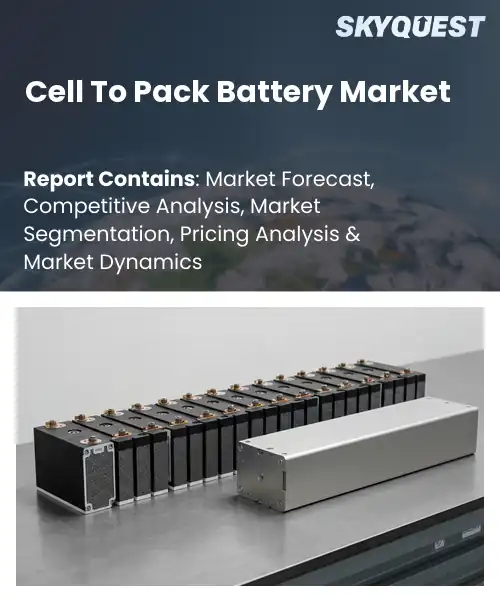
Cell To Pack Battery Market
Report ID: SQMIG20D2480
Report ID: SQMIG20D2480
[email protected]
USA +1 351-333-4748
Report ID:
SQMIG20D2480 |
Region:
Global |
Published Date: February, 2026
Pages:
157
|Tables:
177
|Figures:
79


Global Cell to Pack Battery Market size was valued at USD 24.3 Billion in 2024 and is poised to grow from USD 27.92 Billion in 2025 to USD 84.82 Billion by 2033, growing at a CAGR of 14.9% during the forecast period (2026-2033).
Growing electric vehicle adoption, rising demand for higher energy density batteries, increasing focus on cost reduction per kilowatt-hour, expansion of stationary energy storage systems, and advancements in battery manufacturing technologies are driving sales of cell-to-pack (CTP) battery solutions.
Cell to pack battery manufacturers is focusing on scaling their operations through standardization of designs, which also help them boost their sales. Growing urgency to reduce battery costs while improving energy density is expected to primarily drive cell-to-pack battery market growth. Surge in adoption of electric vehicles and growing investments in battery technology R&D are also expected to create new business scope for cell to pack battery vendors in the long run. Alignment between cell suppliers and automakers on formats and pack interfaces streamlines production lines and lowers per kilowatt-hour costs. As costs decline, OEMs can incorporate larger battery capacities, extending driving range and reducing range anxiety, thereby accelerating EV adoption. These benefits are evident in commercial fleets and electric buses using CTP systems to reduce assembly time and total cost of ownership.
On the contrary, high upfront capital investment, thermal management complexities, safety concerns related to direct cell integration, and dependence on lithium supply chains are slated to inhibit cell-to-pack battery market penetration across the study period.
What is the Impact of AI Integration on Cell-to-pack Battery Industry?
AI is enhancing safety and performance in cell-to-pack (CTP) battery technology by integrating cell-level data with pack-level control systems. AI-driven inspection systems on production lines also detect defects early, improving manufacturing quality and consistency. Advanced battery management systems now use machine learning for accurate cell balancing and early anomaly detection. Predictive models improve thermal management by identifying overheating risks before they escalate. The development of module-less CTP concepts with higher packing density and efficiency is emerging as a global trend.
Market snapshot - 2026-2033
Global Market Size
USD 24.3 Billion
Largest Segment
Pouch
Fastest Growth
Cylindrical
Growth Rate
14.9% CAGR
To get more insights on this market click here to Request a Free Sample Report
The cell to pack battery market is segmented by form factor, chemistry type, production technology, application, end use, and region. Based on form factor, the market is segmented into prismatic, cylindrical, and pouch. Based on chemistry type, the market is segmented into lithium-ion, solid state, nickel manganese cobalt (NMC), Lithium Iron Phosphate (LFP), and other battery types. Based on production technology, the market is segmented into cell-to-pack, cell-to-module and traditional battery assembly. Based on application, the market is segmented into energy storage system, electric vehicles, and others. Based on end use, the market is segmented into consumer electronics, industrial equipment, automotive, residential, commercial, utility, and others. Based on region, the market is segmented into North America, Europe, Asia Pacific, Latin America, and Middle East & Africa.
The prismatic segment is forecasted to account for the highest global cell to pack battery market share in the future. High structural stability, efficient space utilization, and suitability for module-free pack integration are key benefits helping this form gain prominence among end users. Compatibility with standardized pack designs and large-scale manufacturing is also cementing the dominance of this segment.
The demand for cylindrical cells is slated to rise at a rapid pace as per this cell to pack battery industry analysis. Enhanced energy density, mechanical robustness, and automated manufacturing scalability offered by this form factor is slated to help make it an opportune segment through 2033 and beyond.
The electric vehicles segment is slated to spearhead the global cell to pack battery market revenue generation in the long run. High energy density offered by cell to pack batterycoupled with its simplified assembly is making it a mainstay in this application segment. Continuous innovation in battery integration and pack optimization further sustains dominance in this segment.
The energy storage systems segment is slated to exhibit high CAGR over the coming years. Increasing adoption of renewable energy solutions and high emphasis on grid balancing are expected to boost cell to pack battery integration in energy storage space going forward.
To get detailed segments analysis, Request a Free Sample Report
Presence of established manufacturing ecosystems and coordinated supply chain networks are helping Asia Pacific emerge as a leading region for cell to pack battery providers. High investments in cell technology, materials processing, and automated assembly R&D are also expected to cement the dominance of this region. Collaborations between OEMs and battery manufacturers are also facilitating the high sales of cell to pack battery products. Supportive policy environments and industrial strategies across countries such as India, China, South Korea, and Japan also offer sustained revenue generation through 2033 and beyond.
Japan Cell to Pack Battery Market
High emphasis on precision engineering and stringent quality standards is expected to shape cell to pack battery adoption in Japan. Improving reliability, cooling, and safety, and pack design of cell to pack battery solutions remains the prime focus of companies in the country. Research organizations and equipment suppliers assist in improving assembly process and testing procedures. Adoption of cell to pack battery in high-end applications and systems that optimize energy density with long-term durability and predictable performance is high.
South Korea Cell to Pack Battery Market
Robust integration between cell production and pack assembly is augmenting the demand for cell to pack battery technology in South Korea. Cell to pack battery companies that opt for efficient manufacturing, miniaturization, and high-speed assembly lines are expected to be more popular in the country. Strategic partnerships with global carmakers and local automotive companies are also expected to boost the sales of cell to pack battery products in the future.
Electrification of the automotive sector and shift towards localized battery ecosystems are estimated to influence the demand for cell to pack battery across Europe. Rising investments in electric vehicle R&D and growing emphasis on sustainability are also predicted to create opportunities for cell to pack battery providers. Public policy and industrial incentives encourage investment in domestic production, recycling infrastructure, and cross border collaboration. Emphasis on lifecycle management, second life usage, and circular supply chains are also expected to generate new business scope for cell to pack battery vendors operating in European countries.
Germany Cell to Pack Battery Market
Presence of top automotive companies and a dense supplier network are influencing cell to pack battery demand in Germany. Preference for cell to pack battery solutions that ensure scalability and serviceability is expected to be high. Test lab facilities and quality control processes underpin a market focus on robust, vehicle-ready pack systems that meet high customer demands for quality and performance.
United Kingdom Cell to Pack Battery Market
Presence of leading innovations hubs, specialist engineering firms, and research institutions are leading the creation of novel cell to pack battery solutions in the United Kingdom. Customized integration expertise and rapid design iteration are expected to be popular traits of cell to pack battery companies operating in the country. Start-up collaboration with established suppliers enables the development of manufacturable systems from prototypes. Government support and investment in skills development also expands business scope for market players in the long run.
France Cell to Pack Battery Market
Coordinated industrial initiatives and an emphasis on building sovereign capabilities are shaping cell to pack battery demand in France. French companies are giving importance to the development of the entire value chain, right from the design of the pack to recycling, and are focusing on sustainable materials. Collaborations between car manufacturers, technology companies, and research institutions are also creating new opportunities.
Launch of new efforts to improve local manufacturing of batteries and diversification of supply chains are driving consistent demand for cell to pack battery solutions in North America. Presence of innovation centres and cross-sector collaborations are also helping advance architecture research, focusing on manufacturability, safety standards, and modularity for different mobility and storage applications. Increased cooperation on mining and materials processing initiatives supports the enhancement of feedstock security. Resilient supply chains, developments in recycling abilities, and fast-tracking commercialization routes provide strong growth potential through 2033.
United States Cell to Pack Battery Market
The development of local battery pack producers and robust demand from OEMs are expected to influence cell to pack battery demand in the United States. Rising investments in scalable manufacturing processes, advanced thermal and structural solutions, and integration with vehicle electronics are also expected to generate new business scope in the long run. Public and private sector efforts are aimed at pilot lines and demonstration projects that can de-risk large-scale implementation of cell to pack battery technologies.
Canada Cell to Pack Battery Market
Proximity to large automotive markets and expertise in raw material supply is making Canada a key market for cell to pack battery companies. Increasing cooperation betweenmaterial suppliers, technology innovators, and pack integrators is also estimated to create new business scope in the future. Canadian sector efforts are centered on value-added processing, advanced materials research, and recycling pathway integration into pack life cycle planning.
To know more about the market opportunities by region and country, click here to
Buy The Complete Report
Rising Electric Vehicle Adoption
Scaling Production and Cost Reduction
Complex Assembly and integration Challenges
Fluctuations in Raw Material Price and Availability
Request Free Customization of this report to help us to meet your business objectives.
Competitive landscape is driven by OEM demand to raise pack level energy density and reduce part counts, prompting incumbent battery makers to license cell to pack technology and system suppliers to offer structural pack solutions; examples include CATL licensing CTP to Hyundai Mobis, BYD adopting cell to pack blade concepts, and suppliers like Kautex developing composite CTP housings. Strategies in market competition are licensing, strategic partnerships, targeted M and A, and integrated thermal and structural innovation.
Scale and Standardization
Integration with Vehicle Architectures
SkyQuest’s ABIRAW (Advanced Business Intelligence, Research & Analysis Wing) is our Business Information Services team that Collects, Collates, Correlates, and Analyses the Data collected by means of Primary Exploratory Research backed by robust Secondary Desk research.
As per SkyQuest analysis, rising electric vehicle adoption and increasing demand for higher energy density battery systems are anticipated to drive the demand for cell-to-pack battery solutions going forward. However, thermal management complexities, high capital investment requirements, and safety concerns associated with direct cell integration are slated to slow down the adoption of cell-to-pack battery systems in the future. Asia Pacific is slated to spearhead the demand for cell-to-pack batteries owing to strong EV manufacturing capacity and large-scale battery production ecosystems. Advancements in module-free architectures and AI-enabled battery management systems are anticipated to be key trends driving the cell-to-pack battery sector over the coming years.
| Report Metric | Details |
|---|---|
| Market size value in 2024 | USD 24.3 Billion |
| Market size value in 2033 | USD 84.82 Billion |
| Growth Rate | 14.9% |
| Base year | 2024 |
| Forecast period | 2026-2033 |
| Forecast Unit (Value) | USD Billion |
| Segments covered |
|
| Regions covered | North America (US, Canada), Europe (Germany, France, United Kingdom, Italy, Spain, Rest of Europe), Asia Pacific (China, India, Japan, Rest of Asia-Pacific), Latin America (Brazil, Rest of Latin America), Middle East & Africa (South Africa, GCC Countries, Rest of MEA) |
| Companies covered |
|
| Customization scope | Free report customization with purchase. Customization includes:-
|
To get a free trial access to our platform which is a one stop solution for all your data requirements for quicker decision making. This platform allows you to compare markets, competitors who are prominent in the market, and mega trends that are influencing the dynamics in the market. Also, get access to detailed SkyQuest exclusive matrix.
Table Of Content
Executive Summary
Market overview
Parent Market Analysis
Market overview
Market size
KEY MARKET INSIGHTS
COVID IMPACT
MARKET DYNAMICS & OUTLOOK
Market Size by Region
KEY COMPANY PROFILES
Methodology
For the Cell To Pack Battery Market, our research methodology involved a mixture of primary and secondary data sources. Key steps involved in the research process are listed below:
1. Information Procurement: This stage involved the procurement of Market data or related information via primary and secondary sources. The various secondary sources used included various company websites, annual reports, trade databases, and paid databases such as Hoover's, Bloomberg Business, Factiva, and Avention. Our team did 45 primary interactions Globally which included several stakeholders such as manufacturers, customers, key opinion leaders, etc. Overall, information procurement was one of the most extensive stages in our research process.
2. Information Analysis: This step involved triangulation of data through bottom-up and top-down approaches to estimate and validate the total size and future estimate of the Cell To Pack Battery Market.
3. Report Formulation: The final step entailed the placement of data points in appropriate Market spaces in an attempt to deduce viable conclusions.
4. Validation & Publishing: Validation is the most important step in the process. Validation & re-validation via an intricately designed process helped us finalize data points to be used for final calculations. The final Market estimates and forecasts were then aligned and sent to our panel of industry experts for validation of data. Once the validation was done the report was sent to our Quality Assurance team to ensure adherence to style guides, consistency & design.
Analyst Support
Customization Options
With the given market data, our dedicated team of analysts can offer you the following customization options are available for the Cell To Pack Battery Market:
Product Analysis: Product matrix, which offers a detailed comparison of the product portfolio of companies.
Regional Analysis: Further analysis of the Cell To Pack Battery Market for additional countries.
Competitive Analysis: Detailed analysis and profiling of additional Market players & comparative analysis of competitive products.
Go to Market Strategy: Find the high-growth channels to invest your marketing efforts and increase your customer base.
Innovation Mapping: Identify racial solutions and innovation, connected to deep ecosystems of innovators, start-ups, academics, and strategic partners.
Category Intelligence: Customized intelligence that is relevant to their supply Markets will enable them to make smarter sourcing decisions and improve their category management.
Public Company Transcript Analysis: To improve the investment performance by generating new alpha and making better-informed decisions.
Social Media Listening: To analyze the conversations and trends happening not just around your brand, but around your industry as a whole, and use those insights to make better Marketing decisions.
REQUEST FOR SAMPLE
 REQUEST FREE CUSTOMIZATION
Global Cell To Pack Battery Market size was valued at USD 24.3 Billion in 2024 and is poised to grow from USD 27.92 Billion in 2025 to USD 84.82 Billion by 2033, growing at a CAGR of 14.9% during the forecast period (2026-2033).
CATL (Contemporary Amperex Technology Co., Limited), BYD Company Limited, LG Energy Solution, Tesla, Inc., Samsung SDI, SVOLT Energy Technology, Gotion High-Tech, EVE Energy Co., Ltd., CALB (China Aviation Lithium Battery), SK On (SK Innovation), Panasonic Energy, Farasis Energy, Sunwoda Electronic Co., Ltd., Ganfeng LiEnergy, Envision AESC, Northvolt AB, A123 Systems, Tianjin EV Energies (TNE), REPT BATTERO Energy Co., Ltd., One (Our Next Energy)
The key driver of the Cell To Pack Battery Market is the rapid expansion of the electric vehicle (EV) industry. Increasing demand for higher energy density, cost-efficient battery designs, improved vehicle range, and simplified pack architecture is accelerating the adoption of cell-to-pack technology globally.
Key trends in the Cell To Pack Battery Market include rising adoption of cell-to-pack (CTP) architecture for improved energy density, increasing use in electric vehicles and energy storage systems, integration of advanced battery management systems, focus on cost reduction and manufacturing efficiency, and growth of solid-state and next-generation battery technologies.
Asia-Pacific accounted for the largest share in the Cell To Pack Battery Market, driven by strong electric vehicle production, large-scale battery manufacturing capacity, supportive government policies, and the presence of leading battery manufacturers in China, Japan, and South Korea.


Want to customize this report? This report can be personalized according to your needs. Our analysts and industry experts will work directly with you to understand your requirements and provide you with customized data in a short amount of time. We offer $1000 worth of FREE customization at the time of purchase.
Feedback From Our Clients


 USA (+1) 351-333-4748

