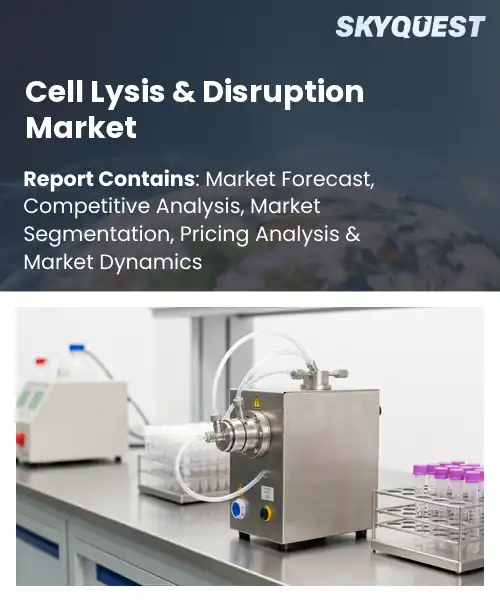
Cell Lysis & Disruption Market
Report ID: SQMIG35H2476
Report ID: SQMIG35H2476
[email protected]
USA +1 351-333-4748
Report ID:
SQMIG35H2476 |
Region:
Global |
Published Date: May, 2026
Pages:
157
|Tables:
150
|Figures:
78


Global Cell Lysis & Disruption Market size was valued at USD 6.8 Billion in 2024 and is poised to grow from USD 7.43 Billion in 2025 to USD 15.14 Billion by 2033, growing at a CAGR of 9.3% during the forecast period (2026-2033).
The cell lysis & disruption market comprises instruments reagents and consumables that break open cells to release intracellular content for analysis production and quality control. Its importance drives from demand in research and industry where extracting proteins nucleic acids and metabolites underpins drug discovery diagnostics and biomanufacturing. Historically methods evolved from mortar and pestle techniques toward mechanized sonicators bead mills and high-pressure homogenizers while enzyme-based kits and automated platforms emerged to meet reproducibility needs. The primary driver has been rapid expansion of biologics research and high-throughput omics; as companies pursue complex therapeutics the need for scalable standardized lysis solutions intensified.
Building on that market expansion a key factor driving growth has been the shift toward automated high-throughput lysis platforms. As laboratories required consistent outcomes for large sample volumes vendors developed integrated instruments and standardized kits reducing variability and hands-on time. Automation shortened turnaround times which enabled faster vaccine formulation and accelerated proteomic studies that feed into drug pipelines. Single-cell sequencing workflows rely on gentle reproducible disruption to preserve molecular integrity while industrial bioprocessing benefits when scalable homogenizers improve yield and downstream purification. Consequently increased operational efficiency and predictable regulatory compliance create new commercial opportunities for suppliers and service providers globally.
How is AI improving operational efficiency in the cell lysis & disruption market?
The use of Artificial Intelligence (AI) has improved operational efficiency within the cell lysis & disruption market by creating smarter automation, providing real-time monitoring and adaptive process control. Important components of this new paradigm include automated controls over mechanical processes such as sonication and bead milling, predictive maintenance for instruments and data-driven assurance of quality. The overall trend in the market is to move from stand-alone hardware to fully integrated workflows consisting of sensors, analytics and automated laboratory systems. By embedding AI models into hardware systems, vendors are able to reduce variability, increase reproducibility and decrease hands-on time while maintaining sample integrity.
Examples of this new approach include automated sonication protocols, AI-guided reagent handling and closed-loop optimization of lysis parameters. In July 2025, Covaris announced a joint venture with Hamilton to create an automated solution for FFPE extraction utilizing sonication-based cell lysis along with automation of the workflow. This illustrates how AI-enabled process orchestration and predictive analytics can increase throughput and decrease manual labor.
Market snapshot - (2026-2033)
Global Market Size
USD 6.8 Billion
Largest Segment
Reagents & Consumables
Fastest Growth
Reagents & Consumables
Growth Rate
9.3% CAGR
To get more insights on this market click here to Request a Free Sample Report
Global cell lysis & disruption market is segmented into product type, technique, cell type, application, end user and region. Based on product type, the market is segmented into Instruments and Reagents & Consumables. Based on technique, the market is segmented into Mechanical Disruption and Non-Mechanical Disruption. Based on cell type, the market is segmented into Mammalian Cells, Bacterial Cells, Yeast, Fungi & Algae Cells and Plant Cells. Based on application, the market is segmented into Protein Isolation, Nucleic Acid Isolation, Cell Organelle Isolation, Downstream Processing, Diagnostics & Clinical Applications and Drug Discovery & Development. Based on end user, the market is segmented into Pharmaceutical & Biotechnology Companies, Academic & Research Institutes, Hospitals & Diagnostic Laboratories, Cell Banks, Contract Research & Manufacturing Organizations and Others. Based on region, the market is segmented into North America, Europe, Asia Pacific, Latin America and Middle East & Africa.
The instruments segment dominates with large cell lysis & disruption market share as they provide integrated/integrated and automatically scalable techniques for different types of cell/organism samples and different numbers of samples per day. There is a strong focus on precision, reproducibility, and compatibility with downstream analysis using engineered Instrumentation, which decreases variability and speeds up workflows; thus they are being adopted quickly in both research and bioprocess settings. Instruments have become an integral part of the overall infrastructure of reliable, high-performance lysis operations, additional vendor support and the development of platform ecosystems for these instruments have strengthened this position.
As per cell lysis & lysis market forecast, reagent & consumable sales are projected to experience the highest growth rate, due to their point-of-use simplicity and lower operational barriers. Continuous innovation in reagents used in assays, single use formats and automated consumables will continue to increase demand for repeat business. This in turn will allow broader utilization of these product types from all types of laboratories and provide a catalyst to develop new applications and opportunities for commercialization.
As per cell lysis & lysis market forecast, the mechanical disruption segment is currently dominating the cell lysis & disruption market due to the versatility of the mechanical means of lysis. Mechanical disruption processes produce a wide variety of samples from diverse matrices and provide significant advantages through reproducible and consistent cell breaks that allow for scaling and high throughput output from the cell lysate. Some of the established mechanical disruption methodologies produce predictable yields and are easily integrated into both manufacturing and analytical pipelines, thus making them valuable in process development and industrial research where consistent performance and compatibility with downstream processes are essential.
As per cell lysis & lysis market outlook, non-mechanical disruption is the fastest-growing method, as it provides a gentler means of lysing cells while preserving sensitive biomolecules and providing workflows for both single cell and diagnostic applications. As a result, advancements using enzymatic reagents, acoustic and chemical methods, and microfluidic integration have increased the variety of applications, drawn investments into new products, and enabled new types of assays, point-of-care formats, and very sensitive analytical procedures.
To get detailed segments analysis, Request a Free Sample Report
The innovation ecosystem in North America is very concentrated, with an abundance of both commercial and academic sources of funding. A large number of companies manufacture instruments and reagents, which establishes an extremely substantial industry base. A strong supportive framework for regulation, and early use of automated and high throughput methods for disruption, helps drive the usage of such technologies. There are a lot of contract research organisations, and laboratories that provide contract services, which allow quick transition of technology from the research laboratory to applications.
As per cell lysis & disruption market regional forecast, United States is facilitated by the presence of many innovation clusters, manufacturers of lysis hardware, as well as well-funded research institutions that place a high value on automation and high throughput lysis and disruption technologies. Close ties between academia and industry encourage the development of custom lysis methods, while many contract laboratories provide services to outsource complex lysis and disruption workflows.
As per cell lysis & disruption market regional outlook, Canada is characterized by strong public research institutions, coupled with a fast-growing number of companies immersed in commercializing lysis products, and a variety of funding opportunities for technologies that encourage the adoption of flexible automated lysis platforms. A focus on translational research encourages partnerships between academic institutions and small biotech firms to develop novel methods for cell lysis and disruption, while a network of regional service providers provide unique expertise related to lysis/disruption. A co-operatively-based procurement and regulatory environment encourages the use of automated lysis technology for the validation of studies and its subsequent use in clinical and industrial applications, allowing for the development of an increasingly sophisticated user and supplier group.
As per cell lysis & disruption industry analysis, Asia Pacific expansion is driven by expanding biotechnology and pharmaceutical research hubs, increasing product development initiatives and rising demand for advanced sample preparation workflows across academia and industry. National programs and institutional investments support development of localized instrument manufacturing and reagent supply chains, while strong ties between industrial players and universities accelerate method transfer and validation. A growing base of contract research and testing laboratories offers accessible service models that lower barriers to adoption. Partnerships between regional companies and global suppliers facilitate technology transfer, training and localized technical support, enabling rapid uptake of automated and specialized disruption platforms and reinforcing the region as a dynamic growth area for innovative lysis technologies. Increasing attention to regulatory harmonization and workforce development enhances confidence among buyers, while investments in digital integration and scalable manufacturing enable local firms to meet complex research and diagnostic needs.
Japan cell lysis & disruption market have a long history of using precision Instruments and validating methods using established companies and research institutions. Therefore, lysis solutions that generate accurate results provide the customer with the confidence to use that solution due to the established lysis supply chain the manufactures.
The cell lysis & disruption market is driven by a strong network of Biotech start-up companies, support from the Korean government for the commercialization of technology-related products and many advanced instrument manufacturers. The presence of a diverse laboratory network of both contract research organizations (CROs) and academic institutions provides a large pool of robust method validation for therapuetic and diagnostic work processes.
Europe is expanding its impact through the convergence of cutting-edge academic research with specialist equipment manufacturing and a robust pharmaceutical and biotech sector that requires proven, high-quality lysis solutions. Coordinated efforts to develop harmonised validation standards and collaborative research projects will give buyers greater confidence in their ability to reproduce results with consistency, as well as increasing the number of validated methods that are available. A comprehensive network of contract researchers and testing laboratories can provide an extensive range of service options, and experienced providers provide strong technical support after the sale and through training.
Germany combines precision engineering expertise with a strong industrial biotechnology sector and established instrument manufacturers who emphasize durability. Collaborative linkages between technical universities and commercial laboratories facilitate rigorous method validations and customised solutions for specific applications. An ecosystem of suppliers provides technical training, ongoing maintenance, and customised service and support options; this helps encourage adoption of lysis products by both pharmaceutical and non-pharmaceutical researchers. Suppliers focus on the integration of lysis products with downstream analytical systems provides additional utility to customers' complex workflows.
The UK cell lysis & disruption market is driven by academic institutions, a robust life sciences cluster of research and industry, and translational links that promote the use of versatile lysis technology. This demand is also accelerated by an emphasis on innovation in diagnostics and the need for clinical assay development, which promotes the validation and uptake of automated platforms in laboratories. There is a large network of service providers and contract research organizations that offer expertise in lysis and disruption, while suppliers provide localized training and support to help users implement lysis and disruption technologies in laboratories and clinical settings.
The cell lysis & disruption market in France reflects excellent public research capabilities, expertise in molecular biology, and industrial interest in the processing of samples. Nationally, research institutions and biotechnology companies collaborate on the development of specialized lysis technologies for therapeutic development and diagnostics. Suppliers offer customized equipment and disposable products to users in both research and clinical settings. The emphasis placed on rigorous validation, training, and integration with analytical workflows, has led to an increased level of uptake by academic research laboratories, clinical laboratories, and research organizations seeking reliable solutions for cell lysis and disruption.
To know more about the market opportunities by region and country, click here to
Buy The Complete Report
Expansion of Biopharmaceutical Research
Technological Advancements In Equipment
High Capital And Operational Costs
Regulatory And Validation Challenges
Request Free Customization of this report to help us to meet your business objectives.
Recent Developments in the Cell Lysis & Disruption Market
SkyQuest’s ABIRAW (Advanced Business Intelligence, Research & Analysis Wing) is our Business Information Services team that Collects, Collates, Correlates, and Analyses the Data collected by means of Primary Exploratory Research backed by robust Secondary Desk research.
As per SkyQuest analysis, a key driver is expansion of biopharmaceutical research which fuels demand for scalable reproducible lysis solutions, and a second driver is growing adoption of automation and high throughput platforms that reduce hands on time and improve reproducibility. A restraint is high capital and operational costs that limit uptake among smaller laboratories and in emerging markets. The instruments segment dominates as integrated automated platforms set performance standards, and North America is the dominating region due to concentrated innovation ecosystems, strong funding and dense industry academic collaborations that accelerate commercialization and adoption across diagnostics therapeutics and industrial biotechnology.
| Report Metric | Details |
|---|---|
| Market size value in 2024 | USD 6.8 Billion |
| Market size value in 2033 | USD 15.14 Billion |
| Growth Rate | 9.3% |
| Base year | 2024 |
| Forecast period | (2026-2033) |
| Forecast Unit (Value) | USD Billion |
| Segments covered |
|
| Regions covered | North America (US, Canada), Europe (Germany, France, United Kingdom, Italy, Spain, Rest of Europe), Asia Pacific (China, India, Japan, Rest of Asia-Pacific), Latin America (Brazil, Rest of Latin America), Middle East & Africa (South Africa, GCC Countries, Rest of MEA) |
| Companies covered |
|
| Customization scope | Free report customization with purchase. Customization includes:-
|
To get a free trial access to our platform which is a one stop solution for all your data requirements for quicker decision making. This platform allows you to compare markets, competitors who are prominent in the market, and mega trends that are influencing the dynamics in the market. Also, get access to detailed SkyQuest exclusive matrix.
Table Of Content
Executive Summary
Market overview
Parent Market Analysis
Market overview
Market size
KEY MARKET INSIGHTS
COVID IMPACT
MARKET DYNAMICS & OUTLOOK
Market Size by Region
KEY COMPANY PROFILES
Methodology
For the Cell Lysis & Disruption Market, our research methodology involved a mixture of primary and secondary data sources. Key steps involved in the research process are listed below:
1. Information Procurement: This stage involved the procurement of Market data or related information via primary and secondary sources. The various secondary sources used included various company websites, annual reports, trade databases, and paid databases such as Hoover's, Bloomberg Business, Factiva, and Avention. Our team did 45 primary interactions Globally which included several stakeholders such as manufacturers, customers, key opinion leaders, etc. Overall, information procurement was one of the most extensive stages in our research process.
2. Information Analysis: This step involved triangulation of data through bottom-up and top-down approaches to estimate and validate the total size and future estimate of the Cell Lysis & Disruption Market.
3. Report Formulation: The final step entailed the placement of data points in appropriate Market spaces in an attempt to deduce viable conclusions.
4. Validation & Publishing: Validation is the most important step in the process. Validation & re-validation via an intricately designed process helped us finalize data points to be used for final calculations. The final Market estimates and forecasts were then aligned and sent to our panel of industry experts for validation of data. Once the validation was done the report was sent to our Quality Assurance team to ensure adherence to style guides, consistency & design.
Analyst Support
Customization Options
With the given market data, our dedicated team of analysts can offer you the following customization options are available for the Cell Lysis & Disruption Market:
Product Analysis: Product matrix, which offers a detailed comparison of the product portfolio of companies.
Regional Analysis: Further analysis of the Cell Lysis & Disruption Market for additional countries.
Competitive Analysis: Detailed analysis and profiling of additional Market players & comparative analysis of competitive products.
Go to Market Strategy: Find the high-growth channels to invest your marketing efforts and increase your customer base.
Innovation Mapping: Identify racial solutions and innovation, connected to deep ecosystems of innovators, start-ups, academics, and strategic partners.
Category Intelligence: Customized intelligence that is relevant to their supply Markets will enable them to make smarter sourcing decisions and improve their category management.
Public Company Transcript Analysis: To improve the investment performance by generating new alpha and making better-informed decisions.
Social Media Listening: To analyze the conversations and trends happening not just around your brand, but around your industry as a whole, and use those insights to make better Marketing decisions.
REQUEST FOR SAMPLE
 REQUEST FREE CUSTOMIZATION
Global Cell Lysis & Disruption Market size was valued at USD 6.8 Billion in 2024 and is poised to grow from USD 7.43 Billion in 2025 to USD 15.14 Billion by 2033, growing at a CAGR of 9.3% during the forecast period (2026-2033).
Competitive intensity in the global cell lysis and disruption market is rising as single cell omics and integrated sample to answer workflows drive demand for miniaturized, consumable rich lysis solutions. Established vendors respond through targeted acquisitions and platform partnerships while innovators push microfluidic and acoustic shearing advances. Examples include Beckman Coulter's Labcyte acquisition, proteoCHIP partnerships and instrument upgrades from Covaris and ClaremontBio. 'Thermo Fisher Scientific Inc.', 'Merck KGaA', 'Danaher Corporation', 'Bio-Rad Laboratories, Inc.', 'QIAGEN N.V.', 'F. Hoffmann-La Roche Ltd.', 'Becton, Dickinson and Company', 'Miltenyi Biotec GmbH', 'Agilent Technologies, Inc.', 'Eppendorf SE', 'Promega Corporation', 'Takara Bio Inc.', 'New England Biolabs, Inc.', 'Covaris, LLC', 'Qsonica LLC', 'Claremont BioSolutions, LLC', 'Parr Instrument Company', 'Cell Signaling Technology, Inc.', 'Microfluidics International Corporation', 'Revvity, Inc.'
The growing investment and focus on biopharmaceutical research have expanded adoption of advanced cell lysis and disruption solutions across discovery and process development pipelines. Manufacturers and research institutions prioritize efficient sample preparation and downstream processing to improve protein yield, maintain integrity, and accelerate candidate screening. Demand for scalable and reproducible disruption methods is reinforced by need for compatibility with varied cell types and workflows. This sustained R&D emphasis drives suppliers to innovate and broaden product portfolios, supporting market growth through enhanced utility and applicability.
Automation And High Throughput: Adoption of automated and high-throughput lysis platforms is reshaping laboratory workflows by reducing hands-on time, improving reproducibility, and enabling standardized processing of large sample cohorts. Integration with robotic handlers, plate-based formats, and automated liquid handling systems facilitates consistent disruption across diverse cell types and sample matrices. This trend supports faster assay turnaround, scalable screening, and streamlined downstream purification, while lowering operator-dependent variability and accelerating discovery and development pipelines in areas such as biologics, diagnostics, and systems biology and translational research.
Why does North America Dominate the Global Cell Lysis & Disruption Market? |@12


Want to customize this report? This report can be personalized according to your needs. Our analysts and industry experts will work directly with you to understand your requirements and provide you with customized data in a short amount of time. We offer $1000 worth of FREE customization at the time of purchase.
Feedback From Our Clients


 USA (+1) 351-333-4748

