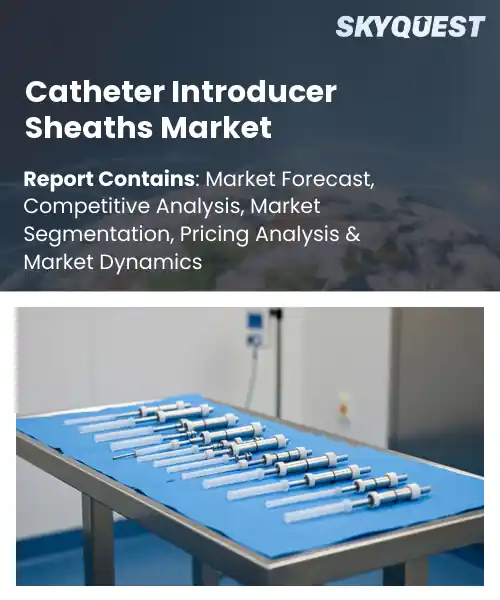
Catheter Introducer Sheaths Market
Report ID: SQMIG35B2370
Report ID: SQMIG35B2370
[email protected]
USA +1 351-333-4748
Report ID:
SQMIG35B2370 |
Region:
Global |
Published Date: June, 2026
Pages:
157
|Tables:
143
|Figures:
78


Global Catheter Introducer Sheaths Market size was valued at USD 1.56 Billion in 2024 and is poised to grow from USD 1.68 Billion in 2025 to USD 3.0 Billion by 2033, growing at a CAGR of 7.52% during the forecast period (2026-2033).
The catheter introducer sheath market encompasses devices that facilitate the safe insertion of catheters during minimally invasive procedures such as angiography, electrophysiology and peripheral vascular interventions. Its importance stems from the need to reduce vessel trauma, lower infection risk, and improve procedural efficiency, which directly influences patient outcomes and hospital cost structures. Over the past decade the market has expanded as clinicians embraced percutaneous techniques, driven by the adoption of drug‑eluting stents and advanced imaging. For instance, the rise of transradial interventions in cardiology boosted demand for low‑profile, hydrophilic sheaths, prompting manufacturers to broaden product portfolios and invest in innovations. One decisive growth driver is the accelerating prevalence of chronic cardiovascular disease, which pushes hospitals to adopt catheter therapies that rely on introducer sheaths. As patient populations age, the frequency of peripheral artery disease and atrial fibrillation procedures rises, creating a cascade where higher procedure volumes translate into sustained sheath consumption. This dynamic encourages suppliers to explore opportunities in emerging markets, where infrastructure upgrades and reimbursement reforms open treatment pathways. For example, China's shift toward reimbursement for percutaneous coronary interventions has spurred local distributors to stock a broader range of sheath sizes, thereby expanding market penetration and fostering competitive pricing.
How is AI influencing the design and adoption of catheter introducer sheaths?
AI is reshaping catheter introducer sheath design by enabling rapid virtual prototyping, predictive material performance and patient specific geometry. Machine learning models analyze procedural data to suggest optimal tip curvature and sheath stiffness, reducing the number of physical iterations required. This accelerates product development cycles and lowers costs, which is critical as the global market expands to meet rising demand for minimally invasive interventions. AI also supports real time guidance systems that integrate sheath selection with imaging, helping clinicians choose the right device for each anatomy. As hospitals adopt data driven workflows, manufacturers that embed AI into their design pipelines gain a competitive edge.June 2023, Terumo Medical Corporation introduced an AI driven introducer sheath that automatically adjusts stiffness based on vessel size, streamlining procedure planning and reducing setup time. This innovation illustrates how AI can boost efficiency and supports the market’s continued expansion.
Market snapshot - (2026-2033)
Global Market Size
USD 1.56 Billion
Largest Segment
Integrated Introducer Sheaths
Fastest Growth
Steerable Introducer Sheaths
Growth Rate
7.52% CAGR
To get more insights on this market click here to Request a Free Sample Report
Global catheter introducer sheaths market is segmented by product type, french size, application area, coating type, end user environment and region. Based on product type, the market is segmented into Integrated Introducer Sheaths, Separable Introducer Sheaths and Steerable Introducer Sheaths. Based on french size, the market is segmented into Below 10F, 10F to 16F and Above 16F. Based on application area, the market is segmented into Interventional Cardiology, Vascular Interventions and Others. Based on coating type, the market is segmented into Hydrophilic Coated Sheaths and Non-Coated Sheaths. Based on end user environment, the market is segmented into Hospitals, Ambulatory Surgical Centers and Specialty Clinics. Based on region, the market is segmented into North America, Europe, Asia Pacific, Latin America and Middle East & Africa.
Integrated Introducer Sheaths segment dominates because they combine the sheath and delivery system into a single unit, simplifying the procedural workflow and reducing device exchanges. This integration enhances procedural efficiency, minimizes patient trauma, and shortens operation time, which clinicians prioritize for complex interventions. Their ease of use and compatibility with a broad range of catheters further cement their preference among interventional teams, driving widespread adoption across the market.
However, Separable Introducer Sheaths segment is witnessing the strongest growth momentum because recent innovations enable modular assembly, allowing clinicians to customize sheath length and diameter per case. This flexibility meets emerging procedural demands, especially in complex vascular pathways, and drives manufacturers to develop components, expanding portfolios and creating revenue streams in the catheter introducer market.
10F to 16F segment dominates because this size range aligns with the majority of coronary and peripheral interventions, offering an optimal balance between lumen capacity and patient comfort. Clinicians favor these dimensions for delivering essential therapeutic devices while minimizing vascular trauma. The compatibility with a wide array of catheters and guidewires, coupled with established procedural protocols, reinforces their prevalence, making them the go to choice in routine and complex cases alike.
Meanwhile, Above 16F segment emerges as a growth area because expanding transcatheter therapies require larger lumens for bulky devices such as valve prostheses. Manufacturers innovate thinner wall materials that maintain flexibility, allowing safe insertion of oversized sheaths. This evolution creates new procedural options, prompting hospitals to adopt these offerings and accelerating market expansion for large diameter introducer sheaths.
To get detailed segments analysis, Request a Free Sample Report
North America retains its leadership through a combination of mature clinical ecosystems, extensive reimbursement frameworks, and a concentration of pioneering medical device firms. The region benefits from a highly regulated environment that encourages innovation while ensuring patient safety, fostering rapid adoption of minimally invasive technologies. Robust investment in research collaborations between academic centers and industry accelerates product development, and the presence of large integrated health systems facilitates efficient distribution and training. Skilled clinicians with deep experience in catheter‑based interventions further reinforce market demand, while supportive policy initiatives sustain a favourable commercial landscape.
Catheter Introducer Sheaths Market in the United States thrives on a dense network of leading manufacturers and research institutions that continuously push product innovation. Extensive hospital infrastructures and comprehensive insurance coverage enable swift integration of advanced sheath designs into routine practice. Clinician expertise and a culture of early technology adoption drive consistent demand, while strategic partnerships between suppliers and health providers streamline supply chains. Regulatory pathways that balance safety with efficiency further reinforce market momentum.
Catheter Introducer Sheaths Market in Canada is propelled by a publicly funded health system that emphasizes cost‑effective, high‑quality care. Strong clinical guidelines promote the use of minimally invasive procedures, encouraging hospitals to adopt reliable sheath technologies. Collaborative research programs between universities and device firms foster localized innovation, while cohesive procurement mechanisms ensure broad market accessibility. Skilled interventional specialists and a focus on patient outcomes sustain steady uptake across provincial health networks.
Europe’s expansion is underpinned by harmonised regulatory standards that simplify cross‑border product approvals and encourage pan‑regional distribution. Health systems across the continent prioritize minimally invasive solutions to address ageing demographics, creating sustained clinical demand. Substantial public and private investment in cardiovascular research fuels continuous improvement of sheath designs, while collaborative networks among leading hospitals accelerate knowledge transfer. Reimbursement models that reward procedural efficiency further stimulate adoption, and the presence of several established manufacturers ensures a competitive yet stable supply environment.
Catheter Introducer Sheaths Market in Germany benefits from a strong engineering tradition and a dense concentration of medical technology firms that prioritize precision and reliability. Well‑funded university hospitals drive early clinical trials, creating a feedback loop that refines product performance. Comprehensive health insurance schemes support broad procedural use, while national guidelines endorse minimally invasive approaches. Efficient logistics and a skilled workforce reinforce Germany’s position as a dominant European hub for sheath technologies.
Catheter Introducer Sheaths Market in the United Kingdom is characterised by rapid uptake driven by national health service initiatives that promote advanced catheter procedures. Leading research institutions partner closely with device innovators, accelerating the introduction of next‑generation sheath solutions. Clinical pathways that emphasize patient recovery and cost containment encourage hospitals to adopt efficient technologies. Robust training programmes for interventionalists and streamlined procurement processes further boost market penetration, positioning the United Kingdom as a fast‑growing European market.
Catheter Introducer Sheaths Market in France is emerging through focused governmental support for minimally invasive cardiology. Specialized centers of excellence champion early adoption, while collaborative research projects between French academic hospitals and manufacturers nurture product customization for local practice. Reimbursement frameworks that align with evidence‑based outcomes facilitate broader clinical use. Growing expertise among interventional cardiologists and a commitment to integrating innovative devices into routine care are strengthening France’s foothold in the European landscape.
Asia Pacific is advancing its market presence by leveraging rising healthcare expenditures and a strategic shift toward less invasive therapeutic options. Nations in the region are investing heavily in modernizing hospital infrastructure and expanding specialist training, which together encourage the integration of sophisticated sheath technologies. Local manufacturers are increasingly capable of meeting stringent quality expectations, often collaborating with global partners to accelerate product introduction. Supportive regulatory reforms and growing awareness of patient‑centric care models further stimulate adoption, positioning the region as a burgeoning hub for catheter introducer sheath innovation.
Catheter Introducer Sheaths Market in Japan benefits from a well‑established culture of cardiovascular excellence and an extensive network of high‑volume cardiac centers. Strong collaboration between domestic device makers and research hospitals drives continuous refinement of sheath performance. National health policies that prioritize procedural efficiency support widespread clinical use, while comprehensive training ensures high procedural standards. Efficient distribution channels and a reputation for quality reinforce Japan’s leadership within the regional market.
Catheter Introducer Sheaths Market in South Korea is propelled by rapid modernization of medical facilities and a proactive regulatory environment that streamlines device entry. Aggressive investment in interventional cardiology research equips clinicians with cutting‑edge techniques, encouraging swift adoption of advanced sheath solutions. Government incentives for domestic manufacturing stimulate local production capabilities, while strong export orientation enhances global competitiveness. Focused education programmes for physicians and a commitment to patient‑focused care drive sustained market expansion.
To know more about the market opportunities by region and country, click here to
Buy The Complete Report
Growing Minimally Invasive Procedures
Adoption Of Advanced Imaging
High Cost Of Devices
Regulatory Approval Complexity
Request Free Customization of this report to help us to meet your business objectives.
The global catheter introducer sheaths market is dominated by established players such as Terumo Medical Corporation and Teleflex, whose aggressive product expansion and adoption of advanced hydrophilic coating technologies intensify competition. Rising procedural volumes and demand for low‑profile, high‑precision sheaths drive firms to differentiate through rapid innovation and portfolio diversification, reshaping market dynamics.
Top Player’s Company Profile
Recent Developments
SkyQuest’s ABIRAW (Advanced Business Intelligence, Research & Analysis Wing) is our Business Information Services team that Collects, Collates, Correlates, and Analyses the Data collected by means of Primary Exploratory Research backed by robust Secondary Desk research. As per SkyQuest analysis the global catheter introducer sheaths market is propelled chiefly by the surge in minimally invasive procedures, which pushes hospitals to seek reliable sheaths for safer, quicker access. A second strong catalyst is the expanding use of advanced imaging that encourages manufacturers to design sheaths compatible with real‑time visualization, further boosting demand. North America remains the dominant region, driven by mature clinical ecosystems and extensive reimbursement support. Within the product mix, integrated introducer sheaths lead the market thanks to their single‑unit design that streamlines workflows and reduces device exchanges. However, the high cost of devices acts as a notable restraint, limiting rapid adoption especially in cost‑sensitive settings.
| Report Metric | Details |
|---|---|
| Market size value in 2024 | USD 1.56 Billion |
| Market size value in 2033 | USD 3.0 Billion |
| Growth Rate | 7.52% |
| Base year | 2024 |
| Forecast period | (2026-2033) |
| Forecast Unit (Value) | USD Billion |
| Segments covered |
|
| Regions covered | North America (US, Canada), Europe (Germany, France, United Kingdom, Italy, Spain, Rest of Europe), Asia Pacific (China, India, Japan, Rest of Asia-Pacific), Latin America (Brazil, Rest of Latin America), Middle East & Africa (South Africa, GCC Countries, Rest of MEA) |
| Companies covered |
|
| Customization scope | Free report customization with purchase. Customization includes:-
|
To get a free trial access to our platform which is a one stop solution for all your data requirements for quicker decision making. This platform allows you to compare markets, competitors who are prominent in the market, and mega trends that are influencing the dynamics in the market. Also, get access to detailed SkyQuest exclusive matrix.
Table Of Content
Executive Summary
Market overview
Parent Market Analysis
Market overview
Market size
KEY MARKET INSIGHTS
COVID IMPACT
MARKET DYNAMICS & OUTLOOK
Market Size by Region
KEY COMPANY PROFILES
Methodology
For the Catheter Introducer Sheaths Market, our research methodology involved a mixture of primary and secondary data sources. Key steps involved in the research process are listed below:
1. Information Procurement: This stage involved the procurement of Market data or related information via primary and secondary sources. The various secondary sources used included various company websites, annual reports, trade databases, and paid databases such as Hoover's, Bloomberg Business, Factiva, and Avention. Our team did 45 primary interactions Globally which included several stakeholders such as manufacturers, customers, key opinion leaders, etc. Overall, information procurement was one of the most extensive stages in our research process.
2. Information Analysis: This step involved triangulation of data through bottom-up and top-down approaches to estimate and validate the total size and future estimate of the Catheter Introducer Sheaths Market.
3. Report Formulation: The final step entailed the placement of data points in appropriate Market spaces in an attempt to deduce viable conclusions.
4. Validation & Publishing: Validation is the most important step in the process. Validation & re-validation via an intricately designed process helped us finalize data points to be used for final calculations. The final Market estimates and forecasts were then aligned and sent to our panel of industry experts for validation of data. Once the validation was done the report was sent to our Quality Assurance team to ensure adherence to style guides, consistency & design.
Analyst Support
Customization Options
With the given market data, our dedicated team of analysts can offer you the following customization options are available for the Catheter Introducer Sheaths Market:
Product Analysis: Product matrix, which offers a detailed comparison of the product portfolio of companies.
Regional Analysis: Further analysis of the Catheter Introducer Sheaths Market for additional countries.
Competitive Analysis: Detailed analysis and profiling of additional Market players & comparative analysis of competitive products.
Go to Market Strategy: Find the high-growth channels to invest your marketing efforts and increase your customer base.
Innovation Mapping: Identify racial solutions and innovation, connected to deep ecosystems of innovators, start-ups, academics, and strategic partners.
Category Intelligence: Customized intelligence that is relevant to their supply Markets will enable them to make smarter sourcing decisions and improve their category management.
Public Company Transcript Analysis: To improve the investment performance by generating new alpha and making better-informed decisions.
Social Media Listening: To analyze the conversations and trends happening not just around your brand, but around your industry as a whole, and use those insights to make better Marketing decisions.
REQUEST FOR SAMPLE
 REQUEST FREE CUSTOMIZATION


Want to customize this report? This report can be personalized according to your needs. Our analysts and industry experts will work directly with you to understand your requirements and provide you with customized data in a short amount of time. We offer $1000 worth of FREE customization at the time of purchase.
Feedback From Our Clients


 USA (+1) 351-333-4748

