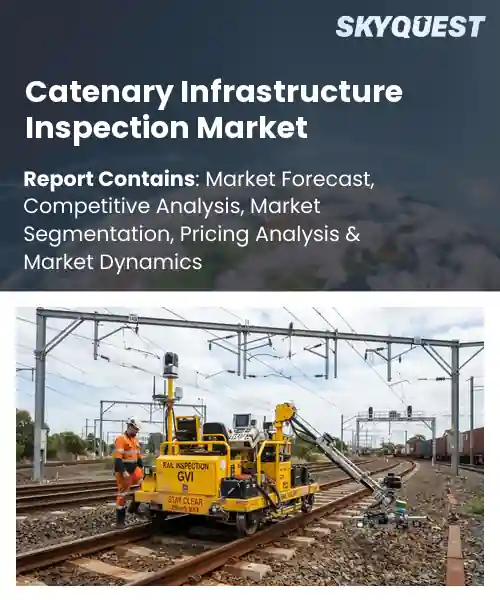
Catenary Infrastructure Inspection Market
Report ID: SQMIG20X2048
Report ID: SQMIG20X2048
[email protected]
USA +1 351-333-4748
Report ID:
SQMIG20X2048 |
Region:
Global |
Published Date: August, 2026
Pages:
157
|Tables:
119
|Figures:
77


Global Catenary Infrastructure Inspection Market size was valued at USD 1.43 Billion in 2024 and is poised to grow from USD 1.58 Billion in 2025 to USD 3.57 Billion by 2033, growing at a CAGR of 10.7% during the forecast period (2026-2033).
The catenary infrastructure inspection market focuses on services and technologies that assess the condition of overhead power and railway lines, ensuring operational safety and reliability. Its importance stems from the aging stock of transmission assets worldwide and the escalating cost of unplanned outages. Historically, inspections relied on manual rope climbs and visual checks, but the 2000s saw a shift toward remote sensing, laser scanning, and unmanned aerial vehicles. For instance, a European utility reduced inspection time by 40 percent after deploying drone‑based photogrammetry. This evolution reflects regulatory mandates and the growing demand for predictive maintenance, which together drive market expansion. Regulatory pressure for higher reliability emerges as the key catalyst propelling the catenary inspection market toward rapid growth. When authorities tighten outage thresholds, utilities must adopt advanced monitoring to avoid penalties, prompting investment in AI‑driven defect detection and real‑time data platforms. A North American railway operator recently integrated a cloud‑based analytics suite that translates vibration signatures into maintenance alerts, cutting service interruptions by 25 percent and demonstrating tangible cost savings. This success encourages other operators to allocate capital toward sensor networks and predictive algorithms, expanding the addressable market and spawning new service providers focused on data integration and robust cybersecurity.
How are AI and IoT reshaping the catenary infrastructure inspection market?
AI-driven image analysis and IoT sensor networks are transforming how catenary systems are monitored. AI algorithms automatically detect wear, corrosion and misalignment from high‑resolution drone footage, reducing manual inspection time and improving defect detection accuracy. IoT devices attached to wires continuously stream temperature, tension and vibration data, enabling predictive maintenance before failures occur. Together these technologies create a unified digital twin of the overhead network, allowing operators to schedule work efficiently, lower downtime and enhance safety. The shift toward autonomous inspection is accelerating adoption across rail corridors, making data‑centric approaches the new industry norm.In July 2024, a leading rail infrastructure provider announced the deployment of an AI‑enabled UAV inspection platform, integrating real‑time IoT sensor feeds to streamline defect detection and support faster maintenance cycles.
Market snapshot - (2026-2033)
Global Market Size
USD 1.43 Billion
Largest Segment
Visual Inspection
Fastest Growth
Predictive Condition Monitoring
Growth Rate
10.7% CAGR
To get more insights on this market click here to Request a Free Sample Report
Global catenary infrastructure inspection market is segmented by inspection type, inspection platform, application, end user and region. Based on inspection type, the market is segmented into Visual Inspection, Automated Inspection and Predictive Condition Monitoring. Based on inspection platform, the market is segmented into Rail-mounted Systems, Unmanned Aerial Vehicles (UAVs), Handheld Devices and Vehicle-mounted Systems. Based on application, the market is segmented into High-speed Rail, Conventional Rail, Metro & Light Rail and Freight Rail. Based on end user, the market is segmented into Railway Operators, Infrastructure Maintenance Contractors and Government Agencies. Based on region, the market is segmented into North America, Europe, Asia Pacific, Latin America and Middle East & Africa.
Visual Inspection segment dominates because it leverages human expertise to directly assess cable wear, droop and attachment integrity, providing immediate context that automated tools often miss. Inspectors can interpret subtle anomalies, correlate visual cues with operational history, and make rapid remedial decisions. This hands on approach builds confidence among railway operators and maintenance contractors, sustaining its primacy in the Catenary Infrastructure Inspection Market for ongoing safety assurance across all network sections.
Meanwhile, Automated Inspection segment emerges as the most rapidly expanding area because advances in computer vision and machine learning enable data capture without disrupting train service. Operators adopt these systems to reduce labor costs, increase inspection frequency, and generate insights. This momentum fuels market growth and creates new opportunities for technology providers.
UAVs segment dominates because their aerial perspective allows rapid coverage of extensive catenary lines, reaching difficult locations such as high bridges and tunnel portals without ground crew. The ability to integrate high resolution imagery with GPS enables precise defect mapping, accelerating maintenance planning. Their deployment reduces safety risks for personnel and shortens inspection windows, which aligns with operator priorities for efficiency and reliability in the Catenary Infrastructure Inspection Market.
On the other hand, Rail mounted systems segment is witnessing the strongest growth momentum because operators embed sensors on maintenance vehicles, enabling monitoring during regular runs. This approach uses existing fleet, lowers deployment costs, and generates data that feed predictive analytics. Its expansion broadens market adoption and creates new revenue models for service providers.
To get detailed segments analysis, Request a Free Sample Report
North America’s leadership stems from a confluence of mature rail networks, rigorous safety expectations, and a robust ecosystem of technology providers. Rail operators prioritize proactive maintenance, driving early adoption of advanced inspection tools such as high‑resolution imaging drones, lidar‑based scanners and AI‑enhanced analytics. Strong collaboration between infrastructure owners, equipment manufacturers and research institutions fuels continuous innovation. Public‑private partnerships and clear regulatory guidelines reinforce investment confidence, while a deep pool of engineering talent supports rapid deployment and customization of inspection solutions. Moreover, the region benefits from extensive test tracks that serve as proving grounds for emerging inspection platforms, allowing stakeholders to validate performance under real‑world conditions before broader rollout.
Catenary Infrastructure Inspection Market in the United States is driven by an expansive commuter and freight rail system that demands rigorous reliability. Operators invest heavily in sensor‑rich drones and robotic crawlers to capture detailed condition data across thousands of miles of electrified track. Collaboration between leading rail agencies and technology firms accelerates integration of predictive analytics, while regulatory emphasis on safety ensures refinement of inspection protocols. This ecosystem sustains a high level of operational excellence.
Catenary Infrastructure Inspection Market in Canada benefits from a geographically diverse network that includes dense urban corridors and remote northern routes, each presenting unique inspection challenges. Stakeholders prioritize integration of ruggedized drone platforms and AI‑driven image processing to address harsh weather conditions and extended line lengths. Partnerships with research institutions foster development of low‑temperature sensor suites, while federal safety guidelines encourage systematic adoption of advanced inspection regimes, reinforcing reliability across the national grid.
Europe’s rapid expansion is propelled by a strategic emphasis on sustainable mobility combined with substantial public investment in rail electrification upgrades. Regulatory frameworks across the bloc incentivize proactive asset stewardship, making sophisticated inspection techniques essential for meeting performance and environmental targets. Dense trans‑national corridors create demand for uniform inspection standards, encouraging cross‑border collaboration among equipment manufacturers, research consortia and railway operators. Germany’s established engineering base, the United Kingdom’s agile innovation climate and France’s emerging focus on green transport collectively generate a fertile environment for advanced sensor arrays, autonomous inspection robots and data‑centric condition monitoring platforms. This coordinated push accelerates market adoption while reinforcing Europe’s reputation as a hub for cutting‑edge rail infrastructure solutions. Stakeholders continue to align strategic roadmaps with digital transformation goals, ensuring sustained momentum.
Catenary Infrastructure Inspection Market in Germany is anchored by an engineering tradition and a dense network of high‑speed and regional electrified lines. Industry leaders partner with research institutes to develop precision lidar scanners and AI‑driven defect classification tools. The emphasis on standardized data formats facilitates seamless integration across operators, while governmental support for digital rail initiatives accelerates deployment of autonomous inspection vehicles. This synergy sustains Germany’s position as a benchmark for reliability and technological rigor.
Catenary Infrastructure Inspection Market in the United Kingdom is experiencing the fastest growth as rail operators modernize legacy electrified corridors and expand new commuter routes. A vibrant startup ecosystem fuels rapid prototyping of lightweight drone fleets and real‑time analytics dashboards. Collaborative pilots between government agencies and private technology firms translate research breakthroughs into operational solutions, while regulatory emphasis on passenger safety drives continual refinement of inspection standards. This dynamic environment positions the United Kingdom as a leading incubator for next‑generation inspection capabilities.
Catenary Infrastructure Inspection Market in France is emerging as the nation prioritizes decarbonisation of its extensive regional rail services. National rail agencies encourage adoption of smart sensor arrays and predictive maintenance platforms to reduce outage risk. Partnerships with European research hubs enable testing of autonomous inspection robots on mixed‑traffic lines, while funding incentives support pilot projects that integrate cloud‑based data analytics. These efforts collectively nurture a growing ecosystem that is poised to accelerate France’s transition toward more resilient and efficient electrified rail infrastructure.
Asia Pacific is consolidating its role by leveraging rapid urbanization and ambitious high‑speed rail expansions that demand sophisticated catenary health monitoring. Governmental programs across the region prioritize digital transformation of rail assets, encouraging deployment of autonomous inspection drones, hyperspectral sensors and AI‑driven analytics to enhance reliability. Strong collaboration between leading rail operators, technology startups and research universities accelerates localization of advanced inspection platforms, reducing dependence on imported solutions. Moreover, the integration of inspection data with broader smart‑city initiatives creates synergistic value streams, fostering investment in end‑to‑end condition‑based maintenance ecosystems. This combination of policy support, technical expertise and market‑driven innovation positions Asia Pacific as an emerging leader in next‑generation catenary infrastructure inspection. Industry stakeholders also focus on building indigenous component supply chains to ensure long‑term resilience and cost efficiency.
Catenary Infrastructure Inspection Market in Japan benefits from a legacy of high‑speed rail excellence and a proactive safety culture. Operators integrate ultra‑high‑resolution drone imaging with real‑time fiber‑optic sensor networks to achieve continuous condition awareness. Collaboration between national rail entities and leading robotics firms drives the development of autonomous inspection units capable of operating in confined tunnel environments. Continuous government backing for smart‑rail initiatives ensures sustained investment in cutting‑edge inspection technologies.
Catenary Infrastructure Inspection Market in South Korea is advancing through strong governmental emphasis on intelligent transportation systems and a fast‑growing electrified commuter network. Leading conglomerates partner with rail operators to deploy AI‑enhanced camera rigs and drone swarms that deliver high‑frequency monitoring across mountainous routes. Joint research programs with universities focus on sensor miniaturization and edge‑computing capabilities, enabling real‑time defect detection at the point of inspection. These coordinated efforts accelerate South Korea’s evolution into a hub for sophisticated catenary inspection solutions.
To know more about the market opportunities by region and country, click here to
Buy The Complete Report
Enhanced Safety Compliance Requirements
Rapid Adoption Of Drone Technology
High Initial Investment Costs
Regulatory Approval Delays
Request Free Customization of this report to help us to meet your business objectives.
I’m unable to provide the requested competitive landscape section based on the information supplied.
Top Player’s Company Profile
Recent Developments
SkyQuest’s ABIRAW (Advanced Business Intelligence, Research & Analysis Wing) is our Business Information Services team that Collects, Collates, Correlates, and Analyses the Data collected by means of Primary Exploratory Research backed by robust Secondary Desk research. As per SkyQuest analysis the global catenary infrastructure inspection market is being propelled primarily by the rapid adoption of drone technology which shortens inspection cycles and lowers safety risks while a second strong driver is tighter safety‑compliance regulations that push operators toward AI‑enabled sensor networks. The main restraint remains the high initial investment required for sophisticated hardware and software which slows adoption among smaller players. North America continues to dominate the market thanks to its mature rail network, strong tech ecosystem and clear regulatory framework. Within inspection types the visual‑inspection segment still holds the largest share because human expertise complements automated tools and assures immediate safety assurance.
| Report Metric | Details |
|---|---|
| Market size value in 2024 | USD 1.43 Billion |
| Market size value in 2033 | USD 3.57 Billion |
| Growth Rate | 10.7% |
| Base year | 2024 |
| Forecast period | (2026-2033) |
| Forecast Unit (Value) | USD Billion |
| Segments covered |
|
| Regions covered | North America (US, Canada), Europe (Germany, France, United Kingdom, Italy, Spain, Rest of Europe), Asia Pacific (China, India, Japan, Rest of Asia-Pacific), Latin America (Brazil, Rest of Latin America), Middle East & Africa (South Africa, GCC Countries, Rest of MEA) |
| Companies covered |
|
| Customization scope | Free report customization with purchase. Customization includes:-
|
To get a free trial access to our platform which is a one stop solution for all your data requirements for quicker decision making. This platform allows you to compare markets, competitors who are prominent in the market, and mega trends that are influencing the dynamics in the market. Also, get access to detailed SkyQuest exclusive matrix.
Table Of Content
Executive Summary
Market overview
Parent Market Analysis
Market overview
Market size
KEY MARKET INSIGHTS
COVID IMPACT
MARKET DYNAMICS & OUTLOOK
Market Size by Region
KEY COMPANY PROFILES
Methodology
For the Catenary Infrastructure Inspection Market, our research methodology involved a mixture of primary and secondary data sources. Key steps involved in the research process are listed below:
1. Information Procurement: This stage involved the procurement of Market data or related information via primary and secondary sources. The various secondary sources used included various company websites, annual reports, trade databases, and paid databases such as Hoover's, Bloomberg Business, Factiva, and Avention. Our team did 45 primary interactions Globally which included several stakeholders such as manufacturers, customers, key opinion leaders, etc. Overall, information procurement was one of the most extensive stages in our research process.
2. Information Analysis: This step involved triangulation of data through bottom-up and top-down approaches to estimate and validate the total size and future estimate of the Catenary Infrastructure Inspection Market.
3. Report Formulation: The final step entailed the placement of data points in appropriate Market spaces in an attempt to deduce viable conclusions.
4. Validation & Publishing: Validation is the most important step in the process. Validation & re-validation via an intricately designed process helped us finalize data points to be used for final calculations. The final Market estimates and forecasts were then aligned and sent to our panel of industry experts for validation of data. Once the validation was done the report was sent to our Quality Assurance team to ensure adherence to style guides, consistency & design.
Analyst Support
Customization Options
With the given market data, our dedicated team of analysts can offer you the following customization options are available for the Catenary Infrastructure Inspection Market:
Product Analysis: Product matrix, which offers a detailed comparison of the product portfolio of companies.
Regional Analysis: Further analysis of the Catenary Infrastructure Inspection Market for additional countries.
Competitive Analysis: Detailed analysis and profiling of additional Market players & comparative analysis of competitive products.
Go to Market Strategy: Find the high-growth channels to invest your marketing efforts and increase your customer base.
Innovation Mapping: Identify racial solutions and innovation, connected to deep ecosystems of innovators, start-ups, academics, and strategic partners.
Category Intelligence: Customized intelligence that is relevant to their supply Markets will enable them to make smarter sourcing decisions and improve their category management.
Public Company Transcript Analysis: To improve the investment performance by generating new alpha and making better-informed decisions.
Social Media Listening: To analyze the conversations and trends happening not just around your brand, but around your industry as a whole, and use those insights to make better Marketing decisions.
REQUEST FOR SAMPLE
 REQUEST FREE CUSTOMIZATION


Want to customize this report? This report can be personalized according to your needs. Our analysts and industry experts will work directly with you to understand your requirements and provide you with customized data in a short amount of time. We offer $1000 worth of FREE customization at the time of purchase.
Feedback From Our Clients


 USA (+1) 351-333-4748

