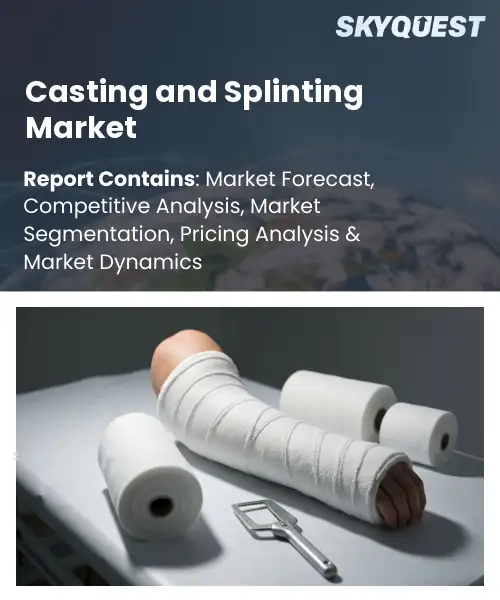
Casting and Splinting Market
Report ID: SQMIG35B2403
Report ID: SQMIG35B2403
[email protected]
USA +1 351-333-4748
Report ID:
SQMIG35B2403 |
Region:
Global |
Published Date: July, 2026
Pages:
157
|Tables:
119
|Figures:
77


Global Casting And Splinting Market size was valued at USD 2.48 Billion in 2024 and is poised to grow from USD 2.63 Billion in 2025 to USD 4.23 Billion by 2033, growing at a CAGR of 6.12% during the forecast period (2026-2033).
An global casting and splinting market encompasses materials and services used to immobilize musculoskeletal injuries, ranging from traditional plaster casts to advanced thermoplastic splints. Its significance lies in enabling recovery and reducing disability, which is critical for aging populations and active lifestyles. Over the past two decades the market has evolved from labor‑intensive gypsum applications toward digitized, patient‑specific solutions driven by 3‑D scanning and additive manufacturing. For instance, hospitals in Europe now employ lightweight carbon‑fiber splints that cut casting time by 40 percent. This shift reflects the driver: demand for faster, more comfortable immobilization that shortens hospital stays and cuts costs.An catalyst for market expansion is the integration of workflow platforms that link diagnosis, design, and delivery of splinting devices. When clinicians capture a patient’s anatomy with portable scanners, computer‑aided design software instantly generates a customized splint geometry, which additive‑manufacturing units produce within hours. This streamlined process reduces turnaround time, minimizes material waste, and lowers labor costs, prompting clinics in North America to adopt production lines that previously required external suppliers. The resulting cost efficiencies attract insurance providers, who are more willing to reimburse fabricated splints, thereby unlocking revenue streams for manufacturers and encouraging investment in R&D for biodegradable polymers and sensor integration.
How is AI-driven automation improving efficiency in the casting and splinting market?
AI driven automation is reshaping the casting and splinting market by streamlining design, production and application processes. Machine learning algorithms analyse patient scans to generate precise splint geometries, reducing manual drafting time. Integrated robotic printers then produce custom devices on demand, eliminating inventory waste. Real time feedback from sensors embedded in casts alerts clinicians to pressure points, shortening adjustment cycles. These capabilities accelerate patient turnover and free staff for higher value tasks. As hospitals adopt digital workflows, overall treatment timelines shrink and cost pressures ease, making the sector more responsive to growing orthopedic demand and improving overall care quality for patients.3M March 2024, introduced an AI driven 3D printing platform that creates patient specific splints within minutes. The system links imaging data to automated design software and a robotic printer, cutting lead time and reducing material waste while supporting faster clinical decisions and higher throughput across orthopedic departments worldwide enhancing patient satisfaction and staff efficiency.
Market snapshot - (2026-2033)
Global Market Size
USD 2.48 Billion
Largest Segment
Casting Supplies
Fastest Growth
Equipment and Other Supplies
Growth Rate
6.12% CAGR
To get more insights on this market click here to Request a Free Sample Report
Global casting and splinting market is segmented by product type, application clinical type, distribution channel, end user and region. Based on product type, the market is segmented into Casting Supplies, Splinting Supplies and Equipment and Other Supplies. Based on application clinical type, the market is segmented into Fracture Management, Sports Injuries, Pediatric Care, Trauma Post-Surgical Immobilization and Others. Based on distribution channel, the market is segmented into Institutional Sales and Retail Sales. Based on end user, the market is segmented into Hospitals, Orthopedic Clinics, Ambulatory Surgical Centers and Nursing Facilities. Based on region, the market is segmented into North America, Europe, Asia Pacific, Latin America and Middle East & Africa.
Casting supplies segment dominates because it forms the core material foundation for most immobilization procedures, providing reliable low maintenance solutions that clinicians trust. Its widespread acceptance stems from ease of application, long standing clinical evidence, and compatibility with diverse patient anatomies. Consequently procurement decisions consistently prioritize these products, reinforcing their central role in shaping market dynamics and supplier relationships across care settings and supporting efficient treatment pathways for clinicians daily.
However, splinting supplies segment emerges as the fastest growing because innovative lightweight materials and modular designs are expanding their use beyond traditional injury care. Clinicians value the enhanced patient comfort and quicker removal, driving adoption in outpatient and sports settings. This momentum unlocks revenue streams and fuels broader market expansion.
Fracture Management segment leads because it addresses the most common clinical need for immobilization, anchoring the core demand for both casting and splinting solutions. The prevalence of acute bone injuries across all ages sustains continuous usage, and clinicians rely on proven protocols that prioritize stability and healing. This entrenched reliance shapes purchasing patterns, supplier focus, and ongoing innovation directed at improving fracture care outcomes for patients and healthcare systems alike.
Meanwhile, sports injuries segment emerges as the fastest growing because heightened participation in activities is spurring demand for lightweight flexible immobilization options. Splint designs that promote mobility attract athletic clinicians, while insurance endorsements encourage coverage. This surge fuels diversification and opens avenues for market entrants focused on performance oriented solutions.
To get detailed segments analysis, Request a Free Sample Report
North America leads due to advanced healthcare infrastructure, strong reimbursement mechanisms, and high adoption of innovative orthopaedic technologies. The region benefits from a mature supply chain that integrates manufacturers, distributors, and specialised clinics, enabling rapid product rollout. Clinical practice patterns emphasize early intervention and rehabilitation, driving consistent demand for high‑quality casting and splinting solutions. Regulatory frameworks support swift product approvals while maintaining safety standards, encouraging both domestic development and foreign investment. Skilled workforce and robust research institutions further reinforce the region’s capacity to innovate, maintain product excellence, and respond to evolving patient needs, cementing its leadership position globally.
Casting and Splinting Market in the United States reflects deep integration of orthopaedic services with private and public payers, fostering widespread utilisation across acute and outpatient settings. Market participants leverage extensive clinical networks to introduce advanced materials and digital design tools, enhancing customisation and patient comfort. Emphasis on evidence‑based practice and continual professional development sustains high demand for both traditional and next‑generation solutions, reinforcing the United States as a pivotal hub for product innovation and market scale.
Casting and Splinting Market in Canada is characterised by a publicly funded health system that prioritises cost‑effectiveness while ensuring access to essential orthopaedic care. Collaborative relationships between provincial health authorities and specialised suppliers enable coordinated adoption of best‑practice devices. Emphasis on training programmes for clinicians supports consistent application of current techniques, while modest market size encourages focused, high‑quality product offerings that align with national health priorities and patient outcomes.
Europe experiences rapid expansion propelled by harmonised regulatory standards, integrated cross‑border healthcare networks, and growing emphasis on patient‑centred care. Strong public healthcare commitments drive consistent procurement of reliable casting and splinting solutions, while private sector growth adds competitive dynamism. Collaborative research initiatives across the continent accelerate development of lightweight, recyclable materials and digital casting technologies. Demographic shifts toward an ageing population increase demand for rehabilitative orthopaedic services, and reimbursement reforms encourage adoption of cost‑efficient yet high‑performance products. These factors collectively position Europe as a vibrant market with accelerating trajectory.
Casting and Splinting Market in Germany benefits from a well‑established engineering tradition and rigorous quality standards that underpin product reliability. Healthcare providers integrate advanced biomechanical designs into routine practice, supported by strong academic‑industry partnerships that foster continual innovation. Reimbursement policies reward efficient treatment pathways, prompting widespread use of both conventional and digitally fabricated splints. The German market’s focus on precision and durability sustains its role as a dominant force within the European landscape.
Casting and Splinting Market in the United Kingdom is experiencing accelerated growth due to proactive NHS initiatives that streamline procurement and encourage adoption of modern orthopaedic technologies. Emphasis on early mobilisation and outpatient care drives demand for lightweight, custom‑fit splints that enhance patient recovery. Collaborative frameworks between clinical bodies and manufacturers promote rapid diffusion of digital casting solutions, while training programmes ensure clinicians remain adept with evolving techniques. This fast‑moving environment positions the United Kingdom as a leading growth engine in Europe.
Casting and Splinting Market in France is emerging as a dynamic segment supported by national health strategies that prioritize rehabilitation and injury prevention. French clinicians increasingly adopt innovative materials that balance comfort with structural support, aligning with patient‑focused care models. Partnerships between research institutions and device makers facilitate introduction of eco‑friendly casting options, resonating with broader sustainability goals. While still developing relative to its neighbours, France’s commitment to advancing orthopaedic practice fuels steady market expansion.
Asia Pacific is strengthening its position through rapid economic development, expanding healthcare coverage, and growing awareness of orthopaedic care standards. Investment in modern hospital infrastructure and the emergence of specialised orthopaedic centres drive demand for sophisticated casting and splinting solutions. Regional manufacturers are adopting digital design and additive manufacturing, reducing lead times and enhancing customisation. Government initiatives promoting injury prevention and post‑acute rehabilitation further stimulate market activity. Coupled with an increasingly skilled clinical workforce, these dynamics enable Asia Pacific to evolve from a nascent market to a significant contributor to global casting and splinting growth.
Casting and Splinting Market in Japan reflects a blend of technological precision and a strong emphasis on patient quality of life. Healthcare providers integrate high‑performance, lightweight materials that align with the country’s focus on minimally invasive orthopaedic interventions. Government‑supported programs encourage adoption of digital casting techniques, improving fit accuracy and reducing treatment cycles. Collaboration between academic institutions and device firms sustains a pipeline of innovative solutions, reinforcing Japan’s reputation for excellence in orthopaedic care.
Casting and Splinting Market in South Korea is propelled by a dynamic health ecosystem that rapidly incorporates cutting‑edge manufacturing processes. Strong emphasis on early recovery and outpatient treatment encourages use of custom‑fit, ergonomically designed splints. Partnerships between technology firms and medical device companies accelerate the rollout of smart materials and sensor‑enabled casting systems. Robust reimbursement frameworks and proactive regulatory pathways support swift market entry, positioning South Korea as an emerging leader in advanced orthopaedic solutions.
To know more about the market opportunities by region and country, click here to
Buy The Complete Report
Increasing Demand For Orthopedic Care
Advancements In 3D Printing Technology
High Cost Of Advanced Materials
Stringent Regulatory Approval Processes
Request Free Customization of this report to help us to meet your business objectives.
The competitive landscape of the global casting and splinting market is shaped by firms leveraging strategic M&A, targeted partnerships, and rapid tech innovation to expand product portfolios and geographic reach. ActivArmor, for example, has introduced three six‑month accelerator programs tailored to pre‑seed, seed and Series A stages, fostering early‑stage innovation and securing pipeline talent, while also pursuing collaborations with medical‑device distributors to accelerate market penetration of its advanced polymer splint solutions. These moves intensify rivalry as companies race to integrate smart materials and digital monitoring capabilities into traditional casting systems.
Top Player’s Company Profile
Recent Developments
SkyQuest’s ABIRAW (Advanced Business Intelligence, Research & Analysis Wing) is our Business Information Services team that Collects, Collates, Correlates, and Analyses the Data collected by means of Primary Exploratory Research backed by robust Secondary Desk research. As per SkyQuest analysis the global casting and splinting market is expanding at a healthy pace, driven first by the rising prevalence of musculoskeletal disorders that pushes hospitals and clinics to seek reliable immobilisation solutions, and second by rapid advances in 3‑D printing which enable patient‑specific casts and splints with shorter lead times. The casting supplies segment remains the core of the market because it provides the foundational materials clinicians trust, while North America leads the world thanks to strong reimbursement frameworks and early adoption of digital technologies. However, the high cost of advanced polymers and smart‑sensor systems restrains broader uptake, especially in cost‑sensitive settings.
| Report Metric | Details |
|---|---|
| Market size value in 2024 | USD 2.48 Billion |
| Market size value in 2033 | USD 4.23 Billion |
| Growth Rate | 6.12% |
| Base year | 2024 |
| Forecast period | (2026-2033) |
| Forecast Unit (Value) | USD Billion |
| Segments covered |
|
| Regions covered | North America (US, Canada), Europe (Germany, France, United Kingdom, Italy, Spain, Rest of Europe), Asia Pacific (China, India, Japan, Rest of Asia-Pacific), Latin America (Brazil, Rest of Latin America), Middle East & Africa (South Africa, GCC Countries, Rest of MEA) |
| Companies covered |
|
| Customization scope | Free report customization with purchase. Customization includes:-
|
To get a free trial access to our platform which is a one stop solution for all your data requirements for quicker decision making. This platform allows you to compare markets, competitors who are prominent in the market, and mega trends that are influencing the dynamics in the market. Also, get access to detailed SkyQuest exclusive matrix.
Table Of Content
Executive Summary
Market overview
Parent Market Analysis
Market overview
Market size
KEY MARKET INSIGHTS
COVID IMPACT
MARKET DYNAMICS & OUTLOOK
Market Size by Region
KEY COMPANY PROFILES
Methodology
For the Casting and Splinting Market, our research methodology involved a mixture of primary and secondary data sources. Key steps involved in the research process are listed below:
1. Information Procurement: This stage involved the procurement of Market data or related information via primary and secondary sources. The various secondary sources used included various company websites, annual reports, trade databases, and paid databases such as Hoover's, Bloomberg Business, Factiva, and Avention. Our team did 45 primary interactions Globally which included several stakeholders such as manufacturers, customers, key opinion leaders, etc. Overall, information procurement was one of the most extensive stages in our research process.
2. Information Analysis: This step involved triangulation of data through bottom-up and top-down approaches to estimate and validate the total size and future estimate of the Casting and Splinting Market.
3. Report Formulation: The final step entailed the placement of data points in appropriate Market spaces in an attempt to deduce viable conclusions.
4. Validation & Publishing: Validation is the most important step in the process. Validation & re-validation via an intricately designed process helped us finalize data points to be used for final calculations. The final Market estimates and forecasts were then aligned and sent to our panel of industry experts for validation of data. Once the validation was done the report was sent to our Quality Assurance team to ensure adherence to style guides, consistency & design.
Analyst Support
Customization Options
With the given market data, our dedicated team of analysts can offer you the following customization options are available for the Casting and Splinting Market:
Product Analysis: Product matrix, which offers a detailed comparison of the product portfolio of companies.
Regional Analysis: Further analysis of the Casting and Splinting Market for additional countries.
Competitive Analysis: Detailed analysis and profiling of additional Market players & comparative analysis of competitive products.
Go to Market Strategy: Find the high-growth channels to invest your marketing efforts and increase your customer base.
Innovation Mapping: Identify racial solutions and innovation, connected to deep ecosystems of innovators, start-ups, academics, and strategic partners.
Category Intelligence: Customized intelligence that is relevant to their supply Markets will enable them to make smarter sourcing decisions and improve their category management.
Public Company Transcript Analysis: To improve the investment performance by generating new alpha and making better-informed decisions.
Social Media Listening: To analyze the conversations and trends happening not just around your brand, but around your industry as a whole, and use those insights to make better Marketing decisions.
REQUEST FOR SAMPLE
 REQUEST FREE CUSTOMIZATION


Want to customize this report? This report can be personalized according to your needs. Our analysts and industry experts will work directly with you to understand your requirements and provide you with customized data in a short amount of time. We offer $1000 worth of FREE customization at the time of purchase.
Feedback From Our Clients


 USA (+1) 351-333-4748

