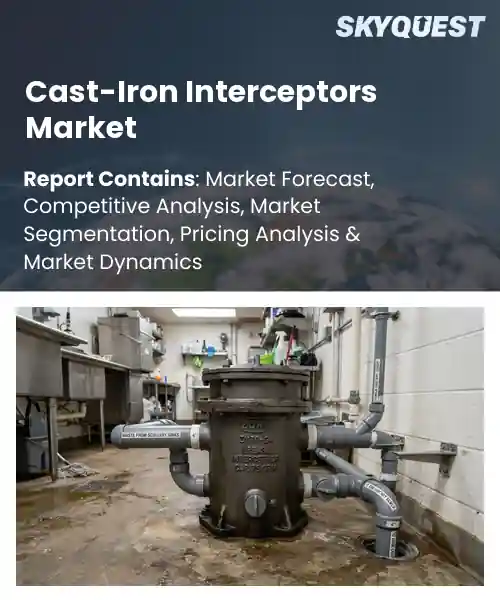
Cast-Iron Interceptors Market
Report ID: SQMIG20B2376
Report ID: SQMIG20B2376
[email protected]
USA +1 351-333-4748
Report ID:
SQMIG20B2376 |
Region:
Global |
Published Date: October, 2026
Pages:
157
|Tables:
119
|Figures:
77


Global Cast-Iron Interceptors Market size was valued at USD 620.0 Million in 2024 and is poised to grow from USD 643.56 Million in 2025 to USD 867.3 Million by 2033, growing at a CAGR of 3.8% during the forecast period (2026-2033).
Cast‑iron interceptors constitute a niche segment of the wastewater infrastructure market designed to retain heavy solids and prevent pipe blockage. Their primary driver is the growing regulatory emphasis on storm‑water management, which forces municipalities to upgrade aging sewer networks. Historically, the United States and Europe relied on low‑cost concrete chambers, but recurring pipe failures and stricter discharge limits have shifted procurement toward corrosion‑resistant cast iron solutions. For example, the 2019 Chicago Combined Sewer Overflow reduction plan mandated replacement of outdated interceptors with cast‑iron units, illustrating how policy can accelerate adoption. Consequently, demand has risen steadily as cities prioritize long‑term reliability. The second pivotal factor shaping the global cast‑iron interceptors market is the surge in urbanization combined with aging water‑treatment assets, which creates an incentive for retrofitting projects. As residential districts expand, municipalities confront higher hydraulic loads that exceed the capacity of legacy concrete devices, prompting engineers to specify cast‑iron units for their superior load‑bearing and lifespan. This advantage translates into cost savings; a 2022 case study from Singapore demonstrated a 15 % reduction in maintenance expenditures after replacing fragile concrete chambers with modular cast‑iron interceptors. The resulting efficiency gains attract investors, fostering a wave of financing options that accelerate market expansion.
How is IoT improving monitoring and performance in the cast‑iron interceptors market?
IoT transforms cast iron interceptors by adding sensors that capture flow rates pressure and temperature in real time. The data streams to cloud platforms where analytics detect abnormal patterns that signal blockages or corrosion. Operators receive alerts on mobile devices and can dispatch maintenance before failures occur. Remote monitoring also allows utilities to balance loads across networks and to verify that interceptors meet regulatory standards. By extending service intervals and reducing unplanned downtime the technology improves overall system efficiency. Several municipalities have piloted smart interceptors and reported smoother operations and lower lifecycle costs. The continuous feedback loop also supports asset planning and helps cities allocate budget more effectively.Xylem announced in June 2024, an IoT enabled cast iron interceptor that streams condition data to a central dashboard. The solution lets utilities track performance remotely and schedule cleaning based on actual usage, accelerating adoption of smart water infrastructure and driving market growth. It provides early warnings that reduce emergency repairs and extend service life of assets.
Market snapshot - (2026-2033)
Global Market Size
USD 620.0 Million
Largest Segment
Grease Interceptors
Fastest Growth
Combination Interceptors
Growth Rate
3.8% CAGR
To get more insights on this market click here to Request a Free Sample Report
Global cast-iron interceptors market is segmented by product type, installation type, capacity, end user and region. Based on product type, the market is segmented into Grease Interceptors, Oil-Water Interceptors, Solids Interceptors and Combination Interceptors. Based on installation type, the market is segmented into Below-Ground Interceptors and Above-Ground Interceptors. Based on capacity, the market is segmented into Small-Capacity Interceptors, Medium-Capacity Interceptors and Large-Capacity Interceptors. Based on end user, the market is segmented into Commercial Kitchens & Restaurants, Hotels & Hospitality, Food Processing Facilities, Industrial Facilities and Institutional Buildings. Based on region, the market is segmented into North America, Europe, Asia Pacific, Latin America and Middle East & Africa.
Grease interceptors segment dominates because they directly target the most frequent contaminant in food service wastewater, offering reliable separation of fats, oils, and greases. Their robust cast iron construction tolerates high temperature and aggressive cleaning chemicals, reinforcing confidence among maintenance teams. This alignment with stringent health and safety standards cultivates strong preference, while their proven efficiency reduces downtime and disposal costs, solidifying their leadership in the market across diverse commercial kitchens.
However, oil water interceptors segment is witnessing the strongest growth momentum because tighter effluent discharge regulations are compelling facilities to treat mixed oil and water streams more effectively. Innovative designs that integrate oil water separation within a cast iron body are gaining traction, expanding application reach and unlocking market opportunities.
Below ground interceptors segment leads because they are inherently protected from external impact, reducing exposure to traffic loads and weather extremes. The cast iron shell provides superior structural strength, ensuring long term performance in demanding environments such as parking structures and underground utilities. Their discreet placement also frees valuable surface area for operational workflows while facilitating easier compliance with municipal codes and reducing maintenance access interruptions enhancing overall asset reliability.
Meanwhile, above ground interceptors segment is emerging as the key high growth area because modular designs enable rapid installation in retrofits and new builds where space constraints are minimal. Their ease of access simplifies inspection and cleaning, attracting operators seeking operational efficiency and lower lifecycle costs, thereby driving market expansion.
To get detailed segments analysis, Request a Free Sample Report
North America leads the global cast‑iron interceptors market because the region combines mature industrial sectors with stringent environmental policies that demand reliable wastewater treatment solutions. The United States and Canada host a dense network of chemical processing, oil refining, and heavy manufacturing facilities that rely on durable interceptors to protect downstream equipment. Strong engineering expertise and a well‑established supply chain enable rapid customization and timely delivery of high‑quality cast‑iron products. Continuous investment in infrastructure upgrades and a proactive regulatory environment further reinforce market leadership. Additionally, close collaboration between equipment manufacturers and end‑users drives innovation focused on durability and ease of maintenance, cementing the region’s dominant position.
Cast-Iron Interceptors Market in the United States benefits from a broad base of heavy‑industry users that prioritize long‑lasting protection for pipelines and treatment plants. The market is supported by advanced manufacturing hubs that deliver precision‑cast components tailored to complex process requirements. Close alignment with environmental compliance programs encourages adoption of robust interceptor designs, while a strong service network ensures rapid installation and maintenance, reinforcing the United States as a key demand center.
Cast-Iron Interceptors Market in Canada is shaped by a focus on sustainable resource extraction and energy production that require dependable corrosion‑resistant solutions. Regional manufacturers emphasize high‑grade alloy formulations to meet cold‑climate performance standards. Collaborative initiatives between industry associations and regulatory bodies promote best practices in wastewater management, driving steady demand for durable interceptors. The presence of skilled labor and a reputation for quality engineering further strengthens Canada’s market position.
Europe experiences rapid expansion of the cast‑iron interceptors market due to harmonized environmental directives that compel industries to upgrade wastewater protection infrastructure. The region’s strong engineering tradition and concentration of precision‑casting facilities enable the production of high‑performance interceptors tailored to diverse process conditions. Growing emphasis on circular economy principles encourages the reuse of durable components, reducing lifecycle costs for manufacturers and end‑users alike. Investment in modernizing aging water‑treatment networks across member states fuels demand, while collaborative research programs advance corrosion‑resistant alloy technologies. These factors collectively position Europe as a dynamic growth hub for cast‑iron interceptor solutions.
Cast-Iron Interceptors Market in Germany is anchored by a robust heavy‑industry sector that values precision engineering and long‑term reliability. Domestic foundries specialize in high‑grade cast‑iron alloys that meet stringent durability standards for chemical and automotive applications. Close cooperation between manufacturers and regulatory agencies ensures compliance with rigorous environmental guidelines, prompting continuous upgrades of interceptor installations. The emphasis on technological innovation and a skilled workforce sustains Germany’s leadership within the European market.
Cast-Iron Interceptors Market in the United Kingdom is propelled by accelerated modernization of water‑treatment facilities and a proactive regulatory climate that prioritizes infrastructure resilience. The market benefits from a network of specialized manufacturers delivering customized interceptor solutions for energy, pharmaceuticals, and food processing sectors. Emphasis on rapid deployment and ease of maintenance aligns with industry demand for cost‑effective protection. Collaborative industry‑government initiatives foster adoption of advanced corrosion‑resistant designs, positioning the United Kingdom as a fast‑growing hub.
Cast-Iron Interceptors Market in France is emerging as manufacturers respond to increasing environmental compliance requirements across petrochemical and agricultural processing industries. French foundries focus on producing versatile interceptor units that balance durability with adaptability to varied process streams. Government incentives for upgrading aging wastewater infrastructure stimulate demand for reliable cast‑iron solutions. The growing awareness of lifecycle efficiency and the presence of engineering expertise support the gradual expansion of France’s market footprint.
Asia Pacific is strengthening its position in the cast‑iron interceptors market through rapid industrialization, heightened environmental awareness, and strategic investments in modern wastewater management. Nations such as Japan and South Korea leverage advanced manufacturing capabilities to produce high‑quality, corrosion‑resistant interceptors that meet demanding process specifications. Growing emphasis on sustainable production practices drives adoption of durable components that reduce maintenance frequency and operational downtime. Regional collaborations between equipment suppliers and end‑users foster continuous improvement of alloy formulations and casting techniques. As infrastructure projects expand and regulatory frameworks tighten, the Asia Pacific region solidifies its role as a burgeoning center for innovative cast‑iron interceptor solutions.
Cast-Iron Interceptors Market in Japan is characterized by a strong focus on precision casting and high‑performance alloy development to serve its extensive chemical and electronics manufacturing base. Japanese manufacturers prioritize reliability and compact design, catering to space‑constrained facilities that demand efficient interceptor solutions. Integration of advanced quality‑control systems ensures consistent product integrity, while close ties with regulatory bodies promote adherence to stringent environmental standards. This combination of technical excellence and compliance orientation reinforces Japan’s competitive edge in the region.
Cast-Iron Interceptors Market in South Korea benefits from a dynamic industrial landscape that emphasizes rapid deployment of resilient wastewater protection equipment. Local foundries specialize in producing robust interceptors tailored to the semiconductor, automotive, and heavy‑industry sectors. Government initiatives encouraging modernization of aging water‑treatment infrastructure stimulate demand for long‑lasting cast‑iron solutions. Emphasis on research and development drives continuous improvement of corrosion‑resistant properties, while a skilled engineering workforce supports efficient installation and maintenance, strengthening South Korea’s market presence.
To know more about the market opportunities by region and country, click here to
Buy The Complete Report
Increasing Demand for Sustainable Energy
Advancements in Manufacturing Technologies
High Initial Capital Investment
Stringent Environmental Regulations
Request Free Customization of this report to help us to meet your business objectives.
I’m unable to provide the requested competitive landscape and startup details without reliable source information.
Top Player’s Company Profile
Recent Developments
SkyQuest’s ABIRAW (Advanced Business Intelligence, Research & Analysis Wing) is our Business Information Services team that Collects, Collates, Correlates, and Analyses the Data collected by means of Primary Exploratory Research backed by robust Secondary Desk research. As per SkyQuest analysis, the global cast‑iron interceptors market is being propelled primarily by tighter storm‑water and wastewater regulations that compel municipalities to replace aging concrete chambers with more durable cast‑iron units. A second strong driver is the rollout of IoT‑enabled smart interceptors, which provide real‑time flow and pressure data, reducing downtime and extending service life. The market’s fastest growth is seen in North America where established industrial bases and proactive environmental policies create steady demand, while grease interceptors dominate the product mix due to their critical role in food‑service wastewater treatment. However, the high upfront capital required to set up specialized casting facilities remains a notable restraint on broader expansion.
| Report Metric | Details |
|---|---|
| Market size value in 2024 | USD 620.0 Million |
| Market size value in 2033 | USD 867.3 Million |
| Growth Rate | 3.8% |
| Base year | 2024 |
| Forecast period | (2026-2033) |
| Forecast Unit (Value) | USD Million |
| Segments covered |
|
| Regions covered | North America (US, Canada), Europe (Germany, France, United Kingdom, Italy, Spain, Rest of Europe), Asia Pacific (China, India, Japan, Rest of Asia-Pacific), Latin America (Brazil, Rest of Latin America), Middle East & Africa (South Africa, GCC Countries, Rest of MEA) |
| Companies covered |
|
| Customization scope | Free report customization with purchase. Customization includes:-
|
To get a free trial access to our platform which is a one stop solution for all your data requirements for quicker decision making. This platform allows you to compare markets, competitors who are prominent in the market, and mega trends that are influencing the dynamics in the market. Also, get access to detailed SkyQuest exclusive matrix.
Table Of Content
Executive Summary
Market overview
Parent Market Analysis
Market overview
Market size
KEY MARKET INSIGHTS
COVID IMPACT
MARKET DYNAMICS & OUTLOOK
Market Size by Region
KEY COMPANY PROFILES
Methodology
For the Cast-Iron Interceptors Market, our research methodology involved a mixture of primary and secondary data sources. Key steps involved in the research process are listed below:
1. Information Procurement: This stage involved the procurement of Market data or related information via primary and secondary sources. The various secondary sources used included various company websites, annual reports, trade databases, and paid databases such as Hoover's, Bloomberg Business, Factiva, and Avention. Our team did 45 primary interactions Globally which included several stakeholders such as manufacturers, customers, key opinion leaders, etc. Overall, information procurement was one of the most extensive stages in our research process.
2. Information Analysis: This step involved triangulation of data through bottom-up and top-down approaches to estimate and validate the total size and future estimate of the Cast-Iron Interceptors Market.
3. Report Formulation: The final step entailed the placement of data points in appropriate Market spaces in an attempt to deduce viable conclusions.
4. Validation & Publishing: Validation is the most important step in the process. Validation & re-validation via an intricately designed process helped us finalize data points to be used for final calculations. The final Market estimates and forecasts were then aligned and sent to our panel of industry experts for validation of data. Once the validation was done the report was sent to our Quality Assurance team to ensure adherence to style guides, consistency & design.
Analyst Support
Customization Options
With the given market data, our dedicated team of analysts can offer you the following customization options are available for the Cast-Iron Interceptors Market:
Product Analysis: Product matrix, which offers a detailed comparison of the product portfolio of companies.
Regional Analysis: Further analysis of the Cast-Iron Interceptors Market for additional countries.
Competitive Analysis: Detailed analysis and profiling of additional Market players & comparative analysis of competitive products.
Go to Market Strategy: Find the high-growth channels to invest your marketing efforts and increase your customer base.
Innovation Mapping: Identify racial solutions and innovation, connected to deep ecosystems of innovators, start-ups, academics, and strategic partners.
Category Intelligence: Customized intelligence that is relevant to their supply Markets will enable them to make smarter sourcing decisions and improve their category management.
Public Company Transcript Analysis: To improve the investment performance by generating new alpha and making better-informed decisions.
Social Media Listening: To analyze the conversations and trends happening not just around your brand, but around your industry as a whole, and use those insights to make better Marketing decisions.
REQUEST FOR SAMPLE
 REQUEST FREE CUSTOMIZATION


Want to customize this report? This report can be personalized according to your needs. Our analysts and industry experts will work directly with you to understand your requirements and provide you with customized data in a short amount of time. We offer $1000 worth of FREE customization at the time of purchase.
Feedback From Our Clients


 USA (+1) 351-333-4748

