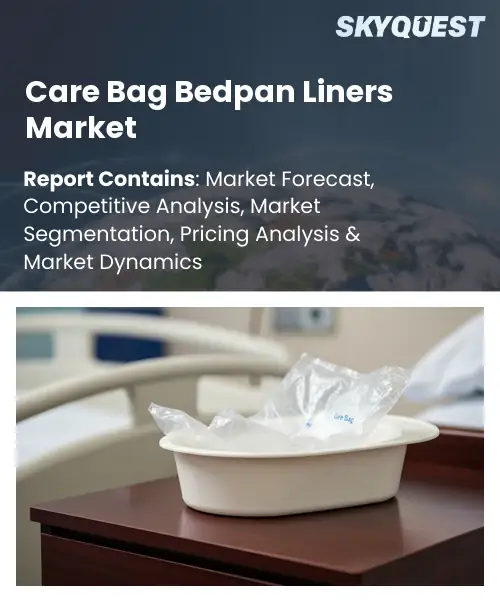
Care Bag Bedpan Liners Market
Report ID: SQMIG35A3328
Report ID: SQMIG35A3328
[email protected]
USA +1 351-333-4748
Report ID:
SQMIG35A3328 |
Region:
Global |
Published Date: March, 2026
Pages:
157
|Tables:
116
|Figures:
77


Global Care Bag Bedpan Liners Market size was valued at USD 1.30 Billion in 2024 and is poised to grow from USD 1.39 Billion in 2025 to USD 2.37 Billion by 2033, growing at a CAGR of 6.9% during the forecast period (2026-2033).
The care bag bedpan liners market encompasses disposable liners that fit bedpans to reduce caregiver contact and simplify waste disposal, improving hygiene in hospitals and long-term care settings. For years, the sector has evolved from the use of basic plastic bags to the use of advanced multi-layered, leak-resistant and biodegradable solutions, such as utilizing antimicrobial films in acute care settings and piloting the use of compostable liners in European nursing homes. The main factor is still related to the increasing number of facilities that now have many more needs surrounding infection prevention, which drives them towards single-use options that are safer to use.
Building on infection-prevention demand, cost containment emerges as a key trend driving the global care bag bedpan liners sector growth because hospitals seek products that lower cleaning labor, reduce cross-contamination expenses, and shorten patient turnover times. When waste handling becomes faster and safer, facilities can reallocate nursing hours and avoid costly infection outbreaks, which in turn incentivizes bulk procurement and supplier consolidation. Biodegradable and antimicrobial technologies represent two unique areas of opportunity that address both sustainability goals and infection control. For example, one of the European systems has been able to achieve significant landfill savings by using compostable liners in their facilities while also ensuring that their hygiene standards are adhered to.
How is Automation Improving Production Efficiency in the Care Bag Bedpan Liners Market?
Automation is improving production efficiency in the care bag bedpan liners market by streamlining material handling and quality control. Key aspects include automated film extrusion and bag forming, integrated dosing of superabsorbent pads, inline vision inspection and robotic packing. Today manufacturers move from manual to automated lines to reduce waste, cut changeover time and ensure consistent sealing and absorbency. That shift helps suppliers meet growing demand for hygienic single use liners and supports faster order fulfillment in hospitals and home care settings.
Market snapshot - 2026-2033
Global Market Size
USD 1.3 Billion
Largest Segment
Disposable Liners
Fastest Growth
Disposable Liners
Growth Rate
6.9% CAGR
To get more insights on this market click here to Request a Free Sample Report
The care bag bedpan liners market is segmented by product type, material type, application, end user and region. Based on product type, the market is segmented into disposable liners and reusable liners. Based on material type, the market is segmented into plastic, paper and compostable. Based on application, the market is segmented into home care and healthcare facilities. Based on end user, the market is segmented into patients, caregivers, healthcare providers and others. Based on region, the market is segmented into North America, Europe, Asia Pacific, Latin America and Middle East & Africa.
Based on the global care bag bedpan liners market growth, disposable liners segment dominates because their single-use design addresses critical infection control and patient comfort priorities in the care bag bedpan liners market. Caregivers will appreciate cleaning to prevent infection through reliable hygiene, minimising waste handling, and reducing cleaning workloads. These features reduce the risk of cross-contamination and simplify clinical processes. Conversely, manufacturers emphasising a reliable product using the correct size and with adequate odour control while integrating with existing containment systems will help cement the decision to purchase and provide routine clinical use.
However, reusable liners are emerging as the most rapidly expanding area due to growing sustainability awareness and life cycle cost concerns that prompt interest in durable, sterilizable products. Improvements in antimicrobial treatments and efficient laundering protocols, along with institutional commitments to waste reduction, are driving pilots and wider trials that open long term procurement and circular economy opportunities for manufacturers and providers.
Plastic segment dominates because its material properties deliver dependable fluid containment, tensile strength, and consistent barrier performance required for safe care bag bedpan liners. With established manufacturing methods and availability of raw materials, as well as consistent quality, both of which are an essential part of facility procurement practices and clinical safety standards. The familiarity of handling characteristics enhances compatibility with both odor control additives and disposal systems which further contributes to the widespread use in both institutional and homecare settings.
However, compostable liners are the fastest growing area as purchasers and institutions prioritize lower environmental impact and biodegradability for care bag waste. Advances in plant-based polymers and recognized composability standards, together with sustainability purchasing policies, are prompting pilots, product introductions, and partnerships that expand procurement choices and create opportunities for green manufacturers and waste service providers.
To get detailed segments analysis, Request a Free Sample Report
As per the global care bag bedpan liners market share, North America dominates due to a confluence of structural advantages within healthcare delivery, supply chain, and regulatory environments. Mature hospital and long-term care systems have a strong interest in preventing infections. They create consistent demand for secure disposal solutions and single-use liners. Existing procurement channels and large-volume group purchasing enable the rapid adoption of new liner technologies and supplier partnerships.
A solid domestic manufacturing base and multinational suppliers ensure product availability, tailored features, and accelerated innovation in materials and ergonomics. Continued emphasis on improving caregiver workflows and waste management infrastructure reinforces market leadership, while close collaboration among providers, distributors, and manufacturers maintains high service levels and continues to improve care bag and bedpan liner offerings.
Care bag bedpan liners market in the United States reflects concentrated demand from acute care and long-term care providers that prioritize infection control and staff safety. Suppliers who have validated products, provide training support, and have dependable logistics will be favoured by purchasing sophistication of a procurement system. The features such as durability, leak-proof, and ease of use distinguish products; however, sustainability can also influence purchasing decisions. A close collaboration between clinicians, purchasers and manufacturers facilitates faster adoption of improved liner designs and work processes.
Care bag bedpan liners market in Canada is shaped by a mix of institutional procurement, provincial health program priorities, and emphasis on caregiver safety. Providers' supplier relationships are dependent upon the supplier's ability to provide dependable service, provide bilingual labeling, and provide sustainable material options. Training and developing a universal product to support consistent adoption across facilities will help create a sense of confidence in liner performance and disposal workflow process consistency for users.
Based on global care bag bedpan liners regional forecast, expansion across Europe is propelled by converging clinical, regulatory, and environmental priorities that elevate demand for effective disposable liners. There has been increased attention on caregiver and patient safety as well as on infection prevention among health systems and long-term care providers, which has resulted in more standardized procurement practices and increased willingness to adopt single-use products that have been validated.
The emphasis on environmentally responsible policies and the increased consumer demand for compostable and/or lower-impact products have created unique opportunities for suppliers to change and improve their offerings and manufacturing processes within the supply chain. The use of centralized and coordinated purchasing through the use of tendering mechanisms within large provider networks allows suppliers to achieve scale variations at the regional level.
Care bag bedpan liners market in Germany is characterized by strong demand from well-structured hospitals and care networks that prioritize certified product quality and effective infection control. To thrive, suppliers work to ensure that they meet or exceed the most stringent of technical specifications, and provide either handling advantages, or demonstrate environmental credentials. Suppliers with strong connections to either distribution partners or procurement agencies create an opportunity for additional service and training support.
Care bag bedpan liners market in United Kingdom is experiencing agile uptake driven by proactive provider pilots, emphasis on caregiver safety, environmental procurement criteria, and a dynamic mix of public and private providers that foster experimentation with new materials and ergonomic formats reducing handling burden. Responsive manufacturers provide integrated services such as distribution and product training. Working closely with clinical teams during trial phases allows manufacturers and hospitals to convert pilot agreements to procurement contracts more rapidly.
Care bag bedpan liners market in France is emerging through adoption by nursing homes and hospital units prioritizing hygiene and comfort. Procurement focuses on environmental performance as well as ensuring continued supply from providers, while simultaneously encouraging suppliers to provide lower impact materials or validated handling characteristics. Additionally, collaborative pilot programs will demonstrate the operational benefits of this process. Specialized distributors and offerings that include training and waste handling guidance enhance acceptance across care settings.
As per global care bag bedpan liners regional outlook, Asia Pacific is strengthening its position through coordinated improvements in manufacturing capability, clinical adoption, and distribution reach. A network of hospitals and senior living facilities has created a high demand for effective, yet affordable, linings that are effective against infection and cost effective. To meet the needs of an increasing array of buyers, local manufacturers and contracted producers have begun to innovate materials, barrier performance and ergonomic design; this innovation is often done in collaboration with Multinational Corporations (MNC) to share technology and quality practices.
Efforts to improve the sophistication of procurement, logistics coverage and training of clinicians are enhancing the ability to serve the entire market. Increasing emphasis on sustainable materials and after sales support such as training and waste management also serves as a means of distinguishing supplier's from one another, and serves to strengthen regional capabilities.
Care bag bedpan liners market trends in Japan is shaped by advanced clinical standards and emphasis on patient dignity and caregiver ergonomics. The top priority for providers is to find a liner that provides a consistent barrier and is easy to handle. Domestic manufacturers are putting an emphasis on using innovative material and high-quality materials and work with their clinical team to develop product features to meet specific needs. Providers are also looking for integrated service offerings such as training and waste handling that will help develop and build trust, which will help support ongoing product use in acute and long-term care settings.
Care bag bedpan liners market in South Korea is advancing through strong manufacturing capability, efficient distribution, and adoption of product formats that improve caregiver workflow. Liners that enable ease of handling, are space-efficient, and have proven reliable containment are valued by hospitals and eldercare facilities. Collaborative efforts between domestic suppliers and international partners promote product innovation/development and quality assurance. In addition, multiple service offerings include training and logistics to promote adoption. Environmental credentialing also influences the priorities of suppliers.
To know more about the market opportunities by region and country, click here to
Buy The Complete Report
Rising Infection Control Emphasis
Growing Elderly Care Demand
High Raw Material Costs
Stringent Environmental Regulations
Request Free Customization of this report to help us to meet your business objectives.
Competition in the global care bag bedpan liners market outlook centers on infection control, macerator compatibility, and absorbent technology. M&A transactions and distribution partnerships are being pursued by established companies (the incumbents), whilst innovators are concentrating on adding super absorbent pads to their portfolio and developing new compostable pulp products. Examples may include Vernacare's acquisitions of infection prevention companies and Cleanis' CareBag GelMax absorbent liners; both companies are working with their respective manufacturers to combine macerators and disposal service providers together to compete for hospital contracts.
Sustainable Material Adoption
Home Care And Decentralization
SkyQuest’s ABIRAW (Advanced Business Intelligence, Research & Analysis Wing) is our Business Information Services team that Collects, Collates, Correlates, and Analyses the Data collected by means of Primary Exploratory Research backed by robust Secondary Desk research.
As per SkyQuest analysis, the global care bag bedpan liners industry is being driven primarily by heightened infection prevention priorities, with growing elderly care demand as a secondary driver that expands need across acute, long-term and home care settings. Disposable liners are still leading in market share because of the convenience of single-use as well as advantages in reducing infection. North America will have the largest share of the market because they have well-developed healthcare systems and bulk purchasing arrangements. High raw material costs are creating price pressures on products, which will slow down the use of more expensive or new kinds of products. There are opportunities for growth in disposable liners through the development of compostable and/or antimicrobial materials, automating the production process and combining suppliers to better service client demand and meet sustainability goals.
| Report Metric | Details |
|---|---|
| Market size value in 2024 | USD 1.30 Billion |
| Market size value in 2033 | USD 2.37 Billion |
| Growth Rate | 6.9% |
| Base year | 2024 |
| Forecast period | 2026-2033 |
| Forecast Unit (Value) | USD Billion |
| Segments covered |
|
| Regions covered | North America (US, Canada), Europe (Germany, France, United Kingdom, Italy, Spain, Rest of Europe), Asia Pacific (China, India, Japan, Rest of Asia-Pacific), Latin America (Brazil, Rest of Latin America), Middle East & Africa (South Africa, GCC Countries, Rest of MEA) |
| Companies covered |
|
| Customization scope | Free report customization with purchase. Customization includes:-
|
To get a free trial access to our platform which is a one stop solution for all your data requirements for quicker decision making. This platform allows you to compare markets, competitors who are prominent in the market, and mega trends that are influencing the dynamics in the market. Also, get access to detailed SkyQuest exclusive matrix.
Table Of Content
Executive Summary
Market overview
Parent Market Analysis
Market overview
Market size
KEY MARKET INSIGHTS
COVID IMPACT
MARKET DYNAMICS & OUTLOOK
Market Size by Region
KEY COMPANY PROFILES
Methodology
For the Care Bag Bedpan Liners Market, our research methodology involved a mixture of primary and secondary data sources. Key steps involved in the research process are listed below:
1. Information Procurement: This stage involved the procurement of Market data or related information via primary and secondary sources. The various secondary sources used included various company websites, annual reports, trade databases, and paid databases such as Hoover's, Bloomberg Business, Factiva, and Avention. Our team did 45 primary interactions Globally which included several stakeholders such as manufacturers, customers, key opinion leaders, etc. Overall, information procurement was one of the most extensive stages in our research process.
2. Information Analysis: This step involved triangulation of data through bottom-up and top-down approaches to estimate and validate the total size and future estimate of the Care Bag Bedpan Liners Market.
3. Report Formulation: The final step entailed the placement of data points in appropriate Market spaces in an attempt to deduce viable conclusions.
4. Validation & Publishing: Validation is the most important step in the process. Validation & re-validation via an intricately designed process helped us finalize data points to be used for final calculations. The final Market estimates and forecasts were then aligned and sent to our panel of industry experts for validation of data. Once the validation was done the report was sent to our Quality Assurance team to ensure adherence to style guides, consistency & design.
Analyst Support
Customization Options
With the given market data, our dedicated team of analysts can offer you the following customization options are available for the Care Bag Bedpan Liners Market:
Product Analysis: Product matrix, which offers a detailed comparison of the product portfolio of companies.
Regional Analysis: Further analysis of the Care Bag Bedpan Liners Market for additional countries.
Competitive Analysis: Detailed analysis and profiling of additional Market players & comparative analysis of competitive products.
Go to Market Strategy: Find the high-growth channels to invest your marketing efforts and increase your customer base.
Innovation Mapping: Identify racial solutions and innovation, connected to deep ecosystems of innovators, start-ups, academics, and strategic partners.
Category Intelligence: Customized intelligence that is relevant to their supply Markets will enable them to make smarter sourcing decisions and improve their category management.
Public Company Transcript Analysis: To improve the investment performance by generating new alpha and making better-informed decisions.
Social Media Listening: To analyze the conversations and trends happening not just around your brand, but around your industry as a whole, and use those insights to make better Marketing decisions.
REQUEST FOR SAMPLE
 REQUEST FREE CUSTOMIZATION
Global Care Bag Bedpan Liners Market size was valued at USD 1.3 Billion in 2024 and is poised to grow from USD 1.39 Billion in 2025 to USD 2.37 Billion by 2033, growing at a CAGR of 6.9% during the forecast period (2026-2033).
Key vendors in the Care Bag Bedpan Liners Market include Cleanis, Medline Industries, Cardinal Health, Kimberly-Clark Corporation, Hollister Incorporated, AMG Medical, Hygie Canada, TSM Group, Dynarex Corporation, Medokare, BrightSky Australia, and McKesson Corporation, competing through hygiene solutions and healthcare distribution networks.
The key driver of the Care Bag Bedpan Liners Market is the increasing emphasis on infection control and hygiene in healthcare settings, along with rising demand for disposable solutions to reduce cross-contamination and improve patient safety.
The key market trend in the Care Bag Bedpan Liners Market is the growing shift toward eco-friendly and biodegradable materials, along with innovations such as odor-control, antibacterial features, and improved leak-proof designs to enhance hygiene, patient comfort, and sustainability.
North America accounted for the largest share in the Care Bag Bedpan Liners Market, driven by advanced healthcare infrastructure, high awareness of infection control practices, and widespread adoption of disposable hygiene solutions in hospitals and care facilities.


Want to customize this report? This report can be personalized according to your needs. Our analysts and industry experts will work directly with you to understand your requirements and provide you with customized data in a short amount of time. We offer $1000 worth of FREE customization at the time of purchase.
Feedback From Our Clients


 USA (+1) 351-333-4748

