Carbon Fiber Tapes Market
Report ID: SQMIG15E3475
Report ID: SQMIG15E3475
[email protected]
USA +1 351-333-4748
Report ID:
SQMIG15E3475 |
Region:
Global |
Published Date: May, 2026
Pages:
157
|Tables:
187
|Figures:
79


Global Carbon Fiber Tapes Market size was valued at USD 3.5 Billion in 2024 and is poised to grow from USD 4.12 Billion in 2025 to USD 15.15 Billion by 2033, growing at a CAGR of 17.68% during the forecast period (2026-2033).
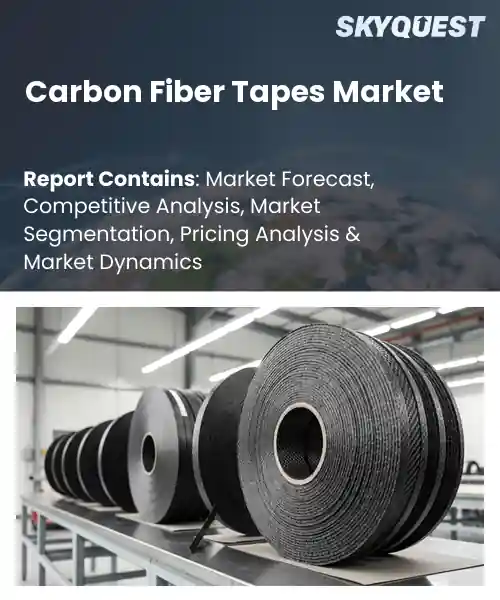
Carbon fiber tapes are narrow, continuous reinforcements they use a lot in advanced composite layup and automated tape placement; and the main pull here is basically weight reduction, but also high stiffness and solid durability. Once industries realized they could get stronger yet lighter structures, the carbon fiber tapes market outlook shifted from niche aerospace to more widespread areas like wind energy, automotive electrification, and sporting goods.
Moreover, building on that adoption curve, one central growth driver is manufacturing automation and integration, which makes cycle times shorter and quality more repeatable, so it opens doors to new applications. When automated tape placement and continuous tow shearing get better, layup precision improves, so automotive OEMs can trade stamped steel for tailored unidirectional tape laminates, less mass, and longer electric vehicle range. In wind, blade makers can use wider tapes to bridge mold areas faster and also reduce blade weight. At the same time, precursor capacity expands while thermoplastic tape technology matures, bringing costs down and supporting recyclable composites. That angle is getting investment, so opportunities show up across infrastructure, pressure vessels, and even consumer goods
AI is boosting production efficiency mostly by tightening the process control and cutting down waste in a way that feels more precise, less wandering around. Some key factors include machine vision to verify surfaces and impregnation, predictive maintenance for the curing equipment, and adaptive recipe tuning so the tape quality stays consistently stable. In general, the carbon fiber tapes industry is under pressure to scale up for aerospace and automotive demand, while also trimming lead times, and keeping things dependable. AI-enabled digital twins and closed-loop controls help speed up automated fiber placement and tape winding setup. That means less rework and shorter ramp periods. Examples like camera-based defect detection replacing manual inspection, and process models that “learn” from real-time sensor data, so the lines become more reliable and flexible over time. Toray, February 2026, secured NCAMP qualification and then released public AFP process data for a new prepreg and unidirectional tape, which supports wider adoption of automation. With that certified reference, AI systems can calibrate AFP and tape layup parameters more accurately, improving first-time yield and accelerating automated tape production.
Market snapshot - (2026-2033)
Global Market Size
USD 3.5 Billion
Largest Segment
Unidirectional Carbon Fiber Tapes
Fastest Growth
Thermoplastic Carbon Fiber Tapes
Growth Rate
17.68% CAGR
To get more insights on this market click here to Request a Free Sample Report
The global carbon fiber tapes market is segmented by product type, resin type, application, manufacturing process, end-use industry, distribution channel, and region. Based on product type, the market is classified into Unidirectional Carbon Fiber Tapes, Bidirectional Carbon Fiber Tapes, Woven Carbon Fiber Tapes, Prepreg Carbon Fiber Tapes, Dry Carbon Fiber Tapes, Thermoplastic Carbon Fiber Tapes, and Others. Based on resin type, the market is divided into Epoxy Resin-based Tapes, Polyamide Resin-based Tapes, Polyether Ether Ketone (PEEK)-based Tapes, Polypropylene-based Tapes, and Others. Based on application, the market is segmented into Aerospace & Defense, Automotive, Wind Energy, Sporting Goods, Marine, Construction & Infrastructure, Industrial Equipment, and Others. Based on the manufacturing process, the market is categorized into Automated Tape Laying, Automated Fiber Placement, Hand Lay-up, Pultrusion, and Others. Based on end-use industry, the market is segmented into Aerospace Industry, Automotive Industry, Renewable Energy Industry, Construction Industry, Sports & Leisure Industry, and Others. Based on distribution channel, the market is classified into Direct Sales, Distributors & Dealers, and Online Sales. Regionally, the market is segmented into North America, Europe, Asia Pacific, Latin America, and Middle East & Africa.
As per the carbon fiber tapes market analysis, the Unidirectional Carbon Fiber Tapes segment dominates, because they offer this unmatched tensile strength and stiffness that lines up with the load path idea so well, it becomes the default pick for primary structural reinforcement in tougher applications. And because their anisotropic behavior is predictable, engineers can juggle the layup strategy for weight reduction AND overall performance in a more controlled way. In addition, the fit with automated placement systems and those mature processing methods helps reduce variability and production risk, so people feel comfortable specifying them in high-value and safety-critical parts across different industries.
Whereas the prepreg Carbon Fiber Tapes category is growing at the fastest expanding segment, mainly because of the integrated resin systems that make processing easier, keep the fiber-to-resin ratio consistent, and cut the cure cycle time down. Their practical usability supports assembly line throughput and more repeatable quality in automotive as well as renewable setups, which lets manufacturers ramp up high-performance composite output while keeping fewer defects on the table.
According to the carbon fiber tapes market forecast, the Epoxy Resin-based Tapes category still owns a lot of ground, because epoxy matrices give that solid mix of mechanical performance, adhesion strength, and thermal stability that fits strict structural and certification needs in high-performance use cases. They also play nicely with prepreg formats and automated laying routines, which lowers manufacturing scatter and supports predictable part behavior, so designers keep leaning toward them for critical components. Moreover, the established supplier ecosystem and processing know-how further lock epoxy tapes in as the market standard for demanding applications.
However, the Polyether Ether Ketone (PEEK)-based Tapes category is predicted to have the largest carbon fiber tapes market share, showing the strongest growth momentum as the demand keeps rising for high-temperature resistant, chemically tough, but still lightweight components. Since PEEK acts like a thermoplastic, it can enable faster processing, welding options, and recyclability. That angle is pulling interest toward aerospace and industrial applications, and with continued material updates and regulatory attention on long-term performance resilience, the opportunity space for these premium tapes keeps widening.
To get detailed segments analysis, Request a Free Sample Report
As per the carbon fiber tapes market regional forecast, Asia Pacific owns the market, not just because they have more plants, but because manufacturing capacity is concentrated, supply chains are much stitched together, and the whole industry ecosystem is specialized in a way that feels almost incremental. In the region, companies often run from raw material processing to precursor creation, then through tape conversion, and finally hand it off to end users in automotive, consumer electronics, wind energy, and a bunch of industrial uses. When pairing process automation with being close to big automotive and electronics hubs, cost competitiveness shows up faster, and application development moves like it has urgency. There’s also this ongoing collaboration between material producers, tape converters, and OEMs, which helps speed up qualification and scale-up for niche tape formats. On top of that, governmental support for advanced materials and export-oriented manufacturing keeps the momentum going, while a skilled technical workforce and lots of suppliers create a situation where innovation and cost efficiency coexist, at least enough to sustain that dominance.
Japan Carbon Fiber Tapes Market
In Japan, the carbon fiber tapes industry is driven by advanced material science, and there’s strong collaboration between research organizations and industry teams. There’s also a clear preference for high-performance uses in aerospace and precision manufacturing. Local producers really push process refinement and quality control to match strict specification sheets. Partnerships with component makers and OEMs help technology move from labs into factories with less friction. The whole market benefits from a culture of modest yet continuous improvement, specialist suppliers, and established testing and certification routes.
South Korea Carbon Fiber Tapes Market
In South Korea, carbon fiber tape demand is tied to electronics and automotive clusters, especially for high-strength tape formats and processing that’s more specialized. Domestic converters often lean into prototyping, automation, and tight coordination with component manufacturers so lightweighting programs actually land on time. Research-to-industry collaboration, along with engineering talent, supports application development for mobility and consumer devices. The market is also shaped by a concentrated supplier web, rigorous quality assurance, and agile production practices that allow faster, wider adoption across the industrial spectrum.
European carbon fiber tapes market penetration comes from technology-led demand meeting strong pull from end markets, and an institutional push toward sustainable lightweighting. European OEMs, mostly in aerospace and high-end automotive, still keep pushing material substitution to reach performance targets and those efficiency goals, so the qualification pipelines for tape formats stay active. There’s also this dense little ecosystem, converters, specialty material suppliers and independent test houses, where it’s easier to get quick application engineering done and move through certification cycles faster. On top of that, policy frameworks that nudge decarbonization and circularity work as incentives, which then boosts the adoption of advanced composites along with recycling, reuse innovations. Collaborative consortia and public-private partnerships also speed up the commercialization of new tape architectures, while the regional focus on precision manufacturing and customization helps suppliers ship differentiated products that fit tight technical requirements and environmental expectations.
Germany Carbon Fiber Tapes Market
The German carbon fiber tapes market benefits from industrial integration, strong automotive and aerospace clusters, and a well-formed supplier base that’s used to conversion work. Local firms tend to stress rigorous testing, process control, and working directly with OEMs so engineering expectations are met cleanly. The ecosystem, specialized converters, material developers, and service providers, helps enable rapid qualification for tape products meant for tough structural applications. There’s also a recurring emphasis on precision manufacturing and long-term partnerships, which help sustain leadership in these assemblies.
United Kingdom Carbon Fiber Tapes Market
In the United Kingdom, carbon fiber tapes are showing strong growth, mostly driven by research collaboration, flexible manufacturing, and adoption in transport and specialty applications. Innovators and converters focus on rapid prototyping and customized tape architectures to satisfy more specific performance needs. Universities and industry maintain close working ties, so technology transfer happens earlier, and early-scale production can follow sooner. The overall market is agile, specialized services, and a readiness to adopt new composite solutions with support from strong supplier networks.
France Carbon Fiber Tapes Market
The French carbon fiber tapes market is still emerging, but it’s gaining momentum through targeted innovation in aerospace and wind energy. Specialty converter folks lean into custom tape designs and specific processing methods that fit the use-case, which helps them reach those higher-value segments. There are strong research hubs and joint clusters behind the scenes, which support both material development and qualification work. At the same time, sustainability and recyclability questions drive the whole product roadmap, so decisions are not made in a vacuum. Overall, the market shows growing industrial interest, selective adoption, and better supplier capabilities, which should enable broader commercialization and more scale.
North America is strengthening its standing in the carbon fiber tapes market via concentrated innovation work, adding more domestic conversion capability, and tightening the connections between material developers and end users. The region has this dense aerospace and defense ecosystem, and also a more maturing automotive composites segment, which ends up pushing qualification for tape formats in structural and semi-structural use. At the same time, public and private R&D efforts help with more advanced processing methods, automation, and better material characterization skills. Beyond that, there are moves to improve supply chain resilience and circularity, which sorta supports wider adoption. When converters work close with OEMs and research institutions, it helps with faster scaling of new tape architectures, and the way the region thinks about commercialization routes makes it easier to grab higher-value use cases. There’s also investment in pilot production lines, workforce development, and supplier integration, which all together helps translate lab wins into consistent, production-ready tape products.
United States Carbon Fiber Tapes Market
The Carbon Fiber Tapes Market in the United States is fueled by aerospace and defense demand, a ramping up of automotive composites activity, and a strong base of material science research. Converters and OEMs work together to qualify tape formats for structural uses, while stressing process repeatability and traceability. Federal research programs back pilot production and advanced characterization work. Meanwhile, a wider network of suppliers is improving domestic supply chain resilience. Overall, the market leans into scale-up readiness and provides support for high-performance applications.
Canada Carbon Fiber Tapes Market
In Canada, the Carbon Fiber Tapes Market is shaped by targeted innovation coming from aerospace suppliers, technology developers, and manufacturing hubs. Specialty converters and research institutions cooperate to fine-tune tape chemistries and processing routes, based on regional needs. Sustainable sourcing and end-of-life thinking are also key influences on product development, and supportive industrial programs help with scale attempts. The market shows adoption across mobility and energy areas, while supplier maturity keeps getting better, and cross-sector cooperation increases.
To know more about the market opportunities by region and country, click here to
Buy The Complete Report
Rising Demand From Aerospace Manufacturers
Lightweighting Initiatives Across Industries
High Manufacturing Costs
Limited Recycling Infrastructure
Request Free Customization of this report to help us to meet your business objectives.
In the global carbon fiber tapes market, the competition stays intense, mostly because OEM lightweighting keeps pushing everything forward, and sustainability mandates that just wont wait around. So companies end up doing M&A, signing strategic supply agreements, and trying to stand out in manufacturing, so they can grab the specification slots. This can be witnessed in Teijin’s move to acquire Renegade, mostly to lock in high-temperature prepreg know-how, and also in supplier investments focused on fibre steering and aligned formable fiber technologies, like iCOMAT’s RTS and Lineat’s AFFT.
Top Player’s Company Profile
Recent Developments in the Carbon Fiber Tapes Market
SkyQuest’s ABIRAW (Advanced Business Intelligence, Research & Analysis Wing) is our Business Information Services team that Collects, Collates, Correlates, and Analyses the Data collected by means of Primary Exploratory Research backed by robust Secondary Desk research.
As per SkyQuest analysis, the global carbon fiber tapes market is powered mainly by aerospace demand for high strength-to-weight performance, with lightweighting initiatives acting as a second major driver that then opens up automotive, wind, and sporting goods possibilities. Unidirectional carbon fiber tapes keep dominating because their anisotropic properties are predictable, and they fit nicely with automated placement. Asia Pacific leads overall, largely due to integrated supply chains, production capacity, and a supportive industrial ecosystem. Still, growth is held back a bit by high manufacturing costs that are linked to precursors and specialized processing, so broader adoption becomes harder, in a way. Even so, the outlook stays positive because automation is improving, thermoplastic tape is getting better, and supply scaling is creating paths toward wider commercialization, so costs should become more competitive too.
| Report Metric | Details |
|---|---|
| Market size value in 2024 | USD 3.5 Billion |
| Market size value in 2033 | USD 15.15 Billion |
| Growth Rate | 17.68% |
| Base year | 2024 |
| Forecast period | (2026-2033) |
| Forecast Unit (Value) | USD Billion |
| Segments covered |
|
| Regions covered | North America (US, Canada), Europe (Germany, France, United Kingdom, Italy, Spain, Rest of Europe), Asia Pacific (China, India, Japan, Rest of Asia-Pacific), Latin America (Brazil, Rest of Latin America), Middle East & Africa (South Africa, GCC Countries, Rest of MEA) |
| Companies covered |
|
| Customization scope | Free report customization with purchase. Customization includes:-
|
To get a free trial access to our platform which is a one stop solution for all your data requirements for quicker decision making. This platform allows you to compare markets, competitors who are prominent in the market, and mega trends that are influencing the dynamics in the market. Also, get access to detailed SkyQuest exclusive matrix.
Table Of Content
Executive Summary
Market overview
Parent Market Analysis
Market overview
Market size
KEY MARKET INSIGHTS
COVID IMPACT
MARKET DYNAMICS & OUTLOOK
Market Size by Region
KEY COMPANY PROFILES
Methodology
For the Carbon Fiber Tapes Market, our research methodology involved a mixture of primary and secondary data sources. Key steps involved in the research process are listed below:
1. Information Procurement: This stage involved the procurement of Market data or related information via primary and secondary sources. The various secondary sources used included various company websites, annual reports, trade databases, and paid databases such as Hoover's, Bloomberg Business, Factiva, and Avention. Our team did 45 primary interactions Globally which included several stakeholders such as manufacturers, customers, key opinion leaders, etc. Overall, information procurement was one of the most extensive stages in our research process.
2. Information Analysis: This step involved triangulation of data through bottom-up and top-down approaches to estimate and validate the total size and future estimate of the Carbon Fiber Tapes Market.
3. Report Formulation: The final step entailed the placement of data points in appropriate Market spaces in an attempt to deduce viable conclusions.
4. Validation & Publishing: Validation is the most important step in the process. Validation & re-validation via an intricately designed process helped us finalize data points to be used for final calculations. The final Market estimates and forecasts were then aligned and sent to our panel of industry experts for validation of data. Once the validation was done the report was sent to our Quality Assurance team to ensure adherence to style guides, consistency & design.
Analyst Support
Customization Options
With the given market data, our dedicated team of analysts can offer you the following customization options are available for the Carbon Fiber Tapes Market:
Product Analysis: Product matrix, which offers a detailed comparison of the product portfolio of companies.
Regional Analysis: Further analysis of the Carbon Fiber Tapes Market for additional countries.
Competitive Analysis: Detailed analysis and profiling of additional Market players & comparative analysis of competitive products.
Go to Market Strategy: Find the high-growth channels to invest your marketing efforts and increase your customer base.
Innovation Mapping: Identify racial solutions and innovation, connected to deep ecosystems of innovators, start-ups, academics, and strategic partners.
Category Intelligence: Customized intelligence that is relevant to their supply Markets will enable them to make smarter sourcing decisions and improve their category management.
Public Company Transcript Analysis: To improve the investment performance by generating new alpha and making better-informed decisions.
Social Media Listening: To analyze the conversations and trends happening not just around your brand, but around your industry as a whole, and use those insights to make better Marketing decisions.
REQUEST FOR SAMPLE
 REQUEST FREE CUSTOMIZATION
Global Carbon Fiber Tapes Market size was valued at USD 3.5 Billion in 2024 and is poised to grow from USD 4.12 Billion in 2025 to USD 15.15 Billion by 2033, growing at a CAGR of 17.68% during the forecast period (2026-2033).
Competition in the global carbon fiber tapes market is driven by OEM lightweighting and sustainability mandates, prompting M&A, strategic supply agreements, and manufacturing differentiation to win specification slots. Examples include Teijin’s acquisition of Renegade to secure high temperature prepreg capabilities, and supplier investments in fibre steering and aligned formable fibre technologies such as iCOMAT’s RTS and Lineat’s AFFT. 'Toray Industries', 'Teijin', 'Hexcel Corporation', 'SGL Carbon', 'Mitsubishi Chemical Group', 'Solvay', 'Park Aerospace', 'Gurit', 'Victrex', 'Evonik Industries', 'Royal TenCate', 'Zoltek', 'Sigmatex', 'Axiom Materials', 'PRF Composite Materials', 'TCR Composites', 'Barrday', 'ACP Composites', 'Rock West Composites', 'Chomarat'
Carbon fiber tapes command preference in aerospace manufacturing because they combine high strength and low weight, enabling designers to meet strict performance and fuel efficiency objectives while simplifying assembly processes. This preference drives procurement and specification decisions across supply chains, prompting manufacturers to integrate tape based composites into structural components, interiors, and secondary assemblies. The resulting steady uptake by prime contractors and tier suppliers supports investments in tape production capacity, process optimization, and material innovations that further reinforce market expansion and market maturity.
Lightweighting Driving Demand: Industry emphasis on lightweighting across transport segments is increasing preference for carbon fiber tapes as designers seek superior strength-to-weight solutions. Tapes enable thinner, optimized laminates and smoother integration with automated manufacturing, supporting cycle time reduction and part consolidation while preserving structural performance. OEMs and suppliers are collaborating earlier to exploit tape compatibility with advanced resins and processes. This trend fosters product differentiation through tailored tape architectures, broadens application scope, and accelerates adoption where weight reduction improves operational and lifecycle outcomes.
Why does Asia Pacific Dominate the Global Carbon Fiber Tapes Market? |@12


Want to customize this report? This report can be personalized according to your needs. Our analysts and industry experts will work directly with you to understand your requirements and provide you with customized data in a short amount of time. We offer $1000 worth of FREE customization at the time of purchase.
Feedback From Our Clients


 USA (+1) 351-333-4748

