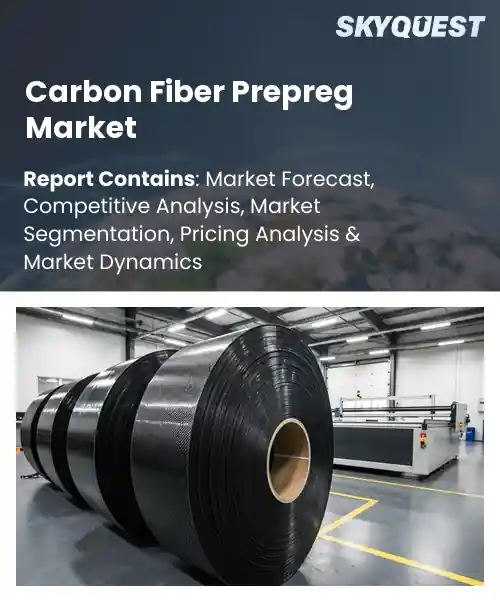
Carbon Fiber Prepreg Market
Report ID: SQMIG15E3194
Report ID: SQMIG15E3194
[email protected]
USA +1 351-333-4748
Report ID:
SQMIG15E3194 |
Region:
Global |
Published Date: February, 2026
Pages:
157
|Tables:
149
|Figures:
78


Global Carbon Fiber Prepreg Market size was valued at USD 8.88 Billion in 2024 and is poised to grow from USD 9.72 Billion in 2025 to USD 20.0 Billion by 2033, growing at a CAGR of 9.44% during the forecast period (2026-2033).
The global carbon fiber prepreg market growth is driven because automotive, aerospace, and renewable energy sectors require materials which need to be both strong and light. Airplane manufacturers increased their use of composite structures because they needed to comply with emission regulations while improving plane fuel efficiency. Boeing and Airbus expanded their use of prepreg materials for upcoming aircraft programs. Tesla and BMW used prepreg materials in their electric vehicle production to create structural elements and battery enclosures which would extend their vehicle operational distance.
Automated manufacturing methods such as automated fiber installation and out-of-autoclave curing have become more widely used because they help manufacturers reduce both production expenses and time requirements. Wind energy companies need additional prepreg materials to produce turbine blades which will enable them to create more powerful and longer-lasting wind turbine blades. Companies in sustainability gained popularity because top suppliers committed resources to develop waste-free manufacturing systems and recycling systems. The combination of these market drivers and trends results in market growth which enables additional companies to access the market.
How Is Out-Of-Autoclave Processing Transforming Prepreg Manufacturing?
The global carbon fiber prepreg market outlook experienced its most important technological progress through the introduction of rapid processing together with out-of-autoclave technologies. The technological advancements enable manufacturers to achieve cost reductions while they increase their production speed. OOA prepregs enable curing processes that do not need expensive high-pressure machinery for their execution. Vacuum pressure serves as an alternative method to oven usage. In 2025, Hexcel and Solvay expanded their OOA prepreg product lines to support aerospace and urban air transportation initiatives. Aerospace vendors who began using these materials for their interior parts and secondary aircraft structures achieved improvements in production efficiency. The automobile industry used rapid-cure OOA prepregs to create electric car structural and body panels which allowed for simultaneous production of multiple vehicles. Additional users adopted OOA technology which made composite manufacturing for mobility and defense, and wind energy uses more cost-effective.
Market snapshot - 2026-2033
Global Market Size
USD 11.5 Billion
Largest Segment
Thermoset Resins
Fastest Growth
Thermoplastic Resins
Growth Rate
10.3% CAGR
To get more insights on this market click here to Request a Free Sample Report
The global carbon fiber prepreg market is segmented into resin type, process, application, and region. By resin type, the market is bifurcated into epoxy resin prepregs and phenolic resin prepregs. Depending on process, it is divided into hot melt and solvent dip. According to the application, the market is classified into aerospace & defense, automotive, sports & leisure, wind energy, marine, and industrial. Regionally, it is analyzed across North America, Europe, Asia-Pacific, Latin America, and Middle East & Africa.
According to the global carbon fiber prepreg market analysis, the epoxy resin prepregs segment establish themselves as the primary carbon fiber prepreg option. The material possessed outstanding strength, bonding capacity, and fatigue resistance which made it ideal for such applications. The materials are commonly used in the production of wind turbine blades, automobile parts, and aircraft structures. Airplane manufacturers such as Airbus and Boeing maintained their market leadership by using epoxy prepregs on wings and fuselage parts throughout this period.
However, the demand for phenolic resin prepregs category will experience substantial growth because infrastructure and transportation projects increasingly mandate the use of fire-resistant materials that produce minimal smoke. The use of phenolic-based composites has grown in train and aircraft and ship interior applications because European and Asia Pacific countries have implemented stricter safety regulations.
As per the global carbon fiber prepreg market forecast, the hot melt segment become the dominant method because it enabled precise resin control together with consistent fiberglass infusion and minimal environmental impact. Hexcel and Toray, the two biggest prepreg manufacturers, used hot melt technology to create high-quality materials for the automotive and aerospace industries. After hot melt prepregs were developed, major EV part suppliers used them to enhance the strength of battery enclosures and body panels.
Whereas the solvent dip method is expected to experience the highest carbon fiber prepreg market share because it will be used in specialized applications which demand affordability. The initial low costs of solvent dip processes led many producers in developing nations to use this method for producing both industrial parts and sports equipment. The development of this process still faces limitations because environmental regulations and solvent recovery requirements remain in place.
To get detailed segments analysis, Request a Free Sample Report
Asia Pacific achieves industrial supremacy through its centralized manufacturing facilities which work together with its complete supply chain systems to meet the strong demand from automotive and aerospace original equipment manufacturers operating in the area. The local producers achieve operational advantages through their direct access to upstream material sources and resin production facilities which assist them in handling their material needs while reducing their expenses. The combination of ongoing factory and pilot line investment with dedicated research centers and university partnerships enables organizations to achieve ongoing improvements in their processes while creating new materials. The industrial development-friendly policy frameworks that establish dense supplier networks and operational export pathways between business locations give organizations a competitive advantage inside the market.
The Japanese carbon fiber prepreg market benefits from a combination of advanced technical skills and robust industrial partnerships and access to leading resin and precursor production facilities. The domestic manufacturers produce premium aerospace components while they develop partnerships with global OEMs to create customized material attributes. The company achieves product consistency through its pilot production operations which implement strict process control measures. The corporate R&D department and research institutes create new innovations in layup techniques which help high-performance global sectors to adopt these techniques.
The South Korea's carbon fiber prepreg market establishes its strong position through its high-performance manufacturing capabilities which deliver advanced composite solutions to its robust automotive and electronics supply chain systems. The local supply companies concentrate on developing processing approaches which allow their equipment to merge with automated systems that construct lightweight products. The joint projects between manufacturers and technology vendors speed up the process of approving materials which will be used in transportation and industrial applications. Organizations achieve quick product changes through their system of quality control and rapid prototyping and multiple levels of supplier networks which also help them enter new performance driven markets.
The North American carbon fiber prepreg market expands because three main forces work together to create high demand for advanced manufacturing processes which aerospace and defense programs and the automotive and electric mobility markets now require. Regional companies develop their production capabilities through material science expertise combined with new automation systems and certification process investments that enable them to create top-quality prepreg products. The strategic agreements between OEMs and tier suppliers and research centers help speed up the process of product approval through their shared development of new manufacturing techniques. Organizations build supply chain resilience through their focus on nearshoring and advanced industrial applications which match regulatory frameworks and certification requirements that support advanced composite materials.
The carbon fiber prepreg market in the United States benefits from established aerospace and defense demand, a robust network of advanced manufacturers and strong collaboration among OEMs and research institutions. Emphasis on qualification, certification and automated layup technologies supports transition from prototypes to production. Domestic suppliers focus on scalability and integration with electrified vehicle platforms. Corporate investments in pilot manufacturing and materials innovation foster iteration, enabling tailored solutions for high-performance and industrial applications.
The Canadian carbon fiber prepreg industry centers its operations around material research and production of specialized products which require university research partnerships for cooperative innovation. Suppliers create customized solutions for new transportation and energy technologies by combining their flexible production capabilities with strict quality control measures. The combination of supportive programs with the presence of skilled engineering professionals permits both testing activities and pilot project implementations. The proximity of the specialized markets to North American OEMs and their cross-border supply chain links enable them to provide specialized prepreg solutions which are customized for markets.
Europe strengthens its market position by establishing joint funding initiatives which target sustainable material development while implementing strict industry regulations and enabling cross-border collaboration between manufacturers and research institutions and original equipment manufacturers. The regional spotlight on lifecycle performance and recyclability and certification pathways leads suppliers to develop new resin systems and manufacturing processes which meet environmental compliance requirements. The automotive and aerospace sectors develop specialized expertise which provides companies with direct access to industrial technology that need piloting demonstration facilities and public research funding for advanced industrial applications. European companies form strategic partnerships with material technology providers and apply modular production methods to create high-value products which meet the specific requirements of demanding applications.
The German carbon fiber prepreg market specializes in advanced composite materials which require precise engineering skills and established automotive supply networks and industrial systems. Suppliers dedicate their resources to establishing high quality standards which require process performance to duplicate and systems integration into automated lines for structural component production. The combined efforts of research institutions and industrial partners speed up the process of material qualification together with specific application development. The manufacturing process and lifecycle performance optimization make products suitable for use in both transportation vehicles and industrial machinery which demand long-lasting components that can be produced through consistent manufacturing practices.
The United Kingdom carbon fiber prepreg market operates from aerospace manufacturing hubs which drive materials production and advanced composites development expertise. Suppliers focus on three key areas which include obtaining certification and establishing traceability systems and developing systems which work with lightweight structural design techniques preferred by key contractors. Public research programs together with industry consortia create the foundation for verifying technology through successful specialized application scaling operations. The ability of suppliers to meet custom needs from the transportation and defense sectors will improve through their service-oriented partnerships which enable them to build systems based on their specific production requirements.
The French carbon fiber prepreg market depends on research institutions and specialty material producers and collaborative partnerships to create its innovative marketplace. The suppliers develop resin formulations which they customize to create products for high-performance transport and specialized industrial uses. The design of houses and composite fabricators work together to speed up the development of lightweight structures through the adoption of prepreg technologies. The manufacturing cluster policy framework supports pilot production operations and technology transfer activities which help build local supply capabilities for high-quality delivery to challenging markets.
To know more about the market opportunities by region and country, click here to
Buy The Complete Report
Rising Aerospace and Automotive Use
The demand for carbon fiber prepreg in aerospace and high-performance automotive applications increases because it enables manufacturers to achieve weight reduction and fuel efficiency and longer component durability while they need to meet exacting performance requirements. The OEMs choose prepreg because of its consistent fiber resin distribution and dependable material properties which ease the certification process for advanced design integration. The use of prepreg materials enables program-level objectives to receive support while designers and engineers work toward their goals of creating light-weight structural solutions. This process creates a loop that drives market growth by establishing production capacity through program objectives which make use of weight-reduced materials.
Expansion In Wind Turbine Components
Wind energy manufacturing has expanded its need for large durable composite blades and structural components which use carbon fiber prepreg to achieve high strength with low weight and resistance to fatigue for extended turbine operation. The adoption of prepreg technology by manufacturers enables them to create materials with stable properties while they produce complex shapes at high speed which they need for offshore and utility scale project growth. The development of renewable energy markets depends on material performance which matches with renewable energy goals because it drives investments in prepreg supply chains and technology development and creates new business opportunities.
High Production and Processing Costs
The growing expenses from raw carbon fibers and autoclave processing and resin systems and skilled labor force companies to reduce their usage of prepreg because these costs increase production costs and project budgets which stops end users from choosing prepreg in large projects or projects with tight budgets. Smaller manufacturers face operational growth difficulties because their specialized equipment and controlled environments create higher cost requirements which decrease market competition and extend the time needed to increase product availability. As cost pressures influence procurement decisions and program approvals, market growth can be delayed while stakeholders evaluate trade offs or pursue alternative composite technologies.
Request Free Customization of this report to help us to meet your business objectives.
The carbon fiber prepreg market has become more competitive because OEMs require lightweight materials which deliver high performance while meeting environmental standards. Major suppliers have responded by developing better technological capabilities which they use to boost their manufacturing capabilities in targeted areas and to identify specific acquisition targets. Hexcel and Fairmat established a strategic recycling relationship, and Mitsubishi Chemical recently acquired European prepreg and recycling assets. Manufacturers are creating new products which include quick-cure prepregs and plant-based resins to boost their production capacity while they establish permanent supply agreements with automotive and aerospace OEMs.
The establishment of Fairmat in 2020 aimed to promote closed-loop carbon fiber prepreg recycling systems while the company develops recycled CFRP sheets for industrial and commercial applications. The business just signed a long-term agreement with Hexcel in the US. The company constructed a recycling facility at its Salt Lake City site which transforms prepreg waste materials into reusable resources. While utilizing low-energy methods of treatment, the system is designed to process waste materials in an automated manner via automatic sorting to create circular supply chains that enable business expansion.
MOB-E-SCRAP began operations in 2021 using mechanical de-lamination technology to recover carbon fiber and glass fibers from resin matrixes as multiple-use feedstock materials for both prepreg and composite manufacturing. The company has exhibited its technology at JEC events while building an industrial demonstration facility in France. The company is currently establishing partnerships to apply its process in electronics manufacturing and solar panel production and composite manufacturing processes. This process generates economic reinforcement materials which meet the energy efficiency standards of current prepreg production processes.
Toray achieved NCAMP qualification for its next generation 3960 prepreg system in February 2026, enabling certified use in aerospace primary structures and reinforcing the company's emphasis on high temperature and high-performance material solutions for defense and aviation customers, while positioning Toray to support certification driven programs with traceable production and standardized prepreg processing.
Mitsubishi Chemical will improve its carbon fiber production capabilities at its Tokai and Sacramento plants through upcoming high-performance enhancements which the company plans to implement starting December 2025. The company will execute its initial capacity expansion which will begin in December 2025 to meet demand from aerospace and hypercar and sports markets. At advanced prepreg customers, the company will deliver targeted supply through its existing facilities while operating excellence will enable it to rapidly supply specialty prepreg materials.
Hexcel launched its HexPly M51 rapid cure prepreg technology at the Paris Air Show in June 2025. The new product enables aerospace manufacturing and ATL and AFP process automation through its design, which extends to both automated systems. The product demonstrates shorter cure cycles and flexible processing choices while OEMs use the system to build practical components through their demonstrations.
SkyQuest’s ABIRAW (Advanced Business Intelligence, Research & Analysis Wing) is our Business Information Services team that Collects, Collates, Correlates, and Analyses the Data collected by means of Primary Exploratory Research backed by robust Secondary Desk research.
As per SkyQuest analysis, the global carbon fiber prepreg market mainly grows because aerospace and automotive industries need lightweight materials which deliver exceptional performance, but the market also benefits from increasing wind energy applications which need longer and stronger turbine blades. The high production and processing costs function as major obstacles which stop most people from using this product despite its actual performance advantages. Asia Pacific leads the market because it contains high manufacturing capacity and complete supply chains which connect resin and precursor suppliers to thermoset resin usage, which is the most common product type because of its established curing properties and certification acceptance. The manufacturing sector will achieve better scalability and reliability through upcoming innovations together with AI-based quality control methods.
| Report Metric | Details |
|---|---|
| Market size value in 2024 | USD 8.88 Billion |
| Market size value in 2033 | USD 20.0 Billion |
| Growth Rate | 9.44% |
| Base year | 2024 |
| Forecast period | 2026-2033 |
| Forecast Unit (Value) | USD Billion |
| Segments covered |
|
| Regions covered | North America (US, Canada), Europe (Germany, France, United Kingdom, Italy, Spain, Rest of Europe), Asia Pacific (China, India, Japan, Rest of Asia-Pacific), Latin America (Brazil, Rest of Latin America), Middle East & Africa (South Africa, GCC Countries, Rest of MEA) |
| Companies covered |
|
| Customization scope | Free report customization with purchase. Customization includes:-
|
To get a free trial access to our platform which is a one stop solution for all your data requirements for quicker decision making. This platform allows you to compare markets, competitors who are prominent in the market, and mega trends that are influencing the dynamics in the market. Also, get access to detailed SkyQuest exclusive matrix.
Table Of Content
Executive Summary
Market overview
Parent Market Analysis
Market overview
Market size
KEY MARKET INSIGHTS
COVID IMPACT
MARKET DYNAMICS & OUTLOOK
Market Size by Region
KEY COMPANY PROFILES
Methodology
For the Carbon Fiber Prepreg Market, our research methodology involved a mixture of primary and secondary data sources. Key steps involved in the research process are listed below:
1. Information Procurement: This stage involved the procurement of Market data or related information via primary and secondary sources. The various secondary sources used included various company websites, annual reports, trade databases, and paid databases such as Hoover's, Bloomberg Business, Factiva, and Avention. Our team did 45 primary interactions Globally which included several stakeholders such as manufacturers, customers, key opinion leaders, etc. Overall, information procurement was one of the most extensive stages in our research process.
2. Information Analysis: This step involved triangulation of data through bottom-up and top-down approaches to estimate and validate the total size and future estimate of the Carbon Fiber Prepreg Market.
3. Report Formulation: The final step entailed the placement of data points in appropriate Market spaces in an attempt to deduce viable conclusions.
4. Validation & Publishing: Validation is the most important step in the process. Validation & re-validation via an intricately designed process helped us finalize data points to be used for final calculations. The final Market estimates and forecasts were then aligned and sent to our panel of industry experts for validation of data. Once the validation was done the report was sent to our Quality Assurance team to ensure adherence to style guides, consistency & design.
Analyst Support
Customization Options
With the given market data, our dedicated team of analysts can offer you the following customization options are available for the Carbon Fiber Prepreg Market:
Product Analysis: Product matrix, which offers a detailed comparison of the product portfolio of companies.
Regional Analysis: Further analysis of the Carbon Fiber Prepreg Market for additional countries.
Competitive Analysis: Detailed analysis and profiling of additional Market players & comparative analysis of competitive products.
Go to Market Strategy: Find the high-growth channels to invest your marketing efforts and increase your customer base.
Innovation Mapping: Identify racial solutions and innovation, connected to deep ecosystems of innovators, start-ups, academics, and strategic partners.
Category Intelligence: Customized intelligence that is relevant to their supply Markets will enable them to make smarter sourcing decisions and improve their category management.
Public Company Transcript Analysis: To improve the investment performance by generating new alpha and making better-informed decisions.
Social Media Listening: To analyze the conversations and trends happening not just around your brand, but around your industry as a whole, and use those insights to make better Marketing decisions.
REQUEST FOR SAMPLE
 REQUEST FREE CUSTOMIZATION
Global Carbon Fiber Prepreg Market size was valued at USD 11.5 Billion in 2024 and is poised to grow from USD 12.68 Billion in 2025 to USD 27.79 Billion by 2033, growing at a CAGR of 10.3% during the forecast period (2026-2033).
Competitive pressures in the carbon fiber prepreg market are driven by OEM lightweighting and sustainability demands, prompting targeted M&A, regional capacity deals and technical differentiation. Recent moves include Mitsubishi Chemical’s acquisition of European prepreg and recycling assets, and Hexcel’s recycling partnership with Fairmat. Suppliers also deploy product innovations such as plant-derived and rapid-cure prepregs to shorten cycle times and secure OEM supply agreements. 'Toray Group', 'Hexcel Corporation', 'Mitsubishi Chemical Corporation', 'ZOLTEK Group', 'Teijin Limited', 'SGL Carbon', 'Gurit Holdings AG', 'Solvay S.A.', 'Axiom Materials', 'Royal TenCate N.V.', 'Formosa Plastics Corporation', 'FIBERMAX', 'ACP COMPOSITES, INC.', 'Composites One LLC', 'Victrex plc', 'Arvind Composite', 'Bharat Composites', 'Bhor Chemicals and Plastics Pvt. Ltd.', 'Funique Composites Private Limited', 'JSM Composites Private Limited'
The increasing specification of carbon fiber prepreg in aerospace and high performance automotive applications drives demand by enabling manufacturers to pursue weight reduction, fuel efficiency, and extended component life while meeting strict performance standards. OEMs favor prepreg for its uniform fiber resin distribution and reliable quality, which simplifies certification and integration into advanced designs. As designers and engineers prioritize lightweight structural solutions, adoption of prepreg materials supports program level objectives and stimulates investment in production capacity, creating a reinforcing cycle that advances market expansion.
Asia Pacific achieves industrial supremacy through its centralized manufacturing facilities which work together with its complete supply chain systems to meet the strong demand from automotive and aerospace original equipment manufacturers operating in the area.


Want to customize this report? This report can be personalized according to your needs. Our analysts and industry experts will work directly with you to understand your requirements and provide you with customized data in a short amount of time. We offer $1000 worth of FREE customization at the time of purchase.
Feedback From Our Clients


 USA (+1) 351-333-4748

