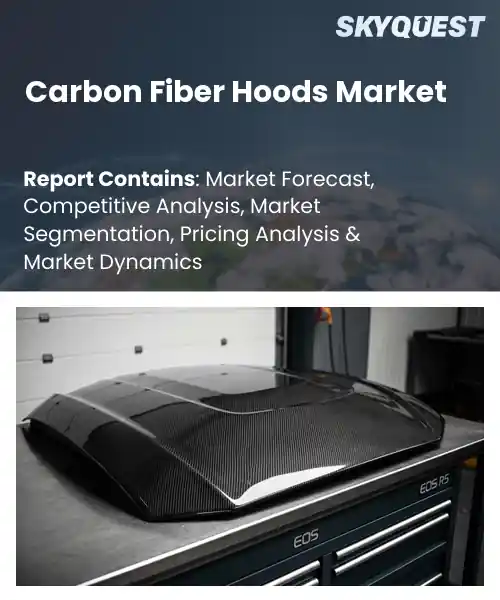
Carbon Fiber Hoods Market
Report ID: SQMIG15A2688
Report ID: SQMIG15A2688
[email protected]
USA +1 351-333-4748
Report ID:
SQMIG15A2688 |
Region:
Global |
Published Date: February, 2026
Pages:
157
|Tables:
143
|Figures:
78


Global Carbon Fiber Hoods Market size was valued at USD 1.36 Billion in 2024 and is poised to grow from USD 1.47 Billion in 2025 to USD 2.72 Billion by 2033, growing at a CAGR of 8.0% during the forecast period (2026-2033).
The global carbon fiber hoods market centers on production and distribution of vehicle hoods made from carbon fiber reinforced polymers, serving OEMs and the aftermarket where performance and weight savings converge. Its primary driver is vehicle lightweighting, a priority for automakers pursuing fuel economy, emissions reduction, and better handling; regulatory pressure and consumer demand for performance accelerated adoption. Previously confined to motorsport and specialist tuners, carbon fiber hoods migrated into premium models and aftermarket offerings as manufacturing methods such as resin transfer molding and automated prepreg consolidation lowered costs and raised quality, exemplified by limited run OEMs and aftermarket brands.Building on that expanded adoption, the critical market factor is cost reduction through scale and process innovation, unlocking OEM integration and aftermarket demand. As carbon fiber production and techniques like out of autoclave curing and automated layup reduce unit costs, manufacturers can offer hoods 30 to 50 percent lighter than steel or aluminum alternatives, improving fuel economy and EV range, enabling performance gains valued in motorsport. Notably in premium EV segments, these effects create opportunities for suppliers to form partnerships with automakers, for aftermarket firms to supply direct replacements, and for recyclers to develop value chains that lower lifecycle costs.
How is automation improving production efficiency in the carbon fiber hoods market?
Automation is reshaping how carbon fiber hoods are made by combining automated layup, precise trimming, and in line inspection to reduce manual rework and improve part consistency. Key aspects include robotic fibre placement, automated kitting, and digital process controls that shorten cycle time and tighten quality. Today adoption is strongest where lightweighting adds premium value such as performance cars and electric vehicle lines. The market context shows manufacturers moving from artisanal hand layup to repeatable cells that lower material waste and enable faster design changes. Examples from overmolding to automated prepreg placement make the case that composites can scale for wider automotive use.Airborne January 2026, demonstrated Automated Ply Placement in production at Airbus Getafe and that example shows how automated preform layup can replace manual steps to raise throughput and repeatability while cutting scrap which directly helps carbon fiber hood producers scale production and lower conversion cost.
Market snapshot - (2026-2033)
Global Market Size
USD 1.36 Billion
Largest Segment
OEMs
Fastest Growth
Aftermarket
Growth Rate
8.0% CAGR
To get more insights on this market click here to Request a Free Sample Report
Global carbon fiber hoods market is segmented by product type, material type, vehicle type, manufacturing process, distribution channel and region. Based on product type, the market is segmented into OEMs and Aftermarket. Based on material type, the market is segmented into Prepreg Carbon Fiber, Wet Layup Carbon Fiber and Vinyl Ester Carbon Fiber. Based on vehicle type, the market is segmented into Passenger Cars, Performance Vehicles and Commercial Vehicles. Based on manufacturing process, the market is segmented into Hand Layup, Automated Fiber Placement and Compression Molding. Based on distribution channel, the market is segmented into Direct Sales, Online Retail and Distributors/Dealers. Based on region, the market is segmented into North America, Europe, Asia Pacific, Latin America and Middle East & Africa.
OEMs segment dominates because OEMs integrate carbon fiber hoods into original vehicle architectures, set performance and safety specifications, and coordinate supply chain investments that push advanced materials into production. Their purchasing power and engineering validation reduce supplier risk, enabling investment in automated processes and high-grade prepreg systems. This institutional support influences design standards and accelerates mainstream acceptance of carbon fiber hoods across model lineups.
However, Aftermarket segment is witnessing the strongest growth momentum as independent manufacturers and tuners cater to consumer demand for personalization and lightweight upgrades. Flexible production techniques, shorter development cycles, and digital retail channels let aftermarket players rapidly introduce varied finishes and fitments, expanding opportunities for small producers and creating diverse offerings that drive further market experimentation and adoption.
Automated Fiber Placement segment leads because it provides precise fiber orientation, consistent consolidation, and repeatable quality that match the complex curvature and strength needs of modern hoods. The technology reduces manual variability and material waste while enabling the use of advanced prepreg systems and digital design integration. These attributes make automated placement attractive for manufacturers seeking scalable, high-performance production and predictable part performance.
Meanwhile, Hand Layup segment is witnessing the strongest growth momentum as its low capital intensity and artisanal flexibility appeal to boutique fabricators and aftermarket specialists. The process supports rapid prototyping, customized geometry, and small-batch production, enabling niche designers to respond quickly to enthusiast preferences and lowering barriers for new entrants to introduce innovative carbon fiber hood variants.
To get detailed segments analysis, Request a Free Sample Report
Asia Pacific dominates the global carbon fiber hoods market through a combination of concentrated automotive manufacturing hubs, extensive supplier ecosystems, and focused material innovation that together lower barriers to adoption. Regional automakers, including premium and performance brands, drive steady OEM demand for lightweight, high performance components, while local composite producers invest in process optimization and localized supply chains that reduce lead times and enable customization for regional vehicle platforms. Strong engineering talent, applied research collaborations, and targeted industrial initiatives support rapid prototyping and quality assurance, allowing manufacturers to scale production efficiently. This integrated environment fosters continuous improvement in cost, manufacturability, and product performance, reinforcing regional competitive advantage in both specialized and broader vehicle segments.
Carbon Fiber Hoods Market in Japan benefits from close collaboration between premium automakers and composite suppliers, robust local materials research, and a concentration of high precision manufacturing expertise. OEMs emphasize lightweighting for performance and efficiency, supporting widespread adoption of carbon fiber replacement panels and hoods. Supply chains reflect deep supplier networks and quality assurance practices, enabling rapid prototyping, validation, and scaled production for specialty and mainstream vehicle segments market integration.
Carbon Fiber Hoods Market in South Korea is shaped by strong ties between large automakers and innovative composite manufacturers, a focus on advanced manufacturing methods, and emphasis on lightweighting for electric and performance models. Investment in automated production and supplier development supports efficient scale up of carbon fiber components. Customer preference for premium styling combined with local engineering capabilities promotes adoption across niche and mainstream vehicle applications, strengthening domestic competence.
North America is experiencing rapid expansion in the carbon fiber hoods market driven by a mix of aftermarket demand, OEM interest in lightweighting for performance and efficiency, and increased investment in domestic composite production capabilities. Performance brands and vehicle electrification initiatives create important end use cases that motivate suppliers to localize advanced material processing and automated manufacturing. Collaboration among material technology firms, tier suppliers, and vehicle manufacturers accelerates validation and integration, while an established customization culture amplifies aftermarket uptake. Regional design and testing infrastructure reduce time to market for new hood designs and enable targeted product differentiation. These dynamics support broader adoption and diversification of supply chains across vehicle categories.
Carbon Fiber Hoods Market in United States combines a strong aftermarket culture with demand from performance and electric vehicle segments and growing domestic composite production. Partnerships among OEMs and material innovators speed adoption of carbon fiber hood solutions that meet safety validation standards. Supplier diversification and automated production support cost reduction and scale. Regional design centers and customization services enable quick response to consumer and fleet requirements across vehicle categories.
Carbon Fiber Hoods Market in Canada benefits from cooperation between engineering centers and composite suppliers, emphasizing efficient production and integration for specialty vehicles. Demand reflects domestic original equipment makers and aftermarket customization that value lightweight performance parts. Investment in supplier capability and manufacturing processes supports regional sourcing. Technical services and testing facilities validate components for safety and quality, encouraging acceptance among local vehicle assemblers and premium retrofit channels market growth.
Europe is strengthening its position in the carbon fiber hoods market by leveraging deep automotive engineering expertise, concentrated clusters of premium OEMs, and sustained investment in research for lightweight materials and sustainable processing. Regional suppliers prioritize high quality, rigorous validation, and design integration that align with stringent vehicle standards, while collaborative initiatives between manufacturers, research institutes, and material innovators advance cost effective production techniques and recycled composite technologies. Strong cluster dynamics in key countries enable fast prototyping, thorough testing, and tailored solutions for performance and luxury segments. These capabilities, together with an established supplier base and experienced engineering talent, enhance European ability to compete on technical merit and value proposition for carbon fiber hood applications.
Carbon Fiber Hoods Market in Germany relies on advanced automotive engineering, strong OEM demand for lightweight solutions, and close collaboration between research institutions and tier suppliers. Precision manufacturing and rigorous validation processes support high quality composite hood production for premium and performance vehicles. Suppliers emphasize process reliability and integration with vehicle safety requirements. Regional cluster synergies enable efficient prototyping and transfer into serial manufacturing for original equipment and retrofit channels.
Carbon Fiber Hoods Market in United Kingdom leverages design led engineering, coachbuilding tradition, and innovation in composite processing. Demand comes from specialist performance marques and an active aftermarket that values lightweight components and aesthetics. Suppliers provide flexible manufacturing for limited runs and customized finishes, supported by testing facilities and material development partnerships. The environment promotes fast concept to prototype cycles and enables niche applications alongside integration into broader vehicle programs.
Carbon Fiber Hoods Market in France benefits from a strong design culture, engineering expertise, and collaborative research on composite performance. Premium automakers and fabricators drive demand for sculpted lightweight hoods that balance aesthetics and structural requirements. Suppliers focus on material innovation and integration services to meet OEM and aftermarket specifications. Prototyping workshops and testing centers support quality validation, enabling efficient transition from concept to validated production components for vehicle segments.
To know more about the market opportunities by region and country, click here to
Buy The Complete Report
Automotive Lightweighting Initiatives
Premium Vehicle Design Preferences
High Material And Production Costs
Repairability And End Of Life Concerns
Request Free Customization of this report to help us to meet your business objectives.
Competitive landscape in carbon fiber hoods is shaped by large material suppliers increasing capacity and OEMs securing supply through partnerships, while startups pursue manufacturing automation to lower costs. Recent strategic moves include Toray’s US capacity expansion, Hexcel’s recycling partnership with Fairmat, and OEM supplier alliances that lock volume commitments, forcing rivals to invest in vertical integration and process innovation. something please dont question anything there.
Top Player’s Company Profile
Recent Developments
SkyQuest’s ABIRAW (Advanced Business Intelligence, Research & Analysis Wing) is our Business Information Services team that Collects, Collates, Correlates, and Analyses the Data collected by means of Primary Exploratory Research backed by robust Secondary Desk research. As per SkyQuest analysis, the global carbon fiber hoods market is advancing as lightweighting for fuel economy and EV range remains a primary driver while growing automation and process innovation serves as a second driver that enables scale and lower unit costs. However high raw material and production costs remain a key restraint limiting mainstream adoption. Asia Pacific leads the market thanks to concentrated automotive hubs and integrated supplier ecosystems, and OEMs are the dominating segment because their engineering validation and purchasing power accelerate integration. The market favors suppliers that can pair cost reductions with reliable production and close OEM collaboration to expand use beyond premium niches.
| Report Metric | Details |
|---|---|
| Market size value in 2024 | USD 1.36 Billion |
| Market size value in 2033 | USD 2.72 Billion |
| Growth Rate | 8.0% |
| Base year | 2024 |
| Forecast period | (2026-2033) |
| Forecast Unit (Value) | USD Billion |
| Segments covered |
|
| Regions covered | North America (US, Canada), Europe (Germany, France, United Kingdom, Italy, Spain, Rest of Europe), Asia Pacific (China, India, Japan, Rest of Asia-Pacific), Latin America (Brazil, Rest of Latin America), Middle East & Africa (South Africa, GCC Countries, Rest of MEA) |
| Companies covered |
|
| Customization scope | Free report customization with purchase. Customization includes:-
|
To get a free trial access to our platform which is a one stop solution for all your data requirements for quicker decision making. This platform allows you to compare markets, competitors who are prominent in the market, and mega trends that are influencing the dynamics in the market. Also, get access to detailed SkyQuest exclusive matrix.
Table Of Content
Executive Summary
Market overview
Parent Market Analysis
Market overview
Market size
KEY MARKET INSIGHTS
COVID IMPACT
MARKET DYNAMICS & OUTLOOK
Market Size by Region
KEY COMPANY PROFILES
Methodology
For the Carbon Fiber Hoods Market, our research methodology involved a mixture of primary and secondary data sources. Key steps involved in the research process are listed below:
1. Information Procurement: This stage involved the procurement of Market data or related information via primary and secondary sources. The various secondary sources used included various company websites, annual reports, trade databases, and paid databases such as Hoover's, Bloomberg Business, Factiva, and Avention. Our team did 45 primary interactions Globally which included several stakeholders such as manufacturers, customers, key opinion leaders, etc. Overall, information procurement was one of the most extensive stages in our research process.
2. Information Analysis: This step involved triangulation of data through bottom-up and top-down approaches to estimate and validate the total size and future estimate of the Carbon Fiber Hoods Market.
3. Report Formulation: The final step entailed the placement of data points in appropriate Market spaces in an attempt to deduce viable conclusions.
4. Validation & Publishing: Validation is the most important step in the process. Validation & re-validation via an intricately designed process helped us finalize data points to be used for final calculations. The final Market estimates and forecasts were then aligned and sent to our panel of industry experts for validation of data. Once the validation was done the report was sent to our Quality Assurance team to ensure adherence to style guides, consistency & design.
Analyst Support
Customization Options
With the given market data, our dedicated team of analysts can offer you the following customization options are available for the Carbon Fiber Hoods Market:
Product Analysis: Product matrix, which offers a detailed comparison of the product portfolio of companies.
Regional Analysis: Further analysis of the Carbon Fiber Hoods Market for additional countries.
Competitive Analysis: Detailed analysis and profiling of additional Market players & comparative analysis of competitive products.
Go to Market Strategy: Find the high-growth channels to invest your marketing efforts and increase your customer base.
Innovation Mapping: Identify racial solutions and innovation, connected to deep ecosystems of innovators, start-ups, academics, and strategic partners.
Category Intelligence: Customized intelligence that is relevant to their supply Markets will enable them to make smarter sourcing decisions and improve their category management.
Public Company Transcript Analysis: To improve the investment performance by generating new alpha and making better-informed decisions.
Social Media Listening: To analyze the conversations and trends happening not just around your brand, but around your industry as a whole, and use those insights to make better Marketing decisions.
REQUEST FOR SAMPLE
 REQUEST FREE CUSTOMIZATION


Want to customize this report? This report can be personalized according to your needs. Our analysts and industry experts will work directly with you to understand your requirements and provide you with customized data in a short amount of time. We offer $1000 worth of FREE customization at the time of purchase.
Feedback From Our Clients


 USA (+1) 351-333-4748

