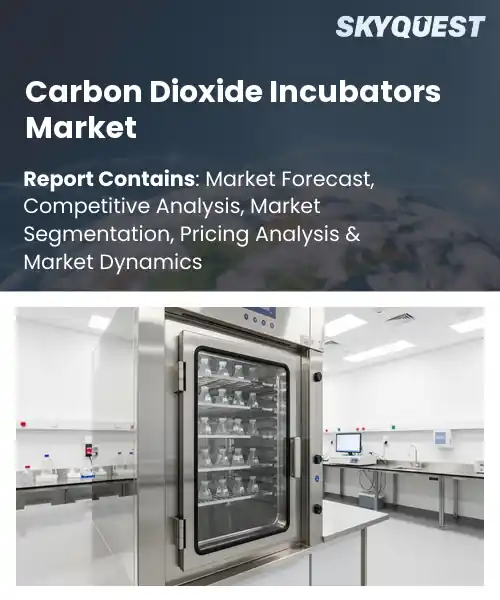
Carbon Dioxide Incubators Market
Report ID: SQMIG35A4066
Report ID: SQMIG35A4066
[email protected]
USA +1 351-333-4748
Report ID:
SQMIG35A4066 |
Region:
Global |
Published Date: July, 2026
Pages:
157
|Tables:
173
|Figures:
79


Global Carbon Dioxide Incubators Market size was valued at USD 1.24 Billion in 2024 and is poised to grow from USD 1.32 Billion in 2025 to USD 2.17 Billion by 2033, growing at a CAGR of 6.4% during the forecast period (2026-2033).
The carbon dioxide (CO₂) incubator market comprises equipment that reliably supplies controlled CO₂ concentrations, temperature, and humidity for cell‑culture and microbiology laboratories. The importance of this field is linked to the need for reproducible biological systems for such applications as vaccine production, drug development, and stem‑cell research. The market has its origins in the 1970s, when immunology laboratories sought reliable environments for mammalian cell cultures, and it developed significantly in the 1990s with the introduction of recombinant protein technologies. Today, the sector is booming due to the need to develop vaccines against pandemic diseases, which is illustrated in the way companies such as thermo fisher and sartorius are responding to the need.
The most decisive factor shaping global expansion is the accelerating demand for personalized medicine, which requires high‑throughput cell‑based assays maintained in precise CO₂ conditions. With the advent of personalized medicine, biotech companies are investing in modular incubators with integrated IoT sensors for real-time monitoring and predictive maintenance. Operating costs are thus reduced while ensuring reduced downtime, leading to growing adoption among contract research and academic institutions. As a consequence, manufacturers are introducing more efficient and sustainability-compliant products that will provide high business opportunities in new markets due to laboratory infrastructure modernization and biodegradation regulations.
How is AI-driven Automation Improving Efficiency in the Carbon Dioxide Incubators Market?
AI‑driven automation is reshaping carbon dioxide incubators by embedding intelligent sensors that continuously monitor temperature, humidity and gas concentration. With the help of machine learning algorithms, data is processed instantly, which leads to automatic adjustment of the heating elements and airflow to maintain optimal performance. This technology reduces the risk of human error, speeds up the setup times, and creates a potential for predictive maintenance resulting in less downtime and improved productivity. The automation of incubators through connection with a cloud-based control panel allows for remote monitoring of the instruments and helps with the expansion of laboratory operations while saving energy.
In October 2025, Thermo Fisher Scientific announced a strategic collaboration with OpenAI to embed generative AI across its life sciences portfolio, accelerating drug development, laboratory workflows, and scientific research. The AI-driven initiative is expected to enhance smart laboratory equipment, including CO₂ incubators, through improved automation, monitoring, predictive maintenance, and operational efficiency.
Market snapshot - (2026-2033)
Global Market Size
USD 1.24 Billion
Largest Segment
Air Jacket CO₂ Incubators
Fastest Growth
Direct Heat CO₂ Incubators
Growth Rate
6.4% CAGR
To get more insights on this market click here to Request a Free Sample Report
Global carbon dioxide incubators market is segmented by product type, capacity, application, end user, control type, sales channel and region. Based on product type, the market is segmented into air jacket CO₂ incubators, water jacket CO₂ incubators, direct heat CO₂ incubators and others. Based on capacity, the market is segmented into small capacity, medium capacity and large capacity. Based on application, the market is segmented into cell culture, tissue engineering, IVF laboratories and others. Based on end user, the market is segmented into pharmaceutical companies, research institutes, hospitals & clinical laboratories and others. Based on control type, the market is segmented into standard CO₂ control and CO₂ & O₂ control. Based on sales channel, the market is segmented into direct sales, laboratory equipment distributors and others. Based on region, the market is segmented into North America, Europe, Asia Pacific, Latin America and Middle East & Africa.
Air jacket CO₂ incubators segment dominates because it provides highly uniform temperature distribution and reliable humidity control, which are critical for sensitive cell culture workflows. The design ensures that there are no temperature differences, which reduces strain on the biological reagents besides having a better reproducibility. This technology is appreciated by the users because of its efficiency when it comes to energy consumption and its maintenance cost which makes it widely accepted in laboratory settings.
However, water jacket CO₂ incubators segment is witnessing the strongest growth momentum because its liquid based thermal regulation delivers superior temperature stability for large scale bioprocessing. Emerging demand for high throughput manufacturing and advanced tissue engineering drives investment in this technology, accelerating market expansion and opening new application opportunities.
CO₂ & O₂ control segment dominates because integrated oxygen regulation enables precise mimicry of physiological environments, essential for stem cell differentiation and three dimensional tissue constructs. This function diminishes hypoxia-induced damage, enhances cell survival rate and facilitates intricate experimental procedures. For this reason, laboratories prefer dual gas systems even if they cost more due to being more adaptable and versatile. Next, manufacturers concentrate on this technology and become strong leaders in the market for CO2 incubators.
On the other hand, standard CO₂ control segment is witnessing the strongest growth momentum because it provides an affordable solution for routine cell culture and quality control labs. Simpler designs lower maintenance and enable rapid deployment in educational and small research settings. Rising demand for cost effective yet reliable incubation drives its expansion and broader market reach.
To get detailed segments analysis, Request a Free Sample Report
North America leads the carbon dioxide incubator arena through a combination of robust research infrastructure, mature industrial ecosystems, and supportive policy frameworks. The coexistence of prestigious academic institutions and research organizations keeps spurring development of capture technology, while the mature chemicals and energy industries afford possibilities for pilot testing. Furthermore, there are supportive government measures that promote commercialization and simplify regulatory frameworks, thus stimulating venture capital investments and investments from large companies. Another positive element is that regional stakeholders engage in easy and beneficial collaboration, making technology transfer possible. In addition, a comprehensive infrastructure makes it possible to transform CO2 into valuable products. Continuous funding streams ensure that early‑stage projects receive the resources necessary to progress toward commercial readiness.
United States Carbon Dioxide Incubators Market
Carbon dioxide incubators market in the United States benefits from deep integration with the nation’s petrochemical and power generation sectors, providing a ready base for large‑scale demonstration projects. Strong venture capital networks support start‑ups that specialize in novel capture solvents and membrane technologies. Federal research initiatives are closely connected to industry collaborations, allowing for the quick creation of prototypes and creating paths for commercialization. Universities also play an important role in providing special knowledge necessary for achieving interdisciplinary solutions.
Canada Carbon Dioxide Incubators Market
Carbon dioxide incubators market in Canada is bolstered by a national emphasis on clean technology and abundant renewable energy resources that support low‑carbon operations. Collaborative hubs link research universities with emerging firms focused on bio‑based utilization of captured CO2. Incentives formulated by the government address the matter of the advancement of technology as well as projects that have just started up. The use of incentives facilitates the integration with the large national processing facility for natural gas, granting possibility for the elaboration of new technologies.
Europe’s carbon dioxide incubator sector is propelled by a unified commitment to climate neutrality, robust public funding mechanisms, and a dense network of industrial clusters that prioritize sustainability. Policies promote circular economy concepts which aim to transform the captured carbon dioxide into chemicals, fuels, and construction materials. A number of collaborative R&D initiatives are undertaken internationally in order to mobilize academic know-how for the purpose of advancing capture and utilization methods. With a good level of involvement from the chemical manufacturing sector enough demand for green raw materials is provided, and numerous financing mechanisms for green innovations help to minimize obstacles for start-up organizations. The combination of favorable regulation, demand from the industry, and scientific excellence offers the necessary environment for fast development of the market across Europe. Moreover, the existence of carbon pricing mechanisms stimulates companies to implement capture solutions in practice, while various industries get the benefits from partnerships with each other.
Germany Carbon Dioxide Incubators Market
Carbon dioxide incubators market in Germany is anchored by a strong engineering tradition and a proactive approach to industrial decarbonization. Leading chemical producers collaborate closely with research institutes to integrate captured CO2 into high‑value polymers and synthetic fuels. The federal programs made seek to achieve industrial applications of pilot plants within already existing industrial zones, thus attending to the goals of national targets aimed at reduction of emissions. The combination of technical expertise implementation along with government and governmental goals helps the country in taking the leading position in Europe.
United Kingdom Carbon Dioxide Incubators Market
Carbon dioxide incubators market in the United Kingdom is experiencing swift expansion driven by an ambitious net‑zero roadmap and a vibrant start‑up ecosystem. Grants at government innovation hubs help speed up innovation of new capture solvents and their conversion technologies. Close links between offshore wind farms and CO2 utilization allow the use of renewable electricity for electrochemical reduction. Academic institutions are good at process modeling while private investors start putting money in new scalable technologies that position the UK as an important player in the field of market acceleration.
France Carbon Dioxide Incubators Market
Carbon dioxide incubators market in France is emerging through strategic emphasis on bio‑based conversion and collaborative public‑private projects. National research agencies sponsor joint laboratories that focus on transforming captured CO2 into renewable chemicals and fuels, leveraging the country’s strong agro‑industrial base. Incentive schemes encourage integration of CO2 utilization within existing industrial clusters, particularly in the northern and western regions. This supportive framework, combined with a growing community of innovative firms, is gradually elevating France’s role in shaping the broader European incubator ecosystem.
Asia Pacific is rapidly consolidating its influence in the carbon dioxide incubator sphere through synergistic policy drives, expanding industrial demand, and accelerated technology transfer. The regional governments have clear visions for the low‑carbon transformation of industry and provide incentives that reduce entry barriers for capture and utilization projects. The growing manufacturing base, especially in energy‑intensive industries, generates a large demand for CO2‑based feedstocks and results in partnerships with technology providers. Cooperation between top research institutions and international companies enables the quick implementation of the newest membrane and catalysis technologies. Furthermore, the region’s growing focus on renewable energy development helps to create energy‑intensive conversion processes, paving the way for circular resource management. This combination of progressive regulation, market demands, and cooperative innovation makes Asia‑Pacific an exciting region for incubator initiatives.
Japan Carbon Dioxide Incubators Market
Carbon dioxide incubators market in Japan is distinguished by an advanced manufacturing sector and a national agenda that prioritizes carbon recycling. Research collaboratives, funded by governments, target the development of highly efficient capture membranes and methods of electrochemical reduction, thus fully utilizing the main knowledge of the country in the field of materials science. The inclusion of captured CO2 into the processes of petrochemicals and synthetic fuels allows to establish a straightforward flow of low-carbon products. A great amount of money is invested into pilot projects due to the consideration of companies on sustainable development matters, whereas cooperation with universities allows to speed up the transfer of innovations from laboratories to the market.
South Korea Carbon Dioxide Incubators Market
Carbon dioxide incubators market in South Korea leverages a high‑tech industrial base and a forward‑looking climate strategy to accelerate adoption of capture and utilization solutions. National research agencies partner with major conglomerates to develop compact, high‑performance capture units suitable for integration with existing petrochemical complexes. The focus on transforming the sequestered CO2 into synthetic hydrocarbons reflects the country’s objective of enhancing the production of renewable fuels. The strong support systems and tax incentives for the new ventures significantly mitigate the risks associated with the new ventures, along with the help from the real-life testbeds.data.
To know more about the market opportunities by region and country, click here to
Buy The Complete Report
Regulatory Support is Driving Adoption
Corporate Sustainability Goals are Elevating Demand
High Capital Expenditure is Limiting Expansion
Technical Integration Challenges are Slowing Deployment
Request Free Customization of this report to help us to meet your business objectives.
The competitive landscape is shaped by aggressive M&A activity, strategic partnerships with energy majors, and rapid tech innovation in modular CO2 incubation systems. The recent transactions are the past purchase of a special sorbent technology by an incubator company in 2025, as well as a joint deal with a major oil producer in 2024 to implement pilot units under water using the current technology.
Top Player’s Company Profile
Recent Developments
SkyQuest’s ABIRAW (Advanced Business Intelligence, Research & Analysis Wing) is our Business Information Services team that Collects, Collates, Correlates, and Analyses the Data collected by means of Primary Exploratory Research backed by robust Secondary Desk research.
As per SkyQuest analysis the global carbon dioxide incubators market is driven primarily by strong regulatory support that incentivises low‑carbon technologies, while corporate sustainability goals form a second catalyst pushing labs and manufacturers toward advanced, IoT‑enabled units. The market is led by North America, where robust research infrastructure and policy incentives sustain demand, and the air jacket incubator segment dominates owing to its uniform temperature control and energy efficiency. However, high capital expenditure remains a restraint, limiting rapid scale‑up for smaller players and slowing broader adoption despite the favorable growth forces in the coming decade.
| Report Metric | Details |
|---|---|
| Market size value in 2024 | USD 1.24 Billion |
| Market size value in 2033 | USD 2.17 Billion |
| Growth Rate | 6.4% |
| Base year | 2024 |
| Forecast period | (2026-2033) |
| Forecast Unit (Value) | USD Billion |
| Segments covered |
|
| Regions covered | North America (US, Canada), Europe (Germany, France, United Kingdom, Italy, Spain, Rest of Europe), Asia Pacific (China, India, Japan, Rest of Asia-Pacific), Latin America (Brazil, Rest of Latin America), Middle East & Africa (South Africa, GCC Countries, Rest of MEA) |
| Companies covered |
|
| Customization scope | Free report customization with purchase. Customization includes:-
|
To get a free trial access to our platform which is a one stop solution for all your data requirements for quicker decision making. This platform allows you to compare markets, competitors who are prominent in the market, and mega trends that are influencing the dynamics in the market. Also, get access to detailed SkyQuest exclusive matrix.
Table Of Content
Executive Summary
Market overview
Parent Market Analysis
Market overview
Market size
KEY MARKET INSIGHTS
COVID IMPACT
MARKET DYNAMICS & OUTLOOK
Market Size by Region
KEY COMPANY PROFILES
Methodology
For the Carbon Dioxide Incubators Market, our research methodology involved a mixture of primary and secondary data sources. Key steps involved in the research process are listed below:
1. Information Procurement: This stage involved the procurement of Market data or related information via primary and secondary sources. The various secondary sources used included various company websites, annual reports, trade databases, and paid databases such as Hoover's, Bloomberg Business, Factiva, and Avention. Our team did 45 primary interactions Globally which included several stakeholders such as manufacturers, customers, key opinion leaders, etc. Overall, information procurement was one of the most extensive stages in our research process.
2. Information Analysis: This step involved triangulation of data through bottom-up and top-down approaches to estimate and validate the total size and future estimate of the Carbon Dioxide Incubators Market.
3. Report Formulation: The final step entailed the placement of data points in appropriate Market spaces in an attempt to deduce viable conclusions.
4. Validation & Publishing: Validation is the most important step in the process. Validation & re-validation via an intricately designed process helped us finalize data points to be used for final calculations. The final Market estimates and forecasts were then aligned and sent to our panel of industry experts for validation of data. Once the validation was done the report was sent to our Quality Assurance team to ensure adherence to style guides, consistency & design.
Analyst Support
Customization Options
With the given market data, our dedicated team of analysts can offer you the following customization options are available for the Carbon Dioxide Incubators Market:
Product Analysis: Product matrix, which offers a detailed comparison of the product portfolio of companies.
Regional Analysis: Further analysis of the Carbon Dioxide Incubators Market for additional countries.
Competitive Analysis: Detailed analysis and profiling of additional Market players & comparative analysis of competitive products.
Go to Market Strategy: Find the high-growth channels to invest your marketing efforts and increase your customer base.
Innovation Mapping: Identify racial solutions and innovation, connected to deep ecosystems of innovators, start-ups, academics, and strategic partners.
Category Intelligence: Customized intelligence that is relevant to their supply Markets will enable them to make smarter sourcing decisions and improve their category management.
Public Company Transcript Analysis: To improve the investment performance by generating new alpha and making better-informed decisions.
Social Media Listening: To analyze the conversations and trends happening not just around your brand, but around your industry as a whole, and use those insights to make better Marketing decisions.
REQUEST FOR SAMPLE
 REQUEST FREE CUSTOMIZATION
Global Carbon Dioxide Incubators Market size was valued at USD 1.24 Billion in 2024 and is poised to grow from USD 1.32 Billion in 2025 to USD 2.17 Billion by 2033, growing at a CAGR of 6.4% during the forecast period (2026-2033).
The competitive landscape is shaped by aggressive M&A activity, strategic partnerships with energy majors, and rapid tech innovation in modular CO2 incubation systems; recent deals include a 2025 acquisition of a proprietary sorbent technology by a leading incubator firm and a 2024 joint venture with a major oil producer to deploy pilot units at offshore sites, driving market consolidation and accelerating deployment timelines. 'Thermo Fisher Scientific Inc.', 'Eppendorf SE', 'PHC Holdings Corporation', 'Binder GmbH', 'Memmert GmbH + Co. KG', 'Esco Lifesciences Group', 'NuAire, Inc.', 'Bellco Glass, Inc.', 'Heal Force Bio-Meditech Holdings Limited', 'LabTech S.r.l.', 'Yamato Scientific Co., Ltd.', 'Sheldon Manufacturing, Inc.', 'Benchmark Scientific Inc.', 'Jeio Tech Co., Ltd.', 'Genlab Limited', 'Caron Products & Services, Inc.', 'Panasonic Healthcare Holdings Co., Ltd.', 'BMT Medical Technology s.r.o.', 'Labwit Scientific Pty Ltd.', 'Being Technology Co., Ltd.'
Regulatory frameworks worldwide are mandating stricter carbon emission limits, prompting governments to fund and endorse incubator programmes that accelerate low‑carbon technologies. This policy environment creates clear incentives for startups and investors, fostering collaborative ecosystems that streamline research, prototyping, and commercialization. As a result, firms are more willing to allocate resources toward innovative solutions, and public‑private partnerships are expanding, thereby enhancing the overall momentum and attractiveness of the carbon dioxide incubator market while also encouraging knowledge transfer and talent development across sectors.
Renewable Energy Coupling: The convergence of carbon‑capture incubators with renewable power sources is reshaping facility design, as operators prioritize solar and wind paired systems to offset energy demand, reduce operational footprints, and improve sustainability narratives for investors. This synergistic approach fosters continuous feedstock availability, stabilizes production cycles, and enhances regulatory goodwill, positioning incubators as integral components of green energy ecosystems while unlocking new partnership models with utilities and clean‑tech innovators and driving long‑term profitability through low‑carbon cost structures in emerging markets worldwide today.
Why does North America Dominate the Global Carbon Dioxide Incubators Market? |@12


Want to customize this report? This report can be personalized according to your needs. Our analysts and industry experts will work directly with you to understand your requirements and provide you with customized data in a short amount of time. We offer $1000 worth of FREE customization at the time of purchase.
Feedback From Our Clients


 USA (+1) 351-333-4748

