Carbon Black Market
Report ID: SQMIG15A2573
Report ID: SQMIG15A2573
[email protected]
USA +1 351-333-4748
Report ID:
SQMIG15A2573 |
Region:
Global |
Published Date: November, 2025
Pages:
192
|Tables:
95
|Figures:
71


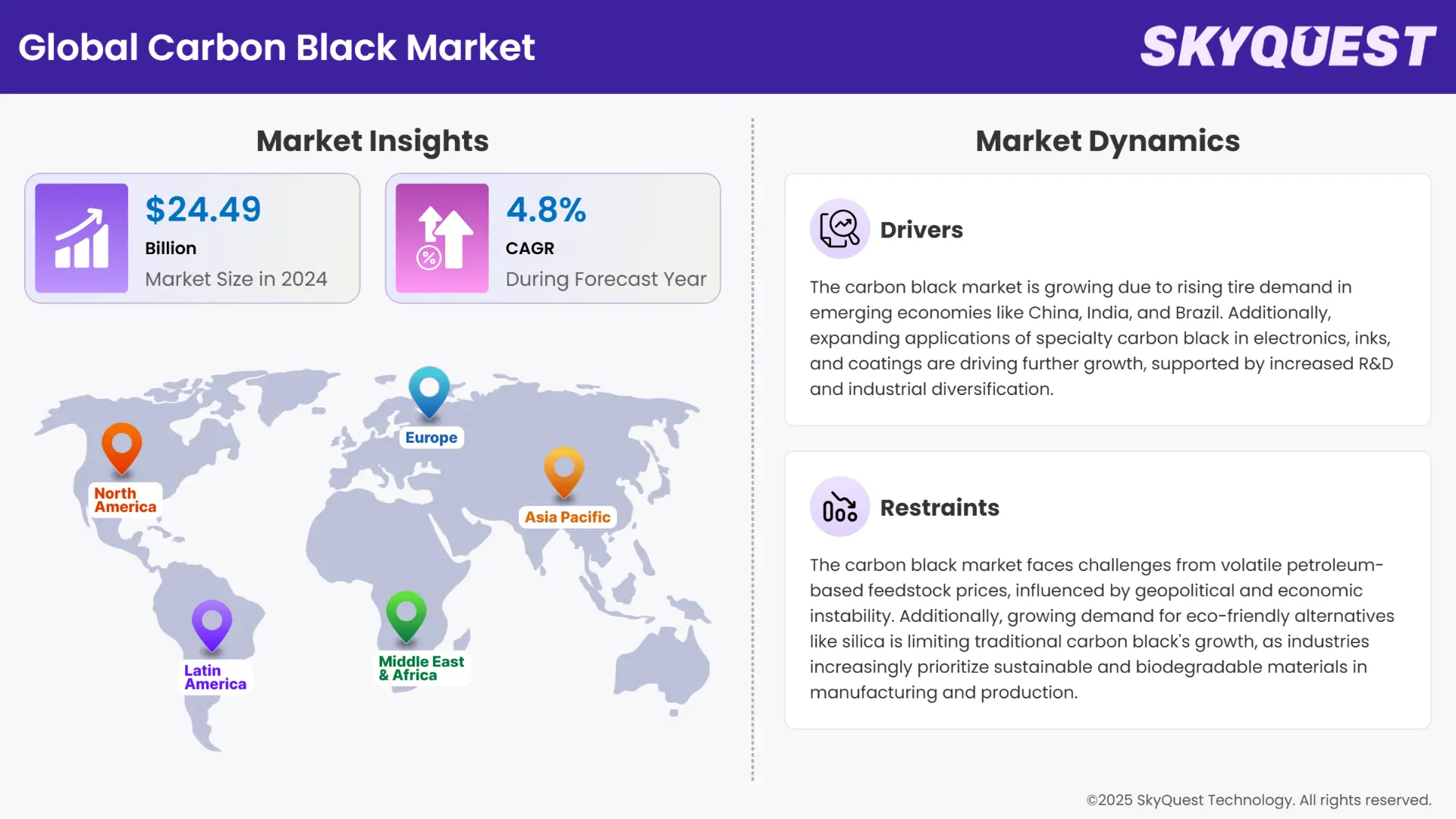
Carbon Black Market size was valued at USD 24.49 Billion in 2024 and is poised to grow from USD 25.67 Billion in 2025 to USD 37.35 Billion by 2033, growing at a CAGR of 4.8% during the forecast period (2026–2033).
The carbon black market in the world has shown sustainable growth because of healthy market demand from the automotive, construction, plastics and electronics industries. The frequent production and sales of vehicles around the world is still driving carbon black demand in tire production. This is particularly true because carbon black is used to enhance tire durability and performance. The growing number of infrastructure projects, particularly in developing economies, increases carbon black consumption in construction products and industrial rubber applications, and also naturally increases the carbon black market.
While carbon black use in plastics has been known for a number of years, the importance of carbon black in producing plastics has increased with the demand of electronics and consumer appliances as the carbon black is helping add conductive and reinforcing elements to electronic components. With this growth of the electronic market, especially electronics that are smart devices and component parts of electric vehicles, the market place for this kind of high performance plastics is also growing. The trend towards automotive refurbishment, and the need for high quality and durable coatings in interchangeable applications, such as marine, aerospace and industrial machinery are creating an increase in the use of carbon black in the solutions produced.
However, the carbon black market faces uncertainties as the crude oil volatility related to carbon black owing to its petroleum origins can be a considerable cost driver of production processes. In addition to this, much of the carbon black pressure increasing the concerns around emissions during the production process and health and environmental ramifications from exposure ultimately results in strict regulation and interest in alternatives, such as sustainable bio-based or silica-based reinforcements.
In response, manufacturers have developed improved processes, sources, and products. Many companies are adopting a cleaner production process and growth into new regions with better industrial standards and policies. As industries work towards sustainable, eco-friendliness material production, the carbon black industry is also seeing an increase in research towards recyclable and environmentally friendly alternatives to stay competitive while addressing changing regulations.
Can Collaborations with Battery Manufacturers Unlock New Growth Opportunities for Carbon Black Companies in the EV Era?
Carbon black companies can focus on collaborating with battery companies to enhance the conductivity and performance of lithium-ion batteries. Growing demand for lithium-ion batteries from the automotive industry as popularity of electric vehicles picks up pace will emerge as a key carbon black market trend to open up new avenues of opportunities for companies in the long run.
Will Embracing Sustainable Production Methods Give Carbon Black Companies a Competitive Edge?
Carbon black providers can focus on incorporating sustainability in their production process and products to maximize their business scope. Use of carbon capture and storage (CCS) and bio-based carbon black production will help carbon black companies stand out from the competition as emphasis on sustainability rises around the world.
Is the Rise of 3D Printing Creating New Growth Frontiers for Carbon Black Applications?
The use of carbon black in 3D printing is taking off as a trend for a variety of reasons including improvement of mechanical strength, UV protection, and electrical conductivity of printed parts. As additive manufacturing continues to grow in various industries including automotive, aerospace and electronics, carbon black is being blended with thermoplastics and resins being used for 3D printing. Therefore, this trend is creating new niche markets and extending the applicability of carbon black beyond the already established usage.
To get more insights on this market click here to Request a Free Sample Report
Global carbon black market is segmented based on type, application, grade, and region. Based on the type, the market is segmented into furnace black, channel black, thermal black, acetylene black, and others. Based on grade, the market is segmented into standard grade and specialty grade. Based on the application, the market is segmented into tire, non- tire rubber, plastics, inks & coatings, and others. Based on the Region, the market is segmented into North America, Europe, Asia-Pacific, South America, and the Middle East and Africa.
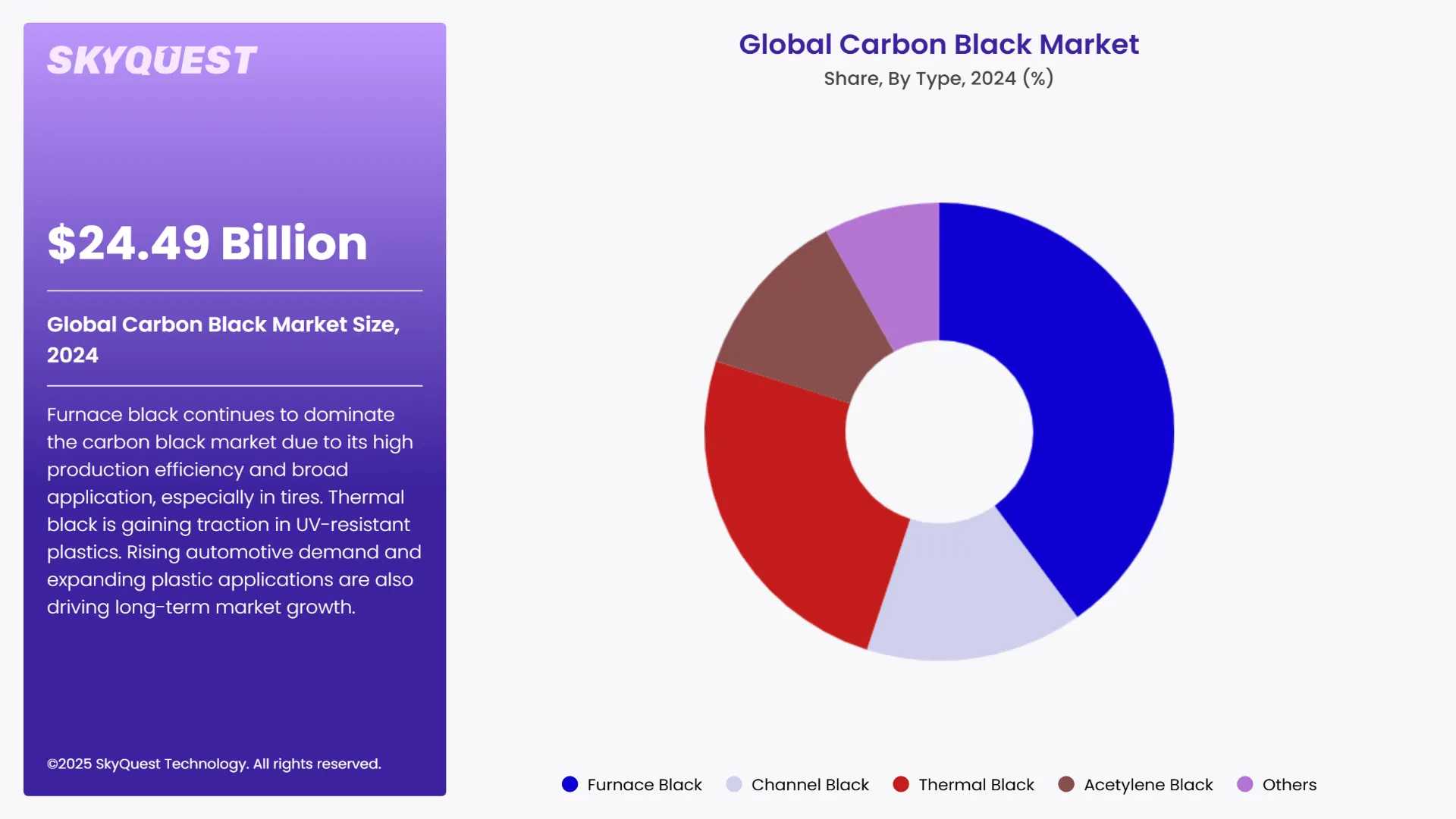
Furnace black is projected to account for a dominant share of the global carbon black market. High production capacity of furnace black production method and its extensive use in multiple applications are allowing this segment to account for a high share. Moreover, the high use of furnace black in the tire industry is also expected to promote its dominance in the long run. Ease of production and high production capacity of furnace black is estimated to help it remain the most widely used carbon black in the global market. The ability of furnace black to enhance mechanical properties of materials will also aid its high market share in carbon black industry.
Thermal black is forecasted to account for the second-largest share of the global carbon black market. The extensive use of thermal black in the plastic industry to provide UV protection to plastics is helping it generate new opportunities for carbon black companies going forward. Surging demand for UV-treated plastic products in commercial and industrial applications is estimated to help this segment bolster carbon black market growth across the study period and beyond. Smooth surface finish and special performance capabilities are also expected to generate new opportunities for carbon black providers focusing on thermal black in the long run.
Tires are projected to account for a substantial share of the global carbon black market outlook in the future. Growing demand for tires owing to rapidly expanding automotive industry and vehicle sales is helping this segment maintain its high carbon black market share. Advancements in tire manufacturing technologies and growing number of tire manufacturing facilities around the world are predicted to create new business scope for carbon black providers in the long run. Growing use of carbon black as an additive and performance filler in tires coupled with high demand for performance tires will also favor carbon black demand outlook in the future.
Meanwhile, the demand for carbon black for plastic applications is slated to rise at a notable CAGR over the coming years. High use of carbon black for the production of products such as conductive packaging, moldings, fibers, semi-conductive cable compounds, and pipes for industrial applications is estimated to help this segment generate new opportunities for market players. Carbon black is used in plastics to provide UV protection and also stabilize plastics for heat and electrical conductivity. Rising demand for specialized plastic products in industrial or commercial settings is slated to present new opportunities for carbon black companies going forward.
To get detailed segments analysis, Request a Free Sample Report
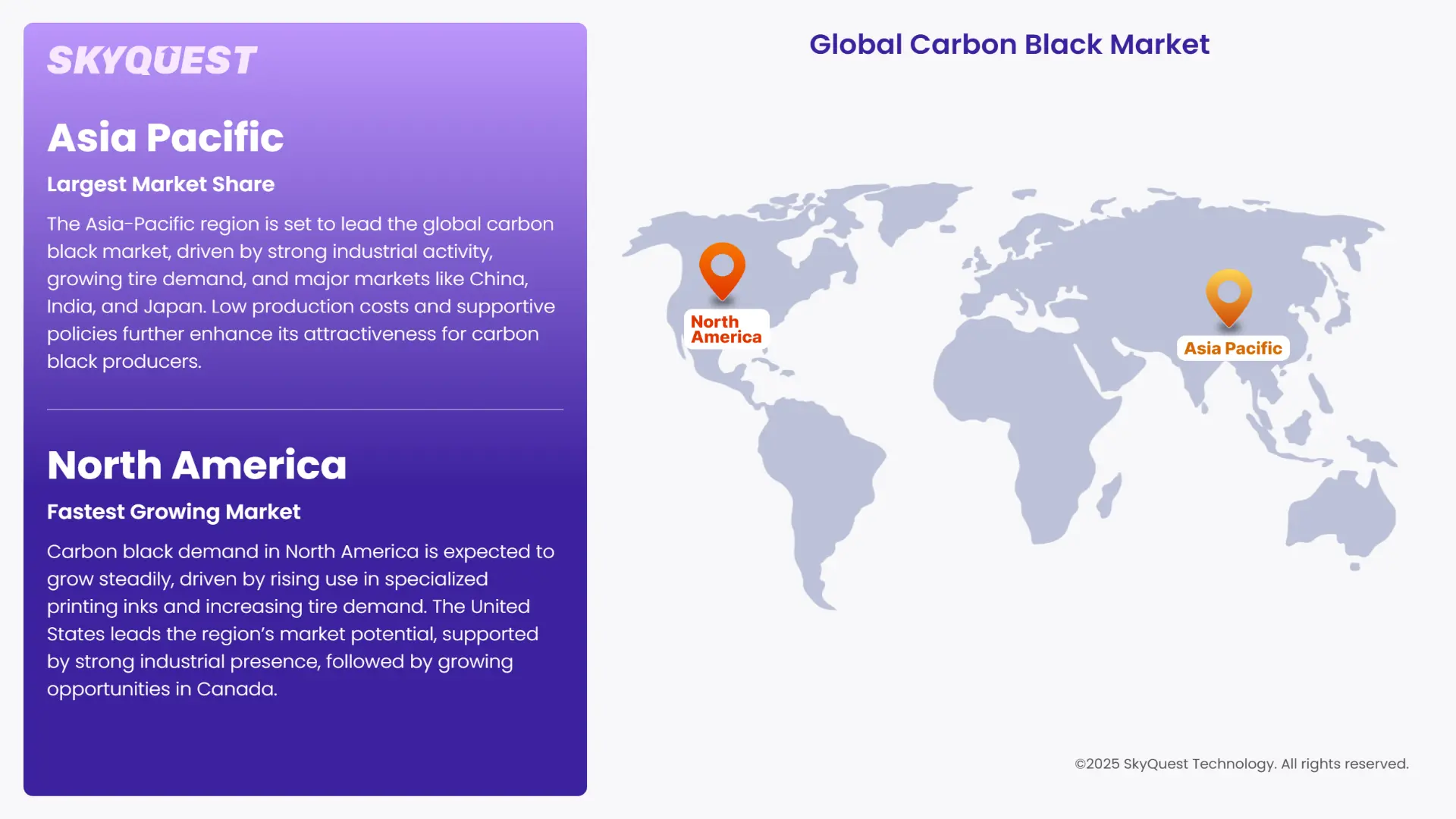
The Asia-Pacific region is expected to have an important share of the global carbon black market. This region has several carbon black suppliers, significant industrial activity, and increasingly higher demand for tires by the automobile production industry, which are all expected to contribute to the region's leading position. India, China, and Japan are slated to be at the forefront of revenue generation for carbon black companies operating in the Asia Pacific region. Supportive government initiatives and low labor and raw material costs of this region are also expected to offer lucrative business scope for carbon black companies in the future.
China is the largest market for carbon black in the Asia Pacific region, due to its vast tire manufacturing, strong industrial foundation, and substantial demand for rubber reinforcing in automotive and construction applications.
India is the second-largest carbon black market in Asia Pacific which is being driven by rising automobile production and a robust construction sector. The country's escalating emphasis on industrialization, urban infrastructure and domestic tire manufacturing is fuelling carbon black demand.
Japan constitutes the third largest carbon black market in the Asia Pacific. Though growth is slower since the market has matured, demand remains in specialty applications such as electronics, plastics and high-performance tires.
On the other hand, the demand for carbon black in the North American region is slated to increase at a notable pace going forward. Rising use of carbon black for the development of specialized inks for printing is slated to be a key trend offering lucrative business scope for carbon black companies in this region. The United States is estimated to be the most opportune market in North America owing to the presence of key industries followed by Canada. Growing demand for tires in this region will also boost the demand for carbon black over the coming years.
The U.S. is the largest carbon black market in North America, driven by relatively large automotive manufacturing operations, considerable tire manufacturing capacity, and significant demand for industrial end use of carbon black like plastics; coatings; and inks, and others.
Canada has the second-largest share of the North American carbon black market. While Canada's market is not as large as the U.S. market, we are seeing continued carbon black consumption growth and spurred on by our growing automotive aftermarket and greater infrastructure projects.
Europe is still the third largest market for carbon black and is supported by its established automotive and aerospace industries, stringent environmental regulations, and demand for high-performance composites. The region is beginning to pivot to more sustainable production methods. For instance, Orion Engineered Carbons opened a new energy-efficient carbon black plant in Italy, which is aimed at lowering emissions while increasing capacity for specialty applications. These developments will align with and simultaneously support the stability of the carbon black market while helping with Europe's climate goals.
To know more about the market opportunities by region and country, click here to
Buy The Complete Report
Is Diversifying Demand Across Tires and High-Value Industries Driving the Next Wave of Growth in the Carbon Black Market?
Rising Automotive Demand in Emerging Economies
Expanding Applications of Specialty Carbon Black
Are Cost Volatility and Eco-Friendly Alternatives Disrupting the Future of the Carbon Black Market?
Price Volatility of Petroleum-Based Feedstocks
Rising Adoption of Sustainable Alternatives
Request Free Customization of this report to help us to meet your business objectives.
Developing sustainable carbon black is projected to be the prime focus of almost all market players going forward. Targeting the countries with increasing urbanization and industrialization will also pay off big time for carbon black companies in the long run. Expanding carbon black production capacity to meet rising demand and launching new carbon black products to maximize business scope will also emerge as popular strategies for market players as per this carbon black market analysis.
Strategic Collaborations with Battery Manufacturers
Embracing Sustainable Practices to Strengthen Market Position
Rising Adoption of Carbon Black in 3D Printing Expands Market Applications
SkyQuest’s ABIRAW (Advanced Business Intelligence, Research & Analysis Wing) is our Business Information Services team that Collects, Collates, Co-relates, and Analyses the Data collected by means of Primary Exploratory Research backed by robust Secondary Desk research.
According to our analyses, the demand for plastic and coating products is on the rise, and the rubber industry is developing rapidly. In addition, more people are choosing electric vehicles which is leading to growth of the carbon black market. Increases in tire manufacturing activity, along with increased demand for specialty inks, are expected to continue to drive carbon black market growth in the future. However, availability of alternative materials and fluctuations in raw material pricing are slated to hamper carbon black demand going forward. Robust industrialization in the Asia Pacific region allows it to hold sway over the global carbon black market development potential. Emphasis on promoting sustainable carbon black production is slated to offer lucrative business scope for market players in the long run.
| Report Metric | Details |
|---|---|
| Market size value in 2024 | USD 24.49 Billion |
| Market size value in 2033 | USD 37.35 Billion |
| Growth Rate | 4.8% |
| Base year | 2024 |
| Forecast period | 2026-2033 |
| Forecast Unit (Value) | USD Billion |
| Segments covered |
|
| Regions covered | North America (US, Canada), Europe (Germany, France, United Kingdom, Italy, Spain, Rest of Europe), Asia Pacific (China, India, Japan, Rest of Asia-Pacific), Latin America (Brazil, Rest of Latin America), Middle East & Africa (South Africa, GCC Countries, Rest of MEA) |
| Companies covered |
|
| Customization scope | Free report customization with purchase. Customization includes:-
|
To get a free trial access to our platform which is a one stop solution for all your data requirements for quicker decision making. This platform allows you to compare markets, competitors who are prominent in the market, and mega trends that are influencing the dynamics in the market. Also, get access to detailed SkyQuest exclusive matrix.
Table Of Content
Executive Summary
Market overview
Parent Market Analysis
Market overview
Market size
KEY MARKET INSIGHTS
COVID IMPACT
MARKET DYNAMICS & OUTLOOK
Market Size by Region
KEY COMPANY PROFILES
Methodology
For the Carbon Black Market, our research methodology involved a mixture of primary and secondary data sources. Key steps involved in the research process are listed below:
1. Information Procurement: This stage involved the procurement of Market data or related information via primary and secondary sources. The various secondary sources used included various company websites, annual reports, trade databases, and paid databases such as Hoover's, Bloomberg Business, Factiva, and Avention. Our team did 45 primary interactions Globally which included several stakeholders such as manufacturers, customers, key opinion leaders, etc. Overall, information procurement was one of the most extensive stages in our research process.
2. Information Analysis: This step involved triangulation of data through bottom-up and top-down approaches to estimate and validate the total size and future estimate of the Carbon Black Market.
3. Report Formulation: The final step entailed the placement of data points in appropriate Market spaces in an attempt to deduce viable conclusions.
4. Validation & Publishing: Validation is the most important step in the process. Validation & re-validation via an intricately designed process helped us finalize data points to be used for final calculations. The final Market estimates and forecasts were then aligned and sent to our panel of industry experts for validation of data. Once the validation was done the report was sent to our Quality Assurance team to ensure adherence to style guides, consistency & design.
Analyst Support
Customization Options
With the given market data, our dedicated team of analysts can offer you the following customization options are available for the Carbon Black Market:
Product Analysis: Product matrix, which offers a detailed comparison of the product portfolio of companies.
Regional Analysis: Further analysis of the Carbon Black Market for additional countries.
Competitive Analysis: Detailed analysis and profiling of additional Market players & comparative analysis of competitive products.
Go to Market Strategy: Find the high-growth channels to invest your marketing efforts and increase your customer base.
Innovation Mapping: Identify racial solutions and innovation, connected to deep ecosystems of innovators, start-ups, academics, and strategic partners.
Category Intelligence: Customized intelligence that is relevant to their supply Markets will enable them to make smarter sourcing decisions and improve their category management.
Public Company Transcript Analysis: To improve the investment performance by generating new alpha and making better-informed decisions.
Social Media Listening: To analyze the conversations and trends happening not just around your brand, but around your industry as a whole, and use those insights to make better Marketing decisions.
REQUEST FOR SAMPLE
 REQUEST FREE CUSTOMIZATION
The carbon black market is expected to experience a compound annual growth rate (CAGR) of 4.8% from 2025 to 2032, which is largely driven by increasing demand across automotive, plastics, and electronics (in particular, the use of carbon black in tires, as well as the screening of plastics with conductive components).
Factors such as fluctuating petroleum feedstock prices and increased environmental regulations due to emissions pose notable challenges to the carbon black market. Thus, these factors continue to shift the industry towards sustainable alternatives and cleaner production technologies to remain competitive.
Carbon black is utilized across a range of applications, including tires, non-tire rubber, plastics, inks, and coatings (in particular, colorant). The compound can provide reinforcement, conductivity, UV protection, and durability in applications in automotive, electronics, building and construction, and industrial products.
In particular, carbon black plays a vital role in providing reinforcement strength in tires, increasing durability and enhancing performance. Carbon black, as well as its obtained markets, is being driven by increasing global vehicle production and the overall increasing demand for tires (and therefore carbon black) used in tire production.
In addition, yes, carbon black is utilized in lithium-ion batteries to provide better conductivity and performance properties. Furthermore, many carbon black processes are continuing to collaborate with battery manufacturers are progressively moving toward opportunities as a result of increased demand for electric vehicles (EVs).
The carbon black market encompasses furnace black, channel black, thermal black, acetylene black, and others. Furnace black is the most prevalent, due to its high efficacy, while thermal black is most commonly used in UV-stabilized plastics.
The Asia-Pacific region is leading the market due to an abundance of industrial activity and demand in tire manufacturing, in addition to the presence of most of the globally significant producers. The region stands to benefit from industry-favorable government policy, low production costs, and rapid urbanization occurring in countries such as China and India.
North America is also experiencing increased carbon black demand from tire production and emerging applications in plastics and specialty inks. Investments being made by the U.S. government from the Inflation Reduction Act, in domestic carbon black facilities and in clean-tech initiatives, will continue supporting the carbon black market.
Yes, companies are adopting sustainable practices and products such as bio-based carbon black and carbon capture to meet regulatory requirements and secure a competitive edge in the global race to eco-friendly manufacturing.
Carbon black continues to disrupt traditional 3D printing applications, improving the mechanical properties of printed parts, including strength, UV stabilization, and conductivity. New blends integrating carbon black with thermoplastics and resins open the door for its use in nearly any sector, and automotive, aerospace and electronics are leading the charge!


Want to customize this report? This report can be personalized according to your needs. Our analysts and industry experts will work directly with you to understand your requirements and provide you with customized data in a short amount of time. We offer $1000 worth of FREE customization at the time of purchase.
Feedback From Our Clients


 USA (+1) 351-333-4748

