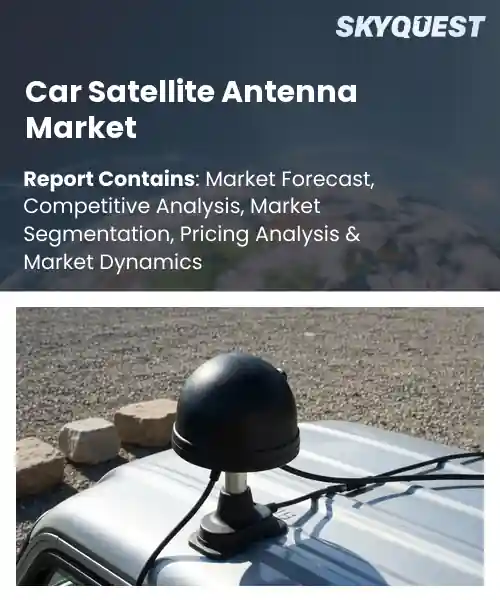
Car Satellite Antenna Market
Report ID: SQMIG25A2755
Report ID: SQMIG25A2755
[email protected]
USA +1 351-333-4748
Report ID:
SQMIG25A2755 |
Region:
Global |
Published Date: June, 2026
Pages:
157
|Tables:
144
|Figures:
78


Global Car Satellite Antenna Market size was valued at USD 2.03 Billion in 2024 and is poised to grow from USD 2.1 Billion in 2025 to USD 2.76 Billion by 2033, growing at a CAGR of 3.49% during the forecast period (2026-2033).
The global car satellite antenna market supplies the hardware that enables vehicles to receive signals from low‑Earth‑orbit satellites for navigation, entertainment and telematics. Its importance stems from the rising expectation that cars function as data hubs, a trend amplified by regulatory mandates for on‑board connectivity and consumer demand for streaming services. Historically the market began with simple satellite radio receivers in the early 2000s, expanded to satellite‑based navigation units in the 2010s, and now embraces multi‑band antennas that support GNSS, TV and emerging V2X services. This evolution reflects the growing reliance on uninterrupted satellite links to deliver information to drivers.
Building on the expanding connectivity baseline, the decisive factor now shaping the car satellite antenna market is the convergence of GNSS precision with vehicle‑to‑everything (V2X) communications, a synergy that drives safety and autonomous‑driving advances. Automakers such as Tesla and Volkswagen adopt dual‑band antennas that capture accurate positioning and low‑latency V2X signals, enabling cooperative adaptive cruise control and hazard alerts. This integration reduces reliance on cellular networks, lowering fleet operating costs and opening revenue opportunities for suppliers of compact designs. Consequently, regions with vehicle growth but limited terrestrial infrastructure become fertile markets where satellite‑linked infotainment and navigation serve as value drivers.
How is AI Enhancing Performance in the Car Satellite Antenna Market?
AI is reshaping the car satellite antenna market by introducing intelligent signal processing and adaptive beam‑forming capabilities. Machine‑learning algorithms analyze vehicle location, speed and surrounding interference to continuously optimize antenna orientation, resulting in stronger links and lower latency. AI‑driven predictive maintenance alerts manufacturers to potential hardware degradation before failures occur, extending product life cycles. Integration with connected‑car platforms enables real‑time data sharing, allowing antennas to anticipate network congestion and switch frequencies proactively. These advances align with the market’s rapid growth as automotive manufacturers seek reliable high‑bandwidth connectivity for navigation, infotainment and autonomous driving functions.
In January 2025, Ignion showcased its AI-powered Oxion platform at CES 2025, enabling engineers to optimize antenna integration using artificial intelligence and machine learning. The technology accelerates the design of automotive satellite and connectivity antennas, improving signal performance, reducing development time, and supporting next-generation connected vehicle applications requiring advanced GNSS and satellite communication capabilities.
Market snapshot - (2026-2033)
Global Market Size
USD 2.03 Billion
Largest Segment
Phased Array Antennas
Fastest Growth
Planar Array Antennas
Growth Rate
3.49% CAGR
To get more insights on this market click here to Request a Free Sample Report
Global car satellite antenna market is segmented by antenna architecture, frequency band spectrum, component assembly, application vehicle class, sales channel and region. Based on antenna architecture, the market is segmented into phased array antennas, reflector antennas and planar array antennas. Based on frequency band spectrum, the market is segmented into Ku-band, Ka-band, L-band and others. Based on component assembly, the market is segmented into antenna unit hardware, tracking and control modules and receiver units. Based on application vehicle class, the market is segmented into premium passenger cars, commercial fleets and recreational vehicles. Based on sales channel, the market is segmented into original equipment manufacturer integration and aftermarket upgrades. Based on region, the market is segmented into North America, Europe, Asia Pacific, Latin America and Middle East & Africa.
Phased array antennas segment dominates because its electronic beam steering eliminates mechanical movement, delivering faster acquisition and more reliable links for moving vehicles. This architecture integrates multiple radiating elements within a compact module, allowing seamless adaptation to changing vehicle orientation and satellite positions. Consequently manufacturers favor it to meet consumer expectations for uninterrupted infotainment and telematics, while its inherent robustness reduces maintenance concerns, reinforcing its leadership in the market.
However, planar array antennas segment is witnessing the strongest growth momentum as manufacturers capitalize on its low profile design that integrates easily into vehicle bodies. The flat form factor aligns with aesthetic trends and enables cost effective mass production, driving adoption across new car models and expanding the market’s future opportunity landscape.
Ka‑band segment dominates because its higher frequency enables substantially larger bandwidth, supporting gigabit level data rates essential for high definition streaming and real time navigation services in vehicles. The increased spectral efficiency allows multiple simultaneous channels, reducing latency and improving user experience. Automotive manufacturers prioritize this band to differentiate premium infotainment offerings, while network operators invest in Ka Band satellites to meet growing demand for rich content, cementing its leading position in the market.
On the other hand, L‑band segment is emerging as the key high growth area because its lower frequency offers superior propagation through adverse weather, appealing to fleet operators needing reliable connectivity. This resilience drives adoption in commercial trucks and rural vehicles, expanding market reach and creating new opportunities for service providers.
To get detailed segments analysis, Request a Free Sample Report
Asia Pacific holds the leading position in the global car satellite antenna market because the region combines world‑class automotive manufacturing with deep expertise in electronic miniaturization. OEMs in the region prioritize integrated connectivity solutions as a core element of vehicle differentiation, prompting early collaboration with antenna suppliers. A dense network of component producers, research institutions, and testing facilities accelerates development cycles and reduces time to market. Consumer expectations for seamless navigation, infotainment and safety services drive strong demand for reliable satellite links. Government initiatives that encourage smart vehicle adoption further reinforce market momentum, while the export orientation of major carmakers spreads regional technology standards worldwide. The growing prevalence of connected car services, such as traffic management, diagnostics and entertainment, intensifies the need for satellite connectivity that can operate across geographic conditions. Moreover, collaboration between telecom operators and automotive groups seeks to blend satellite and terrestrial networks, creating solutions that enhance coverage and bandwidth availability, further fueling market expansion.
Car satellite antenna market in Japan benefits from a mature automotive ecosystem that emphasizes precision engineering and reliability. Domestic manufacturers integrate antenna modules at the design stage, ensuring seamless compatibility with advanced driver assistance systems. Local supplier clusters provide prototyping and customization, supporting niche vehicle segments. Collaboration between automakers, electronics firms and research universities fuels improvement in signal performance and durability, reinforcing Japan’s reputation as a hub for connectivity solutions.
Car satellite antenna market in South Korea thrives on a relationship between vehicle assemblers and electronics firms. The nation’s emphasis on technology adoption encourages integration of antenna arrays that support infotainment and telematics services. Research parks and programs accelerate validation and capabilities. Close supply chain linkages enable response to design changes, while a skilled engineering workforce ensures performance standards, positioning South Korea as a key contributor to regional connectivity solutions.
North America experiences rapid expansion of the car satellite antenna market due to a convergence of consumer expectations for always‑connected driving experiences and strong industry investment in next‑generation communication platforms. Automakers integrate satellite links to enrich navigation, safety alerts and over‑the‑air updates, while fleet operators rely on continuous data streams for efficiency and compliance. A supportive regulatory climate encourages deployment of broadband services across highways, and partnerships between technology providers and vehicle manufacturers accelerate product rollout. Additionally, a mature aftermarket ecosystem and high vehicle turnover rate sustain demand for retrofit and upgrade solutions, reinforcing the region’s momentum. The growing prevalence of connected car services, such as traffic management, diagnostics and entertainment, intensifies the need for satellite connectivity that can operate across geographic conditions. Moreover, collaboration between telecom operators and automotive groups seeks to blend satellite and terrestrial networks, creating solutions that enhance coverage and bandwidth availability, further fueling market expansion.
Car satellite antenna market in the United States is propelled by an ecosystem of equipment manufacturers and technology innovators that prioritize seamless connectivity as a core vehicle attribute. Extensive testing facilities and a strong emphasis on safety standards drive the integration of antenna designs capable of supporting advanced driver assistance and infotainment platforms. Consumer enthusiasm for over‑the‑air updates and real‑time services sustains a demand environment that encourages continuous product refinement.
Car satellite antenna market in Canada benefits from a landscape where automotive firms and research institutions explore satellite‑based connectivity solutions tailored to the country’s geography. Emphasis on safety and environmental performance drives adoption of antenna systems that support traffic information and remote diagnostics, particularly for commercial fleets operating in remote regions. Government incentives for clean‑technology integration further stimulate investment, while a growing consumer appetite for connected features sustains market activity.
Europe strengthens its position in the car satellite antenna market through a combination of stringent emission norms, advanced automotive engineering, and a collaborative research environment that encourages cross‑border innovation. Leading manufacturers embed satellite connectivity to meet growing consumer expectations for real‑time navigation, safety alerts and over‑the‑air updates, while leveraging the region’s strong supply chain for high‑precision component production. Policy frameworks that promote sustainable mobility and digital infrastructure investment further accelerate adoption, and partnerships between telecom operators and automakers aim to create seamless hybrid networks that enhance coverage and bandwidth across diverse markets. The focus on autonomous driving prototypes drives the development of antenna arrays capable of maintaining reliable links under high‑speed conditions, while the presence of numerous standards bodies ensures interoperability across borders. Moreover, European automotive clusters benefit from government‑backed grants that de‑risk the commercialization of next‑generation satellite technologies, reinforcing the continent’s reputation as a hub for high‑quality connectivity solutions.
Car satellite antenna market in Germany is driven by an engineering tradition and a network of Tier‑1 suppliers that excel in precision manufacturing. Automakers prioritize integration of satellite links to support advanced driver assistance, telematics and infotainment features, aligning with the country’s emphasis on road safety and efficiency. Collaborative projects between research institutes and industry players foster development of antenna solutions, reinforcing Germany’s reputation as a leader in automotive connectivity.
Car satellite antenna market in the United Kingdom benefits from an ecosystem of automotive OEMs and startups that focus on integrating satellite connectivity for navigation and safety services. Regulatory emphasis on vehicle emissions and fleet management drives adoption of antenna systems capable of delivering reliable data across rural and urban environments. Collaborations with satellite operators and research centres accelerate the development of antenna technologies that meet the nation’s mobility standards.
Car satellite antenna market in France is shaped by an automotive heritage and a policy environment that encourages transformation of mobility. Manufacturers integrate satellite antenna solutions to provide traffic information, emergency call functionality and over‑the‑air software updates, aligning with national goals for safety and emission reduction. Partnerships with aerospace firms and research laboratories foster innovation in lightweight antenna designs that support the country’s push towards connected future and autonomous vehicles.
To know more about the market opportunities by region and country, click here to
Buy The Complete Report
Rising Demand For Connected Vehicles
Growth Of Autonomous Driving Technologies
High Production Cost Barriers
Regulatory Certification Challenges
Request Free Customization of this report to help us to meet your business objectives.
The competitive landscape of the global car satellite antenna market is intensifying as forecasts project strong growth through 2035. Companies are accelerating technology innovation, such as advanced electronically steerable arrays, and forming strategic collaborations to secure supply chains and meet automotive connectivity demands. These actions aim to differentiate offerings amid rising demand for high‑bandwidth vehicle communications.
Top Player’s Company Profile
Recent Developments
SkyQuest’s ABIRAW (Advanced Business Intelligence, Research & Analysis Wing) is our Business Information Services team that Collects, Collates, Correlates, and Analyses the Data collected by means of Primary Exploratory Research backed by robust Secondary Desk research.
As per SkyQuest analysis, the global car satellite antenna market is being propelled primarily by the rising demand for connected vehicles, which pushes OEMs to embed high‑gain antennas for seamless infotainment and safety services. A second catalyst is the rapid growth of autonomous‑driving technologies that rely on uninterrupted satellite positioning and data links. However, high production‑cost barriers constrain wider adoption, especially in price‑sensitive segments. The Asia Pacific region leads the market thanks to its strong automotive manufacturing base and advanced electronics ecosystem, while phased‑array antennas dominate the segment landscape by offering electronic beam‑steering, compactness and reliable performance for moving vehicles across diverse climatic conditions and vehicle classes, reinforcing its strategic importance for future mobility.
| Report Metric | Details |
|---|---|
| Market size value in 2024 | USD 2.03 Billion |
| Market size value in 2033 | USD 2.76 Billion |
| Growth Rate | 3.49% |
| Base year | 2024 |
| Forecast period | (2026-2033) |
| Forecast Unit (Value) | USD Billion |
| Segments covered |
|
| Regions covered | North America (US, Canada), Europe (Germany, France, United Kingdom, Italy, Spain, Rest of Europe), Asia Pacific (China, India, Japan, Rest of Asia-Pacific), Latin America (Brazil, Rest of Latin America), Middle East & Africa (South Africa, GCC Countries, Rest of MEA) |
| Companies covered |
|
| Customization scope | Free report customization with purchase. Customization includes:-
|
To get a free trial access to our platform which is a one stop solution for all your data requirements for quicker decision making. This platform allows you to compare markets, competitors who are prominent in the market, and mega trends that are influencing the dynamics in the market. Also, get access to detailed SkyQuest exclusive matrix.
Table Of Content
Executive Summary
Market overview
Parent Market Analysis
Market overview
Market size
KEY MARKET INSIGHTS
COVID IMPACT
MARKET DYNAMICS & OUTLOOK
Market Size by Region
KEY COMPANY PROFILES
Methodology
For the Car Satellite Antenna Market, our research methodology involved a mixture of primary and secondary data sources. Key steps involved in the research process are listed below:
1. Information Procurement: This stage involved the procurement of Market data or related information via primary and secondary sources. The various secondary sources used included various company websites, annual reports, trade databases, and paid databases such as Hoover's, Bloomberg Business, Factiva, and Avention. Our team did 45 primary interactions Globally which included several stakeholders such as manufacturers, customers, key opinion leaders, etc. Overall, information procurement was one of the most extensive stages in our research process.
2. Information Analysis: This step involved triangulation of data through bottom-up and top-down approaches to estimate and validate the total size and future estimate of the Car Satellite Antenna Market.
3. Report Formulation: The final step entailed the placement of data points in appropriate Market spaces in an attempt to deduce viable conclusions.
4. Validation & Publishing: Validation is the most important step in the process. Validation & re-validation via an intricately designed process helped us finalize data points to be used for final calculations. The final Market estimates and forecasts were then aligned and sent to our panel of industry experts for validation of data. Once the validation was done the report was sent to our Quality Assurance team to ensure adherence to style guides, consistency & design.
Analyst Support
Customization Options
With the given market data, our dedicated team of analysts can offer you the following customization options are available for the Car Satellite Antenna Market:
Product Analysis: Product matrix, which offers a detailed comparison of the product portfolio of companies.
Regional Analysis: Further analysis of the Car Satellite Antenna Market for additional countries.
Competitive Analysis: Detailed analysis and profiling of additional Market players & comparative analysis of competitive products.
Go to Market Strategy: Find the high-growth channels to invest your marketing efforts and increase your customer base.
Innovation Mapping: Identify racial solutions and innovation, connected to deep ecosystems of innovators, start-ups, academics, and strategic partners.
Category Intelligence: Customized intelligence that is relevant to their supply Markets will enable them to make smarter sourcing decisions and improve their category management.
Public Company Transcript Analysis: To improve the investment performance by generating new alpha and making better-informed decisions.
Social Media Listening: To analyze the conversations and trends happening not just around your brand, but around your industry as a whole, and use those insights to make better Marketing decisions.
REQUEST FOR SAMPLE
 REQUEST FREE CUSTOMIZATION
Global Car Satellite Antenna Market size was valued at USD 2.03 Billion in 2024 and is poised to grow from USD 2.1 Billion in 2025 to USD 2.76 Billion by 2033, growing at a CAGR of 3.49% during the forecast period (2026-2033).
The competitive landscape of the global car satellite antenna market is intensifying as forecasts project strong growth through 2035. Companies are accelerating technology innovation, such as advanced electronically steerable arrays, and forming strategic collaborations to secure supply chains and meet automotive connectivity demands. These actions aim to differentiate offerings amid rising demand for high‑bandwidth vehicle communications. 'TE Connectivity', 'Continental AG', 'Denso Corporation', 'Yokowo Co. Ltd.', 'Laird Connectivity', 'Ficosa International S.A.', 'Furuno Electric Co. Ltd.', 'Harada Industry Co. Ltd.', 'Kathrein SE', 'Kymeta Corporation', 'Intellian Technologies Inc.', 'Antenova Ltd.', 'Molex LLC', 'Taoglas', 'PCTEL Inc.', 'Panorama Antennas Ltd.', 'Ace Technologies Corporation', 'Amphenol Corporation', 'Calearo Antenne S.p.A.', 'Sch things Holding'
The increasing consumer expectation for seamless infotainment, navigation, and safety features is prompting automobile manufacturers to integrate advanced satellite antenna systems that enable reliable connectivity even in remote areas, thereby enhancing vehicle value and supporting brand differentiation in competitive markets. These antennas provide high‑gain signal reception, low latency data transmission, and resilience against environmental disturbances, which are critical for enabling over‑the‑air software updates, real‑time traffic management, and vehicle‑to‑infrastructure communication, all of which are becoming essential components of modern automotive ecosystems.
Integrated Connectivity Expansion: The rise of vehicle‑to‑infrastructure networks drives automakers to embed satellite antennas that support seamless data exchange for navigation, over‑the‑air updates, and real‑time traffic services. Manufacturers are partnering with telecom providers to integrate multi‑band receivers, enabling continuous connectivity even in remote regions where cellular coverage is sparse. This trend elevates the perceived value of in‑car infotainment, encourages subscription‑based services, and pushes suppliers to develop compact, power‑efficient antenna solutions that meet evolving automotive design constraints while maintaining compliance with safety standards globally.
Why does Asia Pacific Dominate the Global Car Satellite Antenna Market? |@12


Want to customize this report? This report can be personalized according to your needs. Our analysts and industry experts will work directly with you to understand your requirements and provide you with customized data in a short amount of time. We offer $1000 worth of FREE customization at the time of purchase.
Feedback From Our Clients


 USA (+1) 351-333-4748

