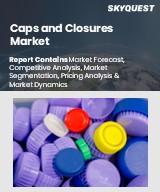
Caps and Closures Market
Report ID: SQMIG30E2046
Report ID: SQMIG30E2046
[email protected]
USA +1 351-333-4748
Report ID:
SQMIG30E2046 |
Region:
Global |
Published Date: June, 2025
Pages:
191
|Tables:
84
|Figures:
73


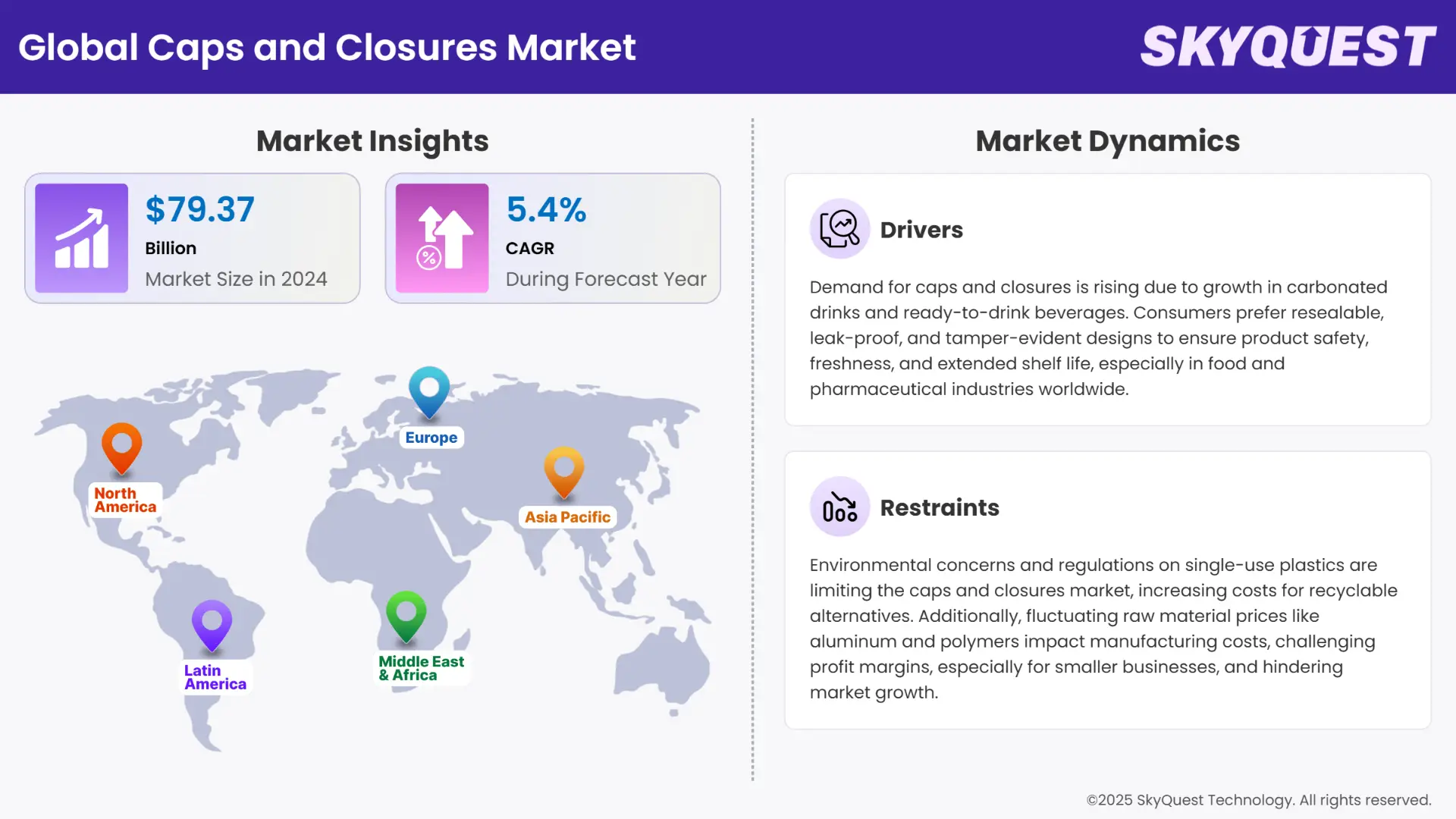
Global Caps and Closures Market size was valued at USD 79.37 Billion in 2024 and is poised to grow from USD 83.65 Billion in 2025 to USD 127.41 Billion by 2033, growing at a CAGR of 5.4% in the forecast period (2026–2033).
Numerous factors, such as the expansion of the packaging industry, a rise in industrial activity, population growth, and urbanization, are causing global caps and closures of market growth. The packaging industry is expanding due to the rising demand for both alcoholic and non-alcoholic beverages as well as a broad range of food items.
Caps and closures are crucial because they serve as barriers to protect the packaging contents from airborne contaminants and make dispensing easier. These packaging solutions are also widely used in many other industries, including healthcare, personal care, home care, and automotive. For instance, Kraft Heinz uses resealable caps on ketchup bottles to ensure product freshness after opening, and Mondelez International uses easy-to-open caps on cheese slices for convenient consumption.
Moreover, the increasing demand for caps and closures market is closely linked to the rapid urbanization of the United States. Urban consumers tend to favor convenient packaging options that are perfect for consuming food and beverages while on the go. According to the UN, 68% of people on Earth will reside in cities by 2050. Currently, over 80% of Americans reside in urban areas, according to the Brookings Institution. For fast-paced urban lifestyles, portability is crucial.
What Role Does AI Play in Ensuring Cap Quality and Precision?
The global caps and closures market outlook has been disrupted by AI. It primarily improves quality control, manufacturing efficiency, and sustainability. During high-speed manufacturing, AI-powered vision technologies are increasingly being used to detect minute flaws like fractures and deformations in caps. For example, the Italian packaging company Pelliconi introduced an AI-based inspection system in April 2024 that detects and eliminates defective caps in a timely manner. This reduces waste and improves overall product consistency. This practical illustration demonstrates how AI is simplifying processes while maintaining high standards of quality, particularly in sectors like beverages and pharmaceuticals where precise sealing and safety are crucial.
To get more insights on this market click here to Request a Free Sample Report
The global caps and closures market is segmented into material, product, application, and region. By material, the market is bifurcated into plastic and metal. Depending on product, it is classified into dispensing caps, screw closures, crown closures, and aerosol closures. According to the application, the market is divided into beverages, food, healthcare, personal care, home care, and industrial. Regionally, it is analyzed across North America, Europe, Asia-Pacific, Latin America, and the Middle East & Africa.
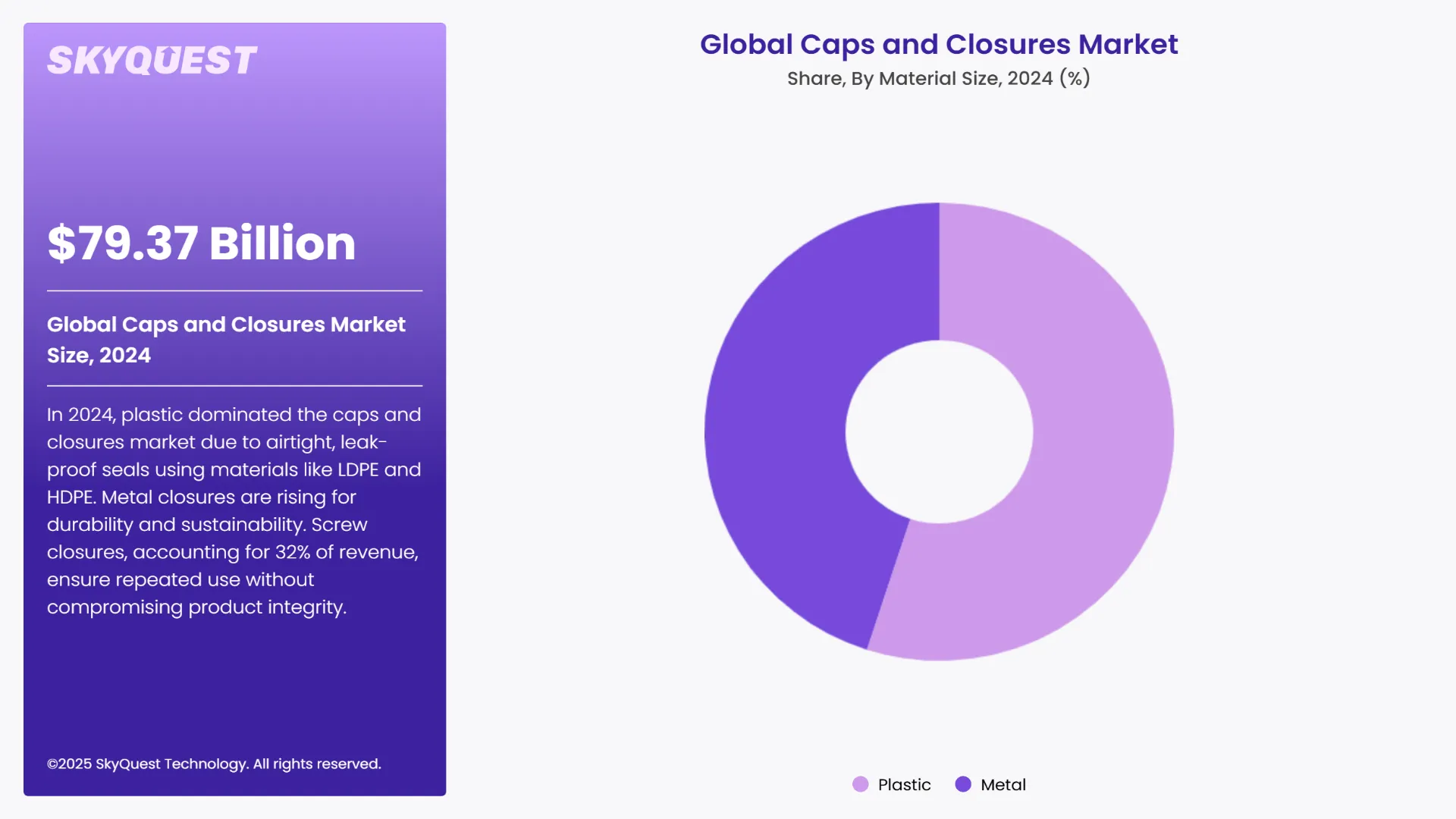
As per the 2024 global caps and closures market analysis, the plastic segment dominated the market. Plastic closures can be designed to create airtight, leak-proof seals that preserve product integrity and prevent spoiling. Certain plastic types, like Low-density Polyethylene (LDPE) and High-density Polyethylene (HDPE), offer good barrier qualities. This shows that due to their low permeability to gases and liquids, air and moisture cannot enter the package. Plasticizers and elastomers are examples of additives that can be added to plastic to improve its flexibility and create a more secure seal against the container's rim.
Screw-on plastic bottles commonly use tamper-evident rings, LDPE liners, and HDPE plastic to create a seal that prevents leaks and preserves beverage freshness. For instance, The Coca-Cola Company primarily uses HDPE to create plastic bottle bodies.
As metal is believed to be more durable and sustainable than plastic, it is gaining popularity in the caps and closures market. It is useful and environmentally friendly due to its strength and recyclability. As a result, metal closures are widely used in many different industries where secure sealing and long shelf life are crucial, including food cans, beverage glass bottles, and pharmaceutical containers.
Based on the 2024 global caps and closures market forecast, more than 32.0% of total revenue came from the screw closures segment. As screw closures are easy to screw on and off, they allow containers to be opened and closed repeatedly without compromising the integrity of the product. They can therefore be found in a wide range of goods, such as food, beverages, pharmaceuticals, and personal care products. Coca-Cola also began using tethered screw caps in 2021 to adhere to the EU's rule, which became operative in July 2024. These caps reduce litter and increase recyclability by remaining in the bottle.
A wide range of dispensing caps, such as pumps, triggers, and flip flops, are used in many end-use industries, such as the food, cosmetics, pharmaceutical, and automotive sectors. The segment is expected to grow more quickly due to the availability of various dispensing caps depending on the product being packaged, their ease of use, and the controlled flow of packaged goods.
To get detailed segments analysis, Request a Free Sample Report
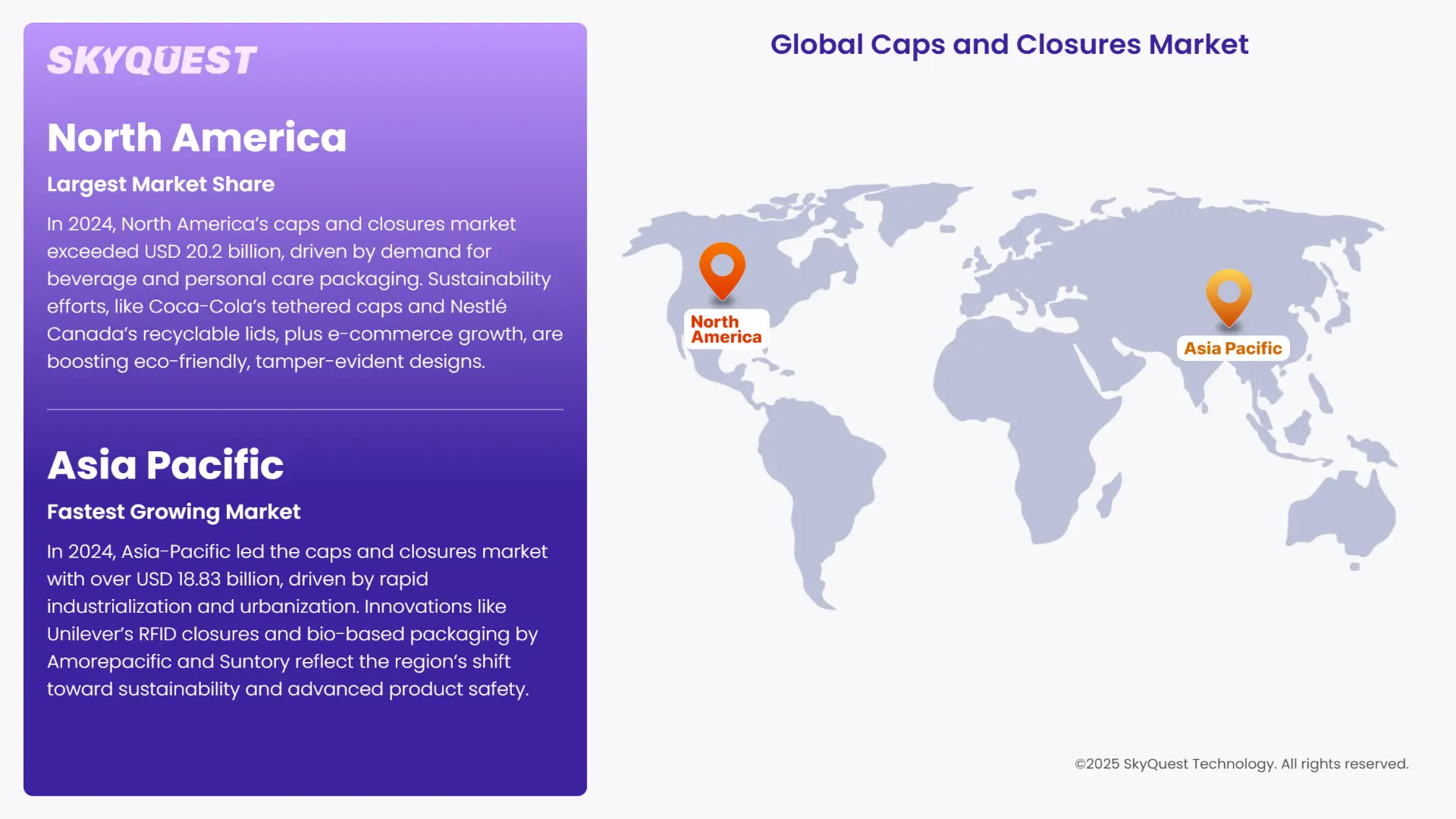
As per the 2024 caps and closures market regional forecast, the market in North America reached more than USD 20.2 billion. This was primarily due to the increased demand for drinks and personal care product packaging. In March 2024, Coca-Cola implemented tethered caps on several of its lines in the United States in an effort to reduce waste. This was in line with the most recent sustainability standards. The demand for clever and tamper-evident closures has increased due to the growth of e-commerce, which is changing packaging design throughout the region. Two of the most crucial elements in the market are still consumer demand for eco-friendly materials and brand-driven package innovation.
The US caps and closures market growth reached more than USD 20.2 billion in 2024 due to growing health consciousness and the desire for safe medication packaging. Pfizer and Berry Global collaborated in May 2024 to add closures that are safe for children and the elderly to its over-the-counter medications, making them safer and easier to obtain. This demonstrates the increasing trend toward utilitarian design in closed stores. Additionally, new products in the food, beverage, and healthcare sectors are still impacted by the need for recyclable materials and clever packaging solutions.
The increasing demand for beverages and medications is fueling Canada's caps and closures industry's steady expansion. In accordance with the government's ban on single-use plastic, Nestlé Canada began using 100% recyclable lids for its Pure Life water bottles in April 2024. Environmentally friendly closures that indicate when they have been tampered with are becoming more and more popular. This aligns with Canada's efforts to promote sustainability.
Asia-Pacific earned the largest caps and closures market share in 2024, with a value of more than USD 18.83 billion due to its rapid industrialization and consumption of packaged goods. In February 2025, Unilever introduced RFID-enabled closures to their personal care packaging in India to facilitate cleanliness monitoring. In emerging countries, where demand is driven by urbanization and lifestyle changes, growth is particularly robust. In keeping with sustainability trends and government initiatives to reduce plastic waste, the region is also shifting toward bio-based products.
The demand from the cosmetics industry keeps South Korea's caps and closures market growth robust despite a slowdown in manufacturing. In May 2025, Amorepacific began utilizing simple packaging with bio-based closures in an effort to attract environmentally conscious customers. This demonstrates how the nation's cosmetics industry is promoting environmentally friendly packaging design.
The growth of non-alcoholic drinks and health supplements contributed to the expansion of Japan's caps and closures market share, which is projected to be worth almost USD 3.21 billion in 2024. In January 2025, Suntory introduced tamper-evident caps composed of 30% plant-based resin. This was a significant step toward increasing the use of bio-resins and improving the safety of all of its beverages.
With an emphasis on sustainability and recyclability, the caps and closures market share in Europe is still expanding. In 2024, Germany alone generated more than USD 4.4 billion, and innovative concepts revolutionized various regions of the nation. Henkel In an effort to reduce the amount of single-use plastic, Germany installed reusable sealing devices at refill stations in June 2024. Regulations requiring environmentally friendly packaging are also being pushed by France and the UK. Manufacturers are investing in biodegradable, tethered, or recycled-content caps in response to pressure from the European Union to ensure compliance in numerous markets.
The UK caps and closures market demand is changing due to store closures and the rise in online shopping. Tesco added smart closures with freshness indicators to its ready-to-drink products in March 2025 to increase transparency. The market is becoming more and more interested in clever, tamper-proof caps that complement the online shopping trend, even though the precise numbers are still low when compared to Germany or France.
In 2024, the French caps and closures market size was valued at approximately USD 1.47 billion. Danone In response to increasing consumer and regulatory demand, France is embracing circular packaging concepts, as evidenced by its use of 100% recycled plastic tops for Evian water bottles in September 2024.
In 2024, the value of the German caps and closures market growth is USD 4.4 billion. This is a result of the nation's robust industrial base and strict sustainability regulations. Reusable product containers with reusable closure systems were introduced in retail locations in June 2024 as part of Henkel's larger "less plastic" strategy. Closures are crucial for achieving waste reduction objectives because of this.
To know more about the market opportunities by region and country, click here to
Buy The Complete Report
Rise in Demand in Beverage Industry
Increase in the Focus on Product Safety and Extending Shelf Life
Concerns Regarding the Environment and Plastic Waste
Fluctuations in Raw Material Prices
Request Free Customization of this report to help us to meet your business objectives.
Although there are large companies in the region as well as globally, the caps and closures industry are somewhat fragmented. AptarGroup and Berry Global concentrate on developing new products, while Silgan Holdings concentrates on purchasing other businesses to expand its operations. Lightweight and recyclable closures are important to Bericap and Closure Systems International. These businesses assist large pharmaceutical and beverage companies, such as Pfizer and Coca-Cola, in ensuring that their closures satisfy sustainability, safety, and branding standards.
Switch to Long-Lasting, Recyclable Materials
Combining Intelligent and Tamper-Proof Features
SkyQuest’s ABIRAW (Advanced Business Intelligence, Research & Analysis Wing) is our Business Information Services team that Collects, Collates, Correlates, and Analyses the Data collected by means of Primary Exploratory Research backed by robust Secondary Desk research.
As per SkyQuest analysis, due to rising beverage consumption, increased health consciousness, and consumer demand for long lasting and safe products, the caps and closures market are expanding steadily. Screw closures are still widely used because they are simple to use and effectively seal objects. However, there are issues because raw material prices fluctuate, and environmental concerns are raised. Manufacturers are spending more on environmentally friendly, recyclable, and intelligent closures in order to remain competitive. To meet new regulations and consumer demands, industry leaders are developing fiber-based, tethered, and tamper-evident solutions. As eco-friendly substitutes and smart packaging gain traction, the market is poised to change. Sustainability and technology will influence closures in important end-user sectors in the future.
| Report Metric | Details |
|---|---|
| Market size value in 2024 | USD 79.37 Billion |
| Market size value in 2033 | USD 127.41 Billion |
| Growth Rate | 5.4% |
| Base year | 2024 |
| Forecast period | 2026–2033 |
| Forecast Unit (Value) | USD Billion |
| Segments covered |
|
| Regions covered | North America (US, Canada), Europe (Germany, France, United Kingdom, Italy, Spain, Rest of Europe), Asia Pacific (China, India, Japan, Rest of Asia-Pacific), Latin America (Brazil, Rest of Latin America), Middle East & Africa (South Africa, GCC Countries, Rest of MEA) |
| Companies covered |
|
| Customization scope | Free report customization with purchase. Customization includes:-
|
To get a free trial access to our platform which is a one stop solution for all your data requirements for quicker decision making. This platform allows you to compare markets, competitors who are prominent in the market, and mega trends that are influencing the dynamics in the market. Also, get access to detailed SkyQuest exclusive matrix.
Table Of Content
Executive Summary
Market overview
Parent Market Analysis
Market overview
Market size
KEY MARKET INSIGHTS
COVID IMPACT
MARKET DYNAMICS & OUTLOOK
Market Size by Region
KEY COMPANY PROFILES
Methodology
For the Caps and Closures Market, our research methodology involved a mixture of primary and secondary data sources. Key steps involved in the research process are listed below:
1. Information Procurement: This stage involved the procurement of Market data or related information via primary and secondary sources. The various secondary sources used included various company websites, annual reports, trade databases, and paid databases such as Hoover's, Bloomberg Business, Factiva, and Avention. Our team did 45 primary interactions Globally which included several stakeholders such as manufacturers, customers, key opinion leaders, etc. Overall, information procurement was one of the most extensive stages in our research process.
2. Information Analysis: This step involved triangulation of data through bottom-up and top-down approaches to estimate and validate the total size and future estimate of the Caps and Closures Market.
3. Report Formulation: The final step entailed the placement of data points in appropriate Market spaces in an attempt to deduce viable conclusions.
4. Validation & Publishing: Validation is the most important step in the process. Validation & re-validation via an intricately designed process helped us finalize data points to be used for final calculations. The final Market estimates and forecasts were then aligned and sent to our panel of industry experts for validation of data. Once the validation was done the report was sent to our Quality Assurance team to ensure adherence to style guides, consistency & design.
Analyst Support
Customization Options
With the given market data, our dedicated team of analysts can offer you the following customization options are available for the Caps and Closures Market:
Product Analysis: Product matrix, which offers a detailed comparison of the product portfolio of companies.
Regional Analysis: Further analysis of the Caps and Closures Market for additional countries.
Competitive Analysis: Detailed analysis and profiling of additional Market players & comparative analysis of competitive products.
Go to Market Strategy: Find the high-growth channels to invest your marketing efforts and increase your customer base.
Innovation Mapping: Identify racial solutions and innovation, connected to deep ecosystems of innovators, start-ups, academics, and strategic partners.
Category Intelligence: Customized intelligence that is relevant to their supply Markets will enable them to make smarter sourcing decisions and improve their category management.
Public Company Transcript Analysis: To improve the investment performance by generating new alpha and making better-informed decisions.
Social Media Listening: To analyze the conversations and trends happening not just around your brand, but around your industry as a whole, and use those insights to make better Marketing decisions.
REQUEST FOR SAMPLE
 REQUEST FREE CUSTOMIZATION
Global Caps and Closures Market size was valued at USD 79.37 Billion in 2024 and is poised to grow from USD 83.65 Billion in 2025 to USD 127.41 Billion by 2033, growing at a CAGR of 5.4% in the forecast period (2026–2033).
Berry Global Inc., AptarGroup Inc., Silgan Holdings Inc., Amcor Plc, RPC Group Plc, Crown Holdings Inc., Bericap GmbH & Co. KG, Closure Systems International Inc., Guala Closures Group, O.Berk Company LLC, Cap & Seal Pvt. Ltd., Albea S.A., Plastmass Group, Tetra Pak International S.A., Comar LLC
The key driver of the caps and closures market is the growing demand for packaged beverages, food, and pharmaceutical products, which requires secure, convenient, and tamper-evident sealing solutions to ensure product safety, freshness, and extended shelf life.
A key market trend in the caps and closures market is the increasing adoption of sustainable and recyclable materials, such as bioplastics and aluminum, along with innovative designs that improve functionality, ease of use, and product differentiation for consumers.
North America accounted for the largest share in the Caps and Closures Market due to strong demand from the food & beverage, pharmaceutical, and personal care industries, coupled with a well-established packaging sector. Increasing consumption of packaged products, stringent product safety requirements, and growing adoption of innovative and sustainable closure solutions further support regional market dominance.


Want to customize this report? This report can be personalized according to your needs. Our analysts and industry experts will work directly with you to understand your requirements and provide you with customized data in a short amount of time. We offer $1000 worth of FREE customization at the time of purchase.
Feedback From Our Clients


 USA (+1) 351-333-4748

