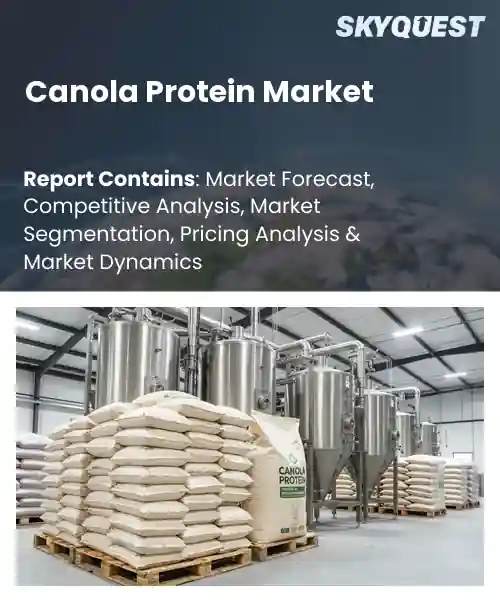
Canola Protein Market
Report ID: SQMIG30I2990
Report ID: SQMIG30I2990
[email protected]
USA +1 351-333-4748
Report ID:
SQMIG30I2990 |
Region:
Global |
Published Date: July, 2026
Pages:
157
|Tables:
173
|Figures:
79


Global Canola Protein Market size was valued at USD 487.3 Million in 2024 and is poised to grow from USD 533.11 Million in 2025 to USD 1093.84 Million by 2033, growing at a CAGR of 9.4% during the forecast period (2026-2033).
The market for canola protein globally has resulted from a wider effort to adopt sustainable plant-based ingredients, and the major driving factor has been the increasing demand for low-environmental impact proteins. The canola protein obtained from the defatted meal of the oilseed provides a balanced profile of amino acids and is associated with reduced greenhouse gas emissions compared to most animal proteins. In the past, the ingredient was mostly used in feed production for livestock, but developments in the fractionation process in the early 2010s made isolates that could be used for human consumption possible.
The major driver of the global market for canola protein is the growing acceptance by regulators of plant-based dietetics and subsequent business uptake. With increasing limitations set on emissions from livestock farming, companies are forced to substitute proteins derived from animals with more sustainable forms of proteins; and here canola protein fills the bill because it has emulsifying and water-binding qualities. The result is investments by companies such as Archer Daniels Midland Company in the production of canola protein isolate for hamburgers and the use of canola protein by pet food manufacturers to conform to labeling regulations.
How is AI-driven Automation Shaping Product Development in the Global Canola Protein Market?
AI powered automation in product development within the global canola protein industry is changing the way data science and bioprocessing work together. Machine learning helps predict functional properties of canola protein isolates, helping researchers to focus on desired texture, solubility, and taste from the early stages of designing. Extraction processes use automation in real time, which helps monitor and regulate temperature and pH, enabling reliable and high purity batches to be produced faster, with fewer trials needed. Workflow tools enable formulation testing to relate to supply chain forecast, making it easy to scale up novel ingredients production. All these features help make product development quicker, less expensive, and more efficient in meeting demands of consumers for plant-based proteins.
Market snapshot - (2026-2033)
Global Market Size
USD 487.3 Million
Largest Segment
Canola Protein Concentrates
Fastest Growth
Hydrolyzed Canola Proteins
Growth Rate
9.4% CAGR
To get more insights on this market click here to Request a Free Sample Report
Global canola protein market is segmented by product type, application, form, end user, nature, distribution channel and region. Based on product type, the market is segmented into Canola Protein Isolates, Canola Protein Concentrates, Hydrolyzed Canola Proteins and Others. Based on application, the market is segmented into Food & Beverages, Animal Nutrition, Sports Nutrition and Others. Based on form, the market is segmented into Powder, Liquid and Others. Based on end user, the market is segmented into Food Manufacturers, Feed Manufacturers, Nutraceutical Companies and Others. Based on nature, the market is segmented into Conventional and Organic. Based on distribution channel, the market is segmented into Direct Sales, Distributors and Others. Based on region, the market is segmented into North America, Europe, Asia Pacific, Latin America and Middle East & Africa.
Canola Protein Isolates segment is leading because this segment provides the maximum level of protein purity that satisfies functional demands of food manufacturers along with clean label claims. Due to its excellent solubility and neutral taste, this segment can easily blend with dairy substitutes, meat replacements, and high protein snacks, resulting in its dominance in the market. Formulators prefer isolating segments to satisfy their nutritional demands and texture, which also emphasizes the significance of this segment in market evolution.
The Hydrolyzed Canola Proteins segment has gained momentum due to its pre-digested peptides which improve the digestibility and functionality of products made with the help of such proteins, especially sports and clinical nutrition products. Consumers’ increased concern about digestive health and recovery time boosts the growth of this segment.
The Powder form segment is leading in market share since it provides the most flexible delivery system which allows manufacturers to introduce the protein from canola into dry mixes, bakery formulations, and fortified flour without any major changes in processing. The stability during transportation and easy dosing is consistent with the efficient manufacturing process. Therefore, formulators opt for powders to ensure that their protein level meets requirements while maintaining sensory characteristics in a broad spectrum of applications.
The Liquid form segment, in turn, is a high growth opportunity due to the possibility of blending the canola protein into beverage systems, functional beverages, and protein shakes easily and without any significant reformulations. Consumer demand and necessity for processing drive this segment's growth.
To get detailed segments analysis, Request a Free Sample Report
North America emerges as the frontrunner in the worldwide canola protein market owing to a well-developed agricultural base, established infrastructure for production, and high levels of consumer acceptance of plant protein sources. A well-established supply chain links growers with modern facilities where protein is extracted in a quality manner, and sufficient quantities are provided. The regulatory environment in the U.S. and Canada is supportive of innovation but does not overlook the issues of food safety, allowing products to be developed at an accelerated pace. Consumers from the region have a high awareness level regarding sustainability and nutrition, spurring demand from the foodservice, ingredients, and supplement markets.
Canola Protein Market in the US has the advantage of having large acreages of canola as well as bioprocessing plants that make it possible to extract the protein at a low cost. The consumer preference for clean labels and high protein foods creates a conducive environment for the usage of ingredients in snacks, meat alternatives, and baking products. Universities and companies' joint research are aimed at improving solubility and texture.
Canada Canola Protein Market benefits from a well-established canola farming industry as well as research efforts that promote innovation in protein separation technology. With the growing interest in sustainability, it is in line with the trend towards environmental responsibility in ingredients, making it favorable for the inclusion in plant-based meat and dairy substitutes. Cooperation with agricultural cooperatives and food producers enables seamless integration into the supply chain with lower process complications.
The European market for canola protein is shaped by strong sustainability considerations, innovative food technologies, and rising consumer demand for plant-based proteins. EU regulatory systems support the development of new protein ingredients while maintaining safety standards and proper labeling. Food manufacturers find it useful to utilize the flexibility of canola protein for creating natural products featuring desired texture in plant-based foods. Research partnerships among universities, ingredient suppliers, and chefs develop innovative processes that increase solubility and sensory characteristics. Policies regarding the use of local plant-based proteins in Germany and the UK foster resilience in supply chains. Marketing activities educate consumers about the health and ecological advantages of plant-based proteins, boosting their adoption in regular retail environments.
Germany Canola Protein Market relies on the strong agricultural background and the sustainable policy of using locally produced plant proteins. Manufacturers leverage the characteristics of canola protein to produce high-protein snacks and meat alternatives that are following the clean-label regulations. Collaborative efforts among the research institutions and raw material suppliers are focused on increasing efficiency and improving texture of canola protein for increased usage in both retail and food service industries.
Canola Protein Market in the United Kingdom is characterized by rapid growth owing to flourishing ecosystems for innovation of plant-based foods and robust demand for sustainable sources of protein among consumers. New ventures as well as established companies include canola protein in meat-free, dairy-free, and functional drinks formulations to satisfy clean-label requirements. Low-carbon ingredient development through governmental incentives fosters innovation partnerships leading to better functionality such as emulsification and water binding. The new products are rapidly adopted by retailers due to growing interest from consumers.
Canola Protein Market in France is gaining momentum with food companies seeking other sources of protein for developing their products to complement clean-eat approaches adopted by the country. Canola protein is appreciated among chefs and food formulators because of its neutral taste profile and wide-ranging applications in adding nutritional value to bakery, snacks, and dairy-free foods. Joint efforts of agronomic research institutes and ingredient suppliers concentrate on enhancing the processability of canola protein, namely improving solubility and texture.
Asia Pacific has been building up its reputation in the canola protein industry due to a series of developments that include the expansion of agricultural production capacity, food security initiatives, and the growing interest of consumers in protein from plants. In particular, Japan and South Korea focus on scientific research to improve the suitability of canola protein for demanding applications including meat substitutes and drinks, which requires the application of highly sophisticated processing techniques. Alternative protein promotion programs run by the government fit within the overall agenda of sustainability and provide funding to pilot and scale-up activities. Increasing populations in urban areas along with changing food preferences generate a need for protein-rich products that are easy to prepare and consume, motivating food producers to use canola protein in their product formulations.
Market for Canola Protein in Japan is positively affected by the presence of excellent research organizations and a food culture that favors delicate tastes. The protein is suitable for inclusion in many products due to its suitability in this regard. Food processors have been using the protein to develop meat alternatives, drinks, and noodles in response to consumers' needs for healthy convenient foods. The government has encouraged collaboration between bio-tech companies and ingredient suppliers through incentives for development of sustainable ingredients.
Development of Canola Protein Market in South Korea takes place with the help of research and development focused on snacks that are rich in proteins and drinks that do not contain any milk, thus satisfying the needs of conscious consumers. Collaboration with universities facilitates quicker advancement in technology that improves emulsification and texture and is suitable for the taste preferences of local consumers. Financial aid from the government for alternative protein use helps launch production.
To know more about the market opportunities by region and country, click here to
Buy The Complete Report
Increasing Consumer Demand for Plant Protein
The consumers’ growing preference for healthful and sustainable proteins has led to changes in their buying habits towards plant-based proteins, and canola protein meets such expectations owing to its balanced amino acid composition and reduced allergenicity. In turn, the food companies are implementing canola protein into various food products, thus enhancing their visibility and setting up a cycle of innovation and acceptance on both sides. The increased demand in canola proteins is driving technological investments and distribution efforts, contributing to rapid market growth across different geographic areas and market segments.
Expanding Foodservice Applications leveraging Canola Protein
Foodservices are always on the hunt for economical and nutritive ingredients to satisfy changing menu trends, and canola protein offers them a flexible ingredient for bakery, non-dairy, and meat alternative formulations. Through utilization of its unique attributes like emulsion formation and water-binding, the chef is able to improve texture and taste, and also achieve clean-label declarations. Such flexibility drives acceptance among foodservices such as restaurants, catering companies, and institutions leading to consistent demand that drives scale up in production and encourages innovation of new uses.
Regulatory Uncertainty Around Novel Ingredients
The regulation regimes of novel ingredients are different throughout various regions, and the use of canola protein usually relates to ingredients that do not have an established approval process. This issue forces companies to spend more time on certification processes and testing, thus prolonging the product development process. It can become a serious barrier in the product development process and prevent new products from being developed. As a result, companies are likely to focus on ingredients that have already been approved, and, hence, reduce the adoption of canola protein.
Supply Chain Constraints Limiting Availability
Production of rapeseed in the world, which serves as the main ingredient in canola protein, is exposed to climatic changes, pest challenges, and rising prices in the commodities market, resulting in unreliable supply of the raw material. The drop in yield results in low feedstock availability, causing increased delivery time and procurement expenses. This poses challenges for the companies to produce the canola protein regularly, compelling them to use other sources as substitutes. This affects market access and slows down the process of new product launches.
Request Free Customization of this report to help us to meet your business objectives.
The competition scenario of the international market for canola protein is one where there is intense competition among the providers of ingredients and food producers with firms increasing their growth through M&A and technology-driven innovations in the form of joint ventures. Recent instances include collaboration between an agri-business firm and a plant protein specialist firm to develop canola protein isolates rich in protein and acquisitions of a canola protein start-up by a food conglomerate to grow its sustainable protein portfolio.
Protein-Friendly Formulations: Companies are now creating various consumer goods that contain canola proteins, taking advantage of their neutral flavor and versatility in functionality. These changes are motivated by the increasing need for healthier, hypoallergenic products, as well as the need to cut back on using soy and pea isolates. With companies testing new tastes and nutritional value, canola protein is making its way into baked goods, milk substitutes, and even meat products, among other uses.
Sustainable Supply Initiatives: Partnerships are being made by industry stakeholders with canola farmers that will ensure responsible sourcing with the emphasis on low input farming and traceability. Such partnerships are aimed at lowering the carbon footprint by using efficient land use, effective pest management, and renewable energy in processing plants. Through such partnerships that comply with sustainability standards and reporting, the producers create value for their brands as well as satisfy consumers' requirements of responsible production of protein.
SkyQuest’s ABIRAW (Advanced Business Intelligence, Research & Analysis Wing) is our Business Information Services team that Collects, Collates, Correlates, and Analyses the Data collected by means of Primary Exploratory Research backed by robust Secondary Desk research.
As per SkyQuest analysis, the global canola protein market will be driven mainly by an increase in consumers’ preference for eco-friendly plant-based proteins, encouraging innovation in products. The second key factor driving growth in the market is the increasing use of canola protein in food service industry, owing to the functionalities of canola protein such as emulsification and water-binding properties which help in creating affordable menu items. North America continues to lead the global market due to the presence of developed agricultural and processing infrastructure and consumers’ inclination towards such products. The canola protein isolates segment leads to the market due to higher purity and functionality provided by isolates.
| Report Metric | Details |
|---|---|
| Market size value in 2024 | USD 487.3 Million |
| Market size value in 2033 | USD 1093.84 Million |
| Growth Rate | 9.4% |
| Base year | 2024 |
| Forecast period | (2026-2033) |
| Forecast Unit (Value) | USD Million |
| Segments covered |
|
| Regions covered | North America (US, Canada), Europe (Germany, France, United Kingdom, Italy, Spain, Rest of Europe), Asia Pacific (China, India, Japan, Rest of Asia-Pacific), Latin America (Brazil, Rest of Latin America), Middle East & Africa (South Africa, GCC Countries, Rest of MEA) |
| Companies covered |
|
| Customization scope | Free report customization with purchase. Customization includes:-
|
To get a free trial access to our platform which is a one stop solution for all your data requirements for quicker decision making. This platform allows you to compare markets, competitors who are prominent in the market, and mega trends that are influencing the dynamics in the market. Also, get access to detailed SkyQuest exclusive matrix.
Table Of Content
Executive Summary
Market overview
Parent Market Analysis
Market overview
Market size
KEY MARKET INSIGHTS
COVID IMPACT
MARKET DYNAMICS & OUTLOOK
Market Size by Region
KEY COMPANY PROFILES
Methodology
For the Canola Protein Market, our research methodology involved a mixture of primary and secondary data sources. Key steps involved in the research process are listed below:
1. Information Procurement: This stage involved the procurement of Market data or related information via primary and secondary sources. The various secondary sources used included various company websites, annual reports, trade databases, and paid databases such as Hoover's, Bloomberg Business, Factiva, and Avention. Our team did 45 primary interactions Globally which included several stakeholders such as manufacturers, customers, key opinion leaders, etc. Overall, information procurement was one of the most extensive stages in our research process.
2. Information Analysis: This step involved triangulation of data through bottom-up and top-down approaches to estimate and validate the total size and future estimate of the Canola Protein Market.
3. Report Formulation: The final step entailed the placement of data points in appropriate Market spaces in an attempt to deduce viable conclusions.
4. Validation & Publishing: Validation is the most important step in the process. Validation & re-validation via an intricately designed process helped us finalize data points to be used for final calculations. The final Market estimates and forecasts were then aligned and sent to our panel of industry experts for validation of data. Once the validation was done the report was sent to our Quality Assurance team to ensure adherence to style guides, consistency & design.
Analyst Support
Customization Options
With the given market data, our dedicated team of analysts can offer you the following customization options are available for the Canola Protein Market:
Product Analysis: Product matrix, which offers a detailed comparison of the product portfolio of companies.
Regional Analysis: Further analysis of the Canola Protein Market for additional countries.
Competitive Analysis: Detailed analysis and profiling of additional Market players & comparative analysis of competitive products.
Go to Market Strategy: Find the high-growth channels to invest your marketing efforts and increase your customer base.
Innovation Mapping: Identify racial solutions and innovation, connected to deep ecosystems of innovators, start-ups, academics, and strategic partners.
Category Intelligence: Customized intelligence that is relevant to their supply Markets will enable them to make smarter sourcing decisions and improve their category management.
Public Company Transcript Analysis: To improve the investment performance by generating new alpha and making better-informed decisions.
Social Media Listening: To analyze the conversations and trends happening not just around your brand, but around your industry as a whole, and use those insights to make better Marketing decisions.
REQUEST FOR SAMPLE
 REQUEST FREE CUSTOMIZATION
Global Canola Protein Market size was valued at USD 487.3 Million in 2024 and is poised to grow from USD 533.11 Million in 2025 to USD 1093.84 Million by 2033, growing at a CAGR of 9.4% during the forecast period (2026-2033).
The competitive landscape of the global canola protein market is shaped by intense rivalry among ingredient suppliers and food manufacturers, with companies accelerating growth through strategic M&A, joint ventures, and technology‑driven product innovation. Recent examples include a partnership between a leading agribusiness and a plant‑based protein specialist to co‑develop high‑protein canola isolates, and the acquisition of a niche canola‑protein startup by a major food conglomerate to expand its sustainable protein portfolio. These moves reflect a focus on securing supply chains, enhancing processing efficiency, and diversifying applications across meat alternatives, dairy‑free products, and functional foods. 'Burcon NutraScience Corporation', 'Merit Functional Foods Corporation', 'DSM-Firmenich AG', 'Cargill, Incorporated', 'Bunge Global SA', 'Louis Dreyfus Company B.V.', 'Roquette Frères S.A.', 'Ingredion Incorporated', 'Archer Daniels Midland Company', 'The Scoular Company', 'CanMar Foods Ltd.', 'Botaneco Inc.', 'Nuseed Global', 'Protein Industries Canada', 'SunOpta Inc.', 'Kerry Group plc', 'Beneo GmbH', 'Axiom Foods, Inc.', 'Cosucra Groupe Warcoing SA', 'AIDP, Inc.'
Consumer preference for healthier, sustainable protein sources is shifting purchasing behavior toward plant‑based alternatives, and canola protein aligns with these expectations due to its favorable amino acid profile and low allergenicity. Food manufacturers respond by incorporating canola protein into a variety of products, which expands market visibility and creates a positive feedback loop of product innovation and consumer acceptance. This growing demand fuels investment in processing technologies and encourages broader distribution channels, thereby accelerating overall market expansion across multiple geographic regions and diverse consumer segments.
Protein-Friendly Formulations: Manufacturers are reformulating a broad range of consumer products to incorporate canola protein as a clean‑label, plant‑based alternative, leveraging its neutral taste and functional versatility. This shift is driven by rising consumer demand for healthier, allergen‑free options and the desire to reduce reliance on soy and pea isolates. As food processors experiment with novel textures and nutritional profiles, canola protein is gaining traction in baked goods, dairy alternatives, and meat analogues, expanding its market presence across multiple categories globally today.
Why does North America Dominate the Global Canola Protein Market? |@12


Want to customize this report? This report can be personalized according to your needs. Our analysts and industry experts will work directly with you to understand your requirements and provide you with customized data in a short amount of time. We offer $1000 worth of FREE customization at the time of purchase.
Feedback From Our Clients


 USA (+1) 351-333-4748

