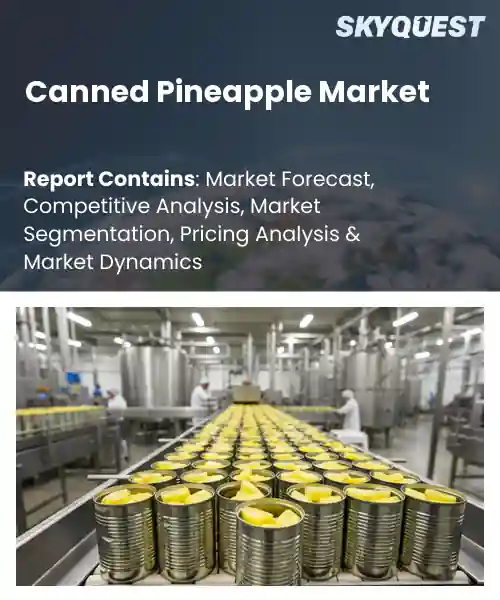
Canned Pineapple Market
Report ID: SQMIG30I2848
Report ID: SQMIG30I2848
[email protected]
USA +1 351-333-4748
Report ID:
SQMIG30I2848 |
Region:
Global |
Published Date: February, 2026
Pages:
157
|Tables:
147
|Figures:
78


Global Canned Pineapple Market size was valued at USD 2.54 Billion in 2024 and is poised to grow from USD 2.66 Billion in 2025 to USD 3.81 Billion by 2033, growing at a CAGR of 4.6% during the forecast period (2026-2033).
Growing demand for convenient fruit products, rising preference for ready-to-use ingredients, increasing consumption of processed foods, advancements in preservation technologies, and expansion of global food supply chains are driving sales of canned pineapple.
Transformation of pineapple from a seasonal product to a perennial product, as ensured by developments in canning techniques and expansion of global supply chain networks by key exporting countries such as the Philippines and Thailand, has added further robustness to market stability. Increased consumption of canned pineapple in ready-to-eat products, sauces, and beverages, along with baked goods, has added significantly to its acceptability by food manufacturers. Increased emphasis on minimizing food waste and labor costs, along with demand for quality products, is also likely to contribute positively to demand for canned pineapple. Growing demand for convenient and shelf-stable fruit options among consumers around the world coupled with the shift toward ready-to-use ingredients is expected to primarily drive canned pineapple market growth. The availability of canned pineapple in multiple formats such as slices, chunks, crushed, and juice-packed products for retail, foodservice, and industrial applications is also promoting consumption of canned pineapple.
On the contrary, fluctuations in raw material supply, price volatility, concerns regarding preservatives and sugar content, environmental impact of metal packaging, and competition from fresh and frozen fruit alternatives are predicted to slow down canned pineapple market penetration going forward.
How is AI Optimizing Supply Chain Forecasting for the Canned Pineapple Market?
Artificial intelligence is helping in the improvement of supply chain forecasting for the canned pineapple industry. This is achieved by incorporating various forms of data, such as demand trends, weather patterns, crop production, and retail activities. This enables the generation of precise short-term and seasonal forecasts for the industry. Machine learning technologies are used for predicting harvest timing and any fluctuations in supply based on retail sales and satellite-based data. Cloud-based traceability and predictive analytics platforms are being increasingly used for responding to changes in crops and trade activities.
In June 2025, Dole announced price increases for canned pineapple, highlighting supply pressure in the market. AI-driven forecasting helps producers better align procurement and processing with expected yields and demand, reducing excess inventory and improving shipment timing to retailers. This increases efficiency and helps stabilize supply.
Market snapshot - (2026-2033)
Global Market Size
USD 2.54 Billion
Largest Segment
Slices
Fastest Growth
Crushed
Growth Rate
4.6% CAGR
To get more insights on this market click here to Request a Free Sample Report
Global canned pineapple market is segmented by product type, packaging type, end use, formulation, distribution channel, and region. Based on product type, the market is segmented into slices, chunks, crushed, and others. Based on packaging type, the market is segmented into cans, pouches, tetra packs, and others. Based on end use, the market is segmented into household / retail consumption, bakery & confectionery, dairy & desserts, foodservice / HoReCa, beverage industry, and others. Based on formulation, the market is segmented into conventional and organic. Based on distribution channel, the market is segmented into retail and online. Based on region, the market is segmented into North America, Europe, Asia Pacific, Latin America, and Middle East & Africa.
The slices segment is projected to account for the highest global canned pineapple market share in the future consumers and manufacturers prefer whole ring aesthetics and portioning that fit into retail display, ready-to-eat, and culinary usage. The consistency of these products makes quality control and label management easier, allowing for premiumization and procurement partnerships. The consistency of these products makes quality control and label management easier, allowing for premiumization and procurement partnerships.
However, chunks are emerging as the most rapidly expanding segment as per this canned pineapple industry analysis. Increasing demand for convenience and multifunctional uses in mixed dishes and ready meals creates new opportunities via this segment. Their ‘ready to use’ form facilitates quicker market penetration in foodservice and industrial applications, and innovation in their flavorings and brine varieties is creating new market opportunities. This is creating a positive market trend for future growth.
The cans segment is slated to lead the global canned pineapple market revenue generation across the study period. Conventional metal-based packaging solutions have demonstrated their effectiveness in preserving products, allowing for efficient stacking, and facilitating cost-effective large batch processing, which is highly valued by manufacturers and retailers alike. The robustness of this type of packaging further adds impetus to large-scale procurements and distribution, which in turn adds credibility to the overall efficiency of product safety and quality, thereby maintaining market penetration and category leadership.
Meanwhile, pouches are seeing the strongest growth momentum, and flexible formats are benefiting from single-serve convenience, lighter transport weights, and on-the-go consumption patterns. They provide resealability and innovative portion control solutions that are appealing to online consumers and create opportunities for brands to explore flavored fillings and premium positionings, and access non-traditional retail channels and end-use applications.
To get detailed segments analysis, Request a Free Sample Report
The region is in a commanding position to dominate global canned pineapple demand due to the abundant supply of tropical fruits, processing infrastructure, and proximity of production areas and major consumer centers. There is a constant availability of raw materials for growers, packers, and exporters because of their strong supply chain. The established canned goods distribution systems provide both mainstream and premium product offerings to the end-users in the Asia Pacific Region. Scale efficiencies are created via competitive cost structures and collaboration with multinational companies on an international scale (i.e., distribution networks). Improvement of lead time and placement on store shelves due to enhancements in quality control, new ideas for flavor and package design, and convenient logistics have solidified the Asia Pacific Region as a leading supplier of canned pineapple products as well as a rapidly expanding consumer base for canned pineapple.
High preference for premium and ready-to-eat products, along with small format packaging, is aiding the growth of canned pineapple consumption in Japan. Also, high-end retail outlets and consumers who are demanding and seeking high-quality and safe products are driving the sales of canned pineapple. High emphasis on innovation, seasonal flavor profiles, and partnerships with foodservice companies ensures year-round consumption of canned pineapple in the country.
Canned pineapple demand in South Korea is driven by demand for convenient forms, snacking, and fusion foods. The segment is driven by robust retail channels and rising demand from young urban consumers. Manufacturers are placing more emphasis on modern packaging, flavor innovation, and partnerships with local food brands. At the same time, robust demand from the foodservice segment for easy-to-use ingredients and co-branding is driving expansion, quality, efficiency, and sustainability.
Changing lifestyles of consumers, which emphasize convenience, multi-purpose use of ingredients, and international flavors, contribute positively to the sales of canned pineapple in North America. Increased awareness of the retail segment and the private label manufacturers offers consumers with a variety of products and packaging according to their needs, especially for consumers who want products to take on the go and meal kits. They are providing consumers with a variety of products and packaging according to their needs, especially for consumers who want products to take on the go and meal kits. Foodservice and QSR segments are increasingly using canned pineapple products to create menus that combine international and mainstream products. These are stimulating steady demand for the category. Partnerships are being built with international processors to ensure the diversity of imports. Marketing efforts are being directed toward the versatility of the category for baking, grilling, beverages, and prepared meal applications. In addition, the popularity of clean label sourcing is also being driven.
Presence of supermarkets and e-commerce platforms allow wide accessibility to canned pineapple products in the United States. Demand is strong in food service, home baking, and beverage areas and is driven by growth in private label items and ongoing innovation in brands. Marketers are also communicating product versatility through recipe ideas, grilling, and cocktail use, as well as health and wellness benefits. This strategy is helping to revitalize product shelf presence and increase use among both core consumers and new demographic groups looking for convenient and flavorful pantry items across the country.
Multicultural culinary styles and the demand for convenient fruit ingredients are contributing factors to the demand for canned pineapple in Canada. Various forms of packaging of canned pineapple products are available from retailers, including bulk packs and individual servings. The focus is on transparency and sustainable production methods. Partnerships are being developed with food processors and bakeries for the use of canned pineapple. Marketing is being done for consumers in urban areas.
Emphasis on product differentiation, stringent quality and safety standards, and a focus on sustainable sourcing are shaping canned pineapple sales in Europe. Retail groups and private labels look for reliable partners who can provide quality and packaging suitable for various consumption patterns, from baking and confectionery to ready meals and snacks. Working closely with both importers and processors helps broaden assortment and better manage seasonal fluctuations. Marketing activities also highlight the origins of canned pineapple and its varied uses. Greater links with foodservice and private labels help the region capture not only the mass market but also more profitable specialty markets, further strengthening its competitive and resilient position in canned pineapple. Additionally, logistics improvements and collaborative sourcing models help respond better to evolving retailer requirements in various countries.
High consumer preference for high quality, reliable sourcing, and sustainability certifications shapes canned pineapple consumption in Germany. Retailers stock a range of own-label and branded products. Discounters influence price and format strategies. Premium and organic products cater to the high-end market. Good foodservice sales are essential for reliable ingredient supplies, which in turn gives good supplier relationships. Innovation in packaging, dual-use packaging, and recipe-based merchandising ensures ongoing relevance to both culinary and convenience-focused consumers.
Diverse usage of canned pineapple across home cooking, bakery, desserts, and pub and restaurant menus is shaping market development in United Kingdom. Private label products are also offered to complement the innovation of the brands. Trade channels are also focused on convenience, ease of preparation, and communicating the story of sourcing and sustainability. This attracts consumers looking for value, premium flavor profiles, and variety.
Culinary styles and gastronomic aspirations, like quality and specialty products, are affecting the sales of canned pineapple products in France. Some traders and food producers are specializing in organic and gourmet products that may be used in various culinary styles. Importers are working with culinary experts to create awareness about the consumption of canned pineapple products.
To know more about the market opportunities by region and country, click here to
Buy The Complete Report
Rising Demand For Convenient Foods
This demand for convenient, shelf-stable products that can be consumed on the go aligns well with canned pineapple, which offers a long shelf life and ready-to-use fruit. Prominence among foodservice operators and retailers, as well as brand marketing of ease of use in recipes and on-the-go consumption, increases visibility. These factors increase consumption opportunities and allow for innovation in terms of packaging and flavor varieties, increasing acceptability among different age groups, which supports the global canned pineapple market outlook.
Expanding Use In Foodservice
Canned pineapple is increasingly used in institutional food programs, restaurants, and prepared food product manufacturing as it provides quality, season-long availability, and ease of portioning. Chefs and product developers use it in sauces, desserts, and prepared foods to add tropical flavors without the variability of fresh pineapple. High demand from chefs and food product developers helps drive larger quantities and steady demand from commercial food users, encouraging manufacturers to increase production and variety, which in turn helps stabilize and increase market potential for canned pineapple.
Perishable Raw Material Challenges
This dependence on fresh pineapple crops for raw materials in canning creates risks of variability in crops and quality, and operational bottlenecks that can hinder smooth production. If crops are less than expected in quantity, and quality is compromised, it becomes hard for production companies to operate, as this affects their raw materials and operational capacity. These risks on the supply side act as a discouragement for companies from expanding capacity and from holding inventory, making it hard for companies in this industry to keep up with demand and hence market growth, as they become less reliable for their consumers.
Packaging And Environmental Concerns
With more focus on sustainable packaging, concerns arise over metal cans, liners, and recyclable materials that are used in the packaging of products. This forces many brands to look into more sustainable alternatives, which are more complex to produce. This can limit the rate of innovation in products due to the complexity in production, which in turn forces many manufacturers to increase costs that are passed on to consumers, thus limiting pricing that can encourage consumption.
Request Free Customization of this report to help us to meet your business objectives.
Canned pineapple companies are expected to focus on product innovation to stand out from the competition. Investing in adoption of sustainable packaging is also a key opportunity as per this canned pineapple market forecast. While the industry is highly opportune there are no specific startups solely focusing on canning pineapples but on a broader note focus on canning of multiple fruits.
SkyQuest’s ABIRAW (Advanced Business Intelligence, Research & Analysis Wing) is our Business Information Services team that Collects, Collates, Correlates, and Analyses the Data collected by means of Primary Exploratory Research backed by robust Secondary Desk research.
As per SkyQuest analysis, increase in demand for convenient and shelf-stable fruit products and increasing adoption of ready-to-use ingredients are anticipated to drive the demand for canned pineapple going forward. However, fluctuations in raw material supply, price volatility, and concerns regarding preservatives and sugar content are slated to slow down the adoption of canned pineapple in the future. North America is slated to spearhead the demand for canned pineapple owing to high consumption of processed foods and strong presence of food processing companies. Integration of AI-driven supply chain forecasting and advancements in preservation technologies are anticipated to be key trends driving the canned pineapple market through 2033.
| Report Metric | Details |
|---|---|
| Market size value in 2024 | USD 2.54 Billion |
| Market size value in 2033 | USD 3.81 Billion |
| Growth Rate | 4.6% |
| Base year | 2024 |
| Forecast period | (2026-2033) |
| Forecast Unit (Value) | USD Billion |
| Segments covered |
|
| Regions covered | North America (US, Canada), Europe (Germany, France, United Kingdom, Italy, Spain, Rest of Europe), Asia Pacific (China, India, Japan, Rest of Asia-Pacific), Latin America (Brazil, Rest of Latin America), Middle East & Africa (South Africa, GCC Countries, Rest of MEA) |
| Companies covered |
|
| Customization scope | Free report customization with purchase. Customization includes:-
|
To get a free trial access to our platform which is a one stop solution for all your data requirements for quicker decision making. This platform allows you to compare markets, competitors who are prominent in the market, and mega trends that are influencing the dynamics in the market. Also, get access to detailed SkyQuest exclusive matrix.
Table Of Content
Executive Summary
Market overview
Parent Market Analysis
Market overview
Market size
KEY MARKET INSIGHTS
COVID IMPACT
MARKET DYNAMICS & OUTLOOK
Market Size by Region
KEY COMPANY PROFILES
Methodology
For the Canned Pineapple Market, our research methodology involved a mixture of primary and secondary data sources. Key steps involved in the research process are listed below:
1. Information Procurement: This stage involved the procurement of Market data or related information via primary and secondary sources. The various secondary sources used included various company websites, annual reports, trade databases, and paid databases such as Hoover's, Bloomberg Business, Factiva, and Avention. Our team did 45 primary interactions Globally which included several stakeholders such as manufacturers, customers, key opinion leaders, etc. Overall, information procurement was one of the most extensive stages in our research process.
2. Information Analysis: This step involved triangulation of data through bottom-up and top-down approaches to estimate and validate the total size and future estimate of the Canned Pineapple Market.
3. Report Formulation: The final step entailed the placement of data points in appropriate Market spaces in an attempt to deduce viable conclusions.
4. Validation & Publishing: Validation is the most important step in the process. Validation & re-validation via an intricately designed process helped us finalize data points to be used for final calculations. The final Market estimates and forecasts were then aligned and sent to our panel of industry experts for validation of data. Once the validation was done the report was sent to our Quality Assurance team to ensure adherence to style guides, consistency & design.
Analyst Support
Customization Options
With the given market data, our dedicated team of analysts can offer you the following customization options are available for the Canned Pineapple Market:
Product Analysis: Product matrix, which offers a detailed comparison of the product portfolio of companies.
Regional Analysis: Further analysis of the Canned Pineapple Market for additional countries.
Competitive Analysis: Detailed analysis and profiling of additional Market players & comparative analysis of competitive products.
Go to Market Strategy: Find the high-growth channels to invest your marketing efforts and increase your customer base.
Innovation Mapping: Identify racial solutions and innovation, connected to deep ecosystems of innovators, start-ups, academics, and strategic partners.
Category Intelligence: Customized intelligence that is relevant to their supply Markets will enable them to make smarter sourcing decisions and improve their category management.
Public Company Transcript Analysis: To improve the investment performance by generating new alpha and making better-informed decisions.
Social Media Listening: To analyze the conversations and trends happening not just around your brand, but around your industry as a whole, and use those insights to make better Marketing decisions.
REQUEST FOR SAMPLE
 REQUEST FREE CUSTOMIZATION
Global Canned Pineapple Market size was valued at USD 2.54 Billion in 2024 and is poised to grow from USD 2.66 Billion in 2025 to USD 3.81 Billion by 2033, growing at a CAGR of 4.6% during the forecast period (2026-2033).
I can do that, but I need a short moment to verify the latest, real startups that meet your criteria. Do you want me to proceed to research and then produce the Competitive Landscape section? 'Del Monte Foods', 'Dole Food Company', 'Chiquita Brands International', 'Libby's', 'Aloha Packers', 'Pinnacle Foods', 'Queen's Quality Foods', 'Goya Foods', 'Fanta Fruit', 'Fresh Del Monte Produce', 'Tropical Food Industries', 'Harvest Hill Beverage Company', 'Aloha Pineapple Company', 'Canned Fruit Company', 'Pacific Coast Producers', 'Sun-Maid Growers of California', 'J.M. Smucker Company', 'H.J. Heinz Company', 'R.P. Mcarthy Company', 'Duck Creek Farms'
Consumers increasingly seek convenient, shelf stable options that fit busy lifestyles, and canned pineapple fulfills this need through long shelf life and ready to use fruit. Retailers and foodservice operators favor products that simplify inventory and meal preparation, leading to wider distribution and promotional support. Brand marketing emphasizes ease of use in recipes and on the go consumption, increasing visibility. Together, these factors expand consumption occasions and support product innovation in packaging and flavors, driving broader acceptance across age groups and retail channels. Promotions amplify exposure.
Premiization Driving Value Propositions: Manufacturers are shifting toward premium and differentiated canned pineapple offerings to meet evolving consumer preferences for higher quality and natural ingredients. Emphasis on premium fruit selection, novel flavor infusions, and value added formats supports brand elevation and margin expansion. Retailers and foodservice operators seek exclusive SKUs and co branded collaborations that reinforce perceived quality. This trend encourages investment in sourcing relationships, product development, and targeted marketing that highlight provenance, freshness retention, and convenient culinary applications for discerning shoppers, sustained loyalty.
The Asia pacific region is in a commanding position to dominate global canned pineapple demand due to the abundant supply of tropical fruits, processing infrastructure, and proximity of production areas and major consumer centers.


Want to customize this report? This report can be personalized according to your needs. Our analysts and industry experts will work directly with you to understand your requirements and provide you with customized data in a short amount of time. We offer $1000 worth of FREE customization at the time of purchase.
Feedback From Our Clients


 USA (+1) 351-333-4748

