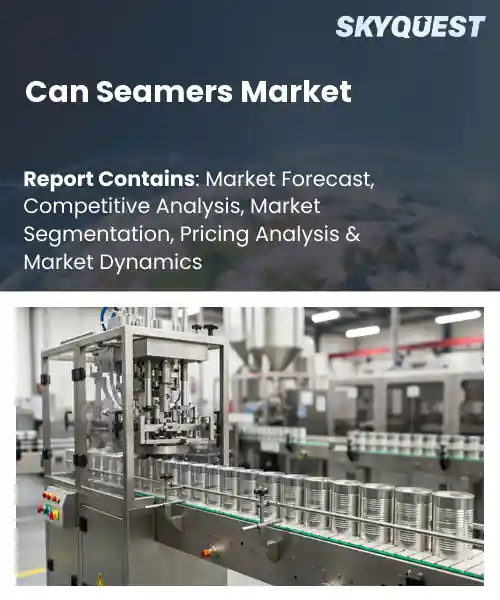
Can Seamers Market
Report ID: SQMIG20I3018
Report ID: SQMIG20I3018
[email protected]
USA +1 351-333-4748
Report ID:
SQMIG20I3018 |
Region:
Global |
Published Date: May, 2026
Pages:
157
|Tables:
142
|Figures:
78


Global Can Seamers Market size was valued at USD 482.5 Million in 2024 and is poised to grow from USD 509.13 Million in 2025 to USD 785.4 Million by 2033, growing at a CAGR of 5.52% during the forecast period (2026-2033).
The can seamers market comprises machinery and automation systems that mechanically join lids to metal beverage and food cans, and it underpins modern packaging efficiency and reliability. Rising demand for shelf-stable beverages and processed foods has expanded usage across global food and beverage industries, while stricter contamination controls have made seam integrity a regulatory and commercial priority. Over decades the sector progressed from manual spindles to high-speed rotary and servo-driven seaming lines, exemplified by adoption of multi-head rotary seamers in beverage plants and compact tabletop machines in craft breweries. This evolution illustrates how performance requirements and scale drove technological innovation and reliability.A key growth factor in the global can seamer market is automation and Industry 4.0 integration, because manufacturers seeking higher throughput and lower downtime invest in servo-driven seamers with predictive maintenance sensors, which reduces unplanned stoppages and increases yield. As a result, large beverage bottlers deploying networked seaming lines report faster format changeovers and lower scrap rates when compared to legacy equipment, creating opportunities for OEMs to offer retrofit kits and analytics services. Additionally sustainability pressures drive demand for precision seamers that enable thinner can gauges without compromising integrity, prompting collaborations between canmakers and seamer suppliers to validate lighter packaging.
How is automation transforming the can seamers market?
Automation is reshaping the can seamer market by shifting the emphasis from manual adjustment to integrated smart systems. Key aspects include precision actuation, machine vision inspection, robotic handling and connected controls that enable faster changeovers and consistent seam quality. The current state shows suppliers combining filler and seamer modules into compact, hygienic blocks while adding in line leak detection and recipe driven formats. This reduces downtime and supports gentler handling of thinner cans which the beverage market increasingly uses. Together these trends create more predictable output, easier maintenance and clearer paths to sustainability through reduced waste and energy use.KHS GmbH and Ferrum Packaging AG, 09/2025, launched the SmartCan Eco filler seamer block which highlights automated hygiene control and modular integration. This development demonstrates how automation drives market efficiency by extending run times reducing cleaning complexity and enabling seamless inspection driven quality control.
Market snapshot - (2026-2033)
Global Market Size
USD 482.5 Million
Largest Segment
Fully Automatic Can Seamers
Fastest Growth
Fully Automatic Can Seamers
Growth Rate
5.52% CAGR
To get more insights on this market click here to Request a Free Sample Report
Global can seamers market is segmented by type, can type, end-use, capacity, distribution and region. Based on type, the market is segmented into Semi-Automatic Can Seamers and Fully Automatic Can Seamers. Based on can type, the market is segmented into Metal (Tin/Aluminum) and Composite Cans. Based on end-use, the market is segmented into Food & Beverage, Pet Food and Chemical & Industrial. Based on capacity, the market is segmented into Below 100 CPM, 100-300 CPM and Above 300 CPM. Based on distribution, the market is segmented into Direct OEM Sales, Distributors and Rental/Leasing. Based on region, the market is segmented into North America, Europe, Asia Pacific, Latin America and Middle East & Africa.
What role do fully automatic can seamers play in enhancing operational efficiency? |@12
Fully automatic can seamers segment leads because production lines demand continuous, high-throughput sealing with consistent quality that manual adjustments cannot sustain. Their integration with upstream filling and downstream inspection systems reduces bottlenecks and labor variability, driving adoption among manufacturers focused on productivity. Robust automation features lower scrap and rework through precise control of seaming parameters, creating operational reliability that reinforces procurement preference and supplier investment in these systems.
However, Semi-Automatic Can Seamers are the most rapidly expanding area due to accessibility for small and mid size producers and flexibility for varied can formats. Their lower capital requirement and simpler maintenance make them appealing for product diversification and pilot production, accelerating adoption where incremental capacity and rapid changeovers create immediate growth opportunities.
How are composite can technologies shaping seamer design requirements? |@12
Metal (Tin/Aluminum) segment dominates because these can types represent the core applications demanding robust, airtight seams and long shelf life that manufacturers prioritize. Compatibility with established seaming technologies and mature standards simplifies equipment specification and operator training, encouraging widespread deployment. The prevalence of traditional food and beverage packaging workflows reinforces investment in proven seaming solutions, driving OEM focus on reliability, repeatability and serviceability for these metal can applications.
Meanwhile, Composite Cans are emerging as the key high growth area because their varied material layers enable lightweighting and novel barrier properties that open new product formats. Seamer manufacturers are innovating tooling and process controls for these assemblies, spurring adoption where brand differentiation and specialized formulations demand new sealing approaches and create fresh aftermarket service opportunities.
To get detailed segments analysis, Request a Free Sample Report
Why does Asia Pacific Dominate the Global Can Seamers Market? |@12
Asia Pacific dominance is driven by a robust manufacturing ecosystem, dense supplier networks, and widespread adoption of automated packaging solutions across food and beverage sectors. Regional manufacturers emphasize precision engineering and continuous incremental innovation, supported by strong aftermarket and service capabilities that encourage equipment deployment. High production throughput requirements in export oriented operations and the presence of specialized OEMs foster localized customization and rapid delivery. Combined with improving infrastructure and skilled technical workforces, these factors create a favorable environment for both new installations and retrofits, reinforcing market leadership across diverse end markets. Government initiatives to modernize industrial facilities and incentives for export competitiveness further stimulate capital investment, while close proximity to major material suppliers reduces lead times and cost exposure. Collaborative partnerships between equipment makers, can producers, and brand owners accelerate technology transfer and adaptation to local packaging formats, reinforcing a virtuous cycle of capacity expansion and technical capability.
Japan Can Seamers Market |@12
Can Seamers Market in Japan benefits from a culture of precision manufacturing and strong integration between machinery designers and food packaging companies. Japanese producers prioritize reliability, compact automation, and high hygiene standards, driving demand for specialized seaming technology. Extensive service networks and a focus on continuous improvement support long equipment lifecycles, while collaboration with premium beverage and canned food brands fosters innovation in seaming processes and tailored solutions and reliability.
South Korea Can Seamers Market |@12
Can Seamers Market in South Korea is marked by rapid adoption of automated packaging systems and strong links to high volume food and beverage manufacturers. Local machine builders focus on compact, high speed configurations and customization for export oriented producers. Skilled technical teams enable fast installation and responsive after sales support, while collaboration with material suppliers and brand owners encourages innovative seaming approaches and durable, serviceable equipment designs and efficiency.
What is Driving the Rapid Expansion of Can Seamers Market in North America? |@12
North America is experiencing rapid expansion due to rising demand for flexible and efficient packaging solutions across artisanal and industrial food and beverage segments. The presence of contract packers and co packers seeking modular seaming equipment for short run versatility accelerates capital investment. Emphasis on food safety, traceability, and hygienic design encourages adoption of upgradable systems and validated maintenance programs. Robust aftermarket ecosystems provide training, spare parts and retrofitting services that lower total lifecycle cost and support continuous operations. Additionally, regional OEMs and solution integrators tailor offerings to accommodate diverse packaging formats and sustainability initiatives, strengthening market penetration across both established production hubs and emerging specialty producers. Close collaboration between equipment suppliers and major brand owners drives specification alignment and rapid deployment of modular lines. Service contract offerings and integration with line controls improve uptime and facilitate compliance with retail and food service standards, further accelerating market adoption.
United States Can Seamers Market |@12
Can Seamers Market in United States reflects a diverse demand base spanning large beverage manufacturers, craft breweries, and contract packers. Operators prioritize modularity, hygienic design, and quick changeover to manage varied production runs. Strong local OEM presence and a wide aftermarket support network enable rapid response and maintenance. Retailer packaging requirements and sustainability commitments prompt investment in adaptable seaming platforms and service agreements that support long term operational resilience overall.
Canada Can Seamers Market |@12
Can Seamers Market in Canada is shaped by a network of regional food processors, seafood canners and specialty beverage producers seeking reliable hygienic seaming solutions. Emphasis on sustainability and recyclable packaging encourages investment in adaptable equipment and modular upgrades. Local suppliers and service partners focus on rapid technical support and training to minimize downtime. Partnerships with equipment integrators enable tailored lines that meet export quality expectations and evolving regulatory standards.
How is Europe Strengthening its Position in Can Seamers Market? |@12
Europe is reinforcing its role through a combination of technological refinement, regulatory alignment and a commitment to sustainable packaging. Equipment manufacturers emphasize energy efficiency, ease of sanitation and compatibility with recycled materials, aligning machines with circular economy objectives. Retrofit and modernization programs are common as producers balance legacy lines with new hygiene and productivity requirements. Strong machinery clusters promote knowledge sharing and specialist engineering that supports niche and high quality canning applications. Cross border supplier networks and service hubs facilitate rapid parts availability and technical support, enabling manufacturers to meet stringent food safety norms and retailer demands while advancing sector competitiveness across mature and emerging markets. Investment in research and adoption of smart manufacturing practices enhance process control. Collaboration between equipment vendors and can producers supports tailored engineering for specialty finishes and batching. Service offerings with training and spare parts support further adoption and resilience of European can seaming operations.
Germany Can Seamers Market |@12
Can Seamers Market in Germany leverages advanced industrial engineering and deep automation expertise to supply robust seaming solutions for throughput and specialty applications. Local manufacturers focus on precision, durability and integration with broader production systems, while machine tool and controls suppliers enable sophisticated line synchronization. Strong export orientation drives modular, serviceable designs, and dense service networks support commissioning, spare parts and training that preserve uptime and meet demanding quality expectations.
United Kingdom Can Seamers Market |@12
Can Seamers Market in United Kingdom is driven by a dynamic beverage sector, widespread craft brewing and an active contract packing industry seeking flexible seaming solutions. Demand centers on lines that enable rapid product changeover, hygienic construction and straightforward maintenance. Local integrators provide customized layouts and strong aftermarket support, while collaboration with brand owners encourages aesthetic seaming specifications. Emphasis on retrofits and line optimization sustains equipment investment and operational continuity.
France Can Seamers Market |@12
Can Seamers Market in France reflects strong demand from premium food producers, artisan canned goods and beverage segments seeking refined seaming performance and presentation. Equipment choices favor hygienic, adaptable machines that support small batch runs and bespoke packaging. Local manufacturers and integrators emphasize customization, finish quality and easy sanitation, while service networks provide commissioning and maintenance. Close collaboration with brand owners helps tailor seaming solutions to culinary and retail expectations.
To know more about the market opportunities by region and country, click here to
Buy The Complete Report
Drivers |@12
Increasing Demand For Canned Beverages
Adoption Of Automation In Packaging
Restraints |@12
High Capital Investment Requirements
Skilled Workforce Shortage Challenges
Request Free Customization of this report to help us to meet your business objectives.
Competitive intensity in the global can seamers market is driven by hygiene led differentiation, AI enabled inspection and expanded aftermarket services, prompting concrete moves such as product launches, alliances and service packages. JBT’s SeamTec 2 Evolute and PRoCARE remote maintenance exemplify technology and service innovation, while trade show activity and consolidation illustrate alliances reshaping distribution and modular craft line availability.
Top Player’s Company Profile
Recent Developments
SkyQuest’s ABIRAW (Advanced Business Intelligence, Research & Analysis Wing) is our Business Information Services team that Collects, Collates, Correlates, and Analyses the Data collected by means of Primary Exploratory Research backed by robust Secondary Desk research. As per SkyQuest analysis, the global can seamers market is poised for steady growth driven by increasing demand for canned beverages and further accelerated by adoption of automation and Industry 4.0 integration as a second driver. A key driver is shifting consumer preference toward shelf-stable, portable cans that raise capacity requirements, while a restraint is the high capital investment required for high-speed automated seamers which limits small and mid-sized producers’ upgrades. Asia Pacific remains the dominating region due to strong manufacturing ecosystems and localized OEM support, and the fully automatic can seamers segment is the dominating segment as producers prioritize continuous, high-throughput, integrated sealing solutions.
| Report Metric | Details |
|---|---|
| Market size value in 2024 | USD 482.5 Million |
| Market size value in 2033 | USD 785.4 Million |
| Growth Rate | 5.52% |
| Base year | 2024 |
| Forecast period | (2026-2033) |
| Forecast Unit (Value) | USD Million |
| Segments covered |
|
| Regions covered | North America (US, Canada), Europe (Germany, France, United Kingdom, Italy, Spain, Rest of Europe), Asia Pacific (China, India, Japan, Rest of Asia-Pacific), Latin America (Brazil, Rest of Latin America), Middle East & Africa (South Africa, GCC Countries, Rest of MEA) |
| Companies covered |
|
| Customization scope | Free report customization with purchase. Customization includes:-
|
To get a free trial access to our platform which is a one stop solution for all your data requirements for quicker decision making. This platform allows you to compare markets, competitors who are prominent in the market, and mega trends that are influencing the dynamics in the market. Also, get access to detailed SkyQuest exclusive matrix.
Table Of Content
Executive Summary
Market overview
Parent Market Analysis
Market overview
Market size
KEY MARKET INSIGHTS
COVID IMPACT
MARKET DYNAMICS & OUTLOOK
Market Size by Region
KEY COMPANY PROFILES
Methodology
For the Can Seamers Market, our research methodology involved a mixture of primary and secondary data sources. Key steps involved in the research process are listed below:
1. Information Procurement: This stage involved the procurement of Market data or related information via primary and secondary sources. The various secondary sources used included various company websites, annual reports, trade databases, and paid databases such as Hoover's, Bloomberg Business, Factiva, and Avention. Our team did 45 primary interactions Globally which included several stakeholders such as manufacturers, customers, key opinion leaders, etc. Overall, information procurement was one of the most extensive stages in our research process.
2. Information Analysis: This step involved triangulation of data through bottom-up and top-down approaches to estimate and validate the total size and future estimate of the Can Seamers Market.
3. Report Formulation: The final step entailed the placement of data points in appropriate Market spaces in an attempt to deduce viable conclusions.
4. Validation & Publishing: Validation is the most important step in the process. Validation & re-validation via an intricately designed process helped us finalize data points to be used for final calculations. The final Market estimates and forecasts were then aligned and sent to our panel of industry experts for validation of data. Once the validation was done the report was sent to our Quality Assurance team to ensure adherence to style guides, consistency & design.
Analyst Support
Customization Options
With the given market data, our dedicated team of analysts can offer you the following customization options are available for the Can Seamers Market:
Product Analysis: Product matrix, which offers a detailed comparison of the product portfolio of companies.
Regional Analysis: Further analysis of the Can Seamers Market for additional countries.
Competitive Analysis: Detailed analysis and profiling of additional Market players & comparative analysis of competitive products.
Go to Market Strategy: Find the high-growth channels to invest your marketing efforts and increase your customer base.
Innovation Mapping: Identify racial solutions and innovation, connected to deep ecosystems of innovators, start-ups, academics, and strategic partners.
Category Intelligence: Customized intelligence that is relevant to their supply Markets will enable them to make smarter sourcing decisions and improve their category management.
Public Company Transcript Analysis: To improve the investment performance by generating new alpha and making better-informed decisions.
Social Media Listening: To analyze the conversations and trends happening not just around your brand, but around your industry as a whole, and use those insights to make better Marketing decisions.
REQUEST FOR SAMPLE
 REQUEST FREE CUSTOMIZATION


Want to customize this report? This report can be personalized according to your needs. Our analysts and industry experts will work directly with you to understand your requirements and provide you with customized data in a short amount of time. We offer $1000 worth of FREE customization at the time of purchase.
Feedback From Our Clients


 USA (+1) 351-333-4748

