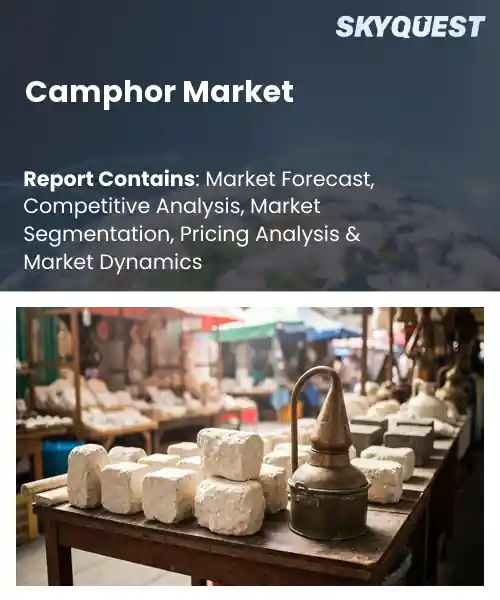
Camphor Market
Report ID: SQMIG15E3876
Report ID: SQMIG15E3876
[email protected]
USA +1 351-333-4748
Report ID:
SQMIG15E3876 |
Region:
Global |
Published Date: July, 2026
Pages:
157
|Tables:
118
|Figures:
77


Global Camphor Market size was valued at USD 573.7 Million in 2024 and is poised to grow from USD 598.37 Million in 2025 to USD 838.0 Million by 2033, growing at a CAGR of 4.3% during the forecast period (2026-2033).
The international camphor market is built on a natural substance that is extracted primarily from the wood of the tree species Cinnamomum camphora and produced artificially from turpentine oil. The significance of this product lies in the fact that it possesses certain antimicrobial characteristics that help in performing the preservative function in ointments, and its distinct smell, which fuels its popularity in personal care products. In the past, production had reached its peak in Southeast Asia in the 20th century because of the colonial trade connections, but later, due to limitations in the use of raw materials, production became artificial in the 1990s.
The increase in demand for organic preservatives and biodegradable insect repellants acts as a growth driver of the global camphor market since companies prefer sustainability to chemicals. This results in greener initiatives by retailers, which in turn leads to an increase in the number of camphor extraction plants in China and Indonesia, resulting in a fall in cost per unit of production. This results in the formulation of antiseptics from camphor as an alternative to paraben in the pharmaceutical industry. Meanwhile, the trend of aromatherapy tourism results in distribution of high-end, certified organic camphor in aromatherapy oils.
How is AI-driven Automation Influencing Supply Chain Efficiency in the Global Camphor Market?
AI-powered automation is transforming the camphor supply chain by connecting production, transportation, and marketing through live data. Predictive models analyze the availability of raw materials and peaks in demand to help manufacturers alter batch production to avoid any disruptions. Automated inventory management systems trace the journey of pallets from the synthesis plant to the distribution center and reduce the chances of any mistakes and enable workers to perform other value-added work. The route planning engine analyzes the best routes that can be followed for the minimum usage of fuel and minimum time in transit. The digital twin helps companies analyze different situations without affecting their operations.
Market snapshot - (2026-2033)
Global Market Size
USD 573.7 Million
Largest Segment
Synthetic Camphor
Fastest Growth
Natural Camphor
Growth Rate
4.3% CAGR
To get more insights on this market click here to Request a Free Sample Report
Global camphor market is segmented by source category, product grade, application, distribution channel and region. Based on source category, the market is segmented into Synthetic Camphor and Natural Camphor. Based on product grade, the market is segmented into Technical Grade, Pharmaceutical Grade and Food Grade. Based on application, the market is segmented into Pharmaceuticals, Personal Care and Cosmetics, Chemical Intermediates, Paints and Coatings, Religious Rituals and Incense and Others. Based on distribution channel, the market is segmented into Direct B2B Procurement and Indirect Retail Channels. Based on region, the market is segmented into North America, Europe, Asia Pacific, Latin America and Middle East & Africa.
Artificial camphor segment holds its dominance since it provides consistency in terms of purity, supply, and scalability, which are the requirements of industrial buyers. Industries prefer artificial camphor due to strict requirements, dependency on natural sources, and cost structure. This consistency impacts the demand in end-user segments including chemicals, intermediate and coating industry. Hence, artificial camphor is playing an important role in procurement strategy and product development of camphor market across the globe.
On the other hand, the Natural camphor segment is experiencing the fastest growth trend since consumers are looking for sustainability in aromatics. Growing demand for green personal care and spirituality products creates scope for harvesting and new methods of extraction.
Personal care and cosmetic segments prevail owing to the cooling and aromatic nature of camphor that fulfills basic requirements of formulations of skin care and hair care products. Its natural source and multipurpose use, such as fragrant agents, preservative and soothing components without any risk, make it suitable for manufacturers. Such conformity to consumer needs for safe but effective components guarantees steady acquisition, fostering innovations and ensuring its preference as additive in camphor market.
The Religious rituals and incense segment become the main high growth segment owing to revival of cultural traditions and development of specialized niche markets. The unique smell of camphor makes it popular among boutique incense and spiritual wellness product suppliers, leading to increased volume of purchases. Such trend increases the channels of distribution and fosters product variety.
To get detailed segments analysis, Request a Free Sample Report
Asia Pacific’s domination of the camphor market is derived from an amalgamation of favorable natural resources and production capacity. Being the home to the indigenous camphor trees, the region has access to high-quality raw material that serves as the basis for both traditional extraction and modern synthesis. Time honored usage of the product in medicine, ceremonies, and cosmetics has resulted in customer awareness and consequent strong demand in different industries. A fully integrated value chain, including growers, manufacturers and consumers, ensures quick delivery and preservation of quality. Research organizations work in collaboration with manufacturing companies to develop new ways of application in pharmaceutical, cosmetic, and advanced materials industries. Favorable policies promote sustainable extraction and investments into manufacturing facilities, ensuring the advantages of the region globally. In addition, trade pacts help export manufactured derivatives to developing countries.
Camphor market in Japan is an advantage due to the tradition of aromatic therapies and cosmetic industry that is keen on using natural ingredients. Domestic producers use sophisticated techniques of distillation to create high-purity extracts that can be applied in cosmetic, pharmaceutical, and functional food production. Close cooperation of laboratory universities and private companies facilitates innovations in products and provides continuous access to sustainable supply of raw materials. Customers appreciate quality and environmental products that are environmentally friendly.
The Camphor Market in South Korea is supported by a solid foundation of chemical production industries using camphor for solvents, adhesives, and polymers. The practice of green chemistry fosters the utilization of camphor as a sustainable source of raw materials, hence bringing in investments both locally and internationally. Collaboration of research institutions with the industry will lead to innovation in medical and aromatherapy applications, with a focus on exporting.
The fast growth of the camphor market in North America is attributed to an interaction of changing consumer lifestyles and industry actions. The growing understanding of the benefits of natural and sustainable sourced components creates demand in the cosmetic, personal care, and specialty fragrances industry. The industry invests in new extraction plants that can ensure high standards of quality and environmentally friendly processing. Partnerships between agricultural suppliers and chemical manufacturers make the chain more effective and ensure access to highly pure substances. The regulations stimulating the development of bio-based products create additional incentives for developing camphor products. Moreover, the research-friendly environment of North America contributes to the development of new uses of camphor.
The Camphor Market in the USA is influenced by consumers from various backgrounds who prefer natural cosmetics and treatment alternatives. Processing plants use advanced methods of purification to offer grades that can be used in cosmetic products, over-the-counter products, and cleaning materials. Collaboration between biotechnology companies and existing chemical organizations enables quick innovations in delivery mechanisms, while the presence of a robust logistics network makes distribution easy. Sustainable product certification adds value to the products for eco-conscious customers.
Strengths of the Camphor Market in Canada include its strong reputation for adhering to high environmental standards along with the favorable regulations for such activities. The local manufacturers use sustainable forestry management practices to provide ethically sourced raw materials attractive to environmentally conscious companies. High capabilities in the refining sector enable production of specialized varieties of camphor which can be used in natural health care products and environmentally friendly solvents.
Europe has become a dominant force in the camphor market by taking advantage of its expertise in technology and sustainable practices, alongside developing uses for the added value of its application. Its well-established industry of chemicals uses cutting-edge catalytic processes to create very pure camphor derivatives which comply with strict requirements for use in pharmaceuticals, high-end perfumes and polymers. European environmental legislation pushes the use of camphor-based solvents instead of fossil-fuel-derived materials, thus increasing demand for green formulations. International partnerships and innovation clusters foster swift commercialization of research findings, especially inhalers and cosmetics. In addition to this, the circular economy principles of Europe make it easy to recycle camphor-containing waste streams.
The market for camphor in Germany is supported by many factors, such as close links with the domestic specialty chemicals industry that values perfection. This industry uses advanced techniques for extraction of high-quality camphor extracts intended for pharmaceutical products, luxury cosmetics, and other products like specialty polymers. Close connections between technical universities and manufacturers ensure the constant improvement in efficiency and functionality of the extraction process. The commitment to eco-design motivates the use of camphor as an ecological solvent.
The Camphor Market in the UK has an advantage in terms of a thriving niche market for fragrances as well as a rising preference for natural products to improve health. The distillation process used by manufacturers in Britain is fused with advanced purification technologies to produce specific varieties of camphor that are suitable for use by boutique perfumeries and medicinal balms, as well as green cleaning products. Joint ventures between research institutions and start-up firms hasten the identification of bioactivities in products.
The Camphor Market in France is characterized by a long-standing history of fragrant expertise combined with future-oriented green chemistry. The key aspect for the French manufacturers lies in the use of artisanal methods of extracting camphor with the preservation of its fragrance characteristics, thus providing an opportunity for high-quality perfumes and foodstuffs. In parallel with it, research laboratories study the application of camphor as a bio-intermediate for pharmaceutical and polymer synthesis.
To know more about the market opportunities by region and country, click here to
Buy The Complete Report
Increasing Demand in Aromatherapy
Growing trend towards natural well-being therapies has resulted in increased consumer interest in herbal components, and cooling odor characteristics of camphor fits in with such trends. Camphor is utilized by manufacturers in formulations for essential oils, massage creams and home fragrances, thus increasing the number of applications for the substance. Such an attitude from consumers positively influences distribution channels and encourages innovations, contributing to marketexpansion. With growing popularity of holistic well-being, usage of camphor will continue to increase in several geographic markets and some gourmet markets as well.
Expansion of Pharmaceutical Formulations
It is due to the pharmacological value of camphor such as analgesic and anti-inflammatory properties that it is increasingly being included in several new modes of drug delivery systems. The incorporation of camphor in topical creams, inhalers, and cough syrups increases efficiency and helps ensure proper compliance with treatment. This flexibility will help promote diversity in pipelines, prompting pharmaceutical organizations to channel more efforts towards the development of camphor-based products.
Stringent Environmental Regulations
Regulatory authorities in prominent production zones enforce stringent restrictions on the production of camphor, in a bid to preserve the natural ecological balance and diversity of the forests. Observing such restrictions means that companies will have to undertake sustainable methods of production, which would mean that the process of production becomes more difficult and lengthier. This could lead to the reduction in availability of the raw material, thereby forcing firms to opt for other materials or alter the specifications of their products.
Fluctuating Raw Material Prices
Raw material costs are very sensitive to changes because the production of camphor involves dependence on certain types of trees. When there is scarcity, the prices shoot up, forcing the producers to look at their quantities or even consider other substitutes. This affects the budgets of the consumers of camphor in terms of unpredictability in prices and leads to postponement of products from entering the market. Therefore, the potential growth of the market is inhibited due to the need for financial security.
Request Free Customization of this report to help us to meet your business objectives.
The world’s market for camphor operates on the basis of strong competition between chemical companies, where mergers and acquisitions have been creating integration in supply chains and strategic alliances providing opportunities to reach new geographic areas. Modern distillation equipment is being developed in order to increase purity and decrease costs of production, while joint ventures with perfume and drug companies facilitate diversification.
Renewable Fragrance Demand Surge: The increasing consumer inclination toward natural and sustainable cosmetics has forced brands to use bio-based camphor as an alternative to synthetic aromatics. There is a trend towards marketing eco-friendly scents, and retailers are rewarding those supply chains who have shown renewable sourcing practices. This has encouraged both small forest owners to cultivate more camphor and big players to establish plantations. Thus, it has become necessary for market players to realign their product portfolio, given the green image of camphor-based perfumes in luxury segments.
Pharma Innovation Driving Camphor Use: Developments in drug delivery methods allow for more applications of camphor, such as its use as a permeation enhancer in topical medicines. Scientists have found ways of using camphor alongside nanocarriers to increase skin penetration of the medicinal components, which ensures quicker results and decreased irritability. These scientific developments are encouraging pharmaceutical manufacturers to revisit old products as well as create new over-the-counter medications using camphor due to its cooling and antimicrobial properties.
SkyQuest’s ABIRAW (Advanced Business Intelligence, Research & Analysis Wing) is our Business Information Services team that Collects, Collates, Correlates, and Analyses the Data collected by means of Primary Exploratory Research backed by robust Secondary Desk research.
As per SkyQuest analysis, the increasing demand for natural wellness products such as aromatherapy that has led to increased use of camphor in essential oil and spa quality blends serves as the key growth driver for the global camphor market. Another significant driver includes the increasing demand for renewable fragrances where companies have replaced synthetic fragrances with natural camphor-based fragrances to satisfy consumer demand for green products. However, the major restraint faced by this market is the presence of environmental regulations that hinder the availability of raw materials. Asia Pacific will continue to dominate the market due to the presence of camphor forests while synthetic camphor product segments will maintain its dominance.
| Report Metric | Details |
|---|---|
| Market size value in 2024 | USD 573.7 Million |
| Market size value in 2033 | USD 838.0 Million |
| Growth Rate | 4.3% |
| Base year | 2024 |
| Forecast period | (2026-2033) |
| Forecast Unit (Value) | USD Million |
| Segments covered |
|
| Regions covered | North America (US, Canada), Europe (Germany, France, United Kingdom, Italy, Spain, Rest of Europe), Asia Pacific (China, India, Japan, Rest of Asia-Pacific), Latin America (Brazil, Rest of Latin America), Middle East & Africa (South Africa, GCC Countries, Rest of MEA) |
| Companies covered |
|
| Customization scope | Free report customization with purchase. Customization includes:-
|
To get a free trial access to our platform which is a one stop solution for all your data requirements for quicker decision making. This platform allows you to compare markets, competitors who are prominent in the market, and mega trends that are influencing the dynamics in the market. Also, get access to detailed SkyQuest exclusive matrix.
Table Of Content
Executive Summary
Market overview
Parent Market Analysis
Market overview
Market size
KEY MARKET INSIGHTS
COVID IMPACT
MARKET DYNAMICS & OUTLOOK
Market Size by Region
KEY COMPANY PROFILES
Methodology
For the Camphor Market, our research methodology involved a mixture of primary and secondary data sources. Key steps involved in the research process are listed below:
1. Information Procurement: This stage involved the procurement of Market data or related information via primary and secondary sources. The various secondary sources used included various company websites, annual reports, trade databases, and paid databases such as Hoover's, Bloomberg Business, Factiva, and Avention. Our team did 45 primary interactions Globally which included several stakeholders such as manufacturers, customers, key opinion leaders, etc. Overall, information procurement was one of the most extensive stages in our research process.
2. Information Analysis: This step involved triangulation of data through bottom-up and top-down approaches to estimate and validate the total size and future estimate of the Camphor Market.
3. Report Formulation: The final step entailed the placement of data points in appropriate Market spaces in an attempt to deduce viable conclusions.
4. Validation & Publishing: Validation is the most important step in the process. Validation & re-validation via an intricately designed process helped us finalize data points to be used for final calculations. The final Market estimates and forecasts were then aligned and sent to our panel of industry experts for validation of data. Once the validation was done the report was sent to our Quality Assurance team to ensure adherence to style guides, consistency & design.
Analyst Support
Customization Options
With the given market data, our dedicated team of analysts can offer you the following customization options are available for the Camphor Market:
Product Analysis: Product matrix, which offers a detailed comparison of the product portfolio of companies.
Regional Analysis: Further analysis of the Camphor Market for additional countries.
Competitive Analysis: Detailed analysis and profiling of additional Market players & comparative analysis of competitive products.
Go to Market Strategy: Find the high-growth channels to invest your marketing efforts and increase your customer base.
Innovation Mapping: Identify racial solutions and innovation, connected to deep ecosystems of innovators, start-ups, academics, and strategic partners.
Category Intelligence: Customized intelligence that is relevant to their supply Markets will enable them to make smarter sourcing decisions and improve their category management.
Public Company Transcript Analysis: To improve the investment performance by generating new alpha and making better-informed decisions.
Social Media Listening: To analyze the conversations and trends happening not just around your brand, but around your industry as a whole, and use those insights to make better Marketing decisions.
REQUEST FOR SAMPLE
 REQUEST FREE CUSTOMIZATION
Global Camphor Market size was valued at USD 573.7 Million in 2024 and is poised to grow from USD 598.37 Million in 2025 to USD 838.0 Million by 2033, growing at a CAGR of 4.3% during the forecast period (2026-2033).
The global camphor market is shaped by intense competition among chemical manufacturers, with recent M&A activity consolidating supply chains and strategic partnerships enabling access to new geographic regions. Companies are investing in advanced distillation technologies to improve purity and lower production costs, while joint ventures with fragrance and pharmaceutical firms accelerate product diversification and market penetration. 'Kanchi Karpooram Limited', 'Mangalam Organics Limited', 'Oriental Aromatics Limited', 'Camphor & Allied Products Ltd.', 'Sonechem Pvt. Ltd.', 'Wuzhou Sanwa Chemicals Co. Ltd.', 'Fujian Yatong Forestry Chemicals Co. Ltd.', 'Taiwan Tekho Marine Biotech Co. Ltd.', 'Aldon Corporation', 'Merck KGaA', 'Tokyo Chemical Industry Co. Ltd.', 'Sigma-Aldrich Corporation', 'Sutong Chemical Co. Ltd.', 'Spectrum Laboratory Products Inc.', 'Siddharth Carbochem Products Ltd.', 'JPC Corp.', 'Sino-Chemical Co. Ltd.', 'Nippon Terpene Chemical Co. Ltd.', 'Harima Chemicals Group Inc.', 'Skyline Chemical Corp.'
The rising popularity of natural wellness practices encourages consumers to seek botanical ingredients, and camphor’s distinctive cooling aroma aligns with these preferences. Manufacturers incorporate camphor into essential oil blends, massage balms, and home fragrance products, creating broader application scopes. This consumer-driven shift strengthens distribution networks and stimulates product innovation, thereby expanding market reach. As awareness of holistic health continues to spread, the demand for camphor‑based solutions is expected to sustain upward momentum across multiple geographic regions, and inspire new culinary experiments in select gourmet markets.
Renewable Fragrance Demand Surge: The growing consumer preference for natural and sustainable personal care products is prompting manufacturers to replace synthetic aromatics with bio‑derived camphor. Brands are highlighting eco‑friendly scent profiles, and retailers are rewarding supply chains that demonstrate renewable sourcing. This shift is encouraging small-scale forest stewards to expand cultivation, while large producers invest in certified plantations. As a result, market participants are re‑configuring product lines to capitalize on the perception of green credibility associated with camphor‑based fragrances in premium luxury segments worldwide.
Why does Asia Pacific Dominate the Global Camphor Market? |@12


Want to customize this report? This report can be personalized according to your needs. Our analysts and industry experts will work directly with you to understand your requirements and provide you with customized data in a short amount of time. We offer $1000 worth of FREE customization at the time of purchase.
Feedback From Our Clients


 USA (+1) 351-333-4748

