
Cam Phasing Systems Market
Report ID: SQMIG25A2653
Report ID: SQMIG25A2653
[email protected]
USA +1 351-333-4748
Report ID:
SQMIG25A2653 |
Region:
Global |
Published Date: March, 2026
Pages:
157
|Tables:
140
|Figures:
78


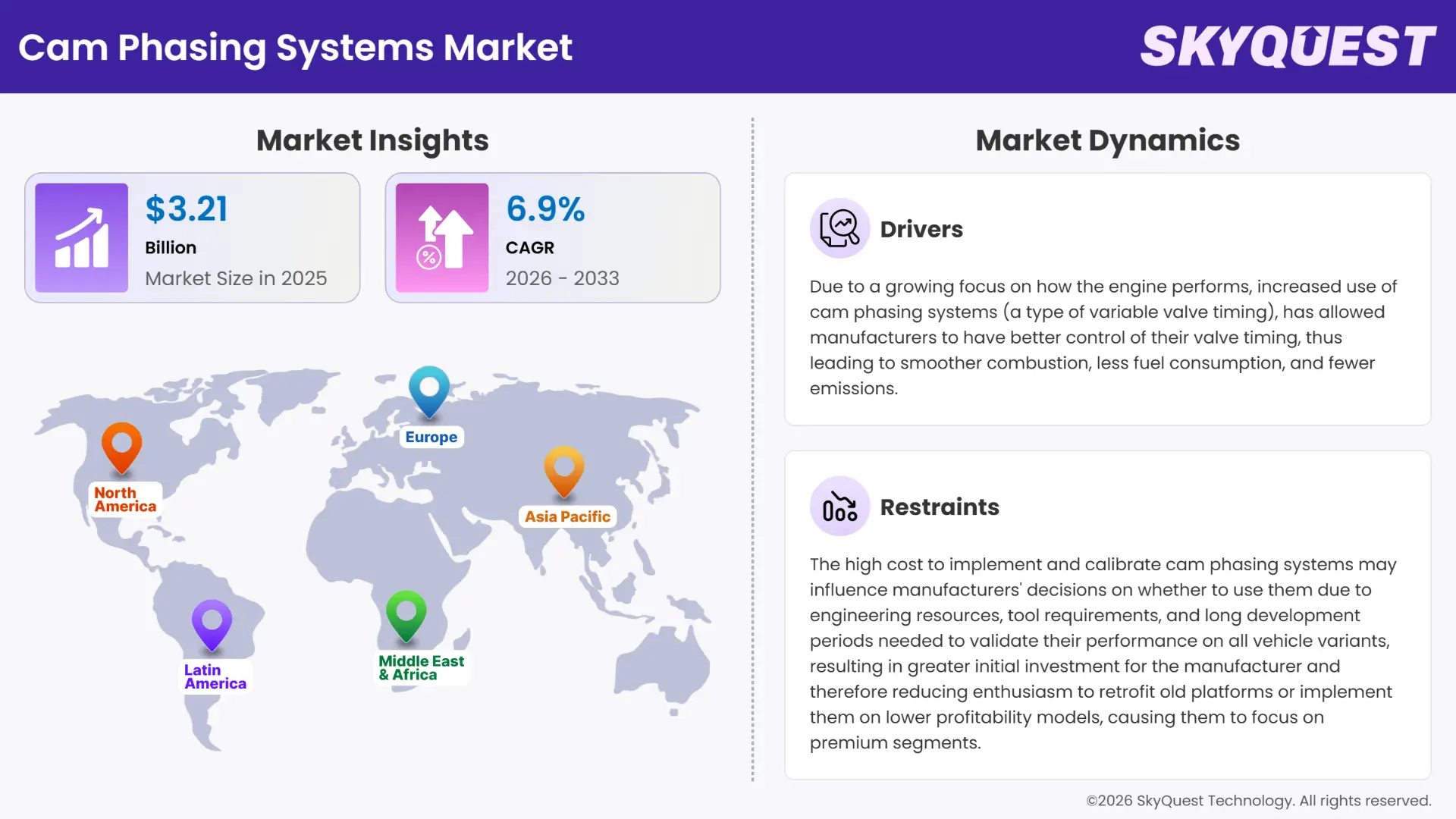
Global Cam Phasing Systems Market size was valued at USD 3.00 Billion in 2024 and is poised to grow from USD 3.21 Billion in 2025 to USD 5.47 Billion by 2033, growing at a CAGR of 6.9% during the forecast period (2026-2033).
Key Takeaways: Market Trends & Insights
The primary driver of the global cam phasing systems market is relentless pressure to reduce emissions and improve fuel economy, which has pushed automakers to adopt variable valve timing widely. This means that cam phasing systems change the timing at which the controls valve timing optimizes combustion during different driving conditions. They help reduce fuel consumption and greenhouse gas emissions, such as NOx and CO2, without requiring an entire engine to redesign. Over past two decades the market evolved from hydraulic phasers on high-end engines to electro-hydraulic and electronic units used across mass-market models; examples include BMW’s VANOS, Toyota’s VVT-i, and supplier platforms that enable downsized turbocharged engines.
A dominant factor in shaping market expansion is engine downsizing combined with turbocharging, because manufacturers pursue higher specific power while meeting regulatory CO2 targets. Cam phasing compensates for reduced displacement in engines due to downsizing, providing optimized torque and transient response; therefore, it's been used by Ford in their EcoBoost valve strategies and Honda to create drivability. Hybrid/mild hybrid are expected to see more utilization; these will increase start/stop cycles and require good timing control to maintain smoothness and emissions performance during cylinder deactivation. As suppliers create lightweight phasers that have quick response time at lower costs, automotive OEMs can use these technologies in all vehicle segments, expanding the potential for aftermarket retrofits and commercial vehicle applications.
How is AI Improving Predictive Maintenance in the Cam Phasing Systems Market?
AI improves predictive maintenance for cam phasing systems by turning raw sensor streams into actionable diagnostics. Key aspects include continuous monitoring of timing position, vibration, oil pressure, and ECU signals and using machine learning to detect subtle anomalies and evolving failure modes. The current state is a shift from calendar based checks to condition based strategies that use edge inference and cloud analytics to prioritize interventions. In the market this reduces unexpected downtime and supports longer service intervals while suppliers and OEMs integrate smart sensors and software into variable valve timing modules. Examples include hydraulic and electrically actuated cam phasers that feed telemetry into digital twin models for clearer root cause analysis.
To get more insights on this market click here to Request a Free Sample Report
The cam phasing systems market is segmented by operation technology, system integration, vane configuration, vehicle type, sales channel and region. Based on operation technology, the market is segmented into hydraulic cam phasers (VVT) and electric cam phasers (eVVT). Based on system integration, the market is segmented into intake only phasing, exhaust only phasing, and dual cam phasing. Based on vane configuration, the market is segmented into vane-type phasers and helical gear-type phasers. Based on vehicle type, the market is segmented into passenger cars and light commercial vehicles (LCV). Based on sales channel, the market is segmented into OEM and aftermarket. Based on region, the market is segmented into North America, Europe, Asia Pacific, Latin America, and Middle East & Africa.
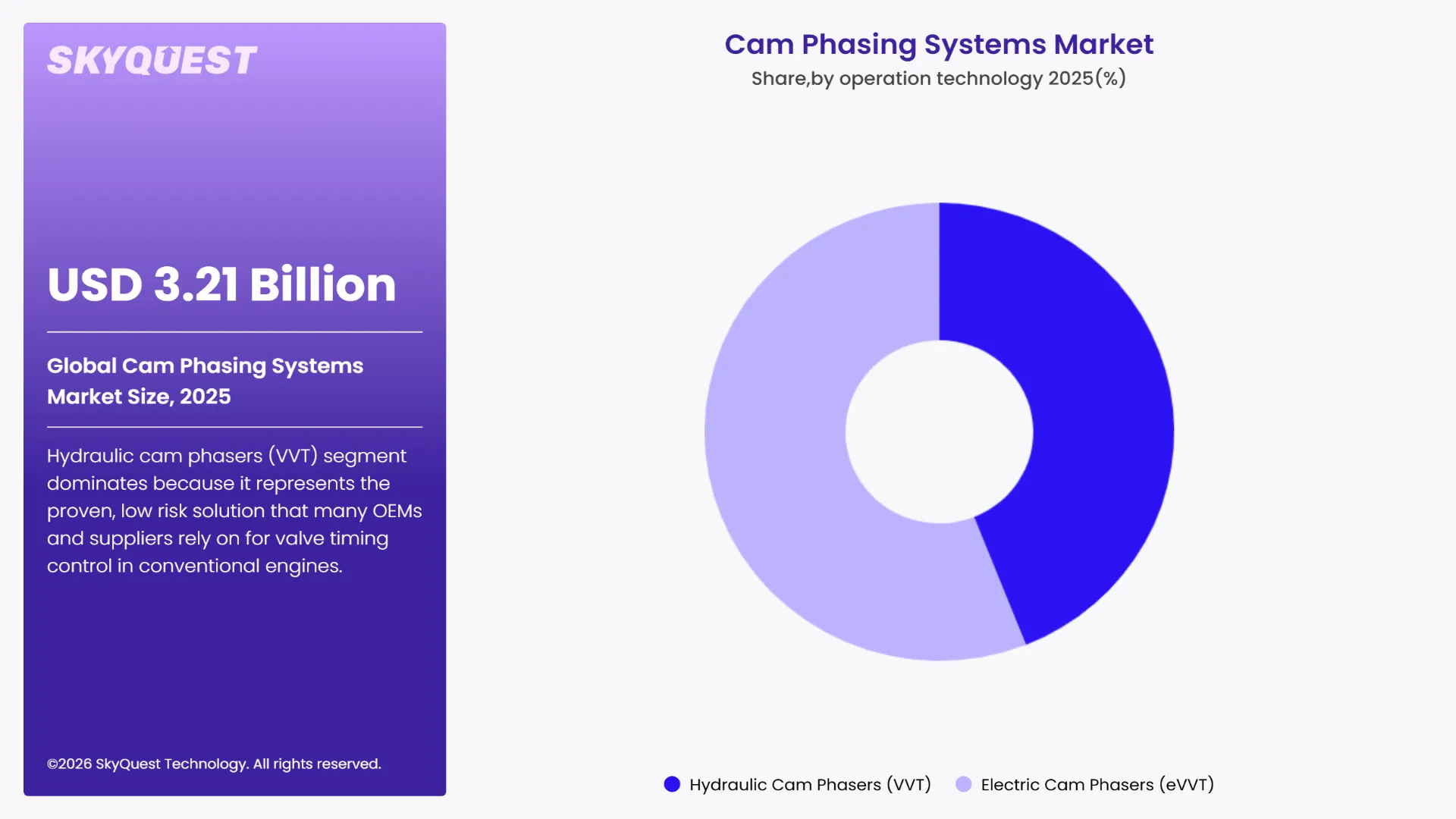
Hydraulic cam phasers (VVT) segment dominates because it represents the proven, low risk solution that many OEMs and suppliers rely on for valve timing control in conventional engines. Its mechanical simplicity and long track record translate into dependable performance, straightforward integration with existing engine architectures, and predictable manufacturing processes, which lowers development and production risk and encourages widespread adoption across vehicle lineups.
However, electric cam phasers (eVVT) are emerging as the most rapidly expanding area in the cam phasing systems market because they enable finer, faster, and more flexible valve timing control that aligns with electrification and stricter emissions targets. Through software control precision as well as hybrid compatibility, engine technologies will develop innovative designs that also provide benefits to consumers by enabling increased fuel efficiency through technology improvements.
Dual cam phasing segment dominates because offering independent intake and exhaust timing control delivers the broadest performance and emissions benefits, making it the preferred choice for applications demanding high efficiency and drivability. This capability supports the use of advanced combustion techniques as well as the ability of OEMs to achieve tighter emission controls, thereby encouraging OEMs to accept higher complexity and cost for the increased operational flexibility that it provides.
However, intake only phasing is emerging as the most rapidly expanding area in the Cam Phasing Systems Market because its lower complexity and cost make it attractive for mass market and light commercial vehicle applications seeking incremental efficiency gains. Its simpler architecture enables easier integration, quicker time to market, and favorable cost-benefit tradeoffs that open growth opportunities in mainstream powertrains and retrofit channels.
To get detailed segments analysis, Request a Free Sample Report
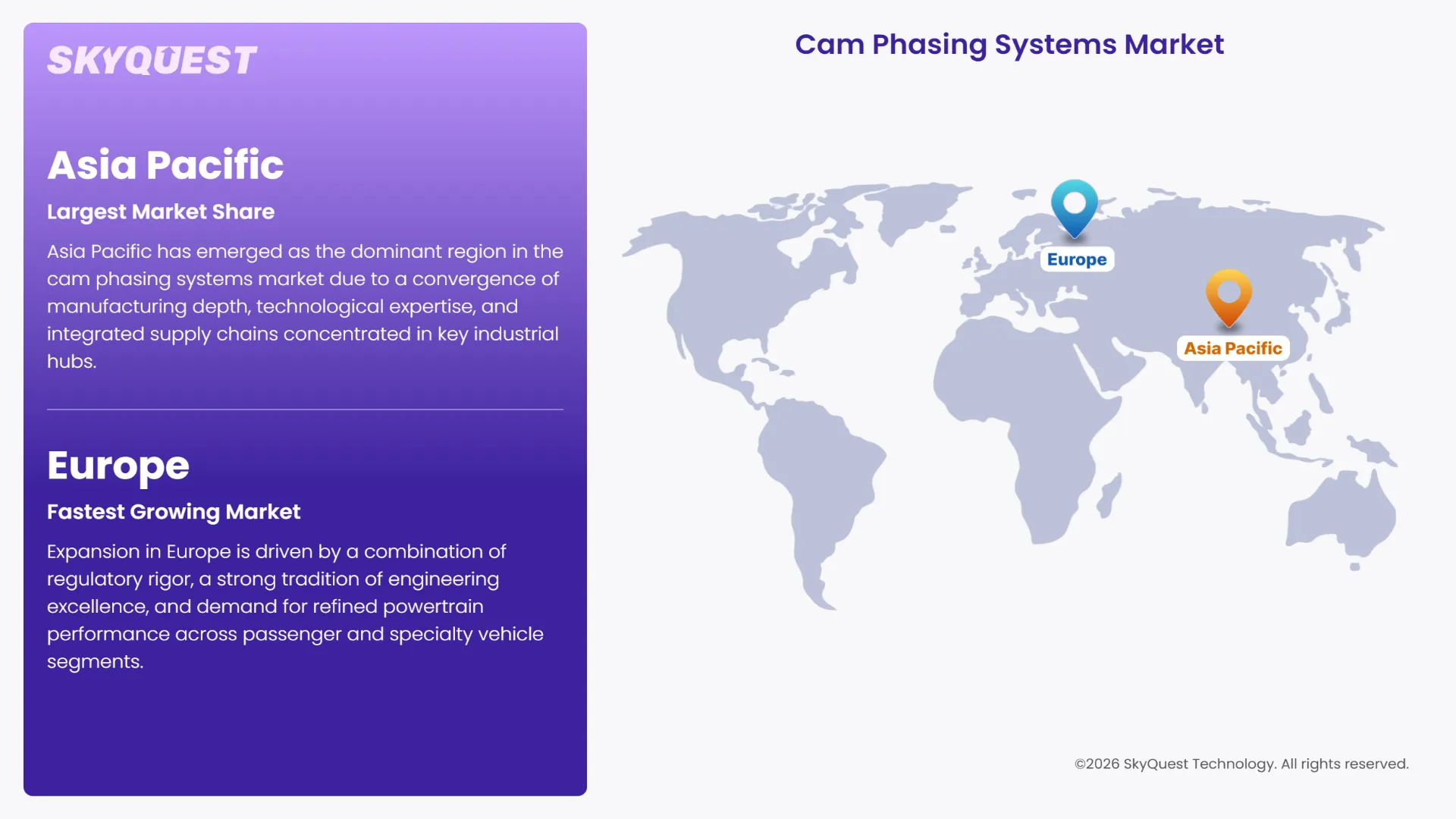
Asia Pacific has emerged as the dominant region in the cam phasing systems market due to a convergence of manufacturing depth, technological expertise, and integrated supply chains concentrated in key industrial hubs. As a result, they have invested heavily in their engineering capabilities and in partnering with OEMs and suppliers to technological advancement through collaborative research and development (R&D). Competitive pricing and an extensive supplier network enable cost-effective production with large volumes of components manufactured and quickly completed.
The aftermarket in the region is very active, and many suppliers export products to global markets, further contributing to the importance of the aftermarket to the region. Specialized suppliers typically provide customized solutions that accommodate the various engine configurations; this, combined with working closely with research organizations and having dedicated test facilities, improves the reliability and customization of the products.
Cam phasing systems market in Japan is characterized by deep OEM integration, sophisticated engineering capabilities, and a focus on precision manufacturing. High reliability, compactness of design, and usage of advanced materials remain primary considerations for suppliers when attempting to satisfy the defined performance requirements. Strong collaboration between OEMs and the component developer has accelerated iterative improvement and customisation. The existence of a domestic testing infrastructure, combined with a culture of continuous improvement, provides the ability to support incremental innovation and long-term product lifecycles along with tight supply chain coordination across the different regions.
Cam phasing systems market in South Korea reflects strong collaboration between major vehicle manufacturers and specialized suppliers, prioritizing compact, high-performance solutions and integration with electronic control systems. Rapidly executed engineering procedures are being emphasized, while modular designed products are being celebrated for an ability to quickly transition between different types of engines. Supportive relationships with suppliers and partners allow us to take advantage of reduced costs on manufacturing. As well as in a timely manner increasing our ability to be competitive regionally.
Expansion in Europe is driven by a combination of regulatory rigor, a strong tradition of engineering excellence, and demand for refined powertrain performance across passenger and specialty vehicle segments. Automakers and suppliers invest in adaptive valve timing solutions to improve efficiency and meet stringent emissions and drivability expectations, creating steady commercial incentives.
An interconnected network comprised of component specialists, development and validation/testing facilities and tier supplier clusters encourage collaborative development/innovation and then enable fast validation of systems by allowing for many different collaborators. The cooperative development of cam phasing technology between OEMs and technology developers speeds up the integration of cam phasing across multiple engine platforms and the aftermarket channel/various specialist tuners facilitate its use in a broader array of cars than before.
Cam phasing systems market growth in Germany benefits from proximity to major automakers and a dense network of precision engineering suppliers. Emphasis on high quality, rigorous testing, and integration with advanced engine controls supports complex application development. Materials and processes can be developed more precisely through collaboration between vendors and technical schools, resulting in quality and reliability for high-performance powertrains. Establishing successful supplier OEM partnerships and validation capabilities offers a foundation for leading the development of advanced cam phasing products.
Cam phasing systems market trends in United Kingdom is characterized by a growing ecosystem of specialist suppliers and a strong culture of high-performance engineering. An emphasis on lightweight designs and the integration of different systems, in addition to the creation of innovative control software, helps to support niche and/or premium vehicle programs. Prototype development can be accelerated by collaborating with automotive research centres, tier suppliers, and custom manufacturers. The dynamics of the vehicle market are pushing for flexible solutions and capabilities of services that will allow for the quick and customized deployment of solutions to specific markets.
Cam phasing systems market share in France shows expansion driven by a push toward efficiency and advanced control systems. Adaptive platforms and highly engineered when it comes to performance-based engines are the focus of domestic suppliers. Their work to create innovative components and develop new materials is being driven through effective collaboration with academia and research organizations. Increasing demands for local production and improved testing facilities from both original equipment manufacturers (OEM) and specialty vehicle manufacturers are consolidating local production facilities, improving testing capabilities, and providing a strong ecosystem of services to facilitate broader market acceptance.
North America is strengthening its position through targeted investment in advanced manufacturing, control electronics, and integrated powertrain testing capabilities that support refined cam phasing applications. To meet the regional vehicle framework and performance standards, OEMs and Suppliers work together to develop the right solutions to the make use of flexible production systems and supplier specialization. The aftermarket and engineering services sector has strong capabilities for providing multiple improvements based on repeated input from the field.
The cross-border supplier networks and shared validation facilities promote scale and consistency, while research institutions partnering with manufacturers provides opportunities for development of new materials, actuation technologies and system controls. The emphasis is on flexibility of applications and serviceability in order to connect cam phasing solutions to the wide-ranging needs of multiple markets and promote greater integration of product development across multiple vehicle platforms.
Cam phasing systems market in United States is driven by a broad supplier ecosystem that emphasizes integration of control electronics, robust manufacturing, and adaptable designs for varied vehicle segments. An established aftermarket group can give valuable feedback about how long products last and can be serviced for improvement purposes. Additionally, a focus on modular constructions and scalability of production facilities allows for greater use of facilities throughout an entire industry while being able to be used in multiple industries.
Cam phasing systems market in Canada benefits from a resilient supplier base and close collaboration with manufacturers and research institutes. Suppliers emphasize durability, materials expertise, and process control tailored to heavy duty and passenger applications. The validation of components and the resilience of supply chains will be supported by strong relationships to cross-border OEMs and engineering centres. By focusing on practical engineering solutions and providing service-oriented support, cam phasing implementations can be adopted by more manufacturers whose desire is for reliable & maintainable implementations.
To know more about the market opportunities by region and country, click here to
Buy The Complete Report
Rising Demand for Engine Efficiency
Advancements In Variable Valve Control
High Implementation and Calibration Costs
Complexity In System Integration
Request Free Customization of this report to help us to meet your business objectives.
Competition in the global cam phasing systems market is driven by incumbent suppliers defending OEM contracts while competitors push electrified phasers and modular platforms to meet stricter emissions and efficiency targets. Companies are increasingly making targeted purchases, launching new products and creating technical partnerships to achieve this goal through platform-level integration. Recently, major powertrain manufacturers have begun acquiring suppliers and launching modular cam phasers at the same time as they have started to develop faster-response phasers.
Predictive Maintenance Adoption
ADAS And Autonomy Integration
SkyQuest’s ABIRAW (Advanced Business Intelligence, Research & Analysis Wing) is our Business Information Services team that Collects, Collates, Correlates, and Analyses the Data collected by means of Primary Exploratory Research backed by robust Secondary Desk research.
As per SkyQuest analysis, a key driver is rising demand for engine efficiency as OEMs adopt variable valve timing to reduce fuel consumption and emissions, and a second driver is continuous advancements in variable valve control that improve responsiveness and integration with hybrid systems. Adoption of lower-margin platforms can be slowed by high costs to implement and calibrate, which remains a major constraint for the industry. The Asia Pacific region dominates in terms of manufacturing due to their size and OEM-supplier cooperation; hydraulic cam phasers are in the largest segment due to their reliability and lower risk in terms of integration. The momentum of the overall market will also be aided by the increase in electrification and predictive maintenance being used more often than before.
| Report Metric | Details |
|---|---|
| Market size value in 2024 | USD 3.00 Billion |
| Market size value in 2033 | USD 5.47 Billion |
| Growth Rate | 6.9% |
| Base year | 2024 |
| Forecast period | 2026-2033 |
| Forecast Unit (Value) | USD Billion |
| Segments covered |
|
| Regions covered | North America (US, Canada), Europe (Germany, France, United Kingdom, Italy, Spain, Rest of Europe), Asia Pacific (China, India, Japan, Rest of Asia-Pacific), Latin America (Brazil, Rest of Latin America), Middle East & Africa (South Africa, GCC Countries, Rest of MEA) |
| Companies covered |
|
| Customization scope | Free report customization with purchase. Customization includes:-
|
To get a free trial access to our platform which is a one stop solution for all your data requirements for quicker decision making. This platform allows you to compare markets, competitors who are prominent in the market, and mega trends that are influencing the dynamics in the market. Also, get access to detailed SkyQuest exclusive matrix.
Table Of Content
Executive Summary
Market overview
Parent Market Analysis
Market overview
Market size
KEY MARKET INSIGHTS
COVID IMPACT
MARKET DYNAMICS & OUTLOOK
Market Size by Region
KEY COMPANY PROFILES
Methodology
For the Cam Phasing Systems Market, our research methodology involved a mixture of primary and secondary data sources. Key steps involved in the research process are listed below:
1. Information Procurement: This stage involved the procurement of Market data or related information via primary and secondary sources. The various secondary sources used included various company websites, annual reports, trade databases, and paid databases such as Hoover's, Bloomberg Business, Factiva, and Avention. Our team did 45 primary interactions Globally which included several stakeholders such as manufacturers, customers, key opinion leaders, etc. Overall, information procurement was one of the most extensive stages in our research process.
2. Information Analysis: This step involved triangulation of data through bottom-up and top-down approaches to estimate and validate the total size and future estimate of the Cam Phasing Systems Market.
3. Report Formulation: The final step entailed the placement of data points in appropriate Market spaces in an attempt to deduce viable conclusions.
4. Validation & Publishing: Validation is the most important step in the process. Validation & re-validation via an intricately designed process helped us finalize data points to be used for final calculations. The final Market estimates and forecasts were then aligned and sent to our panel of industry experts for validation of data. Once the validation was done the report was sent to our Quality Assurance team to ensure adherence to style guides, consistency & design.
Analyst Support
Customization Options
With the given market data, our dedicated team of analysts can offer you the following customization options are available for the Cam Phasing Systems Market:
Product Analysis: Product matrix, which offers a detailed comparison of the product portfolio of companies.
Regional Analysis: Further analysis of the Cam Phasing Systems Market for additional countries.
Competitive Analysis: Detailed analysis and profiling of additional Market players & comparative analysis of competitive products.
Go to Market Strategy: Find the high-growth channels to invest your marketing efforts and increase your customer base.
Innovation Mapping: Identify racial solutions and innovation, connected to deep ecosystems of innovators, start-ups, academics, and strategic partners.
Category Intelligence: Customized intelligence that is relevant to their supply Markets will enable them to make smarter sourcing decisions and improve their category management.
Public Company Transcript Analysis: To improve the investment performance by generating new alpha and making better-informed decisions.
Social Media Listening: To analyze the conversations and trends happening not just around your brand, but around your industry as a whole, and use those insights to make better Marketing decisions.
REQUEST FOR SAMPLE
 REQUEST FREE CUSTOMIZATION
Global Cam Phasing Systems Market size was valued at USD 3.0 Billion in 2024 and is poised to grow from USD 3.21 Billion in 2025 to USD 5.47 Billion by 2033, growing at a CAGR of 6.9% during the forecast period (2026-2033).
Key vendors in the Cam Phasing Systems Market include leading automotive component and powertrain technology companies such as Schaeffler AG, Denso Corporation, BorgWarner Inc., Continental AG, Delphi Technologies, Hitachi Automotive Systems, Aisin Corporation, Mitsubishi Electric Corporation, Valeo, and Robert Bosch GmbH.
The key driver of the Cam Phasing Systems Market is the increasing demand for fuel-efficient and low-emission vehicles. Stringent emission regulations and the need to improve engine performance are driving the adoption of cam phasing systems, which help optimize valve timing and enhance overall engine efficiency.
A key market trend in the Cam Phasing Systems Market is the shift toward advanced electronically controlled systems that improve engine efficiency and responsiveness. Additionally, integration with hybrid powertrains and demand for lightweight, compact designs are driving innovation to enhance fuel economy and reduce emissions.
Asia-Pacific accounted for the largest share in the Cam Phasing Systems Market, driven by high vehicle production, strong presence of automotive manufacturers, and increasing demand for fuel-efficient and low-emission vehicles in countries such as China, India, and Japan.


Want to customize this report? This report can be personalized according to your needs. Our analysts and industry experts will work directly with you to understand your requirements and provide you with customized data in a short amount of time. We offer $1000 worth of FREE customization at the time of purchase.
Feedback From Our Clients


 USA (+1) 351-333-4748

