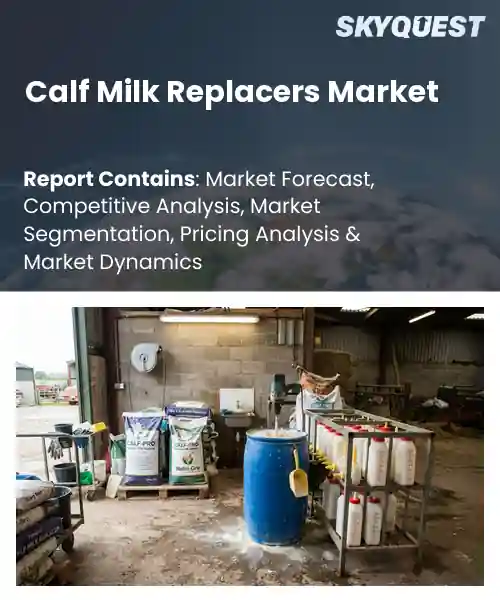
Calf Milk Replacers Market
Report ID: SQMIG30H2574
Report ID: SQMIG30H2574
[email protected]
USA +1 351-333-4748
Report ID:
SQMIG30H2574 |
Region:
Global |
Published Date: September, 2026
Pages:
157
|Tables:
142
|Figures:
78


Global Calf Milk Replacers Market size was valued at USD 2.83 Billion in 2024 and is poised to grow from USD 3.0 Billion in 2025 to USD 4.73 Billion by 2033, growing at a CAGR of 5.87% during the forecast period (2026-2033).
The global calf milk replacer market provides formulated liquid or powdered feeds that replace maternal colostrum and milk for dairy calves, delivering essential nutrition in the pre‑weaning period. Its relevance lies in the direct connection between early calf health and future milk output, prompting farms to use balanced replacers that cut disease risk and boost growth. The market originated in the 1970s after research exposed gaps in traditional feeding, then grew with high‑protein, low‑lactose products. A Midwest dairy that adopted a powdered replacer in 2015 saw a 12 % rise in average daily gain, showing the shift from niche to mainstream. The principal growth driver now is the intensification of dairy operations, which creates demand for scalable nutrition solutions that lower labor and veterinary costs. As herd sizes expand, producers favor milk replacers that can be dosed automatically, reducing reliance on skilled labor and mitigating the variability of on‑farm milk quality. This efficiency gain directly translates into higher profit margins; for instance, a California dairy implemented an automated dispensing system for a low‑lactose replacer, cutting feed wastage by 18 % and shrinking morbidity rates. Consequently, manufacturers are investing in tailored formulations and monitoring tools, unlocking significant market opportunities across emerging dairy regions.
How is AI driving formulation optimization and cost efficiency in the calf milk replacers market?
AI is reshaping calf milk replacer formulation by integrating large datasets on nutrient bioavailability, feed intake patterns and health outcomes. Machine‑learning models predict the optimal balance of proteins, fats and minerals for different growth stages, reducing trial‑and‑error cycles. This accelerates product development and cuts raw‑material waste as formulations are fine‑tuned before large‑scale production. Suppliers can quickly adjust recipes to seasonal ingredient price shifts, maintaining profitability while meeting strict nutritional standards. The technology also enables real‑time monitoring of calf performance, feeding those insights back into the algorithm to continuously improve efficacy and cost efficiency. As dairy farms adopt precision‑feeding practices, AI‑driven solutions become a core competitive advantage in the calf milk replacer market.Alltech announced an AI‑enhanced formulation platform for calf milk replacers in April 2024, demonstrating how predictive analytics streamline ingredient selection and lower production costs, thereby supporting market growth and operational efficiency.
Market snapshot - (2026-2033)
Global Market Size
USD 2.83 Billion
Largest Segment
Milk-Based Replacers
Fastest Growth
Plant-Based Replacers
Growth Rate
5.87% CAGR
To get more insights on this market click here to Request a Free Sample Report
Global calf milk replacers market is segmented by product type, form, protein content, application, distribution channel and region. Based on product type, the market is segmented into Milk-Based Replacers, Plant-Based Replacers and Whey-Based Replacers. Based on form, the market is segmented into Powder and Liquid. Based on protein content, the market is segmented into Low Protein, Medium Protein and High Protein. Based on application, the market is segmented into Dairy Calves and Beef Calves. Based on distribution channel, the market is segmented into Agricultural Cooperatives, Specialty Feed Stores and Online Retail. Based on region, the market is segmented into North America, Europe, Asia Pacific, Latin America and Middle East & Africa.
Milk-Based Replacers segment dominates because it closely mimics the natural composition of bovine colostrum, delivering essential nutrients that support early immune development and growth. Producers trust its proven efficacy, leading to widespread preference across herd management programs. The familiarity of dairy farmers with milk-derived formulas, combined with consistent performance outcomes, reinforces its central position in the market and drives sustained demand. Additionally, the established supply chains and regulatory approvals further cement its dominance.
Meanwhile, Plant Based Replacers segment emerges as the key high growth area because rising consumer interest in sustainable livestock practices fuels experimentation with alternative protein sources. Innovations in formulation improve digestibility and palatability, encouraging adoption among environmentally conscious producers and opening new channels for market expansion and long term profitability.
Powder segment dominates because its long shelf life and ease of transport reduce logistical complexities for farms operating in remote locations. The ability to reconstitute precise nutrient ratios on site offers flexibility in feeding schedules, aligning with routine farm operations. Familiarity with mixing protocols and lower handling costs reinforce its preference among producers seeking reliable, cost effective solutions. Additionally, the ability to store large batches without spoilage supports bulk purchasing, further enhancing its appeal.
On the other hand, Liquid segment is witnessing the strongest growth momentum because it provides immediate ready to feed convenience, eliminating mixing errors and saving labor time. Preservation advances extend shelf stability, making it attractive for operations that value speed and hygiene. This convenience drives adoption across farms, accelerating market expansion and opening product opportunities.
To get detailed segments analysis, Request a Free Sample Report
North America maintains a leading position in the calf milk replacer landscape due to a synergistic combination of mature dairy operations, cutting‑edge nutritional science, and highly integrated supply chains. Producers benefit from extensive research collaborations with academic institutions that accelerate formulation improvements, while large‑scale feed manufacturers provide consistent product quality. Consumers place strong trust in animal health standards, prompting retailers to prioritize premium replacer options. Moreover, regulatory agencies uphold rigorous safety criteria, fostering confidence among producers and encouraging continual investment in innovation. Advanced logistics networks ensure rapid distribution to remote farms, reducing downtime and supporting herd productivity. In addition, the presence of multinational feed companies accelerates the diffusion of best practices across the region, reinforcing a culture of continuous improvement.
Calf Milk Replacers Market is shaped by a broad base of large‑scale dairy operations that prioritize performance‑driven nutrition. Producers collaborate closely with veterinary experts to tailor formulations that address specific health challenges, while a well‑established distribution framework ensures product availability across diverse geographic zones. The emphasis on research and development, supported by substantial private investment, fuels ongoing refinement of protein and mineral profiles suited to intensive herd management.
Calf Milk Replacers Market benefits from a collaborative ecosystem where dairy cooperatives and feed producers share technical expertise to enhance calf health outcomes. Stringent animal welfare guidelines drive adoption of high‑quality replacer blends that emphasize digestibility and immune support. Regional research institutes contribute scientific insights that are rapidly translated into commercial products, while a strong focus on sustainability encourages the integration of environmentally responsible sourcing practices throughout the supply chain.
Europe experiences a swift expansion of the calf milk replacer segment as producers align with evolving consumer expectations for animal welfare and product traceability. The region’s long‑standing dairy heritage combined with rigorous quality standards propels investment in premium nutrition solutions that support early‑life growth and disease resistance. Collaborative research initiatives across academic and industry partners foster innovation in lactose‑free and nutritionally balanced formulations. Governments reinforce progress through policies that encourage sustainable farming practices, while trade networks facilitate efficient cross‑border distribution of specialist products. Retail chains increasingly prioritize shelf‑space for scientifically validated replacers, reinforcing demand among smallholder and large‑scale operations alike. Additionally, heightened emphasis on reducing antibiotic usage encourages producers to adopt nutrition‑driven preventive strategies, thereby elevating the relevance of high‑quality calf milk replacers across the value chain.
Calf Milk Replacers Market is anchored by a strong tradition of precision farming that emphasizes nutritional optimisation from birth. German dairy enterprises collaborate closely with feed scientists to develop replacer blends that balance protein efficiency with mineral bioavailability. Rigorous certification schemes ensure product consistency, while a dense network of specialty distributors guarantees rapid delivery to farms of all sizes. The collective focus on technical excellence sustains Germany’s position as a leading market in the region.
Calf Milk Replacers Market in United Kingdom experiences rapid adoption driven by heightened awareness of calf wellbeing among producers. Innovative startups introduce flexible, modular replacer solutions that cater to variable herd sizes, while established manufacturers expand portfolio ranges to include environmentally friendly ingredients. Industry bodies promote best‑practice guidelines that integrate nutrition with biosecurity, encouraging farms to transition away from traditional milk feeding. This dynamic environment positions the United Kingdom as a fast‑moving hub for market expansion.
Calf Milk Replacers Market benefits from France’s emphasis on terroir‑linked dairy quality, encouraging producers to seek nutrition that aligns with premium cheese and milk production standards. Collaborative projects between agronomic research centres and feed manufacturers yield replacer formulations enriched with locally sourced botanical extracts that support digestive health. A well‑developed retail framework facilitates easy acquisition of specialist products, while governmental incentives for sustainable livestock practices reinforce the shift toward scientifically formulated calf nutrition across the country.
Asia Pacific is progressively cementing its role in the calf milk replacer arena through a blend of technological adoption and expanding dairy sectors. Producers in the region prioritize efficiency gains, turning to nutritionally precise replacers that support rapid early growth while minimizing feed wastage. Growing research collaborations with international institutions accelerate the introduction of formulations that incorporate region‑specific feed ingredients and climate‑adapted nutrient profiles. Government initiatives that promote modern livestock management encourage smallholder farms to upgrade feeding practices, creating broader demand for specialised products. Integrated logistics networks, bolstered by advances in cold‑chain capabilities, ensure timely distribution even to remote farming communities. This coordinated effort of innovation, policy support, and infrastructure development propels Asia Pacific’s ascent in the global market. Consumer awareness of animal health benefits further fuels investment in science‑backed feeding solutions across emerging dairy clusters.
Calf Milk Replacers Market in Japan reflects a sophisticated approach to calf nutrition, driven by a culture of meticulous farm management and high consumer expectations for dairy quality. Japanese feed manufacturers integrate cutting‑edge probiotic technologies to enhance gut health, while collaborating with veterinary experts to fine‑tune mineral balances specific to local breed characteristics. The presence of extensive research facilities accelerates product validation, and a well‑organized distribution system ensures prompt availability to both large‑scale operations and family‑run farms. Emphasis on sustainability encourages the use of renewable feed inputs, reinforcing Japan’s commitment to responsible livestock production.
Calf Milk Replacers Market in South Korea is evolving rapidly as dairy farms modernize and adopt science‑driven feeding protocols. Local manufacturers focus on creating replacer blends that combine high protein efficiency with digestible carbohydrate sources, aligned with national guidelines for animal health. Partnerships with agricultural universities foster continuous improvement of formulae, incorporating indigenous seed extracts that enhance immunity. A responsive supply chain, supported by advanced cold‑storage infrastructure, enables swift delivery to both industrial dairy complexes and smaller husbandry operations, reinforcing the market’s upward momentum.
To know more about the market opportunities by region and country, click here to
Buy The Complete Report
Increasing Demand For Premium Nutrition
Expansion Of Dairy Farming Operations
High Cost Of Specialized Formulas
Regulatory Complexity Across Regions
Request Free Customization of this report to help us to meet your business objectives.
The competitive landscape of the global calf milk replacers market is shaped by intense rivalry among established dairy nutrition leaders and emerging innovators, with recent M&A activity, strategic partnerships, and technology‑driven product enhancements driving differentiation; for example, a leading nutrition firm acquired a specialty probiotic startup to integrate gut‑health solutions, while another major player partnered with a feed‑technology company to launch a precision‑formulated replacer targeting early‑life growth performance.
Top Player’s Company Profile
Recent Developments
SkyQuest’s ABIRAW (Advanced Business Intelligence, Research & Analysis Wing) is our Business Information Services team that Collects, Collates, Correlates, and Analyses the Data collected by means of Primary Exploratory Research backed by robust Secondary Desk research. As per SkyQuest analysis, the global calf milk replacers market is being propelled primarily by the rising demand for premium nutrition that boosts pre‑weaning health and growth, while a second strong driver is the expansion of dairy farming operations that seek scalable, automated feeding solutions. The market is led by North America, where mature supply chains and research support robust adoption, and the milk‑based replacer segment remains dominant because it most closely mimics natural colostrum. However, the high cost of specialized formulas acts as a restraint, limiting uptake among smaller producers and tempering overall growth. Together these forces shape a market poised for steady expansion.
| Report Metric | Details |
|---|---|
| Market size value in 2024 | USD 2.83 Billion |
| Market size value in 2033 | USD 4.73 Billion |
| Growth Rate | 5.87% |
| Base year | 2024 |
| Forecast period | (2026-2033) |
| Forecast Unit (Value) | USD Billion |
| Segments covered |
|
| Regions covered | North America (US, Canada), Europe (Germany, France, United Kingdom, Italy, Spain, Rest of Europe), Asia Pacific (China, India, Japan, Rest of Asia-Pacific), Latin America (Brazil, Rest of Latin America), Middle East & Africa (South Africa, GCC Countries, Rest of MEA) |
| Companies covered |
|
| Customization scope | Free report customization with purchase. Customization includes:-
|
To get a free trial access to our platform which is a one stop solution for all your data requirements for quicker decision making. This platform allows you to compare markets, competitors who are prominent in the market, and mega trends that are influencing the dynamics in the market. Also, get access to detailed SkyQuest exclusive matrix.
Table Of Content
Executive Summary
Market overview
Parent Market Analysis
Market overview
Market size
KEY MARKET INSIGHTS
COVID IMPACT
MARKET DYNAMICS & OUTLOOK
Market Size by Region
KEY COMPANY PROFILES
Methodology
For the Calf Milk Replacers Market, our research methodology involved a mixture of primary and secondary data sources. Key steps involved in the research process are listed below:
1. Information Procurement: This stage involved the procurement of Market data or related information via primary and secondary sources. The various secondary sources used included various company websites, annual reports, trade databases, and paid databases such as Hoover's, Bloomberg Business, Factiva, and Avention. Our team did 45 primary interactions Globally which included several stakeholders such as manufacturers, customers, key opinion leaders, etc. Overall, information procurement was one of the most extensive stages in our research process.
2. Information Analysis: This step involved triangulation of data through bottom-up and top-down approaches to estimate and validate the total size and future estimate of the Calf Milk Replacers Market.
3. Report Formulation: The final step entailed the placement of data points in appropriate Market spaces in an attempt to deduce viable conclusions.
4. Validation & Publishing: Validation is the most important step in the process. Validation & re-validation via an intricately designed process helped us finalize data points to be used for final calculations. The final Market estimates and forecasts were then aligned and sent to our panel of industry experts for validation of data. Once the validation was done the report was sent to our Quality Assurance team to ensure adherence to style guides, consistency & design.
Analyst Support
Customization Options
With the given market data, our dedicated team of analysts can offer you the following customization options are available for the Calf Milk Replacers Market:
Product Analysis: Product matrix, which offers a detailed comparison of the product portfolio of companies.
Regional Analysis: Further analysis of the Calf Milk Replacers Market for additional countries.
Competitive Analysis: Detailed analysis and profiling of additional Market players & comparative analysis of competitive products.
Go to Market Strategy: Find the high-growth channels to invest your marketing efforts and increase your customer base.
Innovation Mapping: Identify racial solutions and innovation, connected to deep ecosystems of innovators, start-ups, academics, and strategic partners.
Category Intelligence: Customized intelligence that is relevant to their supply Markets will enable them to make smarter sourcing decisions and improve their category management.
Public Company Transcript Analysis: To improve the investment performance by generating new alpha and making better-informed decisions.
Social Media Listening: To analyze the conversations and trends happening not just around your brand, but around your industry as a whole, and use those insights to make better Marketing decisions.
REQUEST FOR SAMPLE
 REQUEST FREE CUSTOMIZATION


Want to customize this report? This report can be personalized according to your needs. Our analysts and industry experts will work directly with you to understand your requirements and provide you with customized data in a short amount of time. We offer $1000 worth of FREE customization at the time of purchase.
Feedback From Our Clients


 USA (+1) 351-333-4748

