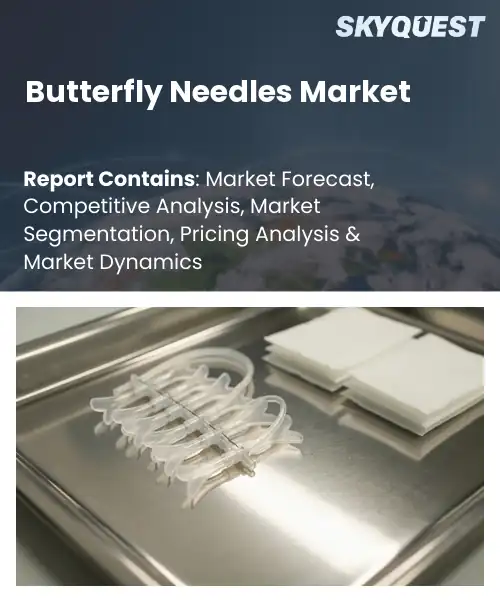
Butterfly Needles Market
Report ID: SQMIG35A3332
Report ID: SQMIG35A3332
[email protected]
USA +1 351-333-4748
Report ID:
SQMIG35A3332 |
Region:
Global |
Published Date: March, 2026
Pages:
157
|Tables:
114
|Figures:
77


Global Butterfly Needles Market size was valued at USD 1.30 Billion in 2024 and is poised to grow from USD 1.41 Billion in 2025 to USD 2.75 Billion by 2033, growing at a CAGR of 8.7% during the forecast period (2026-2033).
Key Takeaways: Market Trends & Insights
The butterfly needles market comprises winged infusion sets used for venous access in phlebotomy, infusion and blood collection, and it matters because these devices shape patient comfort, sampling reliability and safety across hospitals, diagnostic labs and home care. The increase in the demand for safer medical devices to draw blood from patients is driving the growth of the number of blood draws performed each year. This progression has developed into the modified designs of a metal needle to a more advanced design including modified tubing, various gauges, and an integrated safety feature.
Building on that trajectory, the key trend driving the global butterfly needles sector is regulatory pressure for safer devices combined with expanding outpatient and home-care testing, which together drive procurement. When hospitals and clinics respond to needlestick reduction mandates by specifying safety-shielded sets, manufacturers invest in ergonomic designs and automated shields, causing broader adoption and economies of scale that lower unit costs. In practice oncology infusion centers and mobile phlebotomy services adopt disposable winged sets to improve patient throughput and reduce occupational injuries, and as emerging markets upgrade labs, demand rises further creating opportunities for cost-competitive, environmentally friendlier product lines.
How is AI Improving Product Design and Safety in the Butterfly Needles Market?
AI is improving product design and safety in the butterfly needles market by shaping how devices are conceived tested and deployed. Designers use machine learning to analyze insertion forces vein anatomy and material behavior to refine bevel shape and tubing flexibility. In manufacturing AI driven visual inspection improves quality control and reduces defective units. The market is moving toward smarter safety features molded to clinical workflows and to products that are easier for clinicians to use and safer for patients and staff.
In December 2023, Butterfly Network announced a commercialization deal with Mendaera to combine its semiconductor ultrasound and AI imaging with robotic guidance for needle procedures which illustrates how AI enhanced visualization and automation can improve placement accuracy and support broader adoption of safer butterfly needle use.
Market snapshot - 2026-2033
Global Market Size
USD 1.3 Billion
Largest Segment
Winged Butterfly Needles
Fastest Growth
Safety Butterfly Needles
Growth Rate
8.7% CAGR
To get more insights on this market click here to Request a Free Sample Report
Global butterfly needles market is segmented by product type, application, end user, material type and region. Based on product type, the market is segmented into winged butterfly needles and safety butterfly needles. Based on application, the market is segmented into intravenous therapy and blood sampling. Based on end user, the market is segmented into hospitals, emergency clinics and home healthcare. Based on material type, the market is segmented into plastic and glass. Based on region, the market is segmented into North America, Europe, Asia Pacific, Latin America and Middle East & Africa.
Based on the global butterfly needles market growth, safety butterfly needles segment dominates because healthcare providers increasingly prioritize devices that minimize occupational hazards and comply with stringent safety regulations. The features of engineered security, combined with the compatibility of institutional safety protocols, generate enthusiasm for their use throughout all clinical settings. When making purchasing decisions, buyers choose products that reduce exposure risks. Which encourages manufacturers to develop safer versions of the same products and encourage more widespread use of these items in standard venous access procedures.
However, winged butterfly needles are emerging as the most rapidly expanding area due to enduring clinician familiarity and ongoing product refinements that enhance usability for blood collection and delicate venous access. Enhancements in all tubing lengths; needle gauge options; and ease of packaging will expand the range of clinical uses and create new possibilities for diagnostics and procedural workflows in the outpatient environment.
Hospitals segment dominates because large clinical centers require reliable venous access products across multiple departments and purchase through centralized contracting. Due to high volumes of patients seen within care facilities and the high degree of difficulty associated with completing procedures, the development of products that fulfill the requirements for safety, traceability, and continuity of supply is critical. This encourages hospitals to standardize the products they use and motivates manufacturers to develop products specifically for use in hospitals with a focus on compliance with regulations and hospital-specific functionality.
However, home healthcare is emerging as the fastest growing area because expanding outpatient therapies and chronic care delivery outside institutional settings increase demand for simple, safe, and caregiver-friendly venous access solutions. Manufacturers are developing ready-to-use kits, patient education tools, and adaptable packaging to support decentralized care, opening new procurement channels and long-term adoption beyond traditional clinical environments.
To get detailed segments analysis, Request a Free Sample Report
As per the global butterfly needles market share, North America dominates due to a mature healthcare ecosystem characterized by advanced clinical infrastructure, well established procurement channels, and high clinical adoption of safety and comfort-oriented venipuncture devices. The major factor to accelerate product innovations and product availability in the market today result directly from significant concentrations of R&D investments, high levels of collaboration among major manufacturers, and major hospitals/system partners working together. The established regulatory and quality standards allow clinicians to feel confident about the clinical usage of these products. Training programs, along with the growing number of outpatient diagnostic services, also create consistent demand. The established reimbursement methodologies, combined with the high level of public awareness and knowledge about the new methods of minimally invasive blood collection, serve to strengthen their position as market leaders. However, they also permit rapid integration of the new designs, and competition revolves around reliability of shipments, supply chain resiliency, and ease of use by clinicians.
Butterfly needles market in United States is shaped by concentrated clinical demand from hospitals and diagnostic centers, active manufacturer presence, and continuous product refinement focused on safety and user comfort. Close collaboration among suppliers, clinicians, and procurement teams accelerates adoption of enhanced designs. Broad availability through established distribution and specialized procurement channels supports diverse care settings, including outpatient and home care, reinforcing steady clinical preference for quality and convenience delivery.
Butterfly needles market in Canada reflects strong alignment between public health systems and medical suppliers, with emphasis on safe, patient friendly venipuncture solutions and clinician training. By creating regional procurement networks, we can ensure that we reach both urban and remote care settings. Our focus on product reliability, along with compatibility to diagnostic workflows, promotes their use within both hospital labs and community clinics. Collaborating continuously with health authorities keeps the emphasis on maintaining quality and establishing standardized clinical practice.
Based on global butterfly needles regional forecast, Europe is experiencing rapid expansion driven by a combination of increasing diagnostic activity across varied care settings, harmonized regulatory frameworks that facilitate market entry, and a strong regional medtech manufacturing base that fosters product variety and quality. Clinicians prioritize patient comfort and occupational safety, which leads to the increasing adoption of specialized venipuncture solutions. Recent growth in the private and outpatient diagnostic service markets has created additional channels of distribution for these supplies. Large scale distribution efforts will benefit from collaborative projects between hospitals, laboratories and procurement organizations, as well as localized innovation hubs providing the necessary design modifications to fit their various clinical environments. Cross border distribution networks and public procurement processes will continue to enhance distribution options, thus establishing Europe as an exciting and evolving marketplace for both established butterfly needle products and newer product offerings.
Butterfly needles market in Germany benefits from a concentrated medtech manufacturing base and a stringent regulatory culture that emphasizes product quality and clinical evidence. Public procurement policies and strong supply chains create a wide reach across many different types of healthcare settings. Continued acknowledgement of engineering excellence gives institutions opportunities to continue innovating.
Butterfly needles market in United Kingdom is characterized by rapid adoption across private and public diagnostic channels, driven by a strong innovation ecosystem and active clinical evaluation. Patient experience and worker safety find a common goal for facilitating the use of easy-to-use and comfortable devices. The use of agile procurement methods and cooperative arrangements between start-up suppliers and established suppliers allows for speedy introduction into the market. The growth in home sampling and community diagnostic services increases the number of access points and fuels the growth of usage.
Butterfly needles market in France is emerging through modernization of clinical services and growing emphasis on patient centered blood collection. Increasingly, hospitals & private labs are evaluating devices for both safety & ease of use while also expanding their regional procurement initiatives to provide access to various care settings. Investments in clinician training help support acceptance. The following is an overview of how collaboration between local & international suppliers helps customize product features according to national practice standards & regulations.
As per global butterfly needles regional outlook, Asia Pacific is strengthening its position through expanded clinical infrastructure, rising diagnostic capacity, and targeted investment in medical device manufacturing and adaptation. Furthermore, the growing number of diagnostic services available in the community and home collection efforts will lead to increased demand for easier to use venipuncture devices. As clinicians and phlebotomists undergo training, aligning regulatory and building capacity will help clinicians and phlebotomists develop greater confidence in how well the device will perform. Lastly, a wider distribution network and formation of strategic business relationships across multiple countries will provide greater access to the Asia Pacific region as it transitions from having been a niche market, to becoming a leading innovation driven market in terms of demand.
Butterfly needles market in Japan is driven by an established medical device industry and a strong focus on product quality and clinical evidence. Hospitals, and diagnostic centers, prefer designs that offer optimum comfort to patients along with maximum procedural efficiency. Design improvement is supported by the active collaboration of domestic manufacturers and their international technology partners. Distribution network strength and clinician training programs provide a high level of confidence to healthcare providers in the availability of these products throughout hospital, laboratory and home care settings.
Butterfly needles market trends in South Korea reflects strong technology adoption and a proactive manufacturing sector that focuses on compact, user-friendly designs. Hospitals, specialty clinics, and diagnostic laboratories engage in product evaluations that emphasize safety and ergonomic performance. Device manufacturers collaborate with clinical users to improve device features, as exporters create efficiencies that increase volume. Training programs and distribution networks help to foster the use of devices in a wide variety of settings within the community.
To know more about the market opportunities by region and country, click here to
Buy The Complete Report
Rising Demand for Safer Procedures
Technological Advancements in Design
Regulatory Approval Complexity and Variability
Limited Reimbursement and Budget Pressure
Request Free Customization of this report to help us to meet your business objectives.
The competitive landscape in the global butterfly needles market outlook is shaped by consolidation and rapid product innovation. Large strategic moves such as the ICU Medical acquisition of Smiths Medical and recent safety device clearances have intensified competition on safety and usability. Companies pursue acquisitions partnerships and targeted device innovation to win hospital and outpatient contracts while launching safety slides and pre-appointed holder designs as concrete examples.
SkyQuest’s ABIRAW (Advanced Business Intelligence, Research & Analysis Wing) is our Business Information Services team that Collects, Collates, Correlates, and Analyses the Data collected by means of Primary Exploratory Research backed by robust Secondary Desk research.
As per SkyQuest analysis, the global butterfly needles industry is propelled primarily by rising demand for safer, minimally invasive, safety-engineered devices that reduce needlestick injuries and improve patient comfort, with technological advancements in design further enhancing usability and adoption. The largest share of growth occurs in North America due primarily to its mature healthcare infrastructure and robust procurement methods; the Safety Butterfly Needle category has the largest share of market growth, due to the fact that institutions are placing the greatest emphasis on engineered protective features. The complexity and variability of regulatory approvals represent a serious barrier, which slows down the introduction of new products, as well as increases production costs for manufacturers, particularly small manufacturers. The continuing evolution of this market will be the result of innovation, the expansion of home-care options, and product redesigns to achieve sustainability.
| Report Metric | Details |
|---|---|
| Market size value in 2024 | USD 1.30 Billion |
| Market size value in 2033 | USD 2.75 Billion |
| Growth Rate | 8.7% |
| Base year | 2024 |
| Forecast period | 2026-2033 |
| Forecast Unit (Value) | USD Billion |
| Segments covered |
|
| Regions covered | North America (US, Canada), Europe (Germany, France, United Kingdom, Italy, Spain, Rest of Europe), Asia Pacific (China, India, Japan, Rest of Asia-Pacific), Latin America (Brazil, Rest of Latin America), Middle East & Africa (South Africa, GCC Countries, Rest of MEA) |
| Companies covered |
|
| Customization scope | Free report customization with purchase. Customization includes:-
|
To get a free trial access to our platform which is a one stop solution for all your data requirements for quicker decision making. This platform allows you to compare markets, competitors who are prominent in the market, and mega trends that are influencing the dynamics in the market. Also, get access to detailed SkyQuest exclusive matrix.
Table Of Content
Executive Summary
Market overview
Parent Market Analysis
Market overview
Market size
KEY MARKET INSIGHTS
COVID IMPACT
MARKET DYNAMICS & OUTLOOK
Market Size by Region
KEY COMPANY PROFILES
Methodology
For the Butterfly Needles Market, our research methodology involved a mixture of primary and secondary data sources. Key steps involved in the research process are listed below:
1. Information Procurement: This stage involved the procurement of Market data or related information via primary and secondary sources. The various secondary sources used included various company websites, annual reports, trade databases, and paid databases such as Hoover's, Bloomberg Business, Factiva, and Avention. Our team did 45 primary interactions Globally which included several stakeholders such as manufacturers, customers, key opinion leaders, etc. Overall, information procurement was one of the most extensive stages in our research process.
2. Information Analysis: This step involved triangulation of data through bottom-up and top-down approaches to estimate and validate the total size and future estimate of the Butterfly Needles Market.
3. Report Formulation: The final step entailed the placement of data points in appropriate Market spaces in an attempt to deduce viable conclusions.
4. Validation & Publishing: Validation is the most important step in the process. Validation & re-validation via an intricately designed process helped us finalize data points to be used for final calculations. The final Market estimates and forecasts were then aligned and sent to our panel of industry experts for validation of data. Once the validation was done the report was sent to our Quality Assurance team to ensure adherence to style guides, consistency & design.
Analyst Support
Customization Options
With the given market data, our dedicated team of analysts can offer you the following customization options are available for the Butterfly Needles Market:
Product Analysis: Product matrix, which offers a detailed comparison of the product portfolio of companies.
Regional Analysis: Further analysis of the Butterfly Needles Market for additional countries.
Competitive Analysis: Detailed analysis and profiling of additional Market players & comparative analysis of competitive products.
Go to Market Strategy: Find the high-growth channels to invest your marketing efforts and increase your customer base.
Innovation Mapping: Identify racial solutions and innovation, connected to deep ecosystems of innovators, start-ups, academics, and strategic partners.
Category Intelligence: Customized intelligence that is relevant to their supply Markets will enable them to make smarter sourcing decisions and improve their category management.
Public Company Transcript Analysis: To improve the investment performance by generating new alpha and making better-informed decisions.
Social Media Listening: To analyze the conversations and trends happening not just around your brand, but around your industry as a whole, and use those insights to make better Marketing decisions.
REQUEST FOR SAMPLE
 REQUEST FREE CUSTOMIZATION
Global Butterfly Needles Market size was valued at USD 1.3 Billion in 2024 and is poised to grow from USD 1.41 Billion in 2025 to USD 2.75 Billion by 2033, growing at a CAGR of 8.7% during the forecast period (2026-2033).
The competitive landscape in the global butterfly needles market is shaped by consolidation and rapid product innovation. Large strategic moves such as the ICU Medical acquisition of Smiths Medical and recent safety device clearances have intensified competition on safety and usability. Companies pursue acquisitions partnerships and targeted device innovation to win hospital and outpatient contracts while launching safety slide and pre attached holder designs as concrete examples. 'Becton Dickinson and Company', 'Medline Industries, Inc.', 'Terumo Corporation', 'Smiths Medical', 'Covidien', 'Nipro Corporation', 'Cardinal Health', 'Amsino International', 'HAIN Lifecare', 'Medtronic', 'B. Braun Melsungen AG', 'Hollister Incorporated', 'Alaris Medical Systems', 'Stryker Corporation', 'MIVI Neuroscience', 'Rex Medical', 'AngioDynamics', 'Infinity Medical', 'Ethicon', 'Merit Medical Systems'
Growing emphasis on patient safety and infection prevention in clinical and home care settings has increased preference for devices that reduce needlestick risk, driving adoption of butterfly needles with improved safety features. Healthcare providers prioritize products that enhance venipuncture accuracy and comfort, resulting in stronger procurement focus on devices that streamline workflows and reduce complications. This shift in clinical priorities supports broader market expansion as stakeholders favor reliable consumables that align with safety protocols and quality-of-care objectives. Manufacturers respond by investing in design and distribution to meet clinician expectations.
Sustainable Materials Adoption: Manufacturers are prioritizing sustainable materials and eco-design to meet rising purchaser and institutional expectations for reduced environmental impact. Demand favors recyclable, biodegradable, or bio-based polymers and minimized packaging, prompting product redesigns and new supplier partnerships. Sustainability claims influence procurement decisions and brand reputation, encouraging investment in life-cycle assessments and sterilization-compatible materials. Adoption also drives differentiation through transparent sourcing and circularity initiatives, while regulatory and payer environments increasingly reward demonstrable environmental stewardship across the product lifecycle and measurable waste reduction goals.
North America Dominate the Global Butterfly Needles Market.
The market is segmented by product type (standard and safety butterfly needles), application (blood collection, IV therapy, drug delivery, venipuncture), end user (hospitals, diagnostic laboratories, blood banks, home healthcare, clinics), gauge size (18G–33G), and geography.
AI is improving product design and safety by analyzing insertion forces, vein anatomy, and material behavior using machine learning to refine bevel shape and tubing flexibility. In manufacturing, AI-driven visual inspection enhances quality control and reduces defective units.


Want to customize this report? This report can be personalized according to your needs. Our analysts and industry experts will work directly with you to understand your requirements and provide you with customized data in a short amount of time. We offer $1000 worth of FREE customization at the time of purchase.
Feedback From Our Clients


 USA (+1) 351-333-4748

