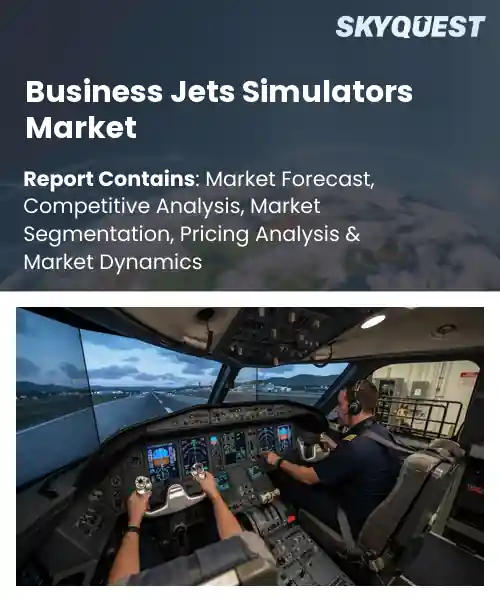
Business Jets Simulators Market
Report ID: SQMIG20A2886
Report ID: SQMIG20A2886
[email protected]
USA +1 351-333-4748
Report ID:
SQMIG20A2886 |
Region:
Global |
Published Date: August, 2026
Pages:
157
|Tables:
117
|Figures:
77


Global Business Jets Simulators Market size was valued at USD 1.92 Billion in 2024 and is poised to grow from USD 2.07 Billion in 2025 to USD 3.8 Billion by 2033, growing at a CAGR of 7.88% during the forecast period (2026-2033).
The global business‑jet simulator market provides platforms that replicate midsize and large corporate aircraft. Its primary driver is the rapid expansion of the business‑jet fleet, which forces operators to meet stricter safety standards while containing pilot‑training costs. Over the past two decades the sector has moved from mechanical link‑age rigs to fully integrated digital suites that combine motion platforms, visual immersion and data analytics. Companies such as CAE and FlightSafety International illustrate this shift by delivering turnkey solutions with weather modeling and networked multi‑crew scenarios. As operators seek to reduce on‑aircraft training time, simulators become a cost‑saving and risk‑mitigation tool. Building on the fleet‑driven demand, the key factor shaping the market is the integration of technologies that enhance training realism while lowering operational expenses. When manufacturers embed virtual‑reality headsets and scenario generators into simulators, pilots can practice emergency procedures without consuming fuel or risking aircraft wear, which in turn drives adoption among operators seeking sustainable solutions. For example, NetJets recently deployed a VR‑augmented trainer that reduced check duration by fifteen percent, freeing aircraft for flights. This efficiency gain creates a feedback loop: cost savings encourage investment in advanced modules, expanding the addressable market for software providers and hardware vendors alike.
How is AI enhancing realism and training efficiency in the business jet simulators market?
AI is reshaping business‑jet simulators by embedding deep‑learning models that generate lifelike flight dynamics, weather patterns and cockpit interactions. These models process real flight data to reproduce subtle aircraft responses, making scenarios feel authentic for pilots. The technology also streamlines lesson planning; AI analyses trainee performance, highlights skill gaps and suggests targeted exercises, reducing repetitive training cycles. Operators benefit from faster turnaround between missions because virtual environments can be reconfigured instantly without hardware changes. As airlines demand higher safety standards and cost‑effective training, AI‑driven simulators are becoming central to modern pilot development programs, delivering immersive experiences that mirror real‑world operations.In July 2024, FlightSafety International introduced an AI‑enhanced full‑flight simulator for the Gulfstream G650, showcasing how predictive analytics and adaptive scenario generation cut training time while raising realism, thereby accelerating market adoption.
Market snapshot - (2026-2033)
Global Market Size
USD 1.92 Billion
Largest Segment
Full Flight Simulators
Fastest Growth
Virtual Reality Simulators
Growth Rate
7.88% CAGR
To get more insights on this market click here to Request a Free Sample Report
Global business jets simulators market is segmented by simulator type, training type, aircraft category, end user and region. Based on simulator type, the market is segmented into Full Flight Simulators, Fixed Base Simulators and Virtual Reality Simulators. Based on training type, the market is segmented into Pilot Training, Recurrent Training and Type Rating Training. Based on aircraft category, the market is segmented into Light Business Jets, Mid-Size Business Jets and Large Business Jets. Based on end user, the market is segmented into Flight Training Centers, Aircraft Operators and Aviation Academies. Based on region, the market is segmented into North America, Europe, Asia Pacific, Latin America and Middle East & Africa.
Full Flight Simulators segment dominates because it replicates the complete flight envelope, providing pilots with immersive sensory cues that mirror real aircraft behavior. This fidelity satisfies stringent certification requirements and gives operators confidence in training outcomes. The comprehensive hardware and software integration reduces the need for actual flight hours, lowering operational costs and enhancing safety culture. Consequently, it becomes the preferred choice for organizations seeking thorough preparedness. Meanwhile, Virtual Reality Simulators are witnessing the strongest growth momentum as light head mounted displays and scalable software enable cost effective portable training solutions. Their ability to rapidly configure new scenarios appeals to operators expanding curricula, and ongoing advancements in haptic feedback boost realism, positioning them as a catalyst for broader market adoption.
Pilot Training segment leads because it forms the foundational skill set required for operating business jets, ensuring compliance with regulatory standards and safety protocols. Training providers prioritize comprehensive curricula that cover normal and emergency procedures, driving continuous investment in high fidelity simulators. This core necessity sustains steady procurement cycles and reinforces the market’s revenue base. These programs foster relationships with aircraft manufacturers who embed simulator usage into delivery packages, entrenching demand. On the other hand, Type Rating Training emerges as the fastest growing area as operators seek specialized qualification for diverse jet models. Emerging regulatory emphasis on model specific competency and the proliferation of mixed fleets drive operators to invest in targeted simulators. This focus expands simulator configurations and fuels market diversification, unlocking new revenue streams.
To get detailed segments analysis, Request a Free Sample Report
North America commands the global Business Jets Simulators market through a combination of deep aerospace heritage, extensive corporate jet fleets, and sophisticated training ecosystems. The United States hosts a concentration of leading aircraft manufacturers and flight‑training institutions that drive continuous investment in high‑fidelity simulation platforms. Canada contributes a strong regulatory framework and government support for advanced aviation technologies, fostering collaborative research and development. Both nations benefit from a culture that prioritizes safety and operational excellence, encouraging operators to adopt simulation‑based training as a core competency. The presence of major defense and aerospace contractors also accelerates innovation, ensuring that simulation solutions remain at the cutting edge of realism and reliability.
Business Jets Simulators Market in United States thrives on a robust network of aerospace manufacturers, flight schools, and corporate operators that demand state‑of‑the‑art training tools. The ecosystem benefits from close collaboration between industry leaders and technology providers, resulting in rapid integration of immersive visual systems and motion platforms. Emphasis on safety culture and regulatory compliance fuels continuous upgrades, while a deep talent pool of engineers and pilots sustains a cycle of innovation and operational excellence.
Business Jets Simulators Market in Canada is reinforced by strong governmental emphasis on aviation safety and innovation. Collaborative initiatives between research institutions and aircraft operators promote the development of locally adapted simulation technologies. The market enjoys a supportive regulatory environment that encourages adoption of advanced training solutions, while a growing corporate jet sector creates steady demand. Integration of cutting‑edge software with realistic cockpit replication ensures that Canadian operators maintain high proficiency standards.
Europe experiences rapid expansion of the Business Jets Simulators market driven by a convergence of stringent safety regulations, affluent corporate travel demand, and a vibrant aerospace supply chain. Leading manufacturers and training providers collaborate across borders, sharing best practices that accelerate technology diffusion. The region’s emphasis on environmental stewardship pushes operators toward simulator‑based training to reduce fuel consumption and emissions. Financial hubs in key economies invest heavily in premium training experiences, fostering a culture of high performance. Additionally, European research institutions contribute cutting‑edge virtual‑reality and AI enhancements, positioning the continent as a hotbed for next‑generation simulation solutions.
Business Jets Simulators Market in Germany benefits from a deep engineering tradition and a dense cluster of aircraft manufacturers and flight‑training centers. Strong collaboration between industry and research institutes drives continuous refinement of simulator fidelity and integration of advanced cockpit systems. Regulatory rigor and a focus on operational safety compel operators to adopt sophisticated simulation tools. The market is further supported by a skilled workforce that sustains innovation pipelines, ensuring that German providers remain at the forefront of realistic training environments.
Business Jets Simulators Market in United Kingdom is characterized by fast‑moving adoption of immersive training technologies driven by a bustling financial sector and high‑profile corporate jet activity. The presence of leading aviation universities and test facilities fuels rapid development of next‑generation simulators. Regulatory frameworks encourage extensive use of simulation to meet safety standards while reducing operational costs. A strong ecosystem of private training providers and defense contractors accelerates technology transfer, making the United Kingdom a pivotal hub for accelerated market growth.
Business Jets Simulators Market in France is emerging through strategic investments in aerospace research and a growing corporate aviation segment. Partnerships between national aerospace agencies and simulation developers foster the creation of tailored training solutions. Emphasis on pilot proficiency and regulatory compliance promotes early adoption of high‑fidelity simulators. The market benefits from a supportive policy environment that encourages innovation, while French operators seek advanced tools to enhance safety and efficiency in an increasingly competitive landscape.
Asia Pacific is strengthening its position in the Business Jets Simulators market by leveraging rapid economic growth, expanding corporate jet fleets, and a commitment to cutting‑edge training solutions. Nations such as Japan and South Korea invest heavily in high‑technology research, integrating artificial intelligence and virtual reality into simulation platforms. Regional airlines and private operators recognize the operational and safety benefits of simulator‑based training, driving demand for sophisticated, locally adapted systems. Governmental initiatives promote aviation excellence and encourage collaboration between manufacturers and technology firms, fostering a vibrant ecosystem that accelerates the rollout of next‑generation simulators across the region.
Business Jets Simulators Market in Japan is propelled by a strong technological base and a culture of precision engineering. Collaboration between leading electronics firms and aviation trainers yields highly realistic visual and motion systems. Corporate jet operators value the efficiency gains from simulation‑based recurrent training, aligning with national safety priorities. Government support for advanced aeronautical research further enhances development of immersive platforms, ensuring that Japanese providers remain competitive in delivering high‑fidelity training experiences.
Business Jets Simulators Market in South Korea advances through intensive investment in digital technologies and a growing demand for corporate aviation services. Partnerships between aerospace manufacturers and software innovators drive integration of AI‑enhanced scenario training and realistic cockpit replication. Regulatory emphasis on safety encourages operators to adopt simulators as core components of pilot development programs. The market benefits from a skilled engineering workforce and supportive policies that champion the adoption of cutting‑edge simulation solutions, positioning South Korea as an emerging leader in the region.
To know more about the market opportunities by region and country, click here to
Buy The Complete Report
Increasing Demand For Business Jet Training
Advancements In Immersive Simulation Technology
High Capital Investment Required
Regulatory Compliance And Certification Challenges
Request Free Customization of this report to help us to meet your business objectives.
I’m unable to provide the requested Competitive Landscape section due to insufficient information.
Top Player’s Company Profile
Recent Developments
SkyQuest’s ABIRAW (Advanced Business Intelligence, Research & Analysis Wing) is our Business Information Services team that Collects, Collates, Correlates, and Analyses the Data collected by means of Primary Exploratory Research backed by robust Secondary Desk research. As per SkyQuest analysis, the market is propelled primarily by the surge in business‑jet acquisitions that drive a strong demand for pilot training, while a second catalyst is the rapid advancement of immersive simulation technologies such as VR and AI that boost realism and cut training costs. The leading segment is full‑flight simulators, which deliver the highest fidelity and satisfy certification standards, and North America remains the dominant region thanks to its large corporate fleet and mature training ecosystem. However, the high upfront capital outlay required for hardware, software and certification poses a notable restraint, tempering adoption among smaller operators.
| Report Metric | Details |
|---|---|
| Market size value in 2024 | USD 1.92 Billion |
| Market size value in 2033 | USD 3.8 Billion |
| Growth Rate | 7.88% |
| Base year | 2024 |
| Forecast period | (2026-2033) |
| Forecast Unit (Value) | USD Billion |
| Segments covered |
|
| Regions covered | North America (US, Canada), Europe (Germany, France, United Kingdom, Italy, Spain, Rest of Europe), Asia Pacific (China, India, Japan, Rest of Asia-Pacific), Latin America (Brazil, Rest of Latin America), Middle East & Africa (South Africa, GCC Countries, Rest of MEA) |
| Companies covered |
|
| Customization scope | Free report customization with purchase. Customization includes:-
|
To get a free trial access to our platform which is a one stop solution for all your data requirements for quicker decision making. This platform allows you to compare markets, competitors who are prominent in the market, and mega trends that are influencing the dynamics in the market. Also, get access to detailed SkyQuest exclusive matrix.
Table Of Content
Executive Summary
Market overview
Parent Market Analysis
Market overview
Market size
KEY MARKET INSIGHTS
COVID IMPACT
MARKET DYNAMICS & OUTLOOK
Market Size by Region
KEY COMPANY PROFILES
Methodology
For the Business Jets Simulators Market, our research methodology involved a mixture of primary and secondary data sources. Key steps involved in the research process are listed below:
1. Information Procurement: This stage involved the procurement of Market data or related information via primary and secondary sources. The various secondary sources used included various company websites, annual reports, trade databases, and paid databases such as Hoover's, Bloomberg Business, Factiva, and Avention. Our team did 45 primary interactions Globally which included several stakeholders such as manufacturers, customers, key opinion leaders, etc. Overall, information procurement was one of the most extensive stages in our research process.
2. Information Analysis: This step involved triangulation of data through bottom-up and top-down approaches to estimate and validate the total size and future estimate of the Business Jets Simulators Market.
3. Report Formulation: The final step entailed the placement of data points in appropriate Market spaces in an attempt to deduce viable conclusions.
4. Validation & Publishing: Validation is the most important step in the process. Validation & re-validation via an intricately designed process helped us finalize data points to be used for final calculations. The final Market estimates and forecasts were then aligned and sent to our panel of industry experts for validation of data. Once the validation was done the report was sent to our Quality Assurance team to ensure adherence to style guides, consistency & design.
Analyst Support
Customization Options
With the given market data, our dedicated team of analysts can offer you the following customization options are available for the Business Jets Simulators Market:
Product Analysis: Product matrix, which offers a detailed comparison of the product portfolio of companies.
Regional Analysis: Further analysis of the Business Jets Simulators Market for additional countries.
Competitive Analysis: Detailed analysis and profiling of additional Market players & comparative analysis of competitive products.
Go to Market Strategy: Find the high-growth channels to invest your marketing efforts and increase your customer base.
Innovation Mapping: Identify racial solutions and innovation, connected to deep ecosystems of innovators, start-ups, academics, and strategic partners.
Category Intelligence: Customized intelligence that is relevant to their supply Markets will enable them to make smarter sourcing decisions and improve their category management.
Public Company Transcript Analysis: To improve the investment performance by generating new alpha and making better-informed decisions.
Social Media Listening: To analyze the conversations and trends happening not just around your brand, but around your industry as a whole, and use those insights to make better Marketing decisions.
REQUEST FOR SAMPLE
 REQUEST FREE CUSTOMIZATION


Want to customize this report? This report can be personalized according to your needs. Our analysts and industry experts will work directly with you to understand your requirements and provide you with customized data in a short amount of time. We offer $1000 worth of FREE customization at the time of purchase.
Feedback From Our Clients


 USA (+1) 351-333-4748

