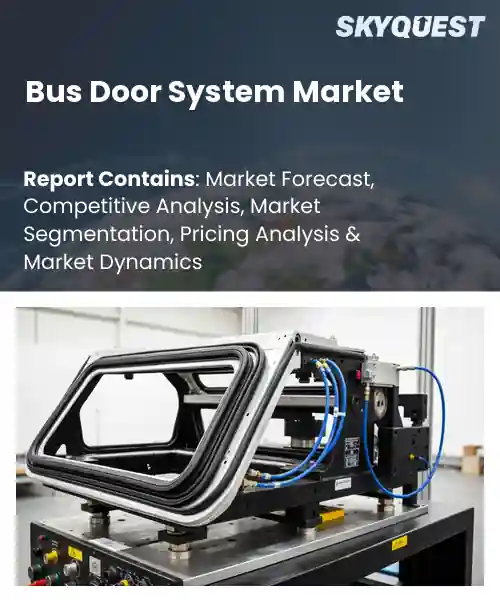
Bus Door System Market
Report ID: SQMIG25A2739
Report ID: SQMIG25A2739
[email protected]
USA +1 351-333-4748
Report ID:
SQMIG25A2739 |
Region:
Global |
Published Date: June, 2026
Pages:
157
|Tables:
142
|Figures:
78


Global Bus Door System Market size was valued at USD 1.22 Billion in 2024 and is poised to grow from USD 1.3 Billion in 2025 to USD 2.22 Billion by 2033, growing at a CAGR of 6.91% during the forecast period (2026-2033).
The major factor influencing the growth of the bus door system market is urbanization, which leads to a change in the use of public transportation. In bus door systems, sliding, folding, and plug doors are available. These doors are used in managing the boarding of passengers, their alighting, and thermal protection. The market is important because the design of doors influences the dwell time and cost, as well as accessibility. Over a period of two decades, bus door systems changed from pneumatically controlled systems to electromechanical systems having sensors and remote diagnostics capabilities.
An essential element that propels global bus door systems into rapid expansion is the development of vehicles using electric drives alongside digitalization since such technology creates an emphasis on energy savings and minimizing idle time, leading to a need for light-weighted, hermetic, and equipped with sensors door units. With the implementation of electric buses, improved insulation helps to minimize energy consumption in the process of heating or cooling, forcing producers to offer plug-type electromechanical door units constructed out of composite materials. In addition, IoT-based doors provide telematics data to facilitate predictive maintenance, resulting in less frequent breakdowns; the example is provided using BRT corridors in Bogotá and Curitiba.
How is IoT Transforming Reliability in the Bus Door System Market?
The Internet of Things is changing how reliability is being addressed in bus door systems through integration of sensors, actuators, and fleet management systems in a feedback loop. Some of the important features include real-time health monitoring, condition-based alerts, and predictive maintenance, moving away from reactive measures to proactive planning. The current market trends in this sector include useof sensorized doors, edge analytics, and remote diagnostics which ensure that there is minimized downtime and increased safety of passengers. There will be benefits of faster isolation of faults, better wear analysis, and over-the-air update capabilities for operators. Some examples include vision AI used to avoid entrapment and smart door sensors that alert on actuator breakdowns, ensuring greater reliability and ease of fleet management.
Market snapshot - (2026-2033)
Global Market Size
USD 1.22 Billion
Largest Segment
Pneumatic Door Systems
Fastest Growth
Electrically Operated Door Systems
Growth Rate
6.91% CAGR
To get more insights on this market click here to Request a Free Sample Report
Global bus door system market is segmented by type, door type, vehicle type, sales channel, end-user and region. Based on type, the market is segmented into Pneumatic Door Systems, Electrically Operated Door Systems and Manual Door Systems. Based on door type, the market is segmented into Plug Door, Bi-Fold Door and Single/Double Leaf Sliding. Based on vehicle type, the market is segmented into City Buses, Intercity/Coach Buses and School Buses. Based on sales channel, the market is segmented into OEM and Aftermarket. Based on end-user, the market is segmented into Public Transit Authorities and Private Bus Operators. Based on region, the market is segmented into North America, Europe, Asia Pacific, Latin America and Middle East & Africa.
Electrical Actuated Bus Doors segment is the most dominant since OEMs and fleet managers have a preference for systems where the actuation process is software controlled and integrated into the overall control system of the vehicle. Electronic diagnostic features and better control ensure fewer instances of unexpected breakdowns and ease of maintenance scheduling. These two benefits explain the tendency towards standardization and supplier consolidation in the bus door systems segment.
The fastest growing one is the Pneumatic Actuated Doors since the mechanical nature of these doors makes it possible to be used in retrofitting programs. Incremental improvements in valves and materials will further facilitate retrofit needs and create additional service and maintenance revenues.
OEM market segment takes the lead as OEMs define the vehicle standards and provide for the integration of the door systems in terms of structure, wiring, and safety. The need for long-term contracts and warranties compels OEMs to choose reliable and certified solutions minimizing the total cost of ownership and satisfying regulatory compliance requirements. The buying power of OEMs ensures the centralization of innovation around their demands within the bus door systems market.
However, the aftermarket segment is currently growing with the most vigorous momentum due to the combination of aging fleet and high customer demand for upgrading. The possibility of installing new doors without replacing the whole vehicle through modular kit replacements, plug & play controls, and service-oriented business model makes it possible.
To get detailed segments analysis, Request a Free Sample Report
Asia-Pacific holds the dominant share in market, attributed to the synergy of well-developed capabilities in manufacturing, the existence of good public transportation network, and collaboration between the vehicle OEMs and their suppliers. In Japan and South Korea, the clusters allow the constant improvement of mechanical and electronic sub-systems while the presence of regional supply chains allows efficient and cost-effective manufacturing of the systems. With high demand for fleet modernization and aftermarket solutions, the markets are deep, prompting a wide variety of products ranging from basic mechanical doors to integrated solutions with sensors. Public transport needs and smart cities development are also accelerating the processes of procurement and trials of new technologies.
Bus Door System Market in Japan is known for its high standards of engineering, stringent safety regulations, and tendency towards long-lasting and precise parts. The tight cooperation between bus manufacturers and providers of door systems contributes to the creation of small and reliable devices designed specifically for city conditions. The focus on reliability throughout its life cycle, ease of maintenance, and integration into passenger information and access control systems promotes the demand for highly technological solutions.
South Korea Bus Door Systems Market shows high synergy among advanced electronics vendors and automotive firms, resulting in door systems with built-in sensing and control capabilities. Emphasis on designing door systems that are compact, easy-to-actuate, and easy to integrate into fleet management systems aids in making urban transport modern and efficient. Local vendor networks ensure quick prototyping and tweaking in accordance with operator input, while also aiding in ensuring durability through after-market service.
The European expansion efforts hinge on a strategy that emphasizes the importance of easily accessible, low emission, public transport, along with fleet renewal investment in cities. Strong vehicle production facilities, primarily those found in Germany, provide engineering expertise and manufacturing capabilities; at the same time, innovation centers spread all over the region customize door mechanisms for electrically-powered and networked buses. Procurement preferences for safety, accessibility, and compatibility lead to a choice for modular and standards-compliant solutions. Innovative projects in the UK, as well as focused modernization efforts in France, generate multiple applications and encourage the creation of customized products by both global manufacturers and regional players.
Bus Door Systems Market in Germany features an industry that has a highly developed network of precision engineering companies and system integrators providing reliable products. The close relationship between major automotive companies and the suppliers of components helps to design platforms that correspond to safety and compatibility standards. The importance of quality and durability makes the use of advanced systems of actuators and sensors preferable.
The UK Bus Door System Market is driven by various urban renewal initiatives and the emphasis on using electricity-operated buses, thereby creating opportunities for bus doors that are suitable for use in such electric vehicles and energy-efficient in functioning. Rapid procurement processes in the city transport department facilitate testing of advanced bus doors that help in improving accessibility and manageability of passengers.
Market for Bus Door System in France is emerging through strategic upgrades in the vehicle fleet and initiatives from regions to enhance accessibility for passengers. The market demand lies in the development of flexible bus doors that fit into various routing needs and ensure reliability of the doors while used in urban and long distance transportation. Cooperation among regional transport companies, local manufacturers and technology companies facilitates development of tailor-made solutions.
North America continues to build on its strengths through the integration of technological innovation with regulatory and purchasing priorities, thus forming paths to the broader implementation of integrated door systems. North America, comprising the United States and Canada, offers an environment where suppliers can test their systems, which are integrated with the characteristics of safety, diagnostic abilities, and ability to interface with alternative power platforms. Focus on the issues of accessibility, operator comfort, and serviceability results in the formation of modular and serviceable systems that minimize the complexities of lifecycle. Partnership between transit authorities, OEMs, and specialty suppliers facilitates aftermarket support and retrofit approaches, thus providing proven solutions for different fleets.
U.S. Bus Door Systems Market highlights the use of sophisticated safety and diagnostic sensor systems and logic specifically suited to the needs of different transit organizations. The growth drivers include fleet upgrades, retrofitting initiatives, and transparency in vendor relations. Good networks of system integrators and maintainers facilitate scaling up and sustainability. Working with academic institutes and test centers contributes to the development of robust designs under different environmental conditions.
The market for bus door systems in Canada places importance on resilience and sustainability to provide consistent performance within challenging settings. Transit operators within the region prefer customization of products that offer a balance between maintainability and accessibility. Partnership between local and foreign manufacturers enables provision of services within local networks and through retrofit solutions. Intelligent door control solutions are implemented through pilot projects and training operators, ensuring that life cycle support is considered.
To know more about the market opportunities by region and country, click here to
Buy The Complete Report
Rising Urbanization and Transit Demand
The increasing movement of people into cities and their rising use of public transport means that there is always a steady demand for quality bus parts, which is likely to push both transport providers and manufacturers toward considering innovative door mechanisms that increase the efficiency and safety of the buses in use. Given that the objective of urban transit organizations is to make sure that passengers board the buses as easily as possible, they have no choice but to consider door mechanisms that help them do it.
Advanced Door Technologies and Integration
The constant evolution of door actuator design, sensor technology and control systems improves reliability, safety and compatibility with vehicle electronics, thereby encouraging operators to upgrade existing units with modular and serviceable solutions. New materials and better seals increase the component durability and limit downtime for maintenance. The diagnostics make possible the prediction-based maintenance, which corresponds to the demands of operators. With growing importance of systems interoperability and ease of integration during vehicle reconditioning and configuration, it is natural that the industry encourages the rapid development of new solutions.
High Initial Procurement Costs
Expenses incurred at the beginning in the case of modern door systems, such as customization, installation into the vehicle's electronics, and adaptation for use in various conditions, can be a disincentive for the adoption of new technology, even though it will pay off eventually, by potential buyers due to budget limitations and priorities in capital allocation. As a result, the manufacturer will have trouble inpersuading customers with their intentions to make an actual purchase.
Complex Regulatory and Certification Requirements
Safety regulations, certification processes based on regional standards, and accessibility requirements make the situation complicated for suppliers who are striving to develop uniform doors. Time to market and difficulties in developing and certifying various products make the supplier adopt a conservative approach to investing and expanding the geography of operations. Such issues can hamper the introduction of innovations because of the uncertainty regarding timeframes and expenses related to adaptation to local requirements.
Request Free Customization of this report to help us to meet your business objectives.
The competitive dynamics within the global bus door system market are dictated by a narrow base of tier 1 vendors who compete based on the aspect of safety, sensors, and OEM ties. Regulatory safety requirements have made the suppliers integrate camera AI and edge inference into their products. Companies seek consolidation, acquisitions, and expansion in order to seal the OEM deals, such as the case of Bosch with its Atlatec acquisition and Masats' capacity expansion.
Smart Connectivity Integration: The new breed of sensors and connectivity and software on board is shaping up to offer buses the next level in door capabilities by allowing them to provide predictive maintenance and diagnostics based on adaptively operating fleet management systems. The need for modularity and data exchange capabilities is the key direction in door system development by vendors and fleet owners, providing opportunities for seamless integration with vehicle telematics and urban transport systems as well as minimizing the impact of operational conditions.
Accessible Safety and Inclusive Design: The emphasis of the industry is being placed on door solutions with universal accessibility and passenger protection in mind. Low threshold entry, easy-to-operate controls, audio/visual/tactile guidance and fail-safe features are among those innovations which make boarding safer when operating under high loads. The cooperation of Original Equipment Manufacturers, transportation organizations and disability advocates results in ergonomic designs and customized controls to increase the dignity and independence of people with disabilities and ensure the operators' comfort at the same time.
SkyQuest’s ABIRAW (Advanced Business Intelligence, Research & Analysis Wing) is our Business Information Services team that Collects, Collates, Correlates, and Analyses the Data collected by means ofPrimary Exploratory Research backed by robust Secondary Desk research.
As per SkyQuest analysis, the rapid pace of urbanization and a move towards using public transport is the key driver whereas one of the restraints is high costs involved at the time of procurement, thus making it difficult to be adopted by small operators. The dominating geographic region is the Asia Pacific, due to the availability of efficient manufacturing, effective transit systems, and collaboration between the OEMs and suppliers, whereas the dominating product type is the electrically operated door system owing to its integration, diagnostic features, and energy efficiency. Another driver of the market includes vehicle electrification and digitalization, which increases the need for airtight and lightweight doors along with sensing assembly for predictive maintenance.
| Report Metric | Details |
|---|---|
| Market size value in 2024 | USD 1.22 Billion |
| Market size value in 2033 | USD 2.22 Billion |
| Growth Rate | 6.91% |
| Base year | 2024 |
| Forecast period | (2026-2033) |
| Forecast Unit (Value) | USD Billion |
| Segments covered |
|
| Regions covered | North America (US, Canada), Europe (Germany, France, United Kingdom, Italy, Spain, Rest of Europe), Asia Pacific (China, India, Japan, Rest of Asia-Pacific), Latin America (Brazil, Rest of Latin America), Middle East & Africa (South Africa, GCC Countries, Rest of MEA) |
| Companies covered |
|
| Customization scope | Free report customization with purchase. Customization includes:-
|
To get a free trial access to our platform which is a one stop solution for all your data requirements for quicker decision making. This platform allows you to compare markets, competitors who are prominent in the market, and mega trends that are influencing the dynamics in the market. Also, get access to detailed SkyQuest exclusive matrix.
Table Of Content
Executive Summary
Market overview
Parent Market Analysis
Market overview
Market size
KEY MARKET INSIGHTS
COVID IMPACT
MARKET DYNAMICS & OUTLOOK
Market Size by Region
KEY COMPANY PROFILES
Methodology
For the Bus Door System Market, our research methodology involved a mixture of primary and secondary data sources. Key steps involved in the research process are listed below:
1. Information Procurement: This stage involved the procurement of Market data or related information via primary and secondary sources. The various secondary sources used included various company websites, annual reports, trade databases, and paid databases such as Hoover's, Bloomberg Business, Factiva, and Avention. Our team did 45 primary interactions Globally which included several stakeholders such as manufacturers, customers, key opinion leaders, etc. Overall, information procurement was one of the most extensive stages in our research process.
2. Information Analysis: This step involved triangulation of data through bottom-up and top-down approaches to estimate and validate the total size and future estimate of the Bus Door System Market.
3. Report Formulation: The final step entailed the placement of data points in appropriate Market spaces in an attempt to deduce viable conclusions.
4. Validation & Publishing: Validation is the most important step in the process. Validation & re-validation via an intricately designed process helped us finalize data points to be used for final calculations. The final Market estimates and forecasts were then aligned and sent to our panel of industry experts for validation of data. Once the validation was done the report was sent to our Quality Assurance team to ensure adherence to style guides, consistency & design.
Analyst Support
Customization Options
With the given market data, our dedicated team of analysts can offer you the following customization options are available for the Bus Door System Market:
Product Analysis: Product matrix, which offers a detailed comparison of the product portfolio of companies.
Regional Analysis: Further analysis of the Bus Door System Market for additional countries.
Competitive Analysis: Detailed analysis and profiling of additional Market players & comparative analysis of competitive products.
Go to Market Strategy: Find the high-growth channels to invest your marketing efforts and increase your customer base.
Innovation Mapping: Identify racial solutions and innovation, connected to deep ecosystems of innovators, start-ups, academics, and strategic partners.
Category Intelligence: Customized intelligence that is relevant to their supply Markets will enable them to make smarter sourcing decisions and improve their category management.
Public Company Transcript Analysis: To improve the investment performance by generating new alpha and making better-informed decisions.
Social Media Listening: To analyze the conversations and trends happening not just around your brand, but around your industry as a whole, and use those insights to make better Marketing decisions.
REQUEST FOR SAMPLE
 REQUEST FREE CUSTOMIZATION
Global Bus Door System Market size was valued at USD 1.22 Billion in 2024 and is poised to grow from USD 1.3 Billion in 2025 to USD 2.22 Billion by 2033, growing at a CAGR of 6.91% during the forecast period (2026-2033).
Competitive landscape in the global bus door system market is shaped by a concentrated set of Tier 1 suppliers competing on safety, sensor integration and OEM relationships; regulatory safety mandates are driving suppliers to embed camera AI and edge inference. Firms pursue consolidation, targeted acquisitions and production expansions to lock in OEM contracts, for example Bosch’s Atlatec buy and Masats’ recent capacity scaling, plus Tier 1 sensor integrations. 'Ventura Systems', 'Masats SA', 'Schaltbau Holding AG', 'FAIVELEY Transport (Wabtec)', 'Vapor Bus International (Wabtec)', 'Hübner Group', 'CETEC GmbH', 'IFE Doors (Knorr-Bremse)', 'Wanzl GmbH', 'NEOPLAN (MAN)', 'Kiekert AG', 'Bode GmbH (Knorr-Bremse)', 'Ficosa International', 'Voith GmbH', 'Mekra Lang GmbH', 'SMB Group', 'STUD Electronic', 'Nabtesco Corporation', 'Safe Way Bus Systems', 'Trans Group'
The accelerating migration of populations into cities and the consequent growth in public transportation usage create sustained demand for reliable, efficient bus components, encouraging operators and manufacturers to prioritize modern door systems that enhance passenger flow, safety, and operational uptime. As urban transit agencies seek to optimize vehicle turnaround and accessibility, procurement decisions favor door technologies that reduce delays and improve boarding efficiency, leading suppliers to invest in product enhancements, customization, and service offerings that align with transit system objectives and urban mobility planning.
Smart Connectivity Integration: Advanced sensor suites, onboard connectivity and software platforms are redefining bus door functionality, enabling predictive maintenance, real-time diagnostics and adaptive operation tied to fleet management systems. Manufacturers and operators are prioritizing modular architectures and data channels to optimize uptime and passenger flow. This trend supports seamless integration with vehicle telematics and urban mobility platforms, improving response to operational conditions and reducing service disruptions while creating pathways for continuous remote updates and performance tuning throughout the vehicle lifecycle.
Why does Asia Pacific Dominate the Global Bus Door System Market? |@12


Want to customize this report? This report can be personalized according to your needs. Our analysts and industry experts will work directly with you to understand your requirements and provide you with customized data in a short amount of time. We offer $1000 worth of FREE customization at the time of purchase.
Feedback From Our Clients


 USA (+1) 351-333-4748

