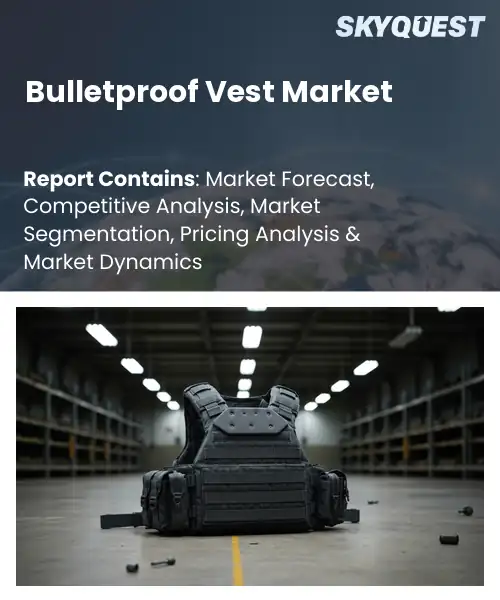
Bulletproof Vest Market
Report ID: SQMIG20A2607
Report ID: SQMIG20A2607
[email protected]
USA +1 351-333-4748
Report ID:
SQMIG20A2607 |
Region:
Global |
Published Date: May, 2026
Pages:
157
|Tables:
181
|Figures:
79


Global Bulletproof Vest Market size was valued at USD 3.02 Billion in 2024 and is poised to grow from USD 3.2 Billion in 2025 to USD 5.02 Billion by 2033, growing at a CAGR of 5.8% during the forecast period (2026-2033).
The bulletproof vest market is the industry that designs, manufactures and distributes personal ballistic protection for military, law enforcement and civilian users, driven by evolving security threats that raise demand and policy attention. Technological progress combined with procurement cycles and high profile safety incidents has hardened budgets and accelerated regional adoption, prompting supplier specialization and clearer regulatory frameworks.Consequently rising asymmetric threats and expanded defense spending constitute the key factor propelling global market growth because governments and agencies respond with procurement programs that fund research into lighter armor. As budgets rise manufacturers invest in advanced fibers and modular plate systems, producing lighter more concealable products that increase uptake among urban police and private security firms demonstrated when metropolitan departments replaced bulky vests with hybrid soft and hard kits to improve officer mobility. Parallel civilian interest driven by direct to consumer sales and regulations creates opportunity for sensor enabled smart armor while cost reductions support penetration in emerging markets.
How is IoT enhancing situational awareness in the bulletproof vest market?
IoT is enhancing situational awareness in the bulletproof vest market by embedding sensors and connectivity into protective gear so wearers and commanders receive real time context. Key aspects include biometric monitoring for stress and injury risk, environmental sensing for heat and toxic exposure, and location telemetry for team tracking. The current state shows growing adoption among public safety and military users as vendors link wearables to resilient networks and analytics platforms. In practice connected vests integrate with body cameras and mesh radios so fused feeds reach command centers and nearby officers, improving decision making and responder safety while vendors prioritize rugged low power designs and secure communications.
Safariland in January 2026, introduced SafariMesh a mesh communications device that pairs with headsets and armor to maintain voice and data links without centralized networks. That capability allows embedded sensors to stream alerts and location data reliably which boosts coordination and reduces operational friction supporting market growth for connected vests.
Market snapshot - (2026-2033)
Global Market Size
USD 3.02 Billion
Largest Segment
Level IIIA Bulletproof Vests
Fastest Growth
Level IV Bulletproof Vests
Growth Rate
5.8% CAGR
To get more insights on this market click here to Request a Free Sample Report
Global bulletproof vest market is segmented by protection level, material type, product type, application, end user, distribution channel and region. Based on protection level, the market is segmented into Level IIA Bulletproof Vests, Level II Bulletproof Vests, Level IIIA Bulletproof Vests, Level III Bulletproof Vests and Level IV Bulletproof Vests. Based on material type, the market is segmented into Aramid Fiber Vests, UHMWPE Vests, Ceramic Composite Vests, Steel Plate Vests and Hybrid Material Vests. Based on product type, the market is segmented into Soft Armor Vests, Hard Armor Vests, Concealable Bulletproof Vests, Tactical Bulletproof Vests and Modular Bulletproof Vests. Based on application, the market is segmented into Military Protection, Law Enforcement Protection, Civilian Protection, VIP Security and Homeland Security. Based on end user, the market is segmented into Defense Forces, Police & Law Enforcement Agencies, Private Security Agencies, Civilians and Government Agencies. Based on distribution channel, the market is segmented into Direct Government Procurement, Authorized Dealers & Distributors and Online Sales. Based on region, the market is segmented into North America, Europe, Asia Pacific, Latin America and Middle East & Africa.
As per bulletproof vest market outlook, the aramid fiber vests segment dominates the market since aramid fibers have a long history as being lightweight, flexible and providing consistent reliability in terms of ballistic protection that meets operational requirements in the law enforcement, security and civilian markets. Reliable manufacturing methods and established supply chains allow for price reductions and standardization of quality, which helps procurement and widespread use. The comfort and ergonomic characteristics of aramid vests reduce fatigue for the wearer, allowing for longer deployments, leading to increased institutional support for the continued leadership position in this market.
As per bulletproof vest market forecast, the UHMWPE vests segment is emerging as the fastest growing segment of the market due to their lightweight nature, increased multi-hit protection and continued advancement in polymers that improve comfort and ballistic capabilities of the vests. Increased interest in lightweight/high-performance personal protective equipment for mobile operations coupled with advances in lamination and processing technology will accelerate the rate of adoption and open up new applications for products to further expand the market opportunity.
Concealable bulletproof vest is leads with large bulletproof vest market share due to design meeting the demand for discreet protection from executives, plainclothes law enforcement, and safety-conscious citizens, while allowing users to wear them under everyday clothing. Emphasis on thin and flexible materials and ergonomic cuts keeps the visual profile low without sacrificing critical ballistic performance, thus creating preference for procurement of less conspicuous protective solutions. The increase in use of concealable vests is driven by user acceptance, compatibility with uniforms, as well as policies encouraging the use of protective apparel that does not interfere with their appearance or mobility, and results in maintaining a leadership position in the market.
As per bulletproof vest market analysis, tactical bulletproof vests are the fastest growing segment as demand for mission adaptable protection rises. Modular load bearing designs, integration with hard plates and accessory rails, and focus on interoperability with gear meet evolving operational doctrines. Continuous innovation in attachment systems and customization options is driving procurement across operational units and unlocking new commercial opportunities.
To get detailed segments analysis, Request a Free Sample Report
The largest share of the global bulletproof vest market is held by North America owing to the concentrated procurement of defense and law enforcement, a well-established industrial base, and advanced research in protective materials. Through strong collaboration between government agencies, universities and manufacturers, high-performance ceramics, composites and sophisticated fibers are developed at a faster pace. Procurement standards and certification regimes encourage the use of premium systems, and a developed supply chain enables fast scale-up and cost optimization. Maintenance, refurbishing and training are examples of aftermarket services that produce recurring revenue and promote supplier relationships. Leading global vendors have regional manufacturing footprints that benefit from skilled labor and leading automation. Joint policy support for first responder protection and military modernization projects maintains procurement pipelines and sustains superiority.
As per global bulletproof vest market regional outlook, United States market is characterized by robust defense procurement channels, active research institutes, and a competitive manufacturing environment centered on advanced materials and modular systems. Rigorous testing, certification and field trials are supported by strong collaboration between agencies and industry, and innovation is driven by increasing demand from tactical units and private security organizations. Integration, ergonomics and lifecycle services are emphasized, reinforcing supplier positions and encouraging continual product refinement.
As per global bulletproof vest market regional forecast, Canada market is focused on operational versatility, interoperability with allied troops and protective solutions suitable to varying climatic situations. Procurement objectives are driven by law enforcement needs and federal requirements and emphasize durability, comfort and lightweight materials. Working with local vendors allows for custom specs and comprehensive certification programs. Elements of service like maintenance, training and refurbishing are critical to maintain preparedness and extend equipment life across agencies and security providers.
Rapid expansion in the Asia Pacific bulletproof vest market is driven by a combination of evolving security needs, modernization of defense and law enforcement forces, and increasing domestic manufacturing capabilities. Governments and agencies prioritize personal protection for military personnel, police, and critical infrastructure teams, prompting procurement of modern, mission-adapted designs. Investment in local production, material science research, and partnerships with established international suppliers accelerates technology transfer and customized solutions. Urbanization and growth of private security demand greater availability of scalable protective equipment, while stricter safety protocols and regional strategic imperatives support sustained market momentum. Expansion of regional supply chains and investments in quality assurance and certification frameworks improve market confidence, enabling wider adoption. Cost-competitive manufacturing paired with localized research into textiles and composite processes produces solutions tailored to climatic and operational contexts. Markets such as maritime security and disaster response demand specialized vests, encouraging product diversification and supplier localization.
As per global bulletproof vest industry analysis, Japan market indicates focus on high quality, production and integration of sophisticated materials research. Domestic suppliers are partnering with research institutes to develop materials that provide the comfort, mobility and multi-threat protection needed for urban and disaster response activities. Regulatory frameworks and rigorous testing build trust among law enforcement and private security buyers. Local producers are innovating and collaborating to meet the demand for modular, low-profile designs that balance protection with wearability.
South Korea bulletproof vest market is driven by the presence of a strong industrial base, active defense modernization programs and collaboration of manufacturers with research centers. Advanced composites, nanotechnology and ergonomic design help create small, high-performance devices for military and law enforcement applications. Domestic suppliers seek export potential and devise answers to needs of urban operations. Robust testing infrastructure and supplier networks enable quick prototyping, quality assurance and product innovation.
Europe’s dominance in the bulletproof vest industry is being boosted by European coordinated research, dedicated manufacturing clusters and harmonised standards that improve interoperability between national forces. Investment in material science, ergonomic design and multifunctional systems helps the creation of versatile solutions for a range of operational conditions. Collaboration among government procurement organizations, defense primes and creative small and medium firms promotes technology maturation and cost effective production. Focus on lifecycle management, certification and integrated training services boost buyer confidence; strategic partnerships and export orientation help European suppliers compete effectively in global and regional markets. Leads providers broaden products driven by homeland security, complex urban operations. Sustainable production and careful integration of monitoring technologies make products more attractive. Accredited testing networks and cross border procurement activities allow for larger acceptance and scalability.
Germany is shaped by engineering expertise, a robust defense industrial ecosystem, and close ties between manufacturers and research institutions. Suppliers emphasize precision manufacturing, modular designs, and compliance with stringent certification standards to meet law enforcement and military needs. Demand for multifunctional systems suited to urban and tactical deployments drives innovation in composites and ergonomic design. Aftermarket maintenance and refurbishment bolster long term readiness and supplier credibility.
UK bulletproof vest market is driven by robust defence research, a developed supply base and targeted procurement for police and specialty forces. Product development is driven by a focus on user-centered design, modularity and integration with communication networks. Rigorous testing and operational feedback loops are strengthened by close partnership between public authorities and industry. The strong private security sector and the competitive export orientation encourage diversification of the product portfolio and continuous supplier investment.
France is supported by strong defense primes, advanced materials research, and focused procurement for national operations. Manufacturers concentrate on adaptable, mission specific solutions that balance protection, mobility, and comfort for diverse deployment scenarios. Collaboration among research centers, SMEs, and public agencies drives certification and testing standards. Service offerings, including training and lifecycle support, strengthen adoption by police, military, private security customers while enhancing supplier competitiveness overall.
To know more about the market opportunities by region and country, click here to
Buy The Complete Report
Expansion Of Military Procurement
Advancements In Lightweight Materials
High Manufacturing Costs
Regulatory Compliance Challenges
Request Free Customization of this report to help us to meet your business objectives.
Competitive pressure in the global bulletproof vest industry is driven by material innovation, procurement contracts and rapid entry of specialized startups. Incumbents pursue M&A and brand acquisitions for distribution scale, as seen when Sellmark acquired BulletSafe in 2020. Strategic supplier partnerships target lighter composite solutions, exemplified by DSM’s collaboration with MKU on Dyneema unidirectional materials, while vendors compete on certification wins and large procurement programmes.
SkyQuest’s ABIRAW (Advanced Business Intelligence, Research & Analysis Wing) is our Business Information Services team that Collects, Collates, Correlates, and Analyses the Data collected by means of Primary Exploratory Research backed by robust Secondary Desk research.
As per SkyQuest analysis, the global bulletproof vest market is propelled by expansion of military procurement while facing restraints from high manufacturing costs. North America remains the dominating region due to concentrated defense and law enforcement procurement and advanced research and development, and aramid fiber vests are the dominating segment because of their proven balance of light weight, flexibility and ballistic performance. A second driver is advancements in lightweight materials that enable more comfortable, mission-ready designs and open civilian and private security use cases. Suppliers increasingly invest in composites, modular systems and connected sensor platforms, but cost pressures and varying regulatory standards will shape adoption rates and supplier strategies going forward. The global bulletproof vest market trend is experiencing significant growth driven by increasing defense modernization programs, rising investments in law enforcement safety equipment and growing demand for lightweight, high-performance ballistic protection.
| Report Metric | Details |
|---|---|
| Market size value in 2024 | USD 3.02 Billion |
| Market size value in 2033 | USD 5.02 Billion |
| Growth Rate | 5.8% |
| Base year | 2024 |
| Forecast period | (2026-2033) |
| Forecast Unit (Value) | USD Billion |
| Segments covered |
|
| Regions covered | North America (US, Canada), Europe (Germany, France, United Kingdom, Italy, Spain, Rest of Europe), Asia Pacific (China, India, Japan, Rest of Asia-Pacific), Latin America (Brazil, Rest of Latin America), Middle East & Africa (South Africa, GCC Countries, Rest of MEA) |
| Companies covered |
|
| Customization scope | Free report customization with purchase. Customization includes:-
|
To get a free trial access to our platform which is a one stop solution for all your data requirements for quicker decision making. This platform allows you to compare markets, competitors who are prominent in the market, and mega trends that are influencing the dynamics in the market. Also, get access to detailed SkyQuest exclusive matrix.
Table Of Content
Executive Summary
Market overview
Parent Market Analysis
Market overview
Market size
KEY MARKET INSIGHTS
COVID IMPACT
MARKET DYNAMICS & OUTLOOK
Market Size by Region
KEY COMPANY PROFILES
Methodology
For the Bulletproof Vest Market, our research methodology involved a mixture of primary and secondary data sources. Key steps involved in the research process are listed below:
1. Information Procurement: This stage involved the procurement of Market data or related information via primary and secondary sources. The various secondary sources used included various company websites, annual reports, trade databases, and paid databases such as Hoover's, Bloomberg Business, Factiva, and Avention. Our team did 45 primary interactions Globally which included several stakeholders such as manufacturers, customers, key opinion leaders, etc. Overall, information procurement was one of the most extensive stages in our research process.
2. Information Analysis: This step involved triangulation of data through bottom-up and top-down approaches to estimate and validate the total size and future estimate of the Bulletproof Vest Market.
3. Report Formulation: The final step entailed the placement of data points in appropriate Market spaces in an attempt to deduce viable conclusions.
4. Validation & Publishing: Validation is the most important step in the process. Validation & re-validation via an intricately designed process helped us finalize data points to be used for final calculations. The final Market estimates and forecasts were then aligned and sent to our panel of industry experts for validation of data. Once the validation was done the report was sent to our Quality Assurance team to ensure adherence to style guides, consistency & design.
Analyst Support
Customization Options
With the given market data, our dedicated team of analysts can offer you the following customization options are available for the Bulletproof Vest Market:
Product Analysis: Product matrix, which offers a detailed comparison of the product portfolio of companies.
Regional Analysis: Further analysis of the Bulletproof Vest Market for additional countries.
Competitive Analysis: Detailed analysis and profiling of additional Market players & comparative analysis of competitive products.
Go to Market Strategy: Find the high-growth channels to invest your marketing efforts and increase your customer base.
Innovation Mapping: Identify racial solutions and innovation, connected to deep ecosystems of innovators, start-ups, academics, and strategic partners.
Category Intelligence: Customized intelligence that is relevant to their supply Markets will enable them to make smarter sourcing decisions and improve their category management.
Public Company Transcript Analysis: To improve the investment performance by generating new alpha and making better-informed decisions.
Social Media Listening: To analyze the conversations and trends happening not just around your brand, but around your industry as a whole, and use those insights to make better Marketing decisions.
REQUEST FOR SAMPLE
 REQUEST FREE CUSTOMIZATION
Global Bulletproof Vest Market size was valued at USD 3.02 Billion in 2024 and is poised to grow from USD 3.2 Billion in 2025 to USD 5.02 Billion by 2033, growing at a CAGR of 5.8% during the forecast period (2026-2033).
Competitive pressure in the global bulletproof vest market is driven by material innovation, procurement contracts and rapid entry of specialized startups. Incumbents pursue M&A and brand acquisitions for distribution scale, as seen when Sellmark acquired BulletSafe in 2020. Strategic supplier partnerships target lighter composite solutions, exemplified by DSM’s collaboration with MKU on Dyneema unidirectional materials, while vendors compete on certification wins and large procurement programmes. 'Safariland', 'Point Blank Enterprises', 'BAE Systems', 'Honeywell International', 'DuPont', '3M', 'MKU', 'ArmorSource', 'Craig International Ballistics', 'EnGarde Body Armor', 'VestGuard', 'Mehler Protection', 'Sarkar Tactical', 'Pacific Safety Products', 'Hardwire', 'US Armor', 'Sioen Industries', 'KDH Defense Systems', 'Protection Group Danmark', 'Ballistic Body Armour'
Expansion of military procurement programs increases demand for body armor as armed forces prioritize soldier protection, modernization, and survivability enhancements. This factor encourages manufacturers to scale production, invest in material innovation, and broaden product portfolios to meet diverse operational requirements. Procurement cycles provide stable, long-term contracts that support industry growth by enabling investment in research, workforce development, and supply chain fortification. The focus on replacing outdated equipment and equipping additional units sustains continuous order flow and incentivizes technological adaptation and capability enhancement.
Advanced Composite Adoption: Manufacturers are shifting toward advanced composites and hybrid textiles that balance protection with reduced weight, enabling longer operational endurance and enhanced mobility for users. Suppliers emphasize material innovation, prototyping and supply chain partnerships to integrate fibers and resin systems. Adoption is driven by demand for ergonomic fit, modular integration and improved comfort in diverse climates. This trend supports product differentiation and opens pathways for collaborations between defense, industrial textiles and research institutions focused on scalable production and field performance validation.
Why does North America Dominate the Global Bulletproof Vest Market? |@12


Want to customize this report? This report can be personalized according to your needs. Our analysts and industry experts will work directly with you to understand your requirements and provide you with customized data in a short amount of time. We offer $1000 worth of FREE customization at the time of purchase.
Feedback From Our Clients


 USA (+1) 351-333-4748

