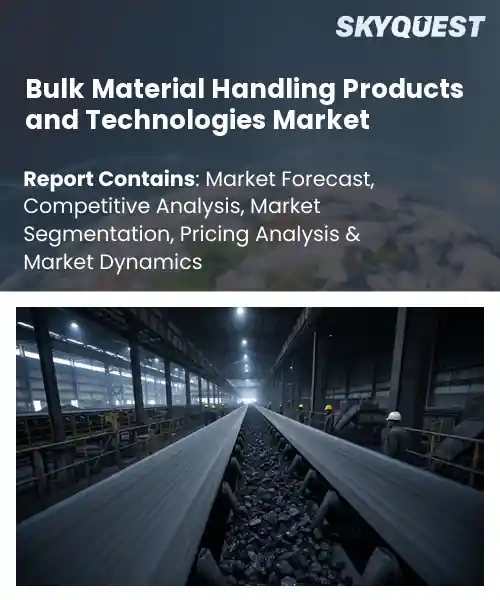
Bulk Material Handling Products and Technologies Market
Report ID: SQMIG20I3219
Report ID: SQMIG20I3219
[email protected]
USA +1 351-333-4748
Report ID:
SQMIG20I3219 |
Region:
Global |
Published Date: July, 2026
Pages:
157
|Tables:
154
|Figures:
78


Global Bulk Material Handling Products And Technologies Market size was valued at USD 5.16 Billion in 2024 and is poised to grow from USD 5.44 Billion in 2025 to USD 8.28 Billion by 2033, growing at a CAGR of 5.4% during the forecast period (2026-2033).
The Global Bulk Material Handling Products and Technologies market includes conveyors, elevators, feeders, and pneumatic systems that move volumes of raw or processed material in construction, mining, agriculture and chemicals. Its importance lies in reducing labor costs, increasing throughput and improving safety, making it vital. In the past two decades the market has evolved from manually operated steel belts to conveyor networks that incorporate IoT analytics for predictive maintenance. For instance, Amazon’s fulfillment centers use roller conveyors to sort parcels daily, while coal mines deploy bucket elevators to move ore from pit to plant, showing how efficiency gains accelerate adoption.Digitalization and automation drive the bulk material handling market by turning equipment into connected assets that anticipate failures and cut energy use. When a conveyor alerts operators to belt wear before a breakdown, downtime drops, operating costs fall, and managers are more inclined to add smart modules. Port terminals illustrate this shift, using IoT‑linked gantry cranes to coordinate container moves, while food processors adopt machine‑vision feeders that adjust speed to product size, lowering waste and power draw. Stricter sustainability rules and expanding manufacturing in emerging economies boost demand for emission managed solutions, spawning retrofit projects and service‑based revenue for vendors.
How are AI and IoT automation shaping the bulk material handling products market?
AI and IoT automation are redefining bulk material handling by linking sensors, analytics and control systems. Real time monitoring of conveyors, crushers and feeders allows predictive maintenance and dynamic routing. Machine learning models learn material characteristics and adjust speed to reduce spillage. Integrated platforms give operators a unified view and enable remote adjustments. The market now favors solutions that combine edge computing with cloud analytics, delivering higher uptime and lower energy use. Examples include smart vibration sensors on belt drives and AI based load forecasting that optimizes storage bin usage.Metso Outotec, June 2023, introduced an AI driven ore flow optimizer that connects conveyor sensors to a cloud platform, automatically adjusting belt speed and crusher settings. The system cuts downtime and improves throughput, showcasing how intelligent automation fuels growth and efficiency in bulk material handling.
Market snapshot - (2026-2033)
Global Market Size
USD 5.16 Billion
Largest Segment
Conveying Systems
Fastest Growth
Services
Growth Rate
5.4% CAGR
To get more insights on this market click here to Request a Free Sample Report
Global bulk material handling products and technologies market is segmented by equipment offering class, conveying technology type, system automation level, bulk material state category, end-use industry sector and region. Based on equipment offering class, the market is segmented into Conveying Systems, Feeding Systems, Storage Silos, Stacking Systems, Reclaiming Systems, Screening Systems, Blending Systems and Services. Based on conveying technology type, the market is segmented into Mechanical Conveying Systems and Pneumatic Conveying Systems. Based on system automation level, the market is segmented into Automated Material Handling Systems, Semi-Automated Material Handling Systems and Manual Material Handling Equipment. Based on bulk material state category, the market is segmented into Powder Form Materials, Granular Form Materials and Lumpy Raw Materials. Based on end-use industry sector, the market is segmented into Mining Extraction, Metallurgy Refining, Construction Material Sites, Chemical Refineries, Food Processing Plants, Agriculture Farms, Power Generation Stations, Pharmaceutical Manufacturing and Others. Based on region, the market is segmented into North America, Europe, Asia Pacific, Latin America and Middle East & Africa.
Mechanical conveying systems segment leads because it provides reliable continuous transport of solids with minimal energy consumption, which aligns with the industry’s demand for high throughput and low operational cost. Its robust design accommodates diverse material characteristics, from fine powders to coarse granules, ensuring consistent performance across harsh environments. This versatility, coupled with low maintenance requirements, makes it the preferred choice for most bulk handling installations throughout the production chain.
Meanwhile, pneumatic conveying systems segment emerges as the most rapidly expanding due to its ability to convey fine powders in sealed lines, reducing dust emission and contamination risks. Innovative compressor technology and flexible pipeline layouts enable new applications in sensitive industries, driving adoption and creating fresh growth pathways for the market.
Construction material sites segment dominates because large scale projects require continuous supply of aggregates, sand and cement, compelling operators to invest in robust handling equipment that ensures uninterrupted flow and storage. The need for rapid cycle times, high reliability, and site adaptability pushes manufacturers to tailor systems that withstand rough terrain and variable weather, cementing its central market position through integrated loading, conveying and storage solutions that minimize downtime and optimize logistics efficiency.
On the other hand, pharmaceutical manufacturing sector emerges as the fastest growing because stringent hygiene standards and precise dosage requirements drive demand for enclosed contamination free handling systems. Advances in cleanroom compatible equipment and automated validation procedures enable seamless integration, expanding market opportunities as companies seek compliant solutions that protect product integrity and accelerate time to market.
To get detailed segments analysis, Request a Free Sample Report
Asia Pacific combines a deep engineering heritage with a rapidly expanding industrial base that fuels demand for sophisticated material handling solutions. Manufacturers benefit from strong supplier ecosystems that emphasize innovation, automation, and customization, meeting the needs of diverse sectors such as construction, mining, and food processing. Strategic government initiatives promote modern infrastructure and advanced manufacturing, encouraging investment in high‑efficiency handling equipment. A skilled workforce and a culture of continuous improvement further enhance product reliability and performance, positioning the region as a preferred source for cutting‑edge technologies and fostering export growth across global markets.
Bulk Material Handling Products and Technologies Market in Japan leverage world‑class precision engineering and a long history of automation excellence. Industry leaders focus on compact, energy‑efficient designs that integrate seamlessly with complex production lines, supporting sectors ranging from automotive to electronics. Collaborative research initiatives drive incremental improvements in durability and control, while strong after‑sales networks ensure sustained operational reliability for end users.
Bulk Material Handling Products and Technologies Market in South Korea benefit from a vibrant manufacturing sector that embraces digitalization and smart factory concepts. Companies prioritize rapid prototyping and scalable solutions, enabling swift adaptation to changing production demands. Emphasis on high‑speed conveyors and robotic handling systems aligns with the country’s focus on advanced electronics and heavy industry, while government support for technology adoption accelerates market penetration.
North America experiences robust expansion driven by heightened focus on operational efficiency and safety across a broad spectrum of industries. Companies prioritize integrated handling systems that reduce manual labor, lower energy consumption, and improve throughput, aligning with stringent regulatory expectations. The region’s strong financial markets facilitate capital investment in advanced equipment, while a culture of innovation encourages adoption of sensor‑enabled and data‑driven solutions. Collaborative partnerships between equipment manufacturers and end‑users foster tailored designs that address specific process challenges, reinforcing the market’s momentum and reinforcing North America’s reputation as a hub for sophisticated material handling technologies.
Bulk Material Handling Products and Technologies Market in the United States emphasize high‑performance solutions that support large‑scale logistics and manufacturing operations. Leading providers integrate advanced control systems and predictive maintenance tools to maximize uptime and reduce operational costs. Strong emphasis on sustainability drives the development of energy‑saving conveyors and dust‑control technologies, resonating with corporate responsibility goals. A mature supplier network and extensive technical expertise enable rapid deployment of customized handling configurations across diverse industry verticals.
Bulk Material Handling Products and Technologies Market in Canada reflect a balance between rugged reliability and environmental stewardship. Companies design equipment capable of handling harsh climatic conditions while minimizing ecological impact. Emphasis on modular and scalable systems allows businesses to adjust capacity efficiently, supporting sectors such as mining, forestry, and food processing. Collaborative research partnerships focus on enhancing safety features and integrating real‑time monitoring, reinforcing the market’s alignment with national priorities for productivity and sustainability.
Europe strengthens its position by integrating sustainability mandates with advanced engineering to create resilient material handling ecosystems. The region’s emphasis on circular economy principles drives the design of recyclable components and energy‑efficient equipment, appealing to environmentally conscious manufacturers. Collaborative standards bodies foster interoperability, enabling seamless integration across multinational supply chains. Investment in digital twins and simulation tools enhances system optimization, reducing waste and improving lifecycle performance. Strong academic‑industry linkages accelerate innovation, while regulatory frameworks encourage adoption of safe, low‑emission technologies, collectively reinforcing Europe’s leadership in sophisticated handling solutions.
Bulk Material Handling Products and Technologies Market in Germany draw upon a tradition of precision manufacturing and robust engineering standards. Companies focus on high‑speed, reliable conveyors and automated storage solutions that cater to automotive and heavy industry sectors. Integration of sophisticated control algorithms enhances process synchronization, while a commitment to durability ensures long‑term performance under demanding conditions. Collaborative research institutes support continuous improvement in material handling efficiency and safety.
Bulk Material Handling Products and Technologies Market in the United Kingdom prioritize flexible and modular designs that address the diverse needs of logistics, construction, and food processing industries. Emphasis on smart sensors and data analytics enables predictive maintenance and operational visibility. Strong regulatory focus on worker safety drives the adoption of ergonomic handling equipment, while a thriving ecosystem of specialist manufacturers supports rapid innovation and customization.
Bulk Material Handling Products and Technologies Market in France combine aesthetic engineering with functional robustness, serving sectors such as aerospace, pharmaceuticals, and bulk material processing. Manufacturers emphasize energy‑saving drives and low‑noise operation to meet stringent environmental and workplace standards. Collaborative initiatives with research bodies foster the development of advanced material handling concepts that integrate seamlessly with digital manufacturing platforms.
To know more about the market opportunities by region and country, click here to
Buy The Complete Report
Increasing Infrastructure Investment
Adoption Of Automation Technologies
High Capital Expenditure
Regulatory Compliance Challenges
Request Free Customization of this report to help us to meet your business objectives.
The competitive landscape is shaped by intense rivalry among equipment manufacturers, with firms pursuing strategic M&A to broaden product portfolios, forming joint ventures to access new geographic markets, and investing heavily in automation and IoT integration to enhance operational efficiency and predictive maintenance capabilities. Recent collaborations between leading conveyor system providers and robotics specialists illustrate how technology innovation drives differentiation and market share gains.
Top Player’s Company Profile
Recent Developments
SkyQuest’s ABIRAW (Advanced Business Intelligence, Research & Analysis Wing) is our Business Information Services team that Collects, Collates, Correlates, and Analyses the Data collected by means of Primary Exploratory Research backed by robust Secondary Desk research. As per SkyQuest analysis, the bulk material handling market is being propelled primarily by rising infrastructure investment that pushes operators to seek higher throughput and lower downtime, while the parallel surge in automation adoption adds another boost by reducing labor costs and enhancing safety through smart sensors and predictive maintenance. The mechanical conveying systems segment remains dominant because of its reliability and energy efficiency across diverse materials. Asia Pacific leads the market thanks to its strong engineering base and rapid industrial expansion. However, the high capital outlay required for advanced equipment restrains slower uptake, especially among smaller firms, tempering overall growth.
| Report Metric | Details |
|---|---|
| Market size value in 2024 | USD 5.16 Billion |
| Market size value in 2033 | USD 8.28 Billion |
| Growth Rate | 5.4% |
| Base year | 2024 |
| Forecast period | (2026-2033) |
| Forecast Unit (Value) | USD Billion |
| Segments covered |
|
| Regions covered | North America (US, Canada), Europe (Germany, France, United Kingdom, Italy, Spain, Rest of Europe), Asia Pacific (China, India, Japan, Rest of Asia-Pacific), Latin America (Brazil, Rest of Latin America), Middle East & Africa (South Africa, GCC Countries, Rest of MEA) |
| Companies covered |
|
| Customization scope | Free report customization with purchase. Customization includes:-
|
To get a free trial access to our platform which is a one stop solution for all your data requirements for quicker decision making. This platform allows you to compare markets, competitors who are prominent in the market, and mega trends that are influencing the dynamics in the market. Also, get access to detailed SkyQuest exclusive matrix.
Table Of Content
Executive Summary
Market overview
Parent Market Analysis
Market overview
Market size
KEY MARKET INSIGHTS
COVID IMPACT
MARKET DYNAMICS & OUTLOOK
Market Size by Region
KEY COMPANY PROFILES
Methodology
For the Bulk Material Handling Products and Technologies Market, our research methodology involved a mixture of primary and secondary data sources. Key steps involved in the research process are listed below:
1. Information Procurement: This stage involved the procurement of Market data or related information via primary and secondary sources. The various secondary sources used included various company websites, annual reports, trade databases, and paid databases such as Hoover's, Bloomberg Business, Factiva, and Avention. Our team did 45 primary interactions Globally which included several stakeholders such as manufacturers, customers, key opinion leaders, etc. Overall, information procurement was one of the most extensive stages in our research process.
2. Information Analysis: This step involved triangulation of data through bottom-up and top-down approaches to estimate and validate the total size and future estimate of the Bulk Material Handling Products and Technologies Market.
3. Report Formulation: The final step entailed the placement of data points in appropriate Market spaces in an attempt to deduce viable conclusions.
4. Validation & Publishing: Validation is the most important step in the process. Validation & re-validation via an intricately designed process helped us finalize data points to be used for final calculations. The final Market estimates and forecasts were then aligned and sent to our panel of industry experts for validation of data. Once the validation was done the report was sent to our Quality Assurance team to ensure adherence to style guides, consistency & design.
Analyst Support
Customization Options
With the given market data, our dedicated team of analysts can offer you the following customization options are available for the Bulk Material Handling Products and Technologies Market:
Product Analysis: Product matrix, which offers a detailed comparison of the product portfolio of companies.
Regional Analysis: Further analysis of the Bulk Material Handling Products and Technologies Market for additional countries.
Competitive Analysis: Detailed analysis and profiling of additional Market players & comparative analysis of competitive products.
Go to Market Strategy: Find the high-growth channels to invest your marketing efforts and increase your customer base.
Innovation Mapping: Identify racial solutions and innovation, connected to deep ecosystems of innovators, start-ups, academics, and strategic partners.
Category Intelligence: Customized intelligence that is relevant to their supply Markets will enable them to make smarter sourcing decisions and improve their category management.
Public Company Transcript Analysis: To improve the investment performance by generating new alpha and making better-informed decisions.
Social Media Listening: To analyze the conversations and trends happening not just around your brand, but around your industry as a whole, and use those insights to make better Marketing decisions.
REQUEST FOR SAMPLE
 REQUEST FREE CUSTOMIZATION


Want to customize this report? This report can be personalized according to your needs. Our analysts and industry experts will work directly with you to understand your requirements and provide you with customized data in a short amount of time. We offer $1000 worth of FREE customization at the time of purchase.
Feedback From Our Clients


 USA (+1) 351-333-4748

