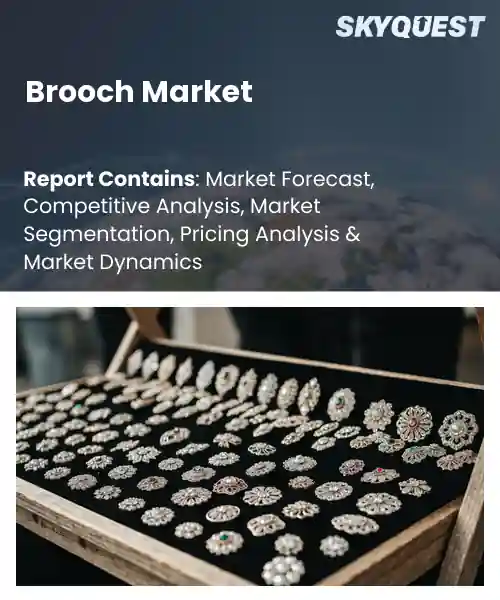
Brooch Market
Report ID: SQMIG20I2914
Report ID: SQMIG20I2914
[email protected]
USA +1 351-333-4748
Report ID:
SQMIG20I2914 |
Region:
Global |
Published Date: April, 2026
Pages:
157
|Tables:
90
|Figures:
76


Global Brooch Market size was valued at USD 842.5 Million in 2024 and is poised to grow from USD 869.46 Million in 2025 to USD 844.9 Million by 2033, growing at a CAGR of 3.2% during the forecast period (2026-2033).
Consumers’ renewed appetite for tactile accessories is the primary driver reshaping the brooch market by turning a niche craft into a visible element of contemporary fashion. The brooch market includes decorative pins made by luxury houses and artisans, and it matters because these objects function as wearable art, status symbols, and heirlooms. Historically the market has shifted from Victorian mourning brooches to Art Deco statements and mid-century costume designs, with recent reinterpretations on runways and in vintage trade. For example, Chanel’s seasonal collections and resales have reintroduced brooches to mainstream audiences while online platforms connect makers with collectors globally today.Digital commerce and personalization are the pivotal factor driving global brooch market growth because expanded online reach causes niche designers to scale while consumer demand for tailored pieces rises. Platforms like Etsy and Farfetch lower distribution barriers, enabling artisans to convert bespoke orders into scalable offerings which in turn encourages investment in sustainable metals and lab-grown gems, attracting ethically minded buyers and supporting higher margins. The effect surfaces in concrete opportunities: brides commission heirloom pins, luxury houses launch influencer-backed capsule brooch lines, and corporations order customized pins for premium gifting, these revenue channels incentivize further product development and market expansion.
How is blockchain enhancing provenance verification in the brooch market?
Blockchain strengthens provenance verification in the brooch market by creating an immutable ledger that links a piece to a permanent digital record. Key aspects include tamper resistant recording of materials, tokenized certificates and on item tagging that tie photos and service history to a unique digital identity. Today auction houses, heritage jewellers and registry platforms are adopting these tools to authenticate vintage and designer brooches, reduce fraud and simplify consignment processes. The result is clearer lineage for collectors and smoother transfers of ownership, making provenance an accessible part of routine valuation and sales.Aura Blockchain Consortium September 2025, the consortium's recognition highlights wider industry adoption and the rollout of digital product passports for jewellery. Recording authenticated histories on a shared ledger makes provenance checks for brooches faster and more transparent and helps dealers and buyers transact with greater confidence.
Market snapshot - (2026-2033)
Global Market Size
USD 842.5 Million
Largest Segment
High Density EPP
Fastest Growth
Low Density EPP
Growth Rate
3.2% CAGR
To get more insights on this market click here to Request a Free Sample Report
Global brooch market is segmented by product grade, end-use industry, function and region. Based on product grade, the market is segmented into High Density EPP, Low Density EPP and Others (Porous & Flame Retardant). Based on end-use industry, the market is segmented into Automotive (Bumper cores/Side-impact panels), Packaging (Food/Electronics), Consumer Products & Toys and Others (HVAC & Aerospace). Based on function, the market is segmented into Impact Resistance & Cushioning and Thermal Insulation. Based on region, the market is segmented into North America, Europe, Asia Pacific, Latin America and Middle East & Africa.
High Density EPP segment dominates because its superior structural integrity and load-bearing capacity meet the Brooch Market’s demand for durable, form-stable mounting components and protective cores. Its high stiffness enables precise shaping and long-term retention of decorative elements, reducing failure modes and returns. This reliability drives adoption among designers and manufacturers seeking consistent performance, streamlining production processes and lowering lifecycle costs through fewer repairs and enhanced product longevity.
However, Low Density EPP is emerging as the fastest growing area due to its light weight, cushioning and lower material cost that enable delicate wearable brooch designs and wider consumer accessibility. Its molding flexibility and amenability to color and texture innovations accelerate product variety, unlocking new price points and distribution channels that expand market opportunities.
Packaging (Food/Electronics) segment leads because its stringent protective and regulatory requirements drive demand for specialized brooch materials and designs that ensure product integrity during transit and shelf display. The need to preserve delicate finishes, prevent contamination and withstand handling compels manufacturers to adopt advanced foams and coatings, prompting supply chain standardization and sustained procurement from packaging-oriented customers, which reinforces design-for-protection priorities across the Brooch Market.
Meanwhile, Consumer Products & Toys is witnessing the strongest growth momentum as manufacturers leverage lightweight, decorative and safe brooch constructions to meet fast-moving retail trends and seasonal releases. Rising demand for novel aesthetics and child-safe materials, combined with licensing-driven collections, fuels rapid product introductions and retailer interest, creating new channels for design experimentation and scaled production.
To get detailed segments analysis, Request a Free Sample Report
Asia Pacific leads global brooch market due to a convergence of cultural affinity for ornamental accessories, sophisticated manufacturing capabilities, strong design innovation, and integrated supply chains that support diverse product tiers. Consumers across key markets favor heritage motifs and contemporary reinterpretations, creating steady demand for artisanal and mass-produced pieces alike. High concentration of skilled artisans, supportive retail ecosystems including boutique and department store channels, and progressive collaborations between designers and manufacturers reinforce market depth. Rapid adoption of digital commerce and influential fashion trends amplify visibility beyond regional borders, while competitive material sourcing and cost efficiencies enable broader distribution and a range of price points. Together these factors sustain leadership and drive continual product evolution across the region. Robust artisan communities and educational programs further enrich creative capacity.
Brooch Market in Japan combines deep respect for craftsmanship with a taste for subtle, refined design, supporting a vibrant community of artisans and niche designers. Domestic consumers value narrative and provenance, encouraging limited edition collections and high-quality materials. Retail structures that blend traditional boutiques with curated modern shops create visibility for both heritage and experimental pieces. Collaboration between designers and ateliers sustains a culture of meticulous finishing and thoughtful presentation.
Brooch Market in South Korea reflects a dynamic fusion of contemporary fashion sensibilities and strong youth-driven trends, enabling designers to experiment with bold forms and mixed materials. Social media and celebrity influence accelerate visibility for innovative collections, while a sophisticated manufacturing base supports rapid iteration from concept to retail. Independent studios and mainstream brands collaborate, producing accessible designer pieces and runs that appeal to trend-conscious consumers seeking distinctive, statement accessories.
Europe experiences rapid expansion in brooch market due to a combination of heritage craftsmanship, influential luxury houses, and a renewed consumer interest in artisanal and bespoke accessories. Deep-rooted jewelry traditions coexist with contemporary designers who reinterpret classic motifs, appealing to both conservative and avant-garde buyers. Strong retail networks spanning independent ateliers, specialty jewelers, and curated online platforms facilitate discovery and accessibility. Heightened focus on sustainable sourcing and transparent production practices enhances brand credibility, while collaborative initiatives between fashion houses and independent creators generate fresh visibility. Cultural events and seasonal showcases stimulate demand for collectible pieces, and the region benefits from a discerning customer base that values provenance, storytelling, and enduring design over transient trends. Investment in small-batch production and design education strengthens long-term creative capacity across markets.
Brooch Market in Germany is marked by growing interest in locally made accessories and experimental design supported by craft schools and independent ateliers. Buyers seek understated, well-crafted pieces with ethical production credentials. Urban concept stores and craft fairs provide platforms for emerging designers, while partnerships between designers and manufacturers help scale artisanal concepts. The market favors practical elegance and material innovation aligned with discerning consumer values and sustainability emphasis.
Brooch Market in United Kingdom is experiencing momentum driven by trend adoption, strong digital retailing, and collaborations between designers and fashion labels. Consumers show appetite for vintage revival, collectible pieces, and limited editions highlighted by media and influencer channels. Independent design scenes and adaptable manufacturing enable quick responses to trend cycles. Retail formats that combine online curation with pop-up shows broaden reach, while sustainability and craftsmanship narratives strengthen consumer trust.
Brooch Market in France is anchored by historic jewelry ateliers and luxury fashion houses that prioritize impeccable finishing and refined aesthetics. Strong domestic appreciation for artisanal heritage and couture-level detailing sustains demand for bespoke and collectible pieces. Prestigious boutiques and department store salons provide premium display and service, while collaborative projects between couture designers produce statement items. The market emphasizes provenance, craftsmanship, and timeless elegance in presentation and retail experience.
North America is strengthening its role in the brooch market through a mix of entrepreneurial design activity, diversified retail strategies, and an emphasis on authenticity and ethical production. Independent designers and small studios leverage digital platforms to reach niche audiences, while established jewelers broaden assortments to include statement and wearable-art pieces. Consumer interest in vintage aesthetics and bespoke customization supports demand for unique accessories. Cross-border collaborations, investment in artisanal training, and the growth of curated retail concepts enhance market sophistication. Embracing sustainable materials and transparent sourcing practices resonates with discerning buyers, and targeted brand storytelling helps translate craftsmanship into commercial appeal across mainstream and specialty channels. Investment in domestic small-batch manufacturing and partnerships with cultural institutions for exhibition and education deepen consumer appreciation and support higher value positioning.
Brooch Market in United States is driven by designer communities and strong direct-to-consumer channels that favor innovative, statement accessories. Vintage collecting trends and influencer visibility elevate demand for distinctive pieces, while bespoke services and personalization options attract discerning buyers. Independent studios collaborate with artisans and manufacturers to translate conceptual design into market-ready collections. Increasing emphasis on provenance, sustainable material selection, and transparent production resonates with consumers seeking meaningful, well-crafted adornments.
Brooch Market in Canada emphasizes locally sourced materials, artisanal production, and design initiatives that highlight regional craftsmanship. Small studios and cooperative workshops foster experimentation with contemporary forms and traditional techniques, appealing to consumers who prioritize ethical sourcing and slow-fashion principles. Curated boutiques and online platforms present designers to audiences, while collaborations with galleries and cultural organizations elevate appreciation for wearable art. The market balances functional simplicity with thoughtful, handcrafted detailing.
To know more about the market opportunities by region and country, click here to
Buy The Complete Report
Growing Demand For Personalization
Integration Of Sustainable Materials
High Production Costs For Craftsmanship
Counterfeit And Imitation Products
Request Free Customization of this report to help us to meet your business objectives.
Competition for share in the global brooch market is sharpening as conglomerates pursue acquisitions and vertical consolidation, while independents drive differentiation through celebrity placements and inclusive product strategies. For example, luxury groups have bought specialist producers to integrate craft and technology, and independent house Sauvereign gained high visibility after a bespoke brooch appeared on the Oscars red carpet.
Top Player’s Company Profile
Recent Developments
SkyQuest’s ABIRAW (Advanced Business Intelligence, Research & Analysis Wing) is our Business Information Services team that Collects, Collates, Correlates, and Analyses the Data collected by means of Primary Exploratory Research backed by robust Secondary Desk research. As per SkyQuest analysis, the global brooch market is experiencing robust growth where the key driver is digital commerce and personalization, which broadens reach and enables bespoke, higher-margin offerings, and a second driver is the rising adoption of sustainable and ethically sourced materials that strengthen brand credibility. A notable restraint is high production costs for skilled craftsmanship that limit scale and price accessibility. The dominating region is Asia Pacific, supported by manufacturing depth and cultural demand, while the dominating segment is High Density EPP due to its structural reliability for mounting and protective cores. Together these forces shape product innovation, premium positioning and new retail channels worldwide.
| Report Metric | Details |
|---|---|
| Market size value in 2024 | USD 842.5 Million |
| Market size value in 2033 | USD 844.9 Million |
| Growth Rate | 3.2% |
| Base year | 2024 |
| Forecast period | (2026-2033) |
| Forecast Unit (Value) | USD Million |
| Segments covered |
|
| Regions covered | North America (US, Canada), Europe (Germany, France, United Kingdom, Italy, Spain, Rest of Europe), Asia Pacific (China, India, Japan, Rest of Asia-Pacific), Latin America (Brazil, Rest of Latin America), Middle East & Africa (South Africa, GCC Countries, Rest of MEA) |
| Companies covered |
|
| Customization scope | Free report customization with purchase. Customization includes:-
|
To get a free trial access to our platform which is a one stop solution for all your data requirements for quicker decision making. This platform allows you to compare markets, competitors who are prominent in the market, and mega trends that are influencing the dynamics in the market. Also, get access to detailed SkyQuest exclusive matrix.
Table Of Content
Executive Summary
Market overview
Parent Market Analysis
Market overview
Market size
KEY MARKET INSIGHTS
COVID IMPACT
MARKET DYNAMICS & OUTLOOK
Market Size by Region
KEY COMPANY PROFILES
Methodology
For the Brooch Market, our research methodology involved a mixture of primary and secondary data sources. Key steps involved in the research process are listed below:
1. Information Procurement: This stage involved the procurement of Market data or related information via primary and secondary sources. The various secondary sources used included various company websites, annual reports, trade databases, and paid databases such as Hoover's, Bloomberg Business, Factiva, and Avention. Our team did 45 primary interactions Globally which included several stakeholders such as manufacturers, customers, key opinion leaders, etc. Overall, information procurement was one of the most extensive stages in our research process.
2. Information Analysis: This step involved triangulation of data through bottom-up and top-down approaches to estimate and validate the total size and future estimate of the Brooch Market.
3. Report Formulation: The final step entailed the placement of data points in appropriate Market spaces in an attempt to deduce viable conclusions.
4. Validation & Publishing: Validation is the most important step in the process. Validation & re-validation via an intricately designed process helped us finalize data points to be used for final calculations. The final Market estimates and forecasts were then aligned and sent to our panel of industry experts for validation of data. Once the validation was done the report was sent to our Quality Assurance team to ensure adherence to style guides, consistency & design.
Analyst Support
Customization Options
With the given market data, our dedicated team of analysts can offer you the following customization options are available for the Brooch Market:
Product Analysis: Product matrix, which offers a detailed comparison of the product portfolio of companies.
Regional Analysis: Further analysis of the Brooch Market for additional countries.
Competitive Analysis: Detailed analysis and profiling of additional Market players & comparative analysis of competitive products.
Go to Market Strategy: Find the high-growth channels to invest your marketing efforts and increase your customer base.
Innovation Mapping: Identify racial solutions and innovation, connected to deep ecosystems of innovators, start-ups, academics, and strategic partners.
Category Intelligence: Customized intelligence that is relevant to their supply Markets will enable them to make smarter sourcing decisions and improve their category management.
Public Company Transcript Analysis: To improve the investment performance by generating new alpha and making better-informed decisions.
Social Media Listening: To analyze the conversations and trends happening not just around your brand, but around your industry as a whole, and use those insights to make better Marketing decisions.
REQUEST FOR SAMPLE
 REQUEST FREE CUSTOMIZATION


Want to customize this report? This report can be personalized according to your needs. Our analysts and industry experts will work directly with you to understand your requirements and provide you with customized data in a short amount of time. We offer $1000 worth of FREE customization at the time of purchase.
Feedback From Our Clients


 USA (+1) 351-333-4748

