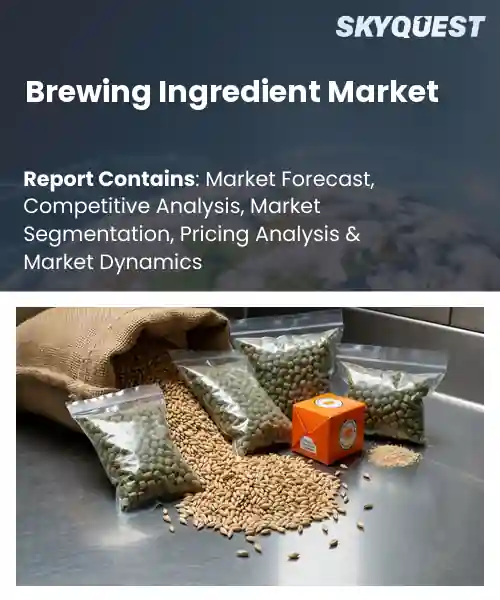
Brewing Ingredient Market
Report ID: SQMIG30H2388
Report ID: SQMIG30H2388
[email protected]
USA +1 351-333-4748
Report ID:
SQMIG30H2388 |
Region:
Global |
Published Date: March, 2026
Pages:
157
|Tables:
175
|Figures:
79


Global Brewing Ingredient Market size was valued at USD 18.60 Billion in 2024 and is poised to grow from USD 19.88 Billion in 2025 to USD 33.91 Billion by 2033, growing at a CAGR of 6.9% during the forecast period (2026-2033).
The brewing ingredient market is made up of many different types of raw materials, such as malted barley, hops, and yeast (as well as adjuncts) that determine how flavorful a beer will be when produced. Consumer demand for craft beers and premium experiences has driven changes in product sourcing and supply chains. The industry has evolved from one of industrial uniformity to one of greater diversity due to the proliferation of microbreweries.
As an example of this shift, there has been an enlargement in the amount of acreage devoted to growing hops in the United States to create new aroma profiles, as well as a rise in the number of craft maltsters who custom craft their kilnets to meet the specifications of craft brewers.
Climate variability and industry consolidation have impacted the availability and pricing of these raw materials, leading to significant investments in the breeding, storage, and procurement of raw materials. The most significant factor driving the brewing ingredients market growth of this trend lies in ingredient innovation in combination with supplier resiliency. By creating new and innovative raw materials with different flavor profiles, brewers are less vulnerable to price fluctuations and can differentiate their products from one another (e.g., through distinct IPA styles) if they produce unique raw materials without sacrificing productivity (e.g., through low alpha and high aromatic hop varieties).
Furthermore, investing in drought resistant varieties of barley and providing contract malting services has minimized the enhanced risks for global breweries associated with price volatility and enabled long-term, reliable sourcing of raw materials.
How is Blockchain Improving Traceability in the Brewing Ingredient Market?
Tracing brewing ingredients through blockchain creates a record of provenance from the farm to the malt house to the brewery in a tamper-proof, shared ledger. Key features of blockchain's traceability of brewing ingredients include full audit reports that cannot be changed, verifiable data regarding the source of the ingredient, and the ability to link specific farms' inputs and quality checks back to a given batch at the brewery level.
With a growing demand for sustainability and traceability, brewers are now utilizing QR codes and ledger records to demonstrate farming methods and handling channels for their ingredients. This has streamlined the investigation process for quality-related issues, reduced the risk associated with ingredient recalls, and improved breeder-supplier collaboration, while also providing consumers with confidence regarding how their ingredients were sourced.
Market snapshot - 2026-2033
Global Market Size
USD 18.6 Billion
Largest Segment
Malt
Fastest Growth
Yeast
Growth Rate
6.9% CAGR
To get more insights on this market click here to Request a Free Sample Report
The brewing ingredient market is segmented into ingredient type, form, beer type, brewery size, function type, end-user and region. Based on ingredient type, the market is segmented into malt, hops, yeast, adjuncts and enzymes. Based on form, the market is segmented into liquid and dry. Based on beer type, the market is segmented into lager, ale, stout and others. Based on brewery size, the market is segmented into craft breweries, microbreweries, industrial breweries and macro brewery.
Based on function type, the market is segmented into fragrance, preservatives, flavor and proteins. Based on end-user, the market is segmented into brewpubs, contract breweries and craft brewers. Based on region, the market is segmented into North America, Europe, Asia Pacific, Latin America, and Middle East & Africa.
As per brewing ingredient market outlook, malt segment dominates because malt provides the fermentable backbone and flavor foundation that most brewers rely on to define beer style and consistency. Its versatility throughout the brewing process, consistent and high quality of malts produced by maltsters with whom brewers have a long-standing relationship, and the demand for malt products continue to drive demand for malt in brewing.
As per brewing ingredient market analysis, the hops segment is the fastest growing in the market due to new extract technologies and the increasing number of consumers interested in hop-centric beers. As brewers develop new hop flavor profiles, increased use of lupulin concentrates/ hop extracts, and develop innovations that provide new aroma profiles, the demand for premium hop varieties will continue to accelerate premiumization.
As per brewing ingredient market forecast, the liquid segment dominates the market because liquid ingredients can be integrated quickly into automated dosing systems, provide consistent dispersion, minimize handling variation across production batches. Liquid ingredients can be quickly integrated into automated dosing systems, supporting streamlined brewery operations. They ensure consistent dispersion, reducing variability across production batches. Liquid formats enhance the efficiency of enzymes, yeast slurries, and concentrated flavors in large-scale brewing processes. Their use helps reduce operational friction in high-volume brewery environments.
The dry segment is experiencing rapid growth due to formulation improvements and stabilization technologies that improve reliability of dry yeast/enzymes. Longer shelf life, easier to store, and more appealing logistics are attracting smaller producers as well as driving artisanal innovations; access to new markets will result from these changes as well as spur new product development.
To get detailed segments analysis, Request a Free Sample Report
As per brewing ingredient market regional outlook, with its established brewing culture, comprehensive supplier networks and stringent standards for raw materials, Europe is the leading region for global brewing ingredient sales. A well-established malt and hop industry provide brewers with reliable, continuous access to a variety of specialized malt and hops. Furthermore, Europe boasts world class research institutions that drive new ingredient innovation and quality control. Additionally, the strong export orientation of European brewers and their integrated logistics capabilities facilitate efficient cross-border distribution of finished products.
A diverse array of consumer preferences nurtures a dual brewing landscape of large-scale production and artisanal experimentation, thus creating demand for distinction among brewing ingredients. Regulatory frameworks that promote traceability and safety enhance buyer confidence in the marketplace, while sustainability initiatives between growers and processors further secure market position by being consistent with the priorities of brewers. Collaborative networks among farmers, maltsters and brewers facilitate the rapid commercialization of new types of brewing ingredients, reinforcing Europe's status as the global leader in the excellence and innovation of brewing ingredients.
The brewing ingredient market in Germany illustrates how hops and barley are grown and cultivated with an extreme focus on the malt manufacturing process. A strong commitment by brewers to technical excellence drives the demand for high quality malts and aroma hop varieties. Therefore, the collaboration between growers and processors creates some of the most consistent qualities in the brewing ingredient market, which supports the continuing popularity of traditional lagers and the exploding interest in innovative craft styles.
The focus on quality by growers and processors and the capabilities of German logistics create a high level of assurance that there will always be sufficient supplies of high-quality brewing ingredients available. Additionally, German breeders and growers conduct extensive research in cooperation with brewers to develop ways to improve existing brewing ingredients to satisfy the diverse requirements of brewers throughout Germany.
The brewing ingredient market for the UK is characterized by a dynamic craft element combined with larger-scale commercial brewers driving the continued demand for specialty malts, yeast strains, and hop profiles. Suppliers of brewing ingredients are focused on ensuring that they can support the continued supply of high-quality ingredients through traceable sourcing processes and promoting the use of consistent flavor profiles to satisfy the discerning nature of brewers.
The logistics and processing capabilities for brewing ingredients allow experimental-style breweries to adopt new ingredients quickly. The collaborative efforts between research organizations and the brewing industry have led to the creation of new ingredient blends that complement the traditional brewing styles of ales while also facilitating innovation in new flavors and refining the overall flavor profile of beer.
The French brewing ingredient market is an amalgam of artisanal brewers and specialty ingredient requirements that promote the demand for a variety of different types of malts, aromatic hops, and wild yeast strains. The desire for distinct flavor profiles from brewers has resulted in many suppliers of brewing ingredients focusing on providing high-quality, sustainable products that express the terroir of their respective regions. In addition to suppliers, many smaller producers have developed strong regional supply chains and cooperative networks that enable them to access or purchase product from other producers. Collaborative research projects have resulted in improved processes that enhance the value of local agricultural-based products by creating new and distinct ingredient offerings.
As per brewing ingredient market regional forecast, the rate of growth in North American markets for brewing ingredients is driven by the strong craft beer movement, an ever-increasing demand from consumers for exciting new flavour experiences, and an increasing focus on sourcing ingredients locally. In response to these trends, ingredient suppliers are rolling out product portfolios that feature many new products categories such as specialty malts, unique hop varieties/cultivars and proprietary yeast strains.
Brand new to the marketplace, these innovative products are gaining momentum through collaboration between brewers and suppliers during the product development process. Investment in malting facilities, hop breeding programs and processing facilities helps to meet the growing demand for brewing ingredients by enhancing the production capacity of domestic sources. Consumer interest in seasonal products and limited release brewing ingredients continues to drive demand for a variety of exciting new flavours.
The US brewing ingredient market consists of an interconnected network of breeding-based agricultural producers, malting facility operators and specialized sales representatives that serve the many types of breweries in business today. Breweries demand a broad range of exciting new hop varieties, specialty malts and unique yeast blends; consequently, these demands have motivated ingredient suppliers to innovate at accelerating rates. Collaboration between breweries and suppliers fosters continual improvement in quality and efficiency of brewing.
The Canada brewing ingredient market benefits from the agricultural strengths of each region of the country, producing barley and hops that produce a high-quality ingredient and can be used in many styles of beers. Local malting facilities and cooperative networks of growers assist with improving traceability of ingredients and providing sustainable ingredient solutions. Suppliers are tailoring products specifically for craft brewers who want terroir flavour and performance in their ingredients. Suppliers also support craft breweries by allowing them to locally develop ingredients through yeast and other product innovation closer to the larger breweries, enabling smaller breweries to access quality ingredients more quickly. There is a complete partnership between suppliers and brewers to provide product solutions.
As per brewing ingredient industry analysis, the Asia Pacific region is advancing its position within the brewing ingredient segment by targeting specific investments in ingredient scientific research, developing regionally unique cultivars, and growing processing capabilities for all types of brewing inputs. Increased consumer interest in higher-quality craft and premium brands has encouraged suppliers of brewing inputs to create uniquely crafted malts, specialty adjuncts, and native flavor-producing organisms that reflect typical culinary practices native to this area.
Japan has an extensive tradition of fermentation science and processing that provides a high-quality base for brewing ingredients. High-quality brewing inputs reflect a focus on producing pure, balanced flavor contributions and working with both traditional and modern styles, resulting in the creation of highly complex profiles characteristic of regional varieties through the utilization of regionally available strains of cereal grains and/or adjunct materials. Manufacturers, who rely heavily on collaboration with research institutions, have built comprehensive quality control systems to ensure consistent strain selection and provide their customers with the highest-quality inputs possible.
The South Korean brewing ingredient market is experiencing rapid diversification as a result of an increased interest in craft brewing and the demand for unique flavor profiles. New products being developed by suppliers include specialty malt lines, localized hop varieties, and different types of yeast strains, enabling experimental brewing processes. Advances in processing technology and quality assurance systems have increased supplier reliability and improved the commercialization of distinctive recipes.
In addition to developing alliances with universities and emerging businesses to foster innovation, suppliers also develop synergies with other suppliers to promote best practices in low-cost production and distribution. Effective logistics allow breweries focusing on traditional beer styles and non-traditional expressions to receive products on time to continue innovating and responding to changing tastes.
To know more about the market opportunities by region and country, click here to
Buy The Complete Report
Rising Craft Beer Demand
Innovation In Functional Ingredients
Raw Material Price Volatility
Complexity of Regulatory Compliance
Request Free Customization of this report to help us to meet your business objectives.
In the global brewing ingredients market, the competitive landscape is evolving. Large legacy suppliers defend their supply chain through partnerships with biotechnology because both types of companies introduce new and different products, primarily through sustainable business practices. Other brewing ingredient market trends are creating partnerships between larger brewers and smaller fermentation start-ups (for instance by creating innovation arms to work together) as well as YeastUp, which uses waste yeast from breweries to turn it into value-added yeast proteins (functional ingredients) and turn excess moisture into brewable yeast to develop and resource solutions for ingredient suppliers.
Sustainable Ingredient Sourcing
Unique and Different Flavors
SkyQuest’s ABIRAW (Advanced Business Intelligence, Research & Analysis Wing) is our Business Information Services team that Collects, Collates, Correlates, and Analyses the Data collected by means of Primary Exploratory Research backed by robust Secondary Desk research.
As per SkyQuest analysis, the global brewing ingredient industry is set to expand driven primarily by rising craft beer demand that pushes brewers to source specialty malts, hops and yeasts for unique flavor profiles. A second driver is innovation in functional ingredients, including specialized enzymes and concentrated flavor extracts, which improve process efficiency and enable product differentiation. However raw material price volatility remains a significant restraint, increasing cost uncertainty and slowing launches. Europe remains the dominant region due to deep supplier networks and legacy brewing culture, and malt is the dominating segment because it provides the fermentable backbone and flavor foundation that defines beer styles and brewer preference. The market is characterized by a consolidated structure where a few global players such as Cargill, Incorporated, Malteurop Groupe, Boortmalt, and Lesaffre hold a significant brewing ingredient market share, supported by their extensive supply chains and strong presence across malt, yeast, and adjunct segments,
| Report Metric | Details |
|---|---|
| Market size value in 2024 | USD 18.60 Billion |
| Market size value in 2033 | USD 33.91 Billion |
| Growth Rate | 6.9% |
| Base year | 2024 |
| Forecast period | 2026-2033 |
| Forecast Unit (Value) | USD Billion |
| Segments covered |
|
| Regions covered | North America (US, Canada), Europe (Germany, France, United Kingdom, Italy, Spain, Rest of Europe), Asia Pacific (China, India, Japan, Rest of Asia-Pacific), Latin America (Brazil, Rest of Latin America), Middle East & Africa (South Africa, GCC Countries, Rest of MEA) |
| Companies covered |
|
| Customization scope | Free report customization with purchase. Customization includes:-
|
To get a free trial access to our platform which is a one stop solution for all your data requirements for quicker decision making. This platform allows you to compare markets, competitors who are prominent in the market, and mega trends that are influencing the dynamics in the market. Also, get access to detailed SkyQuest exclusive matrix.
Table Of Content
Executive Summary
Market overview
Parent Market Analysis
Market overview
Market size
KEY MARKET INSIGHTS
COVID IMPACT
MARKET DYNAMICS & OUTLOOK
Market Size by Region
KEY COMPANY PROFILES
Methodology
For the Brewing Ingredient Market, our research methodology involved a mixture of primary and secondary data sources. Key steps involved in the research process are listed below:
1. Information Procurement: This stage involved the procurement of Market data or related information via primary and secondary sources. The various secondary sources used included various company websites, annual reports, trade databases, and paid databases such as Hoover's, Bloomberg Business, Factiva, and Avention. Our team did 45 primary interactions Globally which included several stakeholders such as manufacturers, customers, key opinion leaders, etc. Overall, information procurement was one of the most extensive stages in our research process.
2. Information Analysis: This step involved triangulation of data through bottom-up and top-down approaches to estimate and validate the total size and future estimate of the Brewing Ingredient Market.
3. Report Formulation: The final step entailed the placement of data points in appropriate Market spaces in an attempt to deduce viable conclusions.
4. Validation & Publishing: Validation is the most important step in the process. Validation & re-validation via an intricately designed process helped us finalize data points to be used for final calculations. The final Market estimates and forecasts were then aligned and sent to our panel of industry experts for validation of data. Once the validation was done the report was sent to our Quality Assurance team to ensure adherence to style guides, consistency & design.
Analyst Support
Customization Options
With the given market data, our dedicated team of analysts can offer you the following customization options are available for the Brewing Ingredient Market:
Product Analysis: Product matrix, which offers a detailed comparison of the product portfolio of companies.
Regional Analysis: Further analysis of the Brewing Ingredient Market for additional countries.
Competitive Analysis: Detailed analysis and profiling of additional Market players & comparative analysis of competitive products.
Go to Market Strategy: Find the high-growth channels to invest your marketing efforts and increase your customer base.
Innovation Mapping: Identify racial solutions and innovation, connected to deep ecosystems of innovators, start-ups, academics, and strategic partners.
Category Intelligence: Customized intelligence that is relevant to their supply Markets will enable them to make smarter sourcing decisions and improve their category management.
Public Company Transcript Analysis: To improve the investment performance by generating new alpha and making better-informed decisions.
Social Media Listening: To analyze the conversations and trends happening not just around your brand, but around your industry as a whole, and use those insights to make better Marketing decisions.
REQUEST FOR SAMPLE
 REQUEST FREE CUSTOMIZATION
Brewing Ingredient Market is projected to reach USD 33.91 Billion by 2033, growing at a CAGR of 6.9% driven by rising craft beer demand and innovation.
Key vendors in the Brewing Ingredient Market include Cargill, Boortmalt, Malteurop Groupe, Lallemand, Angel Yeast, Lesaffre, and Kerry Group, along with Chr. Hansen and Rahr Corporation, driving innovation and global supply.
The key driver of the Brewing Ingredient Market is the rising global demand for craft beer and premium alcoholic beverages, supported by changing consumer preferences, flavor innovation, and the rapid expansion of microbreweries worldwide.
The key market trend in the Brewing Ingredient Market is the increasing use of specialty and innovative ingredients, such as unique hops, tailored yeast strains, and natural additives, as breweries aim to create distinctive flavors and premium craft beer offerings.
Europe accounted for the largest share in the Brewing Ingredient Market, driven by its strong beer culture, high consumption levels, and the presence of established breweries and leading ingredient manufacturers.


Want to customize this report? This report can be personalized according to your needs. Our analysts and industry experts will work directly with you to understand your requirements and provide you with customized data in a short amount of time. We offer $1000 worth of FREE customization at the time of purchase.
Feedback From Our Clients


 USA (+1) 351-333-4748

