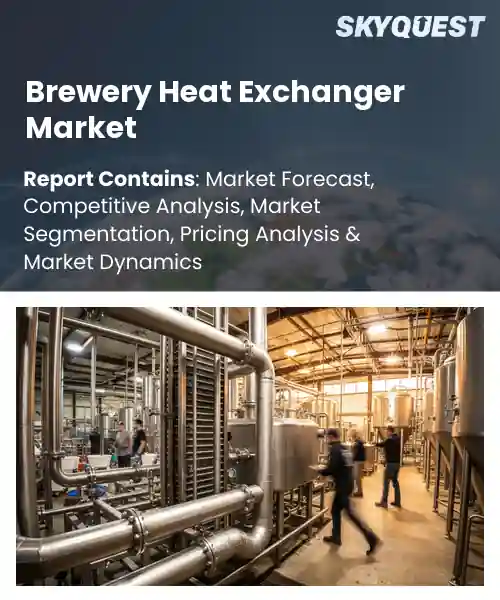
Brewery Heat Exchanger Market
Report ID: SQMIG20D2529
Report ID: SQMIG20D2529
[email protected]
USA +1 351-333-4748
Report ID:
SQMIG20D2529 |
Region:
Global |
Published Date: February, 2026
Pages:
157
|Tables:
116
|Figures:
77


Global Brewery Heat Exchanger Market size was valued at USD 2.2 Billion in 2024 and is poised to grow from USD 2.33 Billion in 2025 to USD 3.72 Billion by 2033, growing at a CAGR of 6.0% during the forecast period (2026-2033).
The primary driver of the brewery heat exchanger market share is the growing need for thermal efficiency and process control as brewers scale, target sustainability. The market covers equipment that transfers heat during wort cooling, fermentation temperature management and CIP cycles, and it matters because exchangers influence product consistency, throughput and energy expenses. Historically, the sector moved from simple cooling jackets and shell-and-tube units toward compact plate-and-frame and brazed-plate solutions engineered for hygiene and cleaning. Several craft breweries across America have begun using plate heat exchangers, whereas big breweries in Europe, on the other hand, have incorporated heat recovery systems into their processes to spend less on culinary steam and lower overhead costs.
Building on the shift toward heat recovery, a key trend driving the global brewery heat exchanger sector demand is regulatory pressure and rising energy costs that make efficient thermal equipment economically attractive. When breweries invest in high-efficiency plate or heat-recovery exchangers they cut gas and electricity bills, which directly improves margins, frees capital for capacity expansion or branding, creating a positive feedback loop that stimulates further equipment purchases. Heat recovered from the process can be used to preheat mash water and can also be used to support the cleaning-in-place (CIP) systems.
How is IoT Improving Efficiency in the Brewery Heat Exchanger Market?
IoT is improving efficiency in the brewery heat exchanger market by tying sensors connectivity and analytics to core thermal processes. Key aspects include continuous monitoring of temperature flow and fouling plus cloud -based analytics that flag performance drift. The current state sees breweries using smart sensors for predictive maintenance targeted cleaning and dynamic control of heat recovery to cut energy and water waste while protecting hygiene. Market context shows strong vendor focus on combining upgraded exchanger designs with digital services, so operators achieve higher uptime lower operating cost and clearer sustainability gains.
Market snapshot - (2026-2033)
Global Market Size
USD 2.2 Billion
Largest Segment
Plate Heat Exchanger
Fastest Growth
Plate Heat Exchanger
Growth Rate
6.0% CAGR
To get more insights on this market click here to Request a Free Sample Report
Global brewery heat exchanger market is segmented by heat exchanger type, material type, technology, end-use application and region. Based on heat exchanger type, the market is segmented into plate heat exchanger, shell and tube, and air cooled heat exchanger. Based on material type, the market is segmented into stainless steel, copper alloy, and others. Based on technology, the market is segmented into traditional technology and advanced technology. Based on end-use application, the market is segmented into brewing process, cooling system, and heating system. Based on region, the market is segmented into North America, Europe, Asia Pacific, Latin America, and Middle East & Africa.
Based on the global brewery heat exchanger market forecast, plate heat exchanger segment dominates because its compact high efficiency design delivers rapid thermal transfer while minimizing hold up volume and footprint, translating to lower energy use and faster process cycles for breweries. Easy disassembly and hygienic cleaning reduce contamination risk and downtime, encouraging adoption across brewhouse operations. These performance and sanitation advantages cause brewers to prioritize plate units for wort cooling and heat recovery, reinforcing their market leadership.
However, shell and tube is emerging as the most rapidly expanding type due to its robustness for high pressure duties, ease of scaling for larger brewhouses, and suitability for heavy duty heating and cooling loops. Long-term asset investments and additional improvements that can be retrofitted are continuing to create new ways for craft breweries to implement their designs faster, at lower costs, and more efficiently.
Traditional technology segment dominates because its proven mechanical simplicity and time tested construction deliver predictable reliability and ease of repair, which aligns with brewers' need for uninterrupted operations. Lifecycle cost and down time will decrease with the use of familiar maintenance procedures and readily available spare parts, while providing regulatory compliance assistance. This will lead to an increase in facility manager preference towards previously established designs of brewing processes, cooling systems and heating systems. Also, lower technical complexity will simplify both staff training & capital planning.
Meanwhile, advanced technology is emerging as the key high growth area driven by digital controls, predictive maintenance, novel materials, and integrated energy recovery systems that unlock operational efficiency and longer asset life. With increasing focus on automated processes and sustainability goals within brewing, more brewers are investing in intelligent heat assembly as a way to rapidly grow their business and create additional service offerings for customers.
To get detailed segments analysis, Request a Free Sample Report
As per the global brewery heat exchanger market analysis, Europe dominates the industry because a dense concentration of established breweries and specialist equipment manufacturers creates a highly integrated ecosystem for innovation, production, and aftermarket support. Strong regulatory and hygiene expectations push brewers toward advanced thermal solutions that improve product integrity and process efficiency. Rapidly implementing advanced heat exchanger design requires both an established engineering base in conjunction with a culture of standards for equipment. With the operators in an active cycle of retrofitting or modernizing their existing units, there is a constant demand for premium equipment and other services.
Brewery heat exchanger market in Germany benefits from proximity to leading engineering firms and a strong tradition of industrial process optimization. The combination of large breweries searching for high quality, long-lasting systems and the thriving craft beer industry creating smaller, more flexible systems has helped to create this trend in demand. They also provide local testing facilities to support the customer and have a skilled workforce who place a high value on precision engineering and modular integration to allow for easy maintenance and future upgrades.
The brewery heat exchanger market in the United Kingdom is driven by a dynamic artisan brewing community and demand for flexible, space efficient solutions suited to urban brewery layouts. Easy to clean products with a fast turnaround time and strict adherence to hygiene are preferred by operators. Packaged solutions, local service support, and tailored solutions for experimental brewing processes are a primary focus for suppliers. Lifecycle service and technical support strengthen the relationship between operators and encourage the adoption of new technologies.
The brewery heat exchanger market in France is shaped by a rich brewing tradition and a strong emphasis on product quality and flavor preservation. Gentle thermal treatment and sanitary design protect the delicate attributes associated with specialty beer; therefore, equipment suppliers will customize solutions for both small, independent microbrewers and large commercial breweries. They provide small, portable, easily cleanable pieces of equipment that can be adapted to many different types of production spaces.
North America is experiencing rapid expansion in the brewery heat exchanger market due to a combination of strong craft brewing momentum, widespread investment in plant upgrades, and an increasing focus on operational efficiency and sustainability. Every brewer at every size continuously looks for those things in the brewhouse/equipment that will help with reducing energy usage, ease of cleaning/sanitizing equipment, and increase production flexibility. Many heat exchanger manufacturers are providing modular designs, along with local service options and good aftermarket programs for their products, to help brewers minimize downtime and simplify maintenance. Additionally, easy access to advanced solutions through distribution partners and equipment financing is making it easier for brewers to use new ways to brew beer.
The brewery heat exchanger market in United States is characterized by diverse operator needs across small craft and large production facilities, driving continuing demand for a wide product portfolio. There is a large preference for breweries to purchase automated easy-to-clean systems that work with their brewing control systems. There are many potential opportunities to retrofit existing processes or improve process efficiency and partners with equipment integrators help maintain an innovative thermal solution supply chain that is competitive in the thermal solution market.
The brewery heat exchanger market in Canada reflects a balance between regional craft innovation and production efficiency priorities. Suppliers will have local service centers available as well as retrofit specialists in order to reduce the onsite inconvenience of business upgrades. Collaboration with engineering firms and attention to lifecycle cost support steady uptake of modern, maintainable heat transfer solutions.
Asia Pacific is strengthening its position in the brewery heat exchanger market through a combination of expanding manufacturing capabilities, targeted technology adoption, and growing domestic brewing activity. Regional equipment producers increasingly offer localized versions of advanced designs while adapting features to meet specific process requirements of local brewers. Investing in automation, sanitation, and small footprint align with the trends of Urban Craft Breweries. Close collaboration between manufacturers and Technical Schools helps improve products very quickly. With continued competition in production costs, as well as improved service distribution, many new heat transfer products have become more affordable.
Brewery heat exchanger market in Japan is characterized by precision engineering with focus on compact hygienic designs suited to small batch and specialty production. Many local equipment manufacturers focus on build quality, corrosion resistance, and ease-of-cleaning features along with a responsive service network. Working closely together gives brewers and equipment manufacturers a great opportunity to develop brewing equipment that fits the needs of brewers with regards to technical designs and their ability to brew.
Brewery heat exchanger market in South Korea is advancing through technology transfer and focus on compact high efficiency solutions suited to urban breweries. Breweries are looking for gear that will be energy-efficient, easy to clean and upgrade. Suppliers are expanding their ranges and aftermarket services to suit customised needs. By working in collaboration with international technology partners and focusing on operator training, we will improve our ability to apply modern heat transfer solutions to various production environments.
To know more about the market opportunities by region and country, click here to
Buy The Complete Report
Rising Demand for Energy Efficiency
Expansion Of Craft and Microbreweries
High Initial Capital Requirements
Complexity Of Maintenance and Cleaning
Request Free Customization of this report to help us to meet your business objectives.
Competitive dynamics in the global brewery heat exchanger market outlook are shaped by incumbent consolidation, sustainability driven product differentiation, and technology partnerships. Major suppliers deploy acquisitions and targeted collaborations to broaden sanitary plate and heat recovery portfolios, for example Alfa Laval’s strategic acquisition activity and Kelvion’s portfolio deals. Energy efficiency and waste heat recovery remain primary competitive drivers for buyers and suppliers.
SkyQuest’s ABIRAW (Advanced Business Intelligence, Research & Analysis Wing) is our Business Information Services team that Collects, Collates, Correlates, and Analyses the Data collected by means of Primary Exploratory Research backed by robust Secondary Desk research.
As per SkyQuest analysis, rising demand for energy efficiency and process control as breweries scale is the primary driver behind growth in the global brewery heat exchanger market trends, supported secondarily by the rapid expansion of craft and microbreweries that require compact, flexible solutions. Due of their compact, highly efficient design, as well as the ability to easily clean them in case of contamination or malfunction, plate heat exchangers continue to be the most popular type of heat exchanger; Europe is the largest user of plate heat exchangers in terms of overall usage due to its many breweries, engineering capabilities, and high levels of hygiene regulations. One factor creating a barrier to adoption is the large initial capital investment that often creates a barrier to smaller operators, which limits their opportunities for upgrade or retrofit to a more modern heat exchanger.
| Report Metric | Details |
|---|---|
| Market size value in 2024 | USD 2.2 Billion |
| Market size value in 2033 | USD 3.72 Billion |
| Growth Rate | 6.0% |
| Base year | 2024 |
| Forecast period | (2026-2033) |
| Forecast Unit (Value) | USD Billion |
| Segments covered |
|
| Regions covered | North America (US, Canada), Europe (Germany, France, United Kingdom, Italy, Spain, Rest of Europe), Asia Pacific (China, India, Japan, Rest of Asia-Pacific), Latin America (Brazil, Rest of Latin America), Middle East & Africa (South Africa, GCC Countries, Rest of MEA) |
| Companies covered |
|
| Customization scope | Free report customization with purchase. Customization includes:-
|
To get a free trial access to our platform which is a one stop solution for all your data requirements for quicker decision making. This platform allows you to compare markets, competitors who are prominent in the market, and mega trends that are influencing the dynamics in the market. Also, get access to detailed SkyQuest exclusive matrix.
Table Of Content
Executive Summary
Market overview
Parent Market Analysis
Market overview
Market size
KEY MARKET INSIGHTS
COVID IMPACT
MARKET DYNAMICS & OUTLOOK
Market Size by Region
KEY COMPANY PROFILES
Methodology
For the Brewery Heat Exchanger Market, our research methodology involved a mixture of primary and secondary data sources. Key steps involved in the research process are listed below:
1. Information Procurement: This stage involved the procurement of Market data or related information via primary and secondary sources. The various secondary sources used included various company websites, annual reports, trade databases, and paid databases such as Hoover's, Bloomberg Business, Factiva, and Avention. Our team did 45 primary interactions Globally which included several stakeholders such as manufacturers, customers, key opinion leaders, etc. Overall, information procurement was one of the most extensive stages in our research process.
2. Information Analysis: This step involved triangulation of data through bottom-up and top-down approaches to estimate and validate the total size and future estimate of the Brewery Heat Exchanger Market.
3. Report Formulation: The final step entailed the placement of data points in appropriate Market spaces in an attempt to deduce viable conclusions.
4. Validation & Publishing: Validation is the most important step in the process. Validation & re-validation via an intricately designed process helped us finalize data points to be used for final calculations. The final Market estimates and forecasts were then aligned and sent to our panel of industry experts for validation of data. Once the validation was done the report was sent to our Quality Assurance team to ensure adherence to style guides, consistency & design.
Analyst Support
Customization Options
With the given market data, our dedicated team of analysts can offer you the following customization options are available for the Brewery Heat Exchanger Market:
Product Analysis: Product matrix, which offers a detailed comparison of the product portfolio of companies.
Regional Analysis: Further analysis of the Brewery Heat Exchanger Market for additional countries.
Competitive Analysis: Detailed analysis and profiling of additional Market players & comparative analysis of competitive products.
Go to Market Strategy: Find the high-growth channels to invest your marketing efforts and increase your customer base.
Innovation Mapping: Identify racial solutions and innovation, connected to deep ecosystems of innovators, start-ups, academics, and strategic partners.
Category Intelligence: Customized intelligence that is relevant to their supply Markets will enable them to make smarter sourcing decisions and improve their category management.
Public Company Transcript Analysis: To improve the investment performance by generating new alpha and making better-informed decisions.
Social Media Listening: To analyze the conversations and trends happening not just around your brand, but around your industry as a whole, and use those insights to make better Marketing decisions.
REQUEST FOR SAMPLE
 REQUEST FREE CUSTOMIZATION
Global Brewery Heat Exchanger Market size was valued at USD 2.2 Billion in 2024 and is poised to grow from USD 2.33 Billion in 2025 to USD 3.72 Billion by 2033, growing at a CAGR of 6.0% during the forecast period (2026-2033).
Competitive dynamics in the global brewery heat exchanger market are shaped by incumbent consolidation, sustainability driven product differentiation, and technology partnerships. Major suppliers deploy acquisitions and targeted collaborations to broaden sanitary plate and heat recovery portfolios, for example Alfa Laval’s strategic acquisition activity and Kelvion’s portfolio deals. Energy efficiency and waste heat recovery remain primary competitive drivers for buyers and suppliers. 'Alfa Laval', 'GEA Group', 'Delta T Systems', 'Xylem Inc.', 'Krones AG', 'SPX Flow', 'Ziemann Holvrieka', 'N.M. Heilig', 'Tetra Pak', 'HRS Heat Exchangers', 'Craft Brew Alliance', 'Thermobreak', 'Heat Transfer Solutions', 'CEME S.p.A.', 'GEA PHE Systems', 'Huber SE', 'APV', 'GEA Westfalia Separator', 'S & D Brewing Equipment', 'Mueller Steam Specialty'
As breweries prioritize energy efficiency to reduce operating costs and environmental impact, demand for advanced heat exchangers increases because these systems improve thermal transfer and reduce energy losses during brewing and wort cooling processes. Manufacturers and operators seek equipment that offers higher heat recovery, lower utility consumption, and compatibility with modern process control, encouraging procurement and retrofits. Investments in efficient heat exchange technologies align with sustainability goals and operational optimization, which stimulates supplier innovation and market expansion as breweries replace outdated units with more efficient alternatives.
Energy Efficiency Focus: Many breweries are prioritizing energy efficient heat exchanger solutions to meet sustainability commitments and reduce operational footprints. Equipment selection emphasizes thermal recovery, minimized heat loss, and compatibility with low carbon heating sources, enabling breweries to reconfigure process flows and retrofit legacy systems for improved lifecycle performance. Suppliers are responding with designs that balance hygienic integrity and compact footprints, while brewers seek partnerships that deliver demonstrable improvements in resource use, regulatory compliance, and long term operational resilience without sacrificing product quality and strengthen competitive positioning.
As per the global brewery heat exchanger market analysis, Europe dominates the industry because a dense concentration of established breweries and specialist equipment manufacturers creates a highly integrated ecosystem for innovation, production, and aftermarket support.


Want to customize this report? This report can be personalized according to your needs. Our analysts and industry experts will work directly with you to understand your requirements and provide you with customized data in a short amount of time. We offer $1000 worth of FREE customization at the time of purchase.
Feedback From Our Clients


 USA (+1) 351-333-4748

