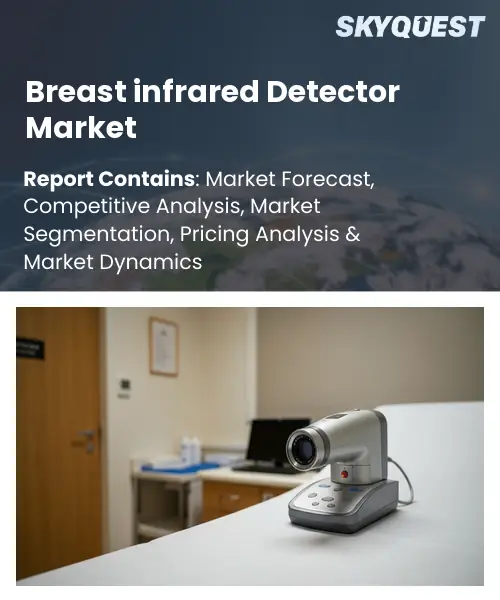
Breast infrared Detector Market
Report ID: SQMIG35A3275
Report ID: SQMIG35A3275
[email protected]
USA +1 351-333-4748
Report ID:
SQMIG35A3275 |
Region:
Global |
Published Date: February, 2026
Pages:
157
|Tables:
114
|Figures:
77


Global Breast Infrared Detector Market size was valued at USD 7.6 Billion in 2024 and is poised to grow from USD 8.58 Billion in 2025 to USD 22.65 Billion by 2033, growing at a CAGR of 12.9% during the forecast period (2026-2033).
Growing demand for noninvasive breast cancer screening, advancements in infrared imaging technology, rising prevalence of breast cancer, integration of AI-based diagnostic analytics, and increasing emphasis on early detection programs are driving the adoption of breast infrared detectors.
Advancements in infrared sensor sensitivity, high-resolution focal plane arrays, and machine learning–based signal processing are significantly improving diagnostic capabilities. The evolution from basic thermography plates to sophisticated infrared imaging systems has been accelerated by improvements in computational analytics and sensor materials. Technological convergence between advanced sensors, algorithmic detection, and cloud infrastructure is enabling scalable deployment in clinics and mobile screening units. Growing awareness regarding early breast cancer detection and the need for radiation-free diagnostic alternatives are expected to primarily drive the breast infrared detector market growth. Early clinical pilots in Europe and the United States demonstrated the adjunctive value of infrared screening alongside mammography, while growing interest in low-resource regions has encouraged the development of portable and cost-efficient devices.
On the contrary, limited clinical validation compared with established imaging modalities, concerns regarding diagnostic accuracy and false positives, high costs of advanced imaging systems, and lack of standardized regulatory guidelines are projected to inhibit breast infrared detector market penetration over the coming years.
How is AI Improving Diagnostic Accuracy in the Breast Infrared Detector Market?
AI is improving diagnostic accuracy in the breast infrared detector market by converting thermal images into objective and consistent assessments that highlight abnormal vascular patterns and localized heat signatures. Machine learning is being utilized to identify complex spatial and temporal patterns that cannot be easily recognized with the naked eye. This is making the detection of thermal signatures more accessible. In the long run, the emphasis on the detection of thermal signatures using AI is expected to increase rapidly with the availability of more real-world studies.
Market snapshot - 2026-2033
Global Market Size
USD 7.6 Billion
Largest Segment
Passive Detection
Fastest Growth
Active Detection
Growth Rate
12.9% CAGR
To get more insights on this market click here to Request a Free Sample Report
The breast infrared detector market is segmented by technology type, application, end user, distribution channel, and region. Based on technology type, the market is segmented into active detection and passive detection. Based on application, the market is segmented into medical diagnosis and industrial applications. Based on end user, the market is segmented into hospitals, research institutions, and others. Based on distribution channel, the market is segmented into direct sales and online Sales. Based on region, the market is segmented into North America, Europe, Asia Pacific, Latin America, and Middle East & Africa.
The active detection segment is slated to account for the highest global breast infrared detector market share in the future. Its ability to deliver controlled thermal illumination and enhanced signal fidelity that improve lesion contrast and diagnostic confidence is helping cement its dominance going forward. Manufacturers prioritize active architectures for integration with analytic algorithms and clinical workflows, prompting focused research and development and clinician adoption. This capability driven preference accelerates device validation, supports stronger clinical acceptance, and drives procurement choices toward systems that offer consistent, reproducible imaging performance and workflow compatibility.
However, passive detection is emerging as the most rapidly expanding segment as per this breast infrared detector industry analysis. Low complexity and noncontact convenience for screening are creating a new business scope via this segment. Sensor sensitivity improvements and smarter algorithms enable portable, low cost devices suited to outpatient settings and telehealth. This momentum attracts new entrants and drives product innovation that broadens market access and use cases.
The direct sales segment is slated to lead the global breast infrared detector market revenue generation over the coming years. Close ties between manufacturers and suppliers that support complex procurement, customized installations, and long term service agreements are helping this segment hold sway over others. Direct engagement helps in the delivery of customized training, instant technical support, and the joint validation of the product with the end user, creating a level of trust and loyalty with the target hospitals and large clinics.
However, the most rapidly growing sales channel is online sales, facilitated by the rise of digital procurement platforms and the ease of purchase for smaller clinics. E-commerce, virtual product demonstrations, and the use of digital media have greatly reduced the educational burden for the purchaser and the overall barrier for new clinics. This is helping in the proliferation of the product for the masses, creating a new revenue stream for subscription-based models.
To get detailed segments analysis, Request a Free Sample Report
Presence of comprehensive clinical ecosystems, concentrated technology leadership, and mature channels for medical device commercialization support sustained dominance in North America. Robust R&D activity in academic medical centers and strong collaboration between clinicians, industry, and specialized service providers are also expected to cement the innovation potential of this region going forward. Reimbursement structures that accommodate non-invasive imaging modalities and the willingness of hospital systems to embrace workflow innovation facilitate early adoption.
A competitive vendor environment and active investment community facilitate product development, distribution, and post-market validation. The dominance of this region can be linked to multidisciplinary care services and its ability to assess patient experiences and its methods of integrating services into current diagnostic procedures. The establishment of effective distribution networks together with dedicated service providers enables the distribution of breast infrared detectors to multiple healthcare facilities.
United States Breast Infrared Detector Market
High investments in clinical research, robust private and public healthcare infrastructure, and presence of top technology providers govern breast infrared detector adoption in the United States. Advanced breast infrared detector demand is fueled by multidisciplinary clinical teams, well-established diagnostic protocols, and vendor-physician partnerships with top medical institutions. The presence of multiple vendors in the market leads to gradual product advancements and service development that focuses on improving patient comfort and operational productivity and creating clinical evidence for adoption.
Canada Breast Infrared Detector Market
Breast infrared detector adoption in Canada is shaped by integrated healthcare networks, emphasis on preventive care, and collaborative research linking academic centers and industry. Domestic companies and international vendors form clinical partnerships to test use cases while both parties work to improve their operational processes and develop services that meet healthcare provider needs and patient care requirements. End users prefer breast infrared detectors because these devices improve patient experience and accessibility.
High emphasis on harmonization of regulatory frameworks, progressive public health priorities that emphasize early detection, and active collaboration are forecasted to boost breast infrared detector sales in Europe. National pilot programs and regional procurement programs establish visible paths which lead to the clinical adoption of this technology. The ongoing development of clinical guidelines enables the implementation of additional imaging techniques into real-world medical operations. Established & growing clusters of medtech companies enable product innovation to take place and facilitate the sharing of knowledge across borders. Local distributors and global suppliers are working together to create value through quality and great patient experience by providing integrated services based upon existing diagnostic workflow interoperability within the healthcare setting.
Germany Breast Infrared Detector Market
Strong engineering and medtech ecosystem, concentrated clinical expertise, and proactive hospital procurement practices are boosting breast infrared detector sales in Germany. The partnership between academic institutions and medical device companies drives both research testing and development of new products. Local service networks together with distributors provide training for clinicians while innovation hubs enable product development which meets performance standards and reliability requirements.
United Kingdom Breast Infrared Detector Market
Robust innovation clusters, clinical trial activity, and progressive procurement models are shaping the adoption of breast infrared detector across the United Kingdom. Large hospital trusts and specialty clinics drive faster technology adoption through their engagement activities while startups and multinational companies work together to enhance product usability and data integration functions. The combination of patient centered care pathways and digital interoperability creates fast adoption processes across various healthcare provider environments.
France Breast Infrared Detector Market
Launch of new coordinated efforts among research institutes, regional health agencies, and innovative medtech firms are influencing breast infrared detector sales in France. Local manufacturers and international vendors create partnerships to demonstrate clinical value while developing service solutions that match clinician requirements and healthcare delivery practices. Pilot programs and initiatives by public and private hospital networks create clinical evidence for breast infrared detectors.
Launch of new focused research initiatives, growing manufacturing competencies, and strategic collaborations between local firms and global technology providers create new opportunities for breast infrared detector vendors in this region. Regional healthcare providers are pursuing cost efficient designs and digital integration of non-invasive diagnostic options that will complement the existing diagnostic imaging infrastructure to drive demand for flexible, non-invasive options such as breast infrared detector.
In addition, by forming clinical and industry partnerships and developing talent in optics and electronics, regional companies provide opportunities to enhance their innovation capacity while implementing commercial strategies to expand the clinical use of these devices in both tertiary care facilities and community-based clinics across the region. Increasing investments in clinical trial programs, scaling up local manufacturing capabilities, and implementing training programs for clinicians and technicians ensure sustained business scope through 2033.
Japan Breast Infrared Detector Market
High optics expertise, precision manufacturing, and strong clinical research capacity are projected to shape breast infrared detector demand in Japan. Access to engineering expertise and specialized suppliers allows for precision in the functioning of the devices. Vendor partnerships facilitate the provision of unique service solutions that match the requirements of medical professionals. Attention to quality specifications and system integration are slated to be highly important factors in deciding on the success of breast infrared detector companies in the country.
South Korea Breast Infrared Detector Market
Breast infrared detector demand in South Korea is slated to be governed by the presence of a robust electronics and medical device sector. Clinical partnerships together with distributor networks enable training for clinicians while offering service support and continuous improvement of user experience and clinical effectiveness. Preference for breast infrared detectors that emphasize digital system integration together with data-based diagnostic methods is expected to be high. Local manufacturers deliver budget-friendly customized solutions which meet specific requirements of medical facilities.
To know more about the market opportunities by region and country, click here to
Buy The Complete Report
Advancements In Detector Sensitivity
Integration With Multimodal Imaging
High Development and Production Costs
Regulatory Approval Complexity
Request Free Customization of this report to help us to meet your business objectives.
The competitive landscape for the global breast infrared detector market combines consolidation by major sensor manufacturers with rapid AI driven differentiation by challengers. Large acquisitions such as Teledyne's purchase of FLIR have reinforced vertical integration, while firms such as Niramai and ThermoMind pursue clinical partnerships and proprietary AI thermal analytics to accelerate clinical acceptance. Strategic moves visible today include M&A, hospital tie ups, targeted grants, and device plus software innovation.
Clinical Imaging Precision Advances
AI Integration Driving Adoption
SkyQuest’s ABIRAW (Advanced Business Intelligence, Research & Analysis Wing) is our Business Information Services team that Collects, Collates, Correlates, and Analyses the Data collected by means of Primary Exploratory Research backed by robust Secondary Desk research.
As per SkyQuest analysis, rising prevalence of breast cancer and increasing demand for noninvasive and radiation-free screening technologies are anticipated to drive the demand for breast infrared detectors going forward. However, limited clinical validation compared to conventional imaging methods and concerns regarding diagnostic accuracy are slated to slow down the adoption of breast infrared detectors in the future. North America is slated to spearhead the demand for breast infrared detectors owing to strong healthcare infrastructure, growing awareness of early cancer detection, and increasing adoption of advanced diagnostic technologies. Integration of artificial intelligence for thermal image analysis and development of portable, cost-efficient screening devices are anticipated to be key trends driving the breast infrared detector sector through 2033.
| Report Metric | Details |
|---|---|
| Market size value in 2024 | USD 7.6 Billion |
| Market size value in 2033 | USD 22.65 Billion |
| Growth Rate | 12.9% |
| Base year | 2024 |
| Forecast period | 2026-2033 |
| Forecast Unit (Value) | USD Billion |
| Segments covered |
|
| Regions covered | North America (US, Canada), Europe (Germany, France, United Kingdom, Italy, Spain, Rest of Europe), Asia Pacific (China, India, Japan, Rest of Asia-Pacific), Latin America (Brazil, Rest of Latin America), Middle East & Africa (South Africa, GCC Countries, Rest of MEA) |
| Companies covered |
|
| Customization scope | Free report customization with purchase. Customization includes:-
|
To get a free trial access to our platform which is a one stop solution for all your data requirements for quicker decision making. This platform allows you to compare markets, competitors who are prominent in the market, and mega trends that are influencing the dynamics in the market. Also, get access to detailed SkyQuest exclusive matrix.
Table Of Content
Executive Summary
Market overview
Parent Market Analysis
Market overview
Market size
KEY MARKET INSIGHTS
COVID IMPACT
MARKET DYNAMICS & OUTLOOK
Market Size by Region
KEY COMPANY PROFILES
Methodology
For the Breast infrared Detector Market, our research methodology involved a mixture of primary and secondary data sources. Key steps involved in the research process are listed below:
1. Information Procurement: This stage involved the procurement of Market data or related information via primary and secondary sources. The various secondary sources used included various company websites, annual reports, trade databases, and paid databases such as Hoover's, Bloomberg Business, Factiva, and Avention. Our team did 45 primary interactions Globally which included several stakeholders such as manufacturers, customers, key opinion leaders, etc. Overall, information procurement was one of the most extensive stages in our research process.
2. Information Analysis: This step involved triangulation of data through bottom-up and top-down approaches to estimate and validate the total size and future estimate of the Breast infrared Detector Market.
3. Report Formulation: The final step entailed the placement of data points in appropriate Market spaces in an attempt to deduce viable conclusions.
4. Validation & Publishing: Validation is the most important step in the process. Validation & re-validation via an intricately designed process helped us finalize data points to be used for final calculations. The final Market estimates and forecasts were then aligned and sent to our panel of industry experts for validation of data. Once the validation was done the report was sent to our Quality Assurance team to ensure adherence to style guides, consistency & design.
Analyst Support
Customization Options
With the given market data, our dedicated team of analysts can offer you the following customization options are available for the Breast infrared Detector Market:
Product Analysis: Product matrix, which offers a detailed comparison of the product portfolio of companies.
Regional Analysis: Further analysis of the Breast infrared Detector Market for additional countries.
Competitive Analysis: Detailed analysis and profiling of additional Market players & comparative analysis of competitive products.
Go to Market Strategy: Find the high-growth channels to invest your marketing efforts and increase your customer base.
Innovation Mapping: Identify racial solutions and innovation, connected to deep ecosystems of innovators, start-ups, academics, and strategic partners.
Category Intelligence: Customized intelligence that is relevant to their supply Markets will enable them to make smarter sourcing decisions and improve their category management.
Public Company Transcript Analysis: To improve the investment performance by generating new alpha and making better-informed decisions.
Social Media Listening: To analyze the conversations and trends happening not just around your brand, but around your industry as a whole, and use those insights to make better Marketing decisions.
REQUEST FOR SAMPLE
 REQUEST FREE CUSTOMIZATION
Global Breast Infrared Detector Market size was valued at USD 7.6 Billion in 2024 and is poised to grow from USD 8.58 Billion in 2025 to USD 22.65 Billion by 2033, growing at a CAGR of 12.9% during the forecast period (2026-2033).
Dilon Technologies, Delcath Systems, Fujifilm Medical Systems, GE Healthcare, Hologic, iCAD, ImmixTechnology, Infraredx, MedX Health, Neusoft Medical Systems, NIR Technologies, Quantum Medical Imaging, Siemens Healthineers, Sirona Dental Systems, SonoCine, Stereotaxis, Toshiba Medical Systems, Varian Medical Systems, Xinhua Sogou Technology, ZyXEL Communications
The key driver of the Breast Infrared Detector Market is the growing demand for non-invasive, radiation-free breast cancer screening and early detection technologies. Rising breast cancer prevalence, increasing awareness of preventive healthcare, and adoption of advanced thermal imaging systems further fuel market growth.
A key market trend in the Breast Infrared Detector Market is the integration of advanced AI and machine learning algorithms with infrared imaging systems. This trend enhances accuracy, early detection, and predictive analysis, while non-invasive, radiation-free technologies are increasingly being adopted in clinical and home-based screening.
North America accounted for the largest share in the Breast Infrared Detector Market, driven by advanced healthcare infrastructure, high adoption of breast cancer screening technologies, growing awareness of early detection, and strong investment in medical imaging innovations.


Want to customize this report? This report can be personalized according to your needs. Our analysts and industry experts will work directly with you to understand your requirements and provide you with customized data in a short amount of time. We offer $1000 worth of FREE customization at the time of purchase.
Feedback From Our Clients


 USA (+1) 351-333-4748

