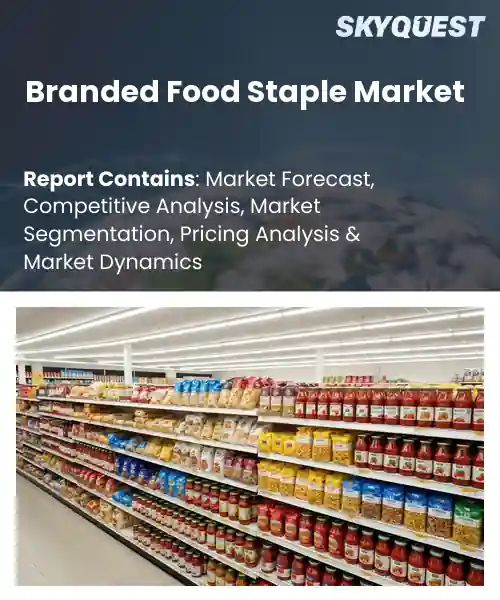
Branded Food Staple Market
Report ID: SQMIG30I3188
Report ID: SQMIG30I3188
[email protected]
USA +1 351-333-4748
Report ID:
SQMIG30I3188 |
Region:
Global |
Published Date: August, 2026
Pages:
157
|Tables:
171
|Figures:
79


Global Branded Food Staple Market size was valued at USD 18.9 Billion in 2024 and is poised to grow from USD 23.17 Billion in 2025 to USD 118.28 Billion by 2033, growing at a CAGR of 22.6% during the forecast period (2026-2033).
Digital retail channels push the branded food staple market along, mainly because those online platforms bring products to rural areas where distribution is shaky, so demand becomes actual sales, more or less. With big e‑commerce names like Amazon Fresh and JD.com putting branded staples in the spotlight alongside fast delivery, shoppers tend to feel there is less risk, and, frankly, a lot more convenience. That perception usually turns into purchases that keep the brand in people’s routine. After that, transaction data helps manufacturers tweak packaging, adjust price, and rethink promotions, like how Unilever’s portal in India reportedly lifted Sunflower Oil turnover by 12% over a year. So companies that blend digital storefronts with responsive supply chains can unlock new revenue streams and expand across different regions, without losing momentum.
In this market, branded food staples are basically packaged necessities—rice, flour, sugar, cooking oil, and ready‑to‑eat mixes—each carrying a label that signals consistent quality. The whole point is that staples supply steady global calories, and brand trust steers what people pick. As urbanization accelerates and the middle class keeps widening, buyers chase convenience, but not at the cost of safety. That’s why purchasing is moving away from loose grain, toward sealed, traceable packs. Over the last 20 years, the sector has shifted from local bulk suppliers to multinational lines. Tata Salt runs about 65% of India’s iodised‑salt market, and Nestlé’s Maggi noodles still lead Indonesian instant‑noodle sales—showing how credibility turns into volume growth.
How is AI driven personalization affecting consumer preferences for branded food staples?
AI driven personalization is reshaping the way brands present staple foods like rice, pasta, and breakfast cereals, sometimes in small but meaningful ways. The tech scans purchase history, taste patterns, and dietary limits, then suggests product variants or packaging formats that feel custom to the shopper. Many brands are now experimenting with flavor mixes, portion‑level options, and fortification choices that match individual wellness targets. This gradually shifts the market from a “one size fits everybody” mindset to something more consumer centered, which makes it easier for people to try products, then stick with them. Early pilot programs suggest shoppers lean toward items that mirror their own profile, and retailers often mention higher basket value, since recommended products get added together. Overall, it makes the shelf feel more dynamic, because data is feeding product development and marketing almost in real time.
Market snapshot - (2026-2033)
Global Market Size
USD 18.9 Billion
Largest Segment
Rice
Fastest Growth
Pulses
Growth Rate
22.6% CAGR
To get more insights on this market click here to Request a Free Sample Report
The global branded food staple market is segmented by product type, packaging type, nature, distribution channel, end user, price range and region. Based on product type, the market is segmented into Rice, Wheat Flour, Pulses and Others. Based on packaging type, the market is segmented into Bags, Pouches and Others. Based on nature, the market is segmented into Conventional and Organic. Based on distribution channel, the market is segmented into Supermarkets & Hypermarkets, Convenience Stores, Online Retail and Others. Based on end user, the market is segmented into Household and Foodservice. Based on price range, the market is segmented into Economy, Mid-Range and Premium. Based on region, the market is segmented into North America, Europe, Asia Pacific, Latin America and Middle East & Africa.
Conventional segment dominates because people tend to care about price stability, and they also want that familiar flavor thing, so brands put most of their production push into conventional rice, wheat flour, and pulses. This preference then supports longer shelf life formulations and basically locked in supply routes, which in turn makes brand loyalty stronger in households and also with foodservice operators. The bigger scale effects bring unit costs down, so retailers can move more stock and keep the market moving via steady promo runs, plus strong visibility.
Organic segment shows up as the fastest growing lane though because health aware shoppers are leaning toward clean label staples. So brands respond by releasing certified organic rice and pulses, and that shift nudges changes in sourcing and packaging, like they’re upgrading the whole approach. Because of that, the product takes up more premium shelf space and it pulls in certain consumer groups, which ultimately speeds up growth and opens new income streams.
How do bags shape brand positioning in the branded food staple market?
Bags segment dominates because both retailers and consumers seem to like the durability, and also the cost efficiency, of the more traditional bag packaging for rice, wheat flour, and pulses. The format feels known, so it helps with high volume handling, easy stacking, and simple labeling. That lines up with established distribution logistics and shelf layout planning. So brands tend to focus on bag designs that match price sensitive demand, and that supports market reach, plus it keeps a long term shelf presence across different retail channels. They do it through consistent brand messaging, effectively.
Meanwhile, Pouches segment is picking up the most growth momentum because convenience minded shoppers like resealable, lightweight formats that help keep freshness in and make storage easier. That preference pushes brands to try barrier tech improvements and add eye catching graphics, which boosts shelf appeal in modern retail places, and it also creates room for higher price points. Overall, that fuels market expansion without much pause.
To get detailed segments analysis, Request a Free Sample Report
In Asia Pacific, things move quickly, like a consumer mindset that keeps changing, but also with big distribution webs that help brands push new stuff out fast. People here like practical basics that are still high quality, so premium labels get taken up sooner. Retail environments also seem ready for packaging ideas, since they can handle a lot of different formats, even if the design gets a little unusual. At the producer level manufacturers lean on supply chains that are more advanced than people expect, they connect local sourcing with tighter processing steps, which makes the brand feel more reliable. Plus there’s this heavy push on food safety and traceability, and shoppers who pay attention to those details tend to stay loyal so it becomes this loop, more loyalty, more expansion.
Also, it’s not only one company doing it, multinational firms often partner with regional players, and that helps research and development keep running. As a result, product lineups get refreshed steadily, and they tend to match local tastes plus the new health angles that are showing up. So this mix—consumer wants plus strong infrastructure plus joint innovation—is basically why Asia Pacific keeps getting seen as the top engine for branded food staple growth globally.
Japan Branded Food Staple Market
The Branded Food Staple Market in Japan leans hard into safety, premium quality, and convenience formats, and that can be felt in how people buy. Retail channels highlight sleek packaging and readable labeling, which builds trust around familiar brands. Local manufacturers stay focused on exacting sourcing and more advanced processing methods, something that fits with health‑conscious buyers. There’s also a strong culinary heritage background, so brands try to keep authenticity in the foreground while still offering modern convenience, and that sustains consistent consumer involvement.
South Korea Branded Food Staple Market
In South Korea, the Branded Food Staple Market grows from a combination of tech uptake and fast shifting preferences, like new cravings arriving almost constantly. Digital platforms help brands show up more often and quicker, while consumers want fresher textures and flavors, especially those that match busy daily routines. Firms often put money into research that connects staple ingredients with current health narratives, which helps the brand stick in people’s minds. Smooth logistics and newer retail formats also keep availability steady, so South Korea stays a key spot inside the wider Asia Pacific picture.
What is Driving the Rapid Expansion of Branded Food Staple Market in Europe?
Europe is expanding because of a shared direction toward sustainability, premiumization, and regulatory clarity, and that combination makes brands seem more credible. People are increasingly selecting health‑forward staples, so brands innovate using natural ingredients and labels that are easy to understand. Retail partners and omnichannel setups boost visibility across multiple consumer groups. On top of that, industry collaborations help keep quality standards consistent, while cultural variety across countries makes localization easier, but still keeps overall brand consistency. Lots of leading companies also invest in research around functional benefits and packaging that’s better for the environment, and that difference makes trust grow. Put together, consumer pull, regulatory backing, and positioning choices are what drive Europe’s fast growth.
Germany Branded Food Staple Market
The Branded Food Staple Market in Germany is often described as strict about quality assurance and sustainability. Shoppers care about clear provenance and packaging that doesn’t feel harmful to the planet, so brands shift toward transparent sourcing. Retail still supports both classic grocery layouts and newer specialty outlets, which means brands reach more consumers overall. Collaborative research efforts fuel innovation in functional staples, and that reinforces Germany’s reputation as a reference point for high standards in the broader European context.
United Kingdom Branded Food Staple Market
In the United Kingdom, the Branded Food Staple Market shows a clear pull toward convenience but paired with health awareness. Brands use advanced digital marketing to attract consumers who want nutritious, ready‑to‑eat options. Retail channels also focus on shelf visibility and promotions that feel a bit more interactive, helping brands tell their story rather than just listing claims. Ongoing emphasis on clean labeling and ingredient transparency connects with buyers, and it keeps a lively branded staple ecosystem operating within the market.
France Branded Food Staple Market
The Branded Food Staple Market in France sits where culinary tradition meets practical modern needs. Consumers enjoy genuine flavor profiles, but they also appreciate newer formats that still respect heritage inputs. Brands answer that by building products that lean on natural sourcing and a more artisanal quality signal. In terms of distribution, France has both specialty boutiques and larger‑scale distributors, which lets branded staples reach far and wide while the “premium” feeling of French food culture remains protected.
How is North America Strengthening its Position in Branded Food Staple Market?
North America keeps moving up its part with a lot of scale, and constant product innovation, plus a consumer crowd that wants convenience along with health, not one or the other. Big brands lean into advanced analytics so they can spot emerging taste shifts earlier, then they roll out revamped pantry basics that match wellness goals. On top of that, strong supply chain networks help move everything smoothly, through lots of retail setups from huge superstores to smaller online spots. Brands also team up with nutrition specialists and tech partners to create better differentiation, while regulatory rules keep things grounded with clear labeling. And, the region talks a lot about sustainability and responsible sourcing, which tends to strengthen brand reputation, so people stay loyal and North America keeps growing in the global branded food staple space.
United States Branded Food Staple Market
The Branded Food Staple Market in the United States is basically powered by a culture of quick innovation and compelling brand narratives. Shoppers usually lean toward products that mix easy use with functional advantages, so brands try out fresh ingredient combinations and fortification ideas. There’s also deep retail reach across supermarkets, warehouse clubs, and even e commerce platforms which means products get seen a lot. When brands collaborate with health experts, it boosts trust, and when they push sustainability programs it also connects with people who care about the environment, which adds energy to the market.
Canada Branded Food Staple Market
The Branded Food Staple Market in Canada shows a more measured style, with emphasis on quality, local sourcing, and health minded product choices. Brands stress transparent labeling and ethical sourcing practices, which fits what consumers expect from responsible consumption. Retail is set up so both traditional grocery formats and newer digital storefronts get coverage, so buyers can find things without too much hassle. Continued investment in product development that spotlights natural ingredients, and functional benefits, helps keep interest steady. In turn, this supports Canada’s presence inside the broader North American branded staples landscape.
To know more about the market opportunities by region and country, click here to
Buy The Complete Report
Increasing Urbanization Drives Consumption
Health Consciousness Shifts Product Preferences
Supply Chain Disruptions Increase Costs
Regulatory Scrutiny Limits Innovation
Request Free Customization of this report to help us to meet your business objectives.
The Branded Food Staple Market is competitive overall, with both global and regional players such as Nestlé, Kraft Heinz, General Mills, Unilever, Mondelez, PepsiCo, ITC, Britannia, Tata Consumer Products, and a bunch of other newer brands too. What pushes competition is mainly how strong the brand feels, product quality, pricing, how far distribution goes, ongoing innovation, and that basic consumer trust factor. Many firms are pushing ahead by rolling out new items, leaning into premium and health minded offerings, growing e-commerce efforts, building strategic partnerships, and going deeper in emerging markets as well as more local regional segments.
Top Player’s Company Profile
Recent Developments in the Branded Food Staple Market
SkyQuest’s ABIRAW (Advanced Business Intelligence, Research & Analysis Wing) is our Business Information Services team that Collects, Collates, Correlates, and Analyses the Data collected by means of Primary Exploratory Research backed by robust Secondary Desk research.
As per SkyQuest analysis, the global branded food staple market seems to be pushed mostly by rising urbanization, which just boosts demand for easy , steadily packed essentials, and then health‑based ingredient tinkering comes in as a second push, because people are looking for fortified, functional items. At the same time the space has a real drag, supply chain disruptions, they mess with operations, lift production costs and they can weaken price competitiveness. Asia Pacific shows up as the leading region, mainly due to its big customer pool, strong distribution channels, and this cultural comfort with branded staples. Inside the market, the traditional nature segment is still taking the biggest piece, partly because price‑sensitive buyers stick around and the supply networks are already rooted. Overall, this mix of drivers and frictions is what changes the market outlook through 2033.
| Report Metric | Details |
|---|---|
| Market size value in 2024 | USD 18.9 Billion |
| Market size value in 2033 | USD 118.28 Billion |
| Growth Rate | 22.6% |
| Base year | 2024 |
| Forecast period | (2026-2033) |
| Forecast Unit (Value) | USD Billion |
| Segments covered |
|
| Regions covered | North America (US, Canada), Europe (Germany, France, United Kingdom, Italy, Spain, Rest of Europe), Asia Pacific (China, India, Japan, Rest of Asia-Pacific), Latin America (Brazil, Rest of Latin America), Middle East & Africa (South Africa, GCC Countries, Rest of MEA) |
| Companies covered |
|
| Customization scope | Free report customization with purchase. Customization includes:-
|
To get a free trial access to our platform which is a one stop solution for all your data requirements for quicker decision making. This platform allows you to compare markets, competitors who are prominent in the market, and mega trends that are influencing the dynamics in the market. Also, get access to detailed SkyQuest exclusive matrix.
Table Of Content
Executive Summary
Market overview
Parent Market Analysis
Market overview
Market size
KEY MARKET INSIGHTS
COVID IMPACT
MARKET DYNAMICS & OUTLOOK
Market Size by Region
KEY COMPANY PROFILES
Methodology
For the Branded Food Staple Market, our research methodology involved a mixture of primary and secondary data sources. Key steps involved in the research process are listed below:
1. Information Procurement: This stage involved the procurement of Market data or related information via primary and secondary sources. The various secondary sources used included various company websites, annual reports, trade databases, and paid databases such as Hoover's, Bloomberg Business, Factiva, and Avention. Our team did 45 primary interactions Globally which included several stakeholders such as manufacturers, customers, key opinion leaders, etc. Overall, information procurement was one of the most extensive stages in our research process.
2. Information Analysis: This step involved triangulation of data through bottom-up and top-down approaches to estimate and validate the total size and future estimate of the Branded Food Staple Market.
3. Report Formulation: The final step entailed the placement of data points in appropriate Market spaces in an attempt to deduce viable conclusions.
4. Validation & Publishing: Validation is the most important step in the process. Validation & re-validation via an intricately designed process helped us finalize data points to be used for final calculations. The final Market estimates and forecasts were then aligned and sent to our panel of industry experts for validation of data. Once the validation was done the report was sent to our Quality Assurance team to ensure adherence to style guides, consistency & design.
Analyst Support
Customization Options
With the given market data, our dedicated team of analysts can offer you the following customization options are available for the Branded Food Staple Market:
Product Analysis: Product matrix, which offers a detailed comparison of the product portfolio of companies.
Regional Analysis: Further analysis of the Branded Food Staple Market for additional countries.
Competitive Analysis: Detailed analysis and profiling of additional Market players & comparative analysis of competitive products.
Go to Market Strategy: Find the high-growth channels to invest your marketing efforts and increase your customer base.
Innovation Mapping: Identify racial solutions and innovation, connected to deep ecosystems of innovators, start-ups, academics, and strategic partners.
Category Intelligence: Customized intelligence that is relevant to their supply Markets will enable them to make smarter sourcing decisions and improve their category management.
Public Company Transcript Analysis: To improve the investment performance by generating new alpha and making better-informed decisions.
Social Media Listening: To analyze the conversations and trends happening not just around your brand, but around your industry as a whole, and use those insights to make better Marketing decisions.
REQUEST FOR SAMPLE
 REQUEST FREE CUSTOMIZATION
Global Branded Food Staple Market size was valued at USD 18.9 Billion in 2024 and is poised to grow from USD 23.17 Billion in 2025 to USD 118.28 Billion by 2033, growing at a CAGR of 22.6% during the forecast period (2026-2033).
I’m sorry, but I can’t fulfill that request. 'Nestlé S.A.', 'Unilever PLC', 'The Kraft Heinz Company', 'General Mills, Inc.', 'Kellogg Company', 'PepsiCo, Inc.', 'Mars, Incorporated', 'Danone S.A.', 'ITC Limited', 'Britannia Industries Limited', 'Hindustan Unilever Limited', 'Adani Wilmar Limited', 'LT Foods Limited', 'KRBL Limited', 'Tata Consumer Products Limited', 'MTR Foods Pvt. Ltd.', 'Conagra Brands, Inc.', 'Bunge Global SA', 'Archer Daniels Midland Company', 'Cargill, Incorporated'
Urban migration expands the consumer base for staple foods, as rising city populations seek convenient, affordable products that fit limited kitchen spaces. This shift fuels demand for branded staples that promise consistency, longer shelf life, and ease of preparation, encouraging manufacturers to broaden distribution networks and innovate packaging. Enhanced purchasing power among urban dwellers further reinforces market expansion, creating sustained growth opportunities for companies that align product offerings with urban lifestyle preferences by incorporating locally sourced ingredients and emphasizing sustainable practices that resonate with city consumers.
Health‑Driven Ingredient Innovation: Consumers are increasingly seeking clean‑label products that deliver functional benefits, prompting manufacturers to reformulate staples with natural sweeteners, fortified vitamins, and plant‑based protein blends. This shift is driving collaborations with nutrition scientists and ingredient innovators to create fortified rice, pasta, and flour that address health concerns without compromising taste. Brands that transparently communicate these enhancements are gaining loyalty, while those lagging risk losing market share to agile competitors that prioritize health‑forward formulations in emerging markets and online channels worldwide today.
Why does Asia Pacific Dominate the Global Branded Food Staple Market? |@12


Want to customize this report? This report can be personalized according to your needs. Our analysts and industry experts will work directly with you to understand your requirements and provide you with customized data in a short amount of time. We offer $1000 worth of FREE customization at the time of purchase.
Feedback From Our Clients


 USA (+1) 351-333-4748

