BPM and RPA Market
Report ID: SQMIG40A2031
Report ID: SQMIG40A2031
[email protected]
USA +1 351-333-4748
Report ID:
SQMIG40A2031 |
Region:
Global |
Published Date: March, 2026
Pages:
157
|Tables:
149
|Figures:
78


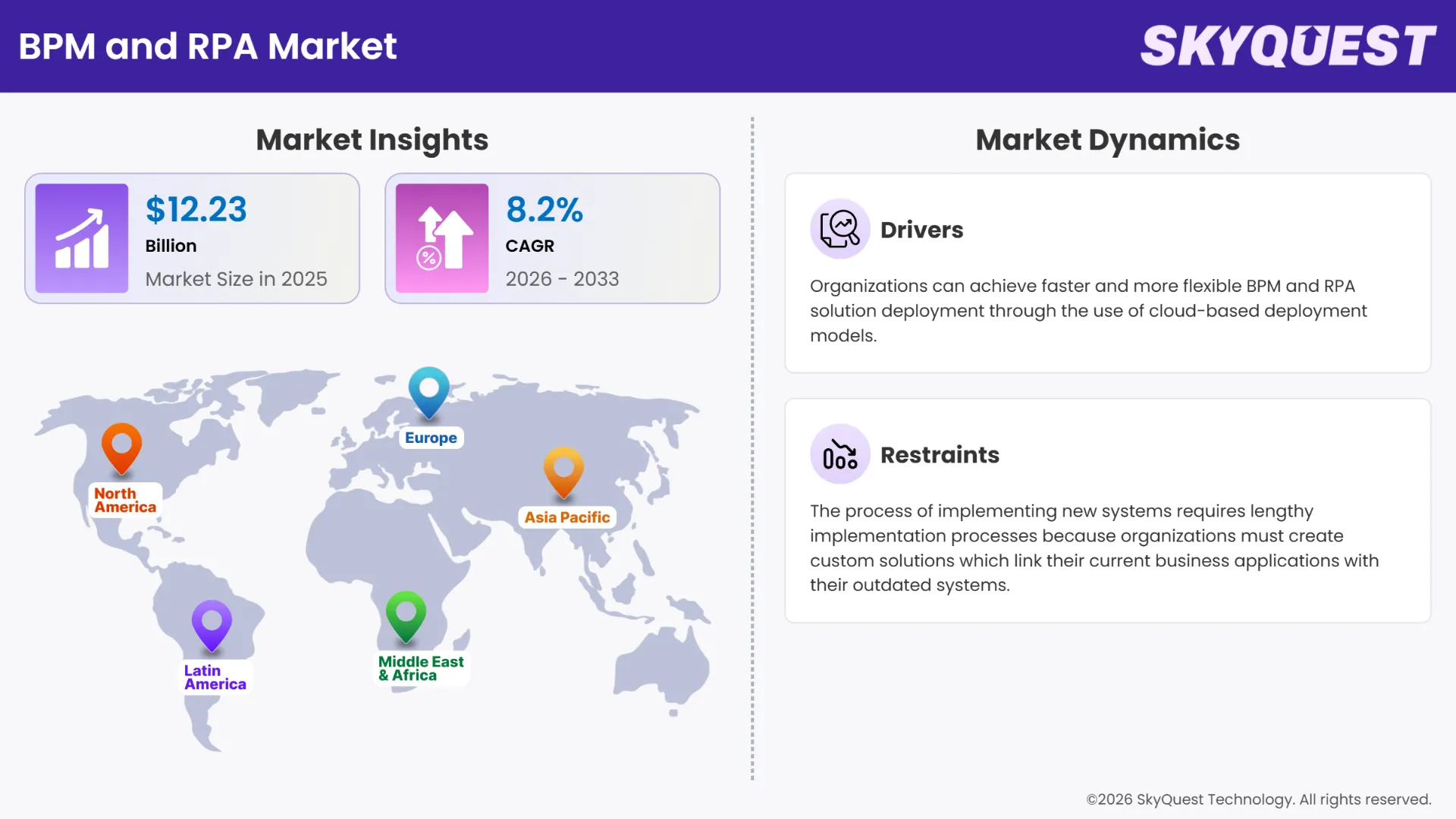
Global BPM and RPA Market size was valued at USD 11.30 Billion in 2024 and is poised to grow from USD 12.23 Billion in 2025 to USD 22.97 Billion by 2033, growing at a CAGR of 8.2% during the forecast period (2026-2033).
Key Takeaways: Market Trends & Insights
The global BPM and RPA market growth is driven because organizations demand operational efficiency to decrease expenses while speeding up service delivery through automation. Business process management (BPM) provides organizations with tools and frameworks to create and track workflows and improve their performance through workflow monitoring. The automation stack built from both systems creates critical business value because it directly influences how businesses handle compliance and customer service delivery and their competitive standing.
Moreover, the global BPM and RPA market outlook evolved from basic rule-based scripts and manual process mapping to advanced AI-powered orchestration platforms which now handle tasks such as invoice processing in financial applications and patient onboarding in healthcare systems. The global BPM and RPA market requires cloud-native and AI technology to develop because these technologies help simplify system deployment while enabling automated solutions for complex cognitive functions. The cost reduction from cloud services leads vendors to provide subscription-based models which help midmarket companies adopt their services faster, thus attracting additional investment and feature development from vendors. RPA systems become more efficient when organizations apply machine learning and NLP technologies because bots can handle variable-format invoice processing and insurance claim triage and customer support.
How is AI-driven Automation Impacting Efficiency and Adoption in the BPM and RPA Market?
AI-driven automation reshapes business process management through its intelligent decision making and natural language interfaces. Automations become more adaptive through automated task execution and contextual data handling, and governance ready models which integrate these vital functions. The current state shows faster pilot production cycles and broader adoption across departments. Market conditions favor vendors offering low code experiences strong security and robust channel support. Leading RPA platforms expand their agentic capabilities while distributors and partners create easier implementation methods to help organizations increase their automation scale, which brings operational advantages to their business.
Microsoft Copilot Coworker, in March 2026, enables productivity applications to use agent-based automation for creating automated workflows which handle multiple tasks that span across different systems. The process allows business users to create automations through conversational prompts, which leads to decision-making improvements and lower manual work requirements.
To get more insights on this market click here to Request a Free Sample Report
The global BPM and RPA market is segmented by component, deployment mode, organization size, application, end-use industry, and region. Based on component, the market is divided into software and services. In terms of deployment mode, it is categorized into on-premises, cloud-based, and hybrid models. By organization size, the market includes small and medium enterprises (SMEs) and large enterprises. Based on application, the segmentation covers finance and accounting automation, human resource (HR) automation, customer service and support, supply chain and operations, as well as other applications. In terms of end-use industry, the market is segmented into banking, financial services and insurance (BFSI), healthcare and life sciences, IT and telecom, retail and e-commerce, manufacturing, government and public sector, and others. Geographically, the market is segmented into North America, Europe, Asia Pacific, Latin America, and the Middle East & Africa.
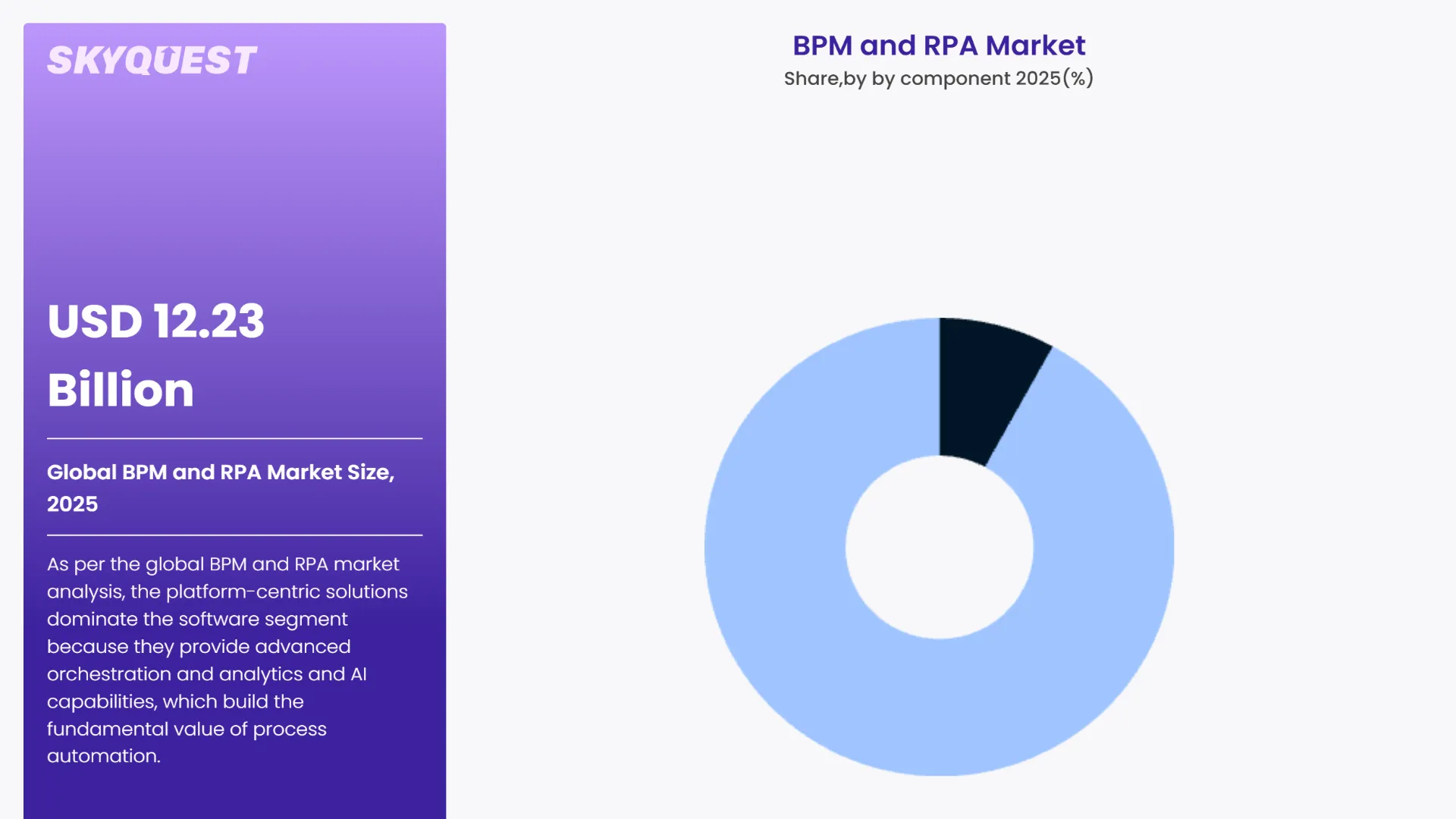
As per the global BPM and RPA market analysis, the platform-centric solutions dominate the software segment because they provide advanced orchestration and analytics and AI capabilities, which build the fundamental value of process automation. This market trend forces vendors to develop modular low code tools and prebuilt connectors which help clients achieve their rapid ROI goals, while they need to handle their deployment projects. The software market establishes its software-based systems as mission-critical elements and development communities around their marketplaces, which lead to higher software usage.
However, the fastest-growing sector develops customers who need managed services and integration services and software customization services that their existing tools cannot deliver. The continuous increase of consulting and implementation services together with outcome-oriented managed services helps organizations establish external operational control, which provides ongoing revenue creation and closer client relationships.
According to the global BPM and RPA market forecast, the cloud segment dominates because its flexible infrastructure and on-demand resource allocation capabilities match the scalable needs of contemporary BPM and RPA projects, which need immediate access to robots and process orchestration and analytics functions without needing to invest in extensive initial infrastructure. Continuous delivery models with native integration to SaaS ecosystems shorten time to value realization, while their centralized monitoring capabilities enable fast development cycles and enterprise-wide implementation of changes which makes cloud deployment the standard method for organizations pursuing transformational automation programs.
Whereas organizations choose hybrid deployment because it enables them to combine their established control systems with new agile methods to achieve compliance requirements while implementing modern updates. The industry needs more vendors to support platforms that enable different systems to work together, tools that connect various systems to enable smooth data movement, and advanced systems that allow institutions to coordinate their multiple operational processes which will lead to increased innovation.
To get detailed segments analysis, Request a Free Sample Report
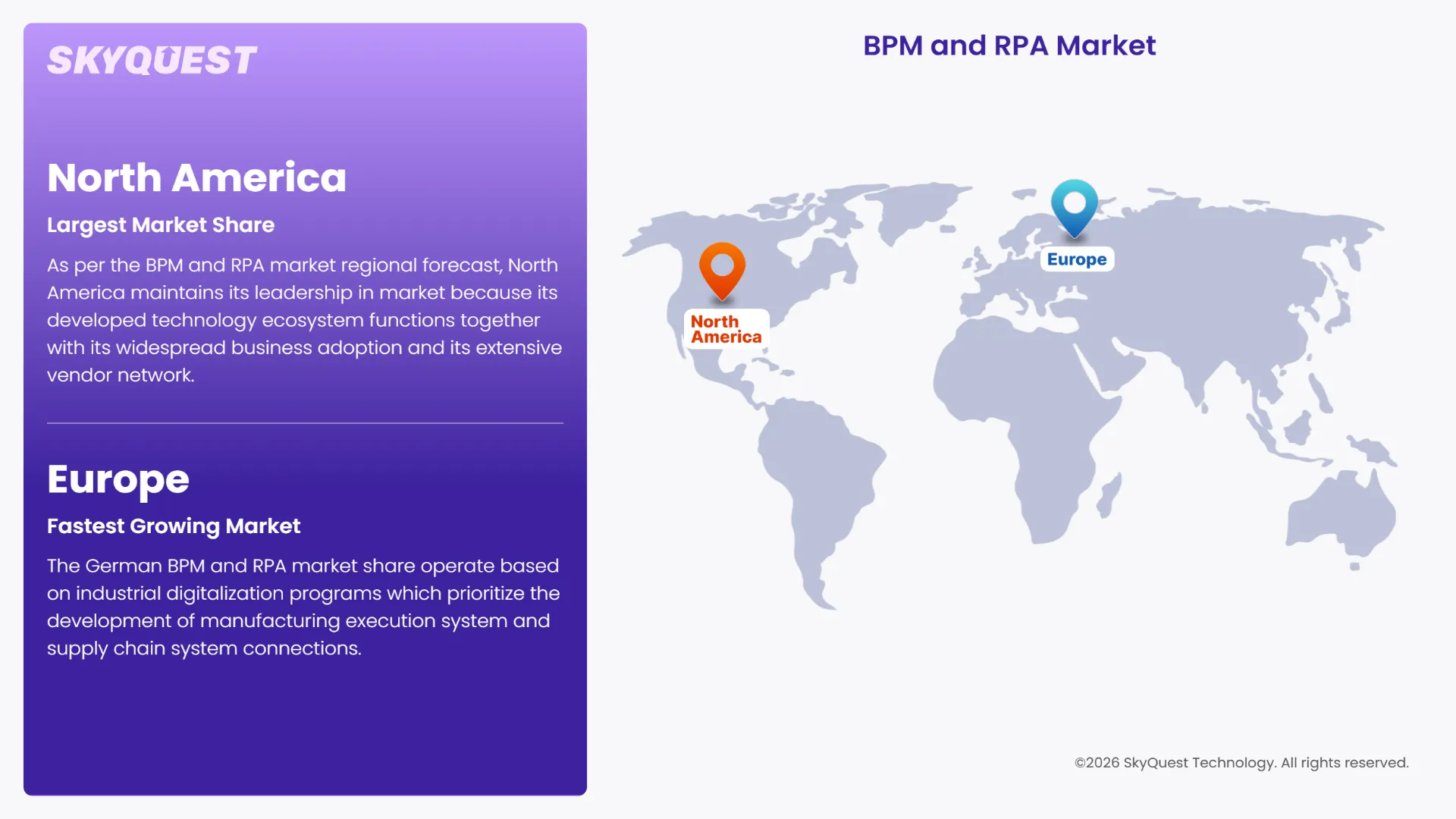
As per the BPM and RPA market regional forecast, North America maintains its leadership in market because its developed technology ecosystem functions together with its widespread business adoption and its extensive vendor network. Automation and process improvement solutions undergo continuous deployment because multiple industry verticals require strong IT infrastructure, and organizations maintain a tradition of improving their business processes. Solution development and implementation proceed at an accelerated pace because organizations can access skilled professionals and make deep research and development investments while they have access to a competitive service provider market. The combination of regulatory clarity and established procurement practices enables organizations to adopt large-scale programs more efficiently. Technology vendors work together with consulting firms to establish collaborative partnerships which result in a startup ecosystem that enables quick experimentation and commercialization of new products. The availability of multiple cloud platforms together with organizations' emphasis on customer-focused transformation enables companies of different sizes to implement integrated automation systems which can grow according to their requirements.
The United States BPM and RPA sector displays comprehensive enterprise commitment to complete automation solutions which includes strong cloud platform compatibility and access to a wide network of vendors and service providers. Large organizations drive complex use cases while mid-market firms pursue incremental automation. The professional services community enables organizations to implement changes rapidly while managing their operational changes. The environment requires organizations to establish solutions which demonstrate their ability to expand operations while maintaining secure system protection and showing measurable improvements in their business processes.
The Canadian BPM and RPA industry display strong alignment with global best practices through its established service providers and its financial services and healthcare and public sector adoption activities. Enterprises emphasize secure, compliant deployments and incremental automation roadmaps that balance innovation with operational risk. The consulting networks with local vendors create customized solutions which match bilingual operational needs for enterprises that need governance and integration and process improvement capabilities.
The European BPM and RPA market penetration occurs because regulated industries prioritize digital transformation while organizations need operational resilience and vendor-consultant partnerships to simplify adoption procedures. Highly developed industry clusters in manufacturing and financial services and public sector modernization generate valuable use cases which facilitate international knowledge exchange. Regulatory frameworks push organizations toward controlled automation strategies because they require standardized governance and data protection practices. Organizations use workforce reskilling programs and excellence centers to expand their operations beyond pilot projects.
The German BPM and RPA market share operate based on industrial digitalization programs which prioritize the development of manufacturing execution system and supply chain system connections. Major industrial and automotive enterprises create demanding automation challenges which require the development of systems that guarantee data protection and online system connections. The local service providers develop solutions which meet the requirements of specific industries. The control of operations through engineering-grade deployments and process reliability becomes essential for organizations which want to achieve operational excellence and create lasting value through automation.
The United Kingdom BPM and RPA market trends receive its main support from the services sector together with banking and finance industry requirements. Organizations use regulation compliance requirements together with customer experience improvements and automation implementation to strengthen their operational resilience. The United Kingdom consulting community provides mature support for digital transformation initiatives which involve all vendors from the United Kingdom. Organizations who adopt cloud systems and agile delivery methods can increase the size of their automation initiatives while meeting their market requirements for regional and language and regulatory differences.
The French BPM and RPA market grows rapidly because startups create new products and public sector modernization programs gain traction while businesses want to improve their customer-facing automation capabilities. The local vendors and service firms establish automated systems which recognize languages while adhering to the regulations of national data protection laws. The consulting ecosystem develops dynamic abilities which enable organizations to move from pilot projects to large scale operations. Automation functions as a strategic asset which helps French companies achieve competitive advantages while they transform their operations through innovation and expansion.
Asia Pacific establishes its position as a BPM and RPA market leader through its technological expertise and its methods of digitalizing industries and its planned investments in building intelligent automation capabilities. Market participants require AI-based process orchestration systems to work together with their current enterprise software systems which they can access through regional cloud services and dedicated service vendors. The manufacturing and export-driven sectors create challenging operational conditions which lead to increased benefits from using dependable and expandable automated systems. Both governmental entities and industrial organizations work toward developing skills and creating standardized solutions which local vendors adjust to different language needs and regulatory requirements. The creation of practical deployment solutions and exportable automation models through vendor and system integrator and industry specialist cooperation leads the region to shift from pilot projects to broader enterprise implementation. The partnership between global vendors and local research institutes advances process intelligence and conversational automation while professional services growth enables businesses to implement large-scale operational solutions.
The Japanese BPM and RPA market operate through its strong commitment to quality control and its advanced manufacturing system links and its operational excellence implementation by major companies. Vendors and systems integrators in the local market create automation solutions which handle both outdated system environments and strict compliance standards. Organizations use process optimization methods which enable humans and machines to work together while bringing about gradual automation advancements. Professional services enable businesses to develop cognitive automation solutions which optimize their social processes through process analytics tools.
The South Korean BPM and RPA market experiences development through business technology usage and its strong telecommunication and IT fields and its research centers which create pathways for financial and manufacturing sectors to adopt automation technologies. Local solution providers put their focus on fast delivery times together with systems which enable mobile and cloud product compatibility. Digital corporate strategies across many organizations together with government programs establish digital upskilling requirements for their staff members who need to enhance their skills. Domestic and export markets receive distinct products which focus on advanced analytics and AI-powered automation solutions.
To know more about the market opportunities by region and country, click here to
Buy The Complete Report
Cloud Based Deployment Models
Advances In Intelligent Automation
Complex System Integration Challenges
Skills Shortages Constraining Adoption
Request Free Customization of this report to help us to meet your business objectives.
The global BPM and RPA market is experiencing a wave of consolidation as companies engage in M&A activities and platform bundling to acquire process discovery and AI solutions which Automation Anywhere achieved through its acquisition of FortressIQ and UiPath through its acquisition of ProcessGold. Major suppliers are embedding LLMs into automation, as Microsoft integrated Copilot into Power Automate, while partner ecosystems and channel agreements intensify platform competition.
SkyQuest’s ABIRAW (Advanced Business Intelligence, Research & Analysis Wing) is our Business Information Services team that Collects, Collates, Correlates, and Analyses the Data collected by means of Primary Exploratory Research backed by robust Secondary Desk research.
As per SkyQuest analysis, the global BPM and RPA market experiences its main growth through organizations which require operational efficiency to reduce expenses while providing faster services. The market faces challenges because companies need to integrate their older systems with new technologies which prevent them from moving their pilot programs into large-scale operations. North America leads the market because its companies use established systems which provide several software platforms in AI-enabled platforms which deliver the primary value of their applications. Cloud-native infrastructure together with low-code development platforms and managed service solutions create a market environment which helps organizations adopt these technologies.
| Report Metric | Details |
|---|---|
| Market size value in 2024 | USD 11.30 Billion |
| Market size value in 2033 | USD 22.97 Billion |
| Growth Rate | 8.2% |
| Base year | 2024 |
| Forecast period | 2026-2033 |
| Forecast Unit (Value) | USD Billion |
| Segments covered |
|
| Regions covered | North America (US, Canada), Europe (Germany, France, United Kingdom, Italy, Spain, Rest of Europe), Asia Pacific (China, India, Japan, Rest of Asia-Pacific), Latin America (Brazil, Rest of Latin America), Middle East & Africa (South Africa, GCC Countries, Rest of MEA) |
| Companies covered |
|
| Customization scope | Free report customization with purchase. Customization includes:-
|
To get a free trial access to our platform which is a one stop solution for all your data requirements for quicker decision making. This platform allows you to compare markets, competitors who are prominent in the market, and mega trends that are influencing the dynamics in the market. Also, get access to detailed SkyQuest exclusive matrix.
Table Of Content
Executive Summary
Market overview
Parent Market Analysis
Market overview
Market size
KEY MARKET INSIGHTS
COVID IMPACT
MARKET DYNAMICS & OUTLOOK
Market Size by Region
KEY COMPANY PROFILES
Methodology
For the BPM and RPA Market, our research methodology involved a mixture of primary and secondary data sources. Key steps involved in the research process are listed below:
1. Information Procurement: This stage involved the procurement of Market data or related information via primary and secondary sources. The various secondary sources used included various company websites, annual reports, trade databases, and paid databases such as Hoover's, Bloomberg Business, Factiva, and Avention. Our team did 45 primary interactions Globally which included several stakeholders such as manufacturers, customers, key opinion leaders, etc. Overall, information procurement was one of the most extensive stages in our research process.
2. Information Analysis: This step involved triangulation of data through bottom-up and top-down approaches to estimate and validate the total size and future estimate of the BPM and RPA Market.
3. Report Formulation: The final step entailed the placement of data points in appropriate Market spaces in an attempt to deduce viable conclusions.
4. Validation & Publishing: Validation is the most important step in the process. Validation & re-validation via an intricately designed process helped us finalize data points to be used for final calculations. The final Market estimates and forecasts were then aligned and sent to our panel of industry experts for validation of data. Once the validation was done the report was sent to our Quality Assurance team to ensure adherence to style guides, consistency & design.
Analyst Support
Customization Options
With the given market data, our dedicated team of analysts can offer you the following customization options are available for the BPM and RPA Market:
Product Analysis: Product matrix, which offers a detailed comparison of the product portfolio of companies.
Regional Analysis: Further analysis of the BPM and RPA Market for additional countries.
Competitive Analysis: Detailed analysis and profiling of additional Market players & comparative analysis of competitive products.
Go to Market Strategy: Find the high-growth channels to invest your marketing efforts and increase your customer base.
Innovation Mapping: Identify racial solutions and innovation, connected to deep ecosystems of innovators, start-ups, academics, and strategic partners.
Category Intelligence: Customized intelligence that is relevant to their supply Markets will enable them to make smarter sourcing decisions and improve their category management.
Public Company Transcript Analysis: To improve the investment performance by generating new alpha and making better-informed decisions.
Social Media Listening: To analyze the conversations and trends happening not just around your brand, but around your industry as a whole, and use those insights to make better Marketing decisions.
REQUEST FOR SAMPLE
 REQUEST FREE CUSTOMIZATION
Global Bpm And Rpa Market size was valued at USD 11.3 Billion in 2024 and is poised to grow from USD 12.23 Billion in 2025 to USD 22.97 Billion by 2033, growing at a CAGR of 8.2% during the forecast period (2026-2033).
Competitive landscape in global BPM and RPA is consolidating as vendors pursue M&A and platform bundling to gain process discovery and AI capabilities, exemplified by Automation Anywhere’s acquisition of FortressIQ and UiPath’s purchase of ProcessGold. Major suppliers are embedding LLMs into automation, as Microsoft integrated Copilot into Power Automate, while partner ecosystems and channel agreements intensify platform competition. 'UiPath', 'Automation Anywhere', 'Blue Prism', 'Appian', 'Pega Systems', 'Nintex', 'Kissflow', 'WorkFusion', 'Bonitasoft', 'Zoho Creator', 'IBM Automation', 'Microsoft Power Automate', 'Oracle Fusion Cloud', 'ABBYY', 'ProcessMaker', 'Bizagi', 'Celonis', 'Redwood Software', 'Salesforce Flow', 'TIBCO Software'
Cloud based deployment models enable organizations to implement BPM and RPA solutions more rapidly and with greater flexibility. By removing complex on premise infrastructure requirements, cloud adoption reduces barriers to entry and allows teams to scale automation efforts as business needs change. This environment supports quicker integration with third party services, fosters iterative development and testing, and encourages experimentation with process redesign. As a result, organizations can realize operational improvements across distributed teams, accelerating adoption and creating a more favorable landscape for vendors to expand product offerings and support services.
Ai-First Process Optimization: Organizations are shifting from rules-based automation to AI-embedded process management that continuously learns from interactions and exceptions. Intelligent capabilities such as contextual understanding, predictive routing, and conversational interfaces are being integrated into BPM and RPA to enable adaptive workflows. Focus on human oversight, model governance, and transparent decisioning supports responsible deployment. This evolution drives higher operational agility, improved customer experiences, and more scalable automation programs across functions while fostering tighter alignment between process design and evolving business priorities and outcomes.
North America Dominate the Global BPM and RPA Market.
Business Process Management (BPM) helps organizations design, monitor, and optimize workflows, while Robotic Process Automation (RPA) automates repetitive and rule-based tasks, improving productivity and reducing manual errors.
The Software segment holds the largest market share due to widespread adoption of BPM platforms and RPA bots that enable organizations to automate and streamline business processes efficiently.
AI is transforming BPM and RPA by enabling intelligent decision-making, natural language processing, predictive analytics, and adaptive workflows. AI-powered automation allows businesses to automate more complex processes beyond traditional rule-based tasks.


Want to customize this report? This report can be personalized according to your needs. Our analysts and industry experts will work directly with you to understand your requirements and provide you with customized data in a short amount of time. We offer $1000 worth of FREE customization at the time of purchase.
Feedback From Our Clients


 USA (+1) 351-333-4748

