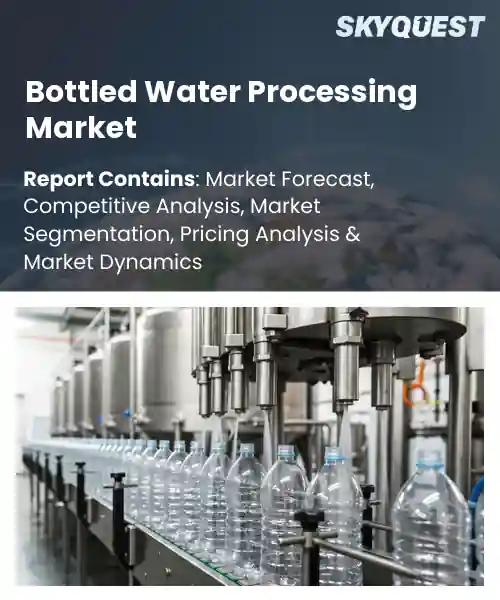
Bottled Water Processing Market
Report ID: SQMIG30F2064
Report ID: SQMIG30F2064
[email protected]
USA +1 351-333-4748
Report ID:
SQMIG30F2064 |
Region:
Global |
Published Date: February, 2026
Pages:
157
|Tables:
120
|Figures:
77


Global Bottled Water Processing Market size was valued at USD 7.4 Billion in 2024 and is poised to grow from USD 7.99 Billion in 2025 to USD 14.79 Billion by 2033, growing at a CAGR of 8.0% during the forecast period (2026-2033).
Growing demand for safe drinking water, rising urbanization, increasing health awareness among consumers, advancements in water purification technologies, and expansion of bottled water distribution networks are driving the growth of the bottled water processing market. Ongoing technological modernization and stricter safety and environmental regulations are pushing manufacturers to adopt advanced purification, packaging, and traceability systems. Furthermore, technologies like membrane filtration, in-line UV monitoring, batch tracking, etc., are enhancing the quality of products, hence promoting consumer demand for certified and trusted brands. In addition, developments like lightweight rPET packaging, modular bottling, etc. have helped the company with its sustainability drive, as well as reaching remote and disaster zones.
Water safety concerns, increased use of packaged drinking water, and urbanization are expected to bolster bottled water processing market growth. In emerging markets such as India and Mexico, growth has been fueled by urban migration and limited access to clean municipal water, while developed markets are witnessing increased demand for premium and flavored bottled water products. On the contrary, environmental concerns related to plastic waste, high operational and energy costs, regulatory compliance challenges, and growing preference for alternative water solutions such as filtration systems are anticipated to slow down bottled water processing market penetration across the study period.
How is IoT Improving Efficiency and Quality Control in the Bottled Water Processing Market?
Internet of Things (IoT) is helping to increase efficiency and quality assurance in bottled water production through the integration of IoT devices, machines, and analytics tools to form a single workflow. IoT is helping to increase efficiency, quality assurance, and monitor bottled water production. IoT devices, such as machine vision, edge analytics, and cloud computing, help increase efficiency, quality assurance, and monitor bottled water production.
In September 2025, Krones introduced the Ingeniq line and Contipure AseptBloc, which integrate IoT and AI into PET water filling systems. These innovations enhance uptime, improve inline quality control, and enable faster production startups with more consistent product quality.
Market snapshot - (2026-2033)
Global Market Size
USD 7.4 Billion
Largest Segment
Bottling Equipment
Fastest Growth
Filtration Equipment
Growth Rate
8.0% CAGR
To get more insights on this market click here to Request a Free Sample Report
The global bottled water processing market is segmented by equipment type, disinfection technology, water type, packaging type, and region. Based on equipment type, the market is segmented into filtration equipment and bottling equipment. Based on disinfection technology, the market is segmented into chlorination, UV treatment, and ozonation. Based on water type, the market is segmented into purified water, sparkling water, mineral water, spring water, and functional water. Based on packaging type, the market is segmented into plastic bottles, glass bottles, metal cans, bioplastics, and others. Based on region, the market is segmented into North America, Europe, Asia Pacific, Latin America, and Middle East & Africa.
The filtration equipment segment is predicted to account for the highest global bottled water processing market share in the future. The foundational nature of this equipment in achieving consistent product safety and quality, removing particulates, microbes and dissolved impurities allows this segment to hold sway over others. Effective filtration processes minimize the effort required for sterilization processes and help meet the high levels of purity with relative ease. Investing in the latest membrane and modular filtration equipment increases the efficiency of the processes, minimizes the effort required for the processes, and provides quality feed water for bottling.
However, bottling equipment is emerging as the fastest growing segment as per this bottled water processing industry analysis. High demand for automation, flexible line configurations, and demand for higher throughput and varied package formats is creating new opportunities. Innovation in the field of filling accuracy, sterilizable machinery, and quick changeover allows producers to increase product variety and decrease labor costs, thus providing opportunities for equipment vendors and increasing the rate of capital investment.
The UV treatment segment is estimated to spearhead the global bottled water processing market revenue generation over the coming years. The ability of UV to deliver effective, chemical free inactivation of bacteria, viruses and protozoa, at critical control points, minimize residual taste and byproduct concerns helps this segment maintain its dominant stance. Its small footprint and ability to integrate with filtration units facilitate inline disinfection without affecting product chemistry. Increased demand for minimally processed, clean label water, as well as process needs to reduce chemical handling, drive disinfection system demand, making UV a preferred disinfection method.
However, ozonation is showing the strongest growth momentum with the powerful oxidation properties that tackle organic issues, off-flavors, and the need for advanced oxidation in premium bottled water applications. The interest in non-residual, high-performance treatments for differentiated product types, as well as the development of regulatory support for the use of ozone, is driving the integration, driving equipment development, and new service creation.
To get detailed segments analysis, Request a Free Sample Report
Robust manufacturing, high consumption demand, and strong investment in processing innovation allow Asia Pacific to spearhead the global bottled water processing demand. Proximity to major supplier and manufacturer locations and advanced capabilities within their supply chains allow producer/manufacturer scalability using sterilizers, filtration and packaging equipment at the same rate or sometimes quicker than manufacturers in North America. In addition, the regulatory environments of several of the region's largest bottled water markets impose strict requirements regarding the quality of bottled water and traceability of the entire manufacturing story, which is driving producers/manufacturers to implement high-quality purification and bottling processes.
Advanced engineering capabilities and high-quality control expectations are shaping bottled water processing demand in Japan. The emphasis on automation, miniaturization of the processing facility, and innovations in water purification technology are all consistent with the premium nature of the product. The local regulatory framework’s emphasis on safety and traceability also bodes well for the adoption of advanced filtration and sterilization technologies. Partnerships between research organizations and component manufacturers help to improve the refinement of the process line and efficiency.
Adoption of compact, high throughput processing equipment and advanced filtration technologies aligned with consumer preferences is boosting bottled water processing equipment sales in South Korea. Emphasis is also seen on differentiation of products and private label development to support flexible processing configurations. Technology providers and bottlers are collaborating to speed up the adoption of automation and quality control technologies to support the consistency and confidence of brands in the consumer market locally. Local manufacturing supports customization of bottling lines and packaging solutions.
A dynamic retail landscape, consumer demand for convenient and premium bottled water formats, and an evolving manufacturing landscape make North America an attractive region to operate in for the future. Sustainable packaging, water efficiency, and recycling-friendly processes are key drivers for consumers and retailers alike. Investment in state-of-the-art filtration technologies and quality control equipment will continue to rise due to government regulations for safety and traceability. Manufacturers are investing with their vendors, raw material suppliers, and brand owners to facilitate product filtration, sterilization, and/or packaging integration that will allow for faster product development. Research and development investments as well as strategic partnerships with technology providers are needed to develop customized purification systems and automate purification systems.
Large scale bottling operations, strong retailer partnerships, and investment in purification and automation technologies sustain bottled water processing demand in the United States. Private label requirements are creating the need for flexible processing lines with high-speed changeovers. Sustainability programs are also emphasizing the importance of lightweight packaging and water management. Joint efforts from the packaging supply chain are helping to provide modular processing solutions that can accommodate changing consumer trends and distribution requirements effectively.
Emphasis on regional processing flexibility, stringent quality expectations, and a growing focus on sustainable packaging are shaping the adoption of bottled water processing solutions in the country. Bottled water companies in Canada prefer flexible processing equipment to accommodate different types of bottled water formats. Strong partnerships with equipment and logistics companies are necessary for efficient distribution in widely spread-out population centers. The investment in purification technology and quality control measures helps to establish trust with retailers and consumers.
Stringent regulatory environments, the emphasis on sustainability, and the traditional need for premium-quality bottled water are creating opportunities for new businesses in the region for bottled water processing companies. The quality and tracing needs of the regulatory environment also create opportunities for investment in the latest technology in purification, sterilization, and monitoring systems. The focus on sustainability within the industry, in terms of circular economy, also supports the development of lightweight packaging, as well as water recovery technologies. Equipment suppliers in the region are specialists in delivering flexible, energy-efficient solutions that support a wide range of water sources and product formats.
Engineering excellence, emphasis on energy efficient processing, and rigorous quality control practices are governing the sales of bottled water processing equipment in Germany. The country has equipment suppliers that specialize in precision filling, advanced sterilization, and automation solutions for the specific needs of water bottling. The emphasis on recyclability and resource efficiency is consistent with environmental objectives. The supplier chain and relationship with research centers also enable continuous improvement of filtration technology and packaging solutions.
Adoption of bottled water processing in the United Kingdom is influenced by retailer power, innovation in packaging, as well as product differentiation. The retailers focus on flexible processing lines that can handle different product formats, especially those in premium and functional segments. Sustainability issues shape the adoption of recyclable packaging and efficient resource management in the processing plants. Working with technology companies and contract fillers helps in the quick implementation, ensuring quality control processes are maintained.
Heritage source-based bottling that emphasizes purity and provenance is expected to boost the demand for bottled water processing solutions across France. Collaboration with equipment specialists allows for customized processing solutions that meet the quality characteristics of artisanal products with automation and efficiency for local and export markets. Processors focus on tailored purification systems, gentle handling, and packaging that communicate premium positioning. Regulatory interest in labeling and source protection is driving robust traceability and water stewardship practices.
To know more about the market opportunities by region and country, click here to
Buy The Complete Report
Increasing Consumer Health Awareness
Online and Retail Channel Growth
Packaging Waste and Environmental Concern
Water Resource Scarcity and Regulation
Request Free Customization of this report to help us to meet your business objectives.
The competitive landscape in bottled water processing is shaped by consolidation, strategic acquisitions, and rapid adoption of onsite processing technologies that reduce transport and waste. Mergers like the BlueTriton carve out and equipment deals by suppliers show M&A driven repositioning, while partnerships and tech pilots such as Mananalu powered by Boomerang illustrate on site bottling and circular packaging strategies.
SkyQuest’s ABIRAW (Advanced Business Intelligence, Research & Analysis Wing) is our Business Information Services team that Collects, Collates, Correlates, and Analyses the Data collected by means of Primary Exploratory Research backed by robust Secondary Desk research.
As per SkyQuest analysis, rising demand for safe drinking water and increasing urbanization are anticipated to drive the demand for bottled water processing going forward. However, environmental concerns related to plastic waste and high operational costs are slated to slow down the adoption of bottled water processing solutions in the future. Asia Pacific is slated to spearhead the demand for bottled water processing owing to rapid urban population growth and inconsistent access to clean municipal water supplies. Advancements in IoT-enabled processing systems, adoption of sustainable packaging solutions, and integration of advanced purification and traceability technologies are anticipated to be key trends driving the bottled water processing sector across the forecast period.
| Report Metric | Details |
|---|---|
| Market size value in 2024 | USD 7.4 Billion |
| Market size value in 2033 | USD 14.79 Billion |
| Growth Rate | 8.0% |
| Base year | 2024 |
| Forecast period | (2026-2033) |
| Forecast Unit (Value) | USD Billion |
| Segments covered |
|
| Regions covered | North America (US, Canada), Europe (Germany, France, United Kingdom, Italy, Spain, Rest of Europe), Asia Pacific (China, India, Japan, Rest of Asia-Pacific), Latin America (Brazil, Rest of Latin America), Middle East & Africa (South Africa, GCC Countries, Rest of MEA) |
| Companies covered |
|
| Customization scope | Free report customization with purchase. Customization includes:-
|
To get a free trial access to our platform which is a one stop solution for all your data requirements for quicker decision making. This platform allows you to compare markets, competitors who are prominent in the market, and mega trends that are influencing the dynamics in the market. Also, get access to detailed SkyQuest exclusive matrix.
Table Of Content
Executive Summary
Market overview
Parent Market Analysis
Market overview
Market size
KEY MARKET INSIGHTS
COVID IMPACT
MARKET DYNAMICS & OUTLOOK
Market Size by Region
KEY COMPANY PROFILES
Methodology
For the Bottled Water Processing Market, our research methodology involved a mixture of primary and secondary data sources. Key steps involved in the research process are listed below:
1. Information Procurement: This stage involved the procurement of Market data or related information via primary and secondary sources. The various secondary sources used included various company websites, annual reports, trade databases, and paid databases such as Hoover's, Bloomberg Business, Factiva, and Avention. Our team did 45 primary interactions Globally which included several stakeholders such as manufacturers, customers, key opinion leaders, etc. Overall, information procurement was one of the most extensive stages in our research process.
2. Information Analysis: This step involved triangulation of data through bottom-up and top-down approaches to estimate and validate the total size and future estimate of the Bottled Water Processing Market.
3. Report Formulation: The final step entailed the placement of data points in appropriate Market spaces in an attempt to deduce viable conclusions.
4. Validation & Publishing: Validation is the most important step in the process. Validation & re-validation via an intricately designed process helped us finalize data points to be used for final calculations. The final Market estimates and forecasts were then aligned and sent to our panel of industry experts for validation of data. Once the validation was done the report was sent to our Quality Assurance team to ensure adherence to style guides, consistency & design.
Analyst Support
Customization Options
With the given market data, our dedicated team of analysts can offer you the following customization options are available for the Bottled Water Processing Market:
Product Analysis: Product matrix, which offers a detailed comparison of the product portfolio of companies.
Regional Analysis: Further analysis of the Bottled Water Processing Market for additional countries.
Competitive Analysis: Detailed analysis and profiling of additional Market players & comparative analysis of competitive products.
Go to Market Strategy: Find the high-growth channels to invest your marketing efforts and increase your customer base.
Innovation Mapping: Identify racial solutions and innovation, connected to deep ecosystems of innovators, start-ups, academics, and strategic partners.
Category Intelligence: Customized intelligence that is relevant to their supply Markets will enable them to make smarter sourcing decisions and improve their category management.
Public Company Transcript Analysis: To improve the investment performance by generating new alpha and making better-informed decisions.
Social Media Listening: To analyze the conversations and trends happening not just around your brand, but around your industry as a whole, and use those insights to make better Marketing decisions.
REQUEST FOR SAMPLE
 REQUEST FREE CUSTOMIZATION
Global Bottled Water Processing Market size was valued at USD 7.4 Billion in 2024 and is poised to grow from USD 7.99 Billion in 2025 to USD 14.79 Billion by 2033, growing at a CAGR of 8.0% during the forecast period (2026-2033).
The competitive landscape in bottled water processing is shaped by consolidation, strategic acquisitions, and rapid adoption of on site processing technologies that reduce transport and waste. Mergers like the BlueTriton carve out and equipment deals by suppliers show M&A driven repositioning, while partnerships and tech pilots such as Mananalu powered by Boomerang illustrate on site bottling and circular packaging strategies. 'Pentair', 'Suez', 'Ecolab', 'Pall Corporation', 'NONGFU SPRING', 'Thermax Limited', 'Culligan Industrial', 'Xylem Inc.', 'GEROLSTEINER BRUNNEN GMBH & CO. KG', 'CG ROXANE, LLC', 'GEA Group AG', 'Krones AG', 'Sidel Group', 'Tetra Laval', 'Lenntech B.V.', 'Serac Group', 'Hongtek Filtration Co., Ltd.', 'Ion Exchange', 'SIPA', 'Veolia'
Increasing consumer focus on hygiene and health has led individuals to prefer sealed, processed bottled water over untreated sources, driving demand for reliable purification and packaging solutions. Manufacturers expand processing capacity and adopt advanced treatment technologies to meet expectations for safety, consistency, and convenience, which encourages investment across the value chain and stimulates product innovation. This persistent preference for perceived safer water stimulates market expansion as companies seek to differentiate offerings through improved processing, quality assurance, and branding that align with health-conscious consumer priorities.
Premiumization And Brand Differentiation: Consumers increasingly seek differentiated bottled water experiences that signal health, lifestyle and status, prompting brands to invest in unique formulations, premium source narratives and artisanal presentation. Product portfolios emphasize functional claims, taste profiles and provenance storytelling alongside collaborations with lifestyle labels to command higher perceived value. Manufacturers allocate resources to flexible production lines, bespoke labeling and modal product launches to capture discretionary spending, while marketing centers on transparency and curated consumer journeys that reinforce loyalty and justify price premiums consistently.
Robust manufacturing, high consumption demand, and strong investment in processing innovation allow Asia Pacific to spearhead the global bottled water processing demand.


Want to customize this report? This report can be personalized according to your needs. Our analysts and industry experts will work directly with you to understand your requirements and provide you with customized data in a short amount of time. We offer $1000 worth of FREE customization at the time of purchase.
Feedback From Our Clients


 USA (+1) 351-333-4748

